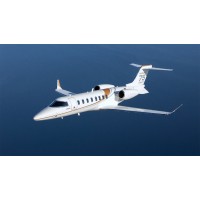


Learjet private jet charter
Learjet is the only business aircraft brand whose name entered general English as a synonym for the product category itself. The Smithsonian National Air and Space Museum records that the Model 23 was so significant that for years "Lear Jet" was synonymous with "bizjet". Carly Simon put a Learjet into the lyrics of a number one single. Frank Sinatra bought one in 1965 and lent it to Elvis Presley. No competing manufacturer has that cultural position, and none is likely to acquire it.
Production, however, has ended. Bombardier announced the closure of the Learjet line in February 2021 and delivered the final aircraft, a Learjet 75, on 28 March 2022 after 60 years and more than 3,000 aircraft. Around 2,000 remain in service worldwide and form the charter fleet available today. Bombardier continues full parts and engineering support, supplies European operators through its Frankfurt parts hub, and was ranked first among business jet manufacturers for product support in the 2025 Aviation International News survey for the second consecutive year. A Learjet booked through Private Jets UK is a supported aircraft with an active maintenance network behind it, not an orphaned type.
Charter cost depends on the specific model, route, date and passenger count. Get a quote via WhatsApp on +44 204 577-31-19 or by email at flight@private-jets.co.uk
Learjet charter rates at a glance
Indicative hourly rates in GBP for departures from UK airports. Every model listed is out of production; rates reflect the active charter market rather than list prices. Final pricing depends on sector length, date, aircraft age and operator. All Private Jets UK quotes are itemised in full.
| Model | Class | Seats | Range | Built | From |
| 35A | Light Jet (classic) | 6-7 | 2,000 nm | 1974-1994 | £2,200/hr |
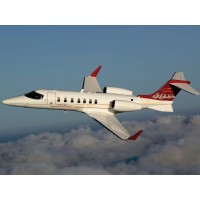
| 40 / 40XR | Light Jet | 7 | 1,857 nm | 2003-2012 | £2,600/hr |
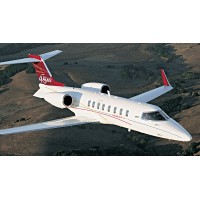
| 45 / 45XR | Light Jet | 8 | 1,999 nm | 1997-2012 | £2,900/hr |
| 70 | Light Jet | 7 | 2,060 nm | Only 13 built | £3,100/hr |
| 75 / 75 Liberty | Light Jet (flagship) | 8-9 | 2,040 nm | 2013-2022 | £3,200/hr |
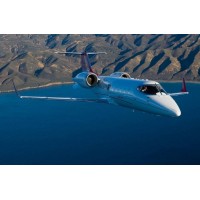
| 60 / 60XR | Midsize | 7-8 | 2,405 nm | 1991-2012; 430 built | £3,400/hr |
Repositioning flights on empty legs reduce these figures by 25 to 75 per cent. For the wider fleet across all manufacturers see the private jet price guide.

Why the word Learjet came to mean private jet
Bill Lear was a self-taught engineer with a high school education who had already invented the car radio sold under the Motorola name and the eight-track tape cartridge. In 1959 he bought the design rights to the FFA P-16, a Swiss ground attack fighter whose programme had been cancelled, and turned its structural design into a civil aircraft. The Model 23 first flew on 7 October 1963 from Wichita, Kansas.
What followed established the brand. In 1966 a Model 23 set 18 speed records on an around-the-world flight completed in three days with 17 stops. On 21 May 1965 a Model 23 flew Los Angeles to New York and back, 5,005 statute miles, in 11 hours 36 minutes. Sinatra flew the Rat Pack to Las Vegas in his. Its fuselage narrows where the wing and engine nacelles extend outward, an aerodynamic technique called area rule borrowed from supersonic fighter design, and it is the reason early Learjets outran everything else in civil aviation.
Practical relevance for a charter client is straightforward. Learjet built its reputation on climb rate and cruise speed rather than cabin volume, and that engineering priority carried through every subsequent model. A Learjet is the aircraft to book when the sector is time-critical. It is not the aircraft to book when eight passengers need to stand up and walk around, with the single exception of the Learjet 60.
The charter fleet, generation by generation
Learjets in charter service fall into four distinct generations. Understanding which generation an operator is offering matters more than the model number alone, because avionics, cabin standard and noise levels differ sharply between them.
Fourth generation: Learjet 70 and 75 (2013 to 2022)
The final and most refined Learjets. Both are modernised developments of the 45XR and 40XR airframes with Honeywell TFE731-40BR engines at 3,850 lbf each, up from 3,500 lbf on the 45XR, and the Bombardier Vision flight deck built on Garmin G5000 with three landscape-format displays and touchscreen controllers. The 75 uses 12 per cent less runway than the 45XR it replaced. Cabin refinements include a pocket door separating the cabin from the cockpit and a Honeywell RE-100 auxiliary power unit.
The 75 seats eight to nine and covers 2,040 nm at NBAA IFR reserves. The 75 Liberty, launched in 2019 at a list price of 9.9 million dollars, is a lower-cost variant with a six-seat executive layout and a larger baggage compartment. Combined 70 and 75 production reached 145 aircraft, of which the 70 accounts for only 13. Availability of a genuine 70 is therefore rare; most operators quoting "Learjet 70/75" will supply a 75.
Third generation: Learjet 40 and 45 (1997 to 2012)
The 45 was the first clean-sheet design since the original Model 23 and the first business jet designed entirely on computer. It entered service in 1997 with Honeywell Primus 1000 avionics and TFE731-20BR engines. The 45XR raised takeoff weights and cruise speeds. The 40 is the shortened variant, seating seven rather than eight, and the 40XR adds the same engine upgrade.
By volume these aircraft form the backbone of the European charter fleet. Bombardier's RACER remanufacturing programme, offered through the Wichita service centre, upgrades 40 and 45 series aircraft with Honeywell DU-875 Primus Elite displays, Gogo Avance L5 connectivity and full interior and exterior refurbishment. When comparing quotes, ask whether the aircraft has been through RACER; the difference in cabin condition and connectivity is substantial.

The midsize outlier: Learjet 60 and 60XR (1991 to 2012)
The 60 is the exception to the family cabin rule. It was the first of the line with a stand-up cabin and a full-size lavatory, and the 60XR has the largest cabin of any model ever built at 17 ft 8 in long. Two Pratt and Whitney Canada PW305A engines give it 2,405 nm of range with four passengers at NBAA reserves, the longest in the range. The 60XR added Rockwell Collins Pro Line 21 avionics, five cabin floor plans, LED lighting and improved insulation when it entered service in 2007.
430 were built across the series. Runway performance is the trade-off: the small 265 sq ft wing evolved from the Model 23 gives the 60 longer field requirements than its midsize competitors, with a balanced field length of around 5,313 ft. It is the wrong aircraft for short or hot-and-high strips and the right aircraft for a fast midsize sector from a full-length runway.
Classic Learjets: 35A and 55 (1974 to 1994)
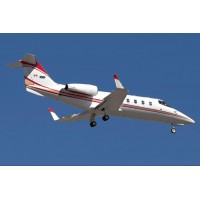
The 35A remains in charter service in small numbers, mostly with operators running air ambulance and cargo work alongside passenger charter. It offers around 2,000 nm of range for six to seven passengers at the lowest Learjet charter rates available. Expect 1970s cabin dimensions, higher noise levels and older avionics. For a short sector where budget is the governing constraint and cabin comfort is not, it remains viable. For anything above two hours, the 45XR or 75 is the better use of money.
Speed and climb: what the reputation actually delivers
Learjet marketing traded on speed for six decades, and the claim deserves an honest examination rather than repetition. Against current-production light jets the cruise speed advantage is now narrow. A Learjet 75 cruises at 464 kt; the Embraer Phenom 300E matches it at 464 kt; the Cessna Citation CJ4 reaches 451 kt. Where the Learjet family retains a genuine and measurable edge is in climb performance.
Learjets reach cruise altitude faster than almost anything in their weight class. A Model 40 climbs to FL430 in 22 minutes. The original Model 23 climbed at 6,900 ft per minute, a figure that embarrassed contemporary airliners. On a one-hour sector the aircraft that reaches efficient cruise altitude first spends a greater proportion of the flight at optimum speed, and the block time difference against a slower-climbing competitor is real.
What this means in practice for UK charter clients:
- Sectors under 90 minutes. London to Edinburgh, Manchester to Paris, Birmingham to Dublin. Climb performance dominates the block time, and this is where the family is at its strongest relative to competitors;
- Sectors of two to three hours. London to Nice, London to Milan, London to Palma. Cruise speed matters more than climb, and the Learjet advantage narrows to a few minutes against a Phenom 300E or Citation XLS+;
- Sectors above three hours. Range and cabin comfort begin to outweigh speed. The 60XR at 2,405 nm is the only member of the family genuinely suited to this bracket, and a current-generation midsize will usually be the better choice.
What ended in 2022, and what did not
Charter clients considering a Learjet reasonably ask what happens to an aircraft type whose manufacturer has stopped building it. What matters is the distinction between production and support.
| Ended | Continuing |
| New aircraft manufacture (final delivery 28 March 2022) | Full Bombardier parts and engineering support |
| The Learjet 85 programme (cancelled October 2015, never certified) | Wichita service centre, expanded and re-staffed as the Learjet Centre of Excellence |
| Wichita as a Learjet production line | Frankfurt parts hub serving European operators, approximately 60,000 part numbers held |
| Factory new-build warranty options | RACER remanufacturing programme for the 40 and 45 series |
Bombardier ranked first among business jet manufacturers in the 2025 Aviation International News Product Support Survey, its second consecutive year in first place, and reported a 92 per cent off-the-shelf parts shipping rate. For a UK charter client the relevant figure is the Frankfurt hub, which ships around 400 individual part numbers every day into the European operator base. Aircraft-on-ground risk on a Learjet chartered in Europe is materially lower than the out-of-production label alone would suggest.
One point of clarification is worth stating plainly, because it appears incorrectly on a number of charter sites. The Model 85 never entered service. Bombardier paused the programme in January 2015 and cancelled it outright on 28 October 2015 with a 1.2 billion dollar write-down. A single prototype flew roughly 70 flights. No customer aircraft was ever delivered and the type was never certified. Any listing offering one for charter is in error.

Indicative Learjet route prices from UK airports
One-way prices for the aircraft noted. Actual quotes vary with date, availability and operator.
- London to Edinburgh - from £4,400 (Learjet 75, 8 passengers, approximately 1 hour 10 minutes);
- London to Paris - from £4,300 (Learjet 45XR, 8 passengers, approximately 1 hour);
- London to Dublin - from £3,900 (Learjet 40XR, 7 passengers, approximately 1 hour 5 minutes);
- London to Amsterdam - from £4,600 (Learjet 45XR, 8 passengers, approximately 1 hour 5 minutes);
- London to Geneva - from £7,200 (Learjet 75, 8 passengers, approximately 1 hour 20 minutes);
- London to Milan - from £7,800 (Learjet 45XR, 8 passengers, approximately 1 hour 50 minutes);
- London to Nice - from £8,600 (Learjet 60XR, 8 passengers, approximately 2 hours);
- London to Madrid - from £9,000 (Learjet 60XR, 8 passengers, approximately 2 hours 15 minutes);
- Manchester to Geneva - from £7,600 (Learjet 75, 8 passengers, approximately 1 hour 35 minutes);
- Edinburgh to Nice - from £10,500 (Learjet 60XR, 8 passengers, approximately 2 hours 30 minutes).
Learjet or a current-production light jet?
For most UK charter briefs the honest comparison is between a 45XR or 75 and an in-production alternative such as the Embraer Phenom 300E, Cessna Citation CJ4 or Citation XLS+. Four factors usually decide it.
- Rate. Learjet charter rates run roughly 10 to 20 per cent below equivalent current-production light jets, because operator acquisition costs are lower on out-of-production aircraft. A 45XR from £2,900 per hour against a Phenom 300E from £2,500 and a Citation XLS+ from £3,000 places the family firmly in competitive territory, and the older 40XR and 35A undercut everything in the class;
- Cabin. This is where the Learjet family concedes ground. Only the 60 offers a stand-up cabin. The 40, 45, 70 and 75 all require passengers to stoop, and the Citation XLS+ at 1.73 m of cabin height is materially more comfortable for a group of eight on a two-hour sector;
- Speed and climb. The Learjet advantage, concentrated on short sectors. If the brief is a same-day return to Edinburgh, Paris or Dublin with a fixed meeting time, the family earns its reputation;
- Availability. With around 2,000 aircraft still flying, availability at 48 to 72 hours notice is generally good across Europe. It is not as deep as the Citation fleet, and short-notice availability in the UK specifically is better for the 45 and 75 than for the 60 or 70.
Learjet was owned by Bombardier from 1990 until production ended, and the same parts, service and engineering organisation supports it. For current-production Bombardier aircraft in the super-midsize and large-cabin categories, see our Bombardier charter page. For the wider light jet market across all manufacturers, browse the complete fleet.
Frequently asked questions
Can you still charter a Learjet in 2026?
Yes. Production ended in March 2022 but approximately 2,000 aircraft remain in service worldwide and are actively chartered. Private Jets UK arranges charter from all UK airports. The most commonly available types in the UK and European market are the 45 and 45XR, the 75 and the midsize 60XR.
Why did Bombardier stop making Learjets?
Bombardier announced the decision in February 2021, citing challenging market dynamics and competition from newer entrants in the light jet category. In 2020 the company delivered 11 of the type against 59 Global and 44 Challenger aircraft. The decision concentrated resources on the higher-margin Global and Challenger lines. The final aircraft was delivered on 28 March 2022 to Northern Jet Management.
Are Learjets still supported now that production has ended?
Yes, and the support position is stronger than the out-of-production label suggests. Bombardier operates the Wichita site as a Learjet Centre of Excellence with expanded service capability, operates the RACER remanufacturing programme for 40 and 45 series aircraft, and supplies European operators from its Frankfurt parts hub. Bombardier was ranked first for product support among business jet manufacturers in the 2025 Aviation International News survey, its second consecutive year in that position.
Which Learjet should I charter?
For two to six passengers on a short UK or Irish sector at the lowest rate, the 40XR from £2,600 per hour. For up to eight on European sectors, the 45XR from £2,900 or the newer 75 from £3,200 with Garmin G5000 avionics and a quieter cabin. For a stand-up cabin, a full lavatory and the longest range in the family at 2,405 nm, the 60XR from £3,400.
What happened to the Learjet 85?
It was cancelled and never entered service. Bombardier suspended the programme in January 2015 and cancelled it on 28 October 2015 with a 1.2 billion dollar write-down, citing weak demand in the midsize segment. One prototype flew approximately 70 test flights after its first flight in April 2014. No production aircraft was built and the type was never certified. It cannot be chartered.
Does a Learjet have a stand-up cabin?
Only the 60 and 60XR. The 60 was the first with a stand-up cabin and full-size lavatory, and the 60XR has the largest cabin in the family at 17 ft 8 in long. The 40, 45, 70 and 75 all have seated-height cabins. If standing headroom matters for your group, specify the 60XR at the enquiry stage or consider a midsize alternative.
How many Learjets were built in total?
More than 3,000 across all models between 1964 and 2022. The 3,000th was delivered in June 2017. Production by major type includes 101 Model 23s, 259 Model 24s, 430 Model 60s and 145 combined 70 and 75 aircraft, of which only 13 were 70s.
Learjet timeline
| Year | Event |
| 1959 | Bill Lear acquires design rights to the cancelled Swiss FFA P-16 fighter |
| 1962 | Lear Jet Corporation established on a 64-acre site at Wichita, Kansas |
| 7 Oct 1963 | Model 23 first flight |
| 1964 | Model 23 enters service; the first purpose-built civil business jet |
| 1965 | Frank Sinatra buys a Model 23; Los Angeles to New York and back in 11 hours 36 minutes |
| 1966 | Model 23 sets 18 speed records on a three-day round-the-world flight |
| 1974 | Model 35 enters service; the longest-running Learjet in production |
| 1990 | Bombardier acquires the company |
| 1993 | Model 60 enters service; first stand-up cabin in the range |
| 1997 | Model 45 enters service; first clean-sheet design since the 23 |
| 2013 | Models 70 and 75 certified with Garmin G5000 Vision flight deck |
| Oct 2015 | Model 85 programme cancelled; 1.2 billion dollar write-down |
| Jun 2017 | 3,000th Learjet delivered |
| 2019 | Model 75 Liberty launched at 9.9 million dollars |
| Feb 2021 | Bombardier announces the end of production |
| 28 Mar 2022 | Final Model 75 delivered; 60 years of production ends |

Page last updated: July 2026. All Learjet models are out of production. Parts and engineering support is provided by Bombardier. Charter availability depends on the active operator fleet and is confirmed at the time of enquiry.
Learjet aircraft available for charter:
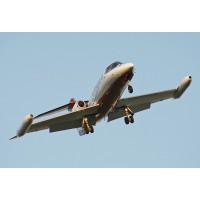
Learjet 25
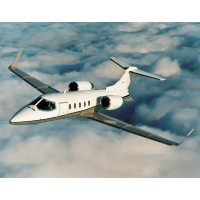
Learjet 31
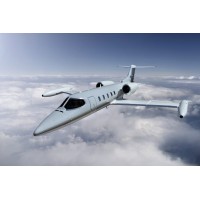
Learjet 35
Learjet 40 / XR
Learjet 45 / XR
Learjet 55
Learjet 60
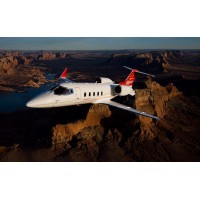
Learjet 60 / XR
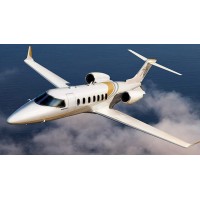
Learjet 70