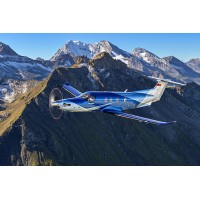


Pilatus private jet charter
Pilatus Aircraft builds two aircraft for business aviation and both are defined by a single capability that no competitor offers: they land where other aircraft cannot. Its PC-24 is the only business jet in the world certified for grass, gravel, dirt, wet earth and snow runways, and the PC-12 is the best-selling pressurised single-engine turboprop ever built and operates from strips as short as 760 metres. Between them they open roughly 21,000 airfields worldwide, against about 11,000 available to a conventional light jet.
Headquartered at Stans in the canton of Nidwalden, delivered 147 aircraft in 2025 on sales of 1.672 billion Swiss francs, with an order backlog of approximately 3.56 billion dollars. Of those deliveries, 82 were PC-12s and 50 were PC-24s. Both types are available for charter from UK airports through Private Jets UK.
Charter cost depends on the aircraft, route, date and passenger count. Get a quote via WhatsApp on +44 204 577-31-19 or by email at flight@private-jets.co.uk
The runway map: where a Pilatus lands and a conventional jet does not
Most brand pages open with heritage. This one opens with the reason Pilatus exists as a charter proposition, because it is the only thing that genuinely separates these aircraft from the rest of the market.
In January 2020 Pilatus completed the rough-field certification campaign for the PC-24. Approval covers surfaces that every other business jet in production is prohibited from using:
| Surface | PC-24 | PC-12 | Conventional light jet |
| Paved runway | Yes | Yes | Yes |
| Grass | Yes | Yes | No |
| Gravel | Yes | Yes | No |
| Dirt and wet earth | Yes | Yes | No |
| Snow | Yes | Yes | No |
| Balanced field length, takeoff | 2,690 ft | ~2,650 ft | 3,100 to 3,600 ft |
| London City steep approach | Certified, 5.5 degrees | Not applicable | Type dependent |
Two consequences follow for a UK charter client. First, geography: farm strips, private estate runways, Highland airfields and Alpine surfaces that would otherwise force a road transfer become direct destinations. Second, season. Grass that is perfectly usable in July may be unusable to a jet in February; the PC-24 is certified for the wet and frozen condition rather than only the dry one.
Certification for the 5.5-degree steep approach at London City Airport is also held, which is unusual for an aircraft with this field performance. Very few types combine rough-field approval with London City access.
One caveat worth stating plainly: unpaved operations always depend on the specific strip, its surface condition on the day, aircraft weight and the operator's own approvals. Certification permits it; the operator authorises it. Confirm at the enquiry stage rather than assuming.
Two aircraft, one question: PC-12 or PC-24?
Pilatus offers a choice of two in business aviation, so the useful comparison is between them rather than against the wider market. Dividing lines are clear.
| PC-12 (turboprop) | PC-24 (jet) | |
| Engines | One PT6, single-pilot certified | Two Williams FJ44-4A |
| Passengers | 6 to 9 | 6 to 8, up to 10 in commuter layout |
| Cruise speed | 280 to 290 kt | ~440 kt |
| Range | Up to ~1,800 nm | ~2,000 nm with four passengers |
| Ceiling | 30,000 ft | 45,000 ft |
| Cabin | 16 ft 11 in long; 326 cu ft | Larger; ~20% more volume than rival light jets |
| Typical UK rate | From £1,900/hr | From £3,400/hr |
The PC-12 is the right answer when the sector is under about two hours, the group is four to eight, budget matters, or the destination is a genuinely small strip. It costs roughly 20 to 30 per cent less per hour than a comparable light jet and burns considerably less fuel. On a Highland or Channel Islands run it is difficult to beat.
The PC-24 is the right answer when the sector is two hours or more, the schedule is tight, or the mission combines rough-field access with jet speed. At 440 kt against 285 kt the time difference on a London to Nice sector is close to an hour, and the PC-24 climbs above weather the PC-12 must fly through at 30,000 ft.
If neither fits, the alternatives worth comparing are the Beechcraft King Air against the PC-12, and the Embraer Phenom 300 or Cessna Citation CJ4 against the PC-24. Premium over both is real, and it buys runway access rather than cabin or speed.
Pilatus PC-24: the Super Versatile Jet
Pilatus opened the order book at EBACE in May 2014 and sold the entire initial production run of 84 aircraft within 36 hours, then closed orders to work through the backlog. EASA and FAA type certification followed on 7 December 2017, with first customer deliveries two months later. Aircraft number 100 was handed over in January 2021, and output has since run at roughly 50 per year, with 50 delivered in 2025 and 51 in 2024.
Two Williams International FJ44-4A engines mounted on the aft fuselage give around 440 kt cruise and a 45,000 ft ceiling. Range is approximately 2,000 nm with four passengers. Balanced field length for takeoff is 2,690 ft and landing distance over a 50 ft obstacle is 2,525 ft, figures that belong to a turboprop rather than a jet of this size. The aircraft is single-pilot certified from the outset, with the Pilatus Advanced Cockpit Environment designed around low single-pilot workload.
Cabin styling came from BMW Designworks and carries roughly 20 per cent more volume than comparable light jets, seating six to eight in executive layout. Its baggage compartment is heated, pressurised and accessible in flight. In 2024 Pilatus launched an improved PC-24 with extended payload and range.
Use of the type extends well beyond corporate charter. Air ambulance operators across Europe, Australia, Africa and the Americas use it, and in 2025 the French Navy became the first European military operator, leasing three aircraft to replace Falcon 10MER airframes, with deliveries running through 2026. Aircraft chosen for medical evacuation from unprepared strips tend to be well built.
Pilatus PC-12: NG, NGX and the new PRO
This aircraft first flew on 31 May 1991 and was certified by Swiss authorities in March 1994 and by the FAA that June. More than 2,000 have been delivered, making it the best-selling pressurised single-engine turbine aircraft in the world. Three generations are active in the charter market and the differences matter when comparing quotes.
PC-12 NG (2008 to 2019)
This generation established the type in European charter. Pratt and Whitney Canada PT6A-67P engine, Honeywell Primus Apex avionics with four 10-inch displays, six to nine passengers. Still the most commonly available PC-12 in the UK charter fleet and the cheapest to book. From £1,900 per flight hour.
PC-12 NGX (2020 to 2025)
A substantial revision. Its PT6E-67XP engine introduced dual-channel FADEC, meaning the pilot manages a single power lever rather than three separate controls, with a corresponding reduction in workload and improvement in fuel management. Cabin refinements included larger windows and a quieter interior. From £2,000 per flight hour.
PC-12 PRO (2025 onwards)
Launched digitally in March 2025 under the tagline Powered by Garmin, and certified by both EASA and the FAA in July 2025. Headline change is the flight deck: the Garmin G3000 PRIME integrated suite with high-resolution touchscreens replaces Honeywell Apex, and Garmin Emergency Autoland is included, a system that will land the aircraft without pilot input if activated. Control yokes and cabin finish are drawn from the PC-24. Pilatus reported that the launch reached over two million people and generated a continuous flow of orders. Charter availability in the UK is limited while operators take delivery. From £2,100 per flight hour on request.
The cargo door no rival fits
Both Pilatus types carry a pallet-sized cargo door as standard equipment, and the PC-24 is the only aircraft in its class to do so. On the PC-12 the opening measures 4 ft 4 in high by 4 ft 5 in wide.
This sounds like a specification detail and is in practice a booking consideration. Conventional light jets load through the passenger door, which sets a hard limit on what can travel with you. Items that routinely defeat that limit and pass easily through a Pilatus cargo door include:
- Skis, snowboards and full ski bags for a group, without splitting the party across two aircraft or shipping equipment ahead;
- Bicycles, boxed or unboxed, and triathlon equipment;
- Golf bags in quantity rather than the two or three a light jet hold accepts;
- Framed artwork, instruments and exhibition material, where dimensions rather than weight are the constraint;
- Medical and technical equipment, which is why both types dominate the air ambulance and special mission market;
- Field sports and shooting equipment for Highland estate trips, alongside the passengers rather than behind them.
On the PC-12 the baggage compartment runs to 34.3 cu ft in addition to the cabin. On the PC-24 the compartment is heated, pressurised and reachable in flight, which matters on longer sectors.
What Pilatus builds that you cannot charter
Pilatus is unusual among business aviation brands in that most of its output is not for the civil market at all, and several charter sites list military types as though they were available. They are not.
- PC-21. An advanced military trainer with tandem ejection seats and no passenger cabin. Pilatus delivered 14 in 2025 to air forces including those of Spain, Canada, France and the Netherlands. It cannot carry passengers and is not available for charter under any circumstances;
- PC-7 MKX. The new basic trainer, launched into service in 2025 with orders from the Netherlands, France and Belgium. Also a military type;
- PC-6 Porter. The legendary short-takeoff utility aircraft. Production ended in 2022 after almost 60 years. A small number remain in specialist operation, generally parachute and utility work rather than passenger charter;
- Helicopters. Pilatus has never built them, despite the claim appearing on a number of aviation directory pages.
A related historical point, since it is frequently garbled: Pilatus rescued the British manufacturer Britten-Norman from receivership and formed Pilatus Britten-Norman in January 1979, then sold the business in 1998. Britten-Norman is independent today. Its Islander is a piston twin rather than a jet, and it remains a genuinely useful aircraft for Scottish island work. See our Britten-Norman Islander charter page.
What a Pilatus costs to charter
Indicative hourly rates in GBP for UK departures. Final pricing depends on sector length, date, aircraft generation and operator.
| Aircraft | Type | Seats | Range | Notes | From |
| PC-12 NG | Single turboprop | 6-9 | ~1,700 nm | Most available in UK charter | £1,900/hr |
| PC-12 NGX | Single turboprop | 6-9 | ~1,800 nm | FADEC single power lever | £2,000/hr |
| PC-12 PRO | Single turboprop | 6-9 | ~1,800 nm | G3000 PRIME; Autoland; limited availability | £2,100/hr |
| PC-24 | Light jet | 6-8 | ~2,000 nm | Rough-field and London City certified | £3,400/hr |
Repositioning flights on empty legs reduce these figures by 25 to 75 per cent. For rates across every manufacturer see the private jet price guide or browse the complete fleet.
Sample sectors and prices
One-way prices for the aircraft noted, departing UK airports. Quotes vary with date, availability and operator.
- London to Edinburgh - from £3,400 (PC-12 NGX, 7 passengers, approximately 1 hour 40 minutes);
- Edinburgh to Islay - from £1,900 (PC-12 NG, 7 passengers, approximately 50 minutes);
- Glasgow to Stornoway - from £1,900 (PC-12 NG, 7 passengers, approximately 55 minutes);
- London to Dublin - from £3,000 (PC-12 NGX, 7 passengers, approximately 1 hour 25 minutes);
- London City to Geneva - from £5,400 (PC-24, 7 passengers, approximately 1 hour 30 minutes, steep approach certified);
- London to Sion or Samedan - from £6,500 (PC-24, 7 passengers, approximately 1 hour 50 minutes, Alpine field);
- London to Nice - from £7,000 (PC-24, 7 passengers, approximately 2 hours);
- London to Paris - from £4,100 (PC-24, 7 passengers, approximately 1 hour 5 minutes);
- Manchester to Jersey - from £2,900 (PC-12 NGX, 7 passengers, approximately 1 hour 25 minutes);
- Inverness to London - from £4,200 (PC-12 NGX, 7 passengers, approximately 2 hours 15 minutes).
Scottish island and Alpine sectors are where these aircraft earn their premium. On a winter run into a short Alpine field, the PC-24 may be the only jet the operator can legally dispatch.
Frequently asked questions
Is the Pilatus PC-12 a private jet?
No, it is a single-engine turboprop, driven by a propeller rather than turbofan thrust. It is pressurised, single-pilot certified and carries six to nine passengers, and on short sectors the passenger experience is close to a light jet. Cruise speed is 280 to 290 kt against roughly 440 kt for the PC-24. Only the PC-24 is a jet.
Can the PC-24 really land on grass?
Yes. Pilatus completed rough-field certification in January 2020 and the PC-24 is approved for grass, gravel, dirt, wet earth and snow, the only business jet in the world with that approval. Balanced field length for takeoff is 2,690 ft. Unpaved operations still depend on the specific strip, surface condition, aircraft weight and the operator's own authorisation, so confirm the destination when you enquire rather than assuming access.
How much does it cost to charter a Pilatus?
PC-12 charter starts from approximately £1,900 per flight hour, roughly 20 to 30 per cent below a comparable light jet. PC-24 charter starts from approximately £3,400 per flight hour, at the upper end of the light jet bracket, reflecting scarcity and the rough-field capability. Edinburgh to Islay on a PC-12 costs from £1,900; London City to Geneva on a PC-24 from £5,400.
What is the difference between the PC-12 NG, NGX and PRO?
NG models (2008 to 2019) carry the PT6A-67P engine and Honeywell Primus Apex avionics. The NGX (2020 to 2025) introduced the PT6E-67XP with dual-channel FADEC, reducing engine management to a single power lever. PRO models, launched in March 2025 and certified by EASA and the FAA in July 2025, replaces the flight deck with Garmin G3000 PRIME and adds Garmin Emergency Autoland, with cabin and yokes derived from the PC-24. All three seat up to nine and are single-pilot certified.
Can I charter a Pilatus PC-21?
No. This is a military advanced trainer with tandem ejection seats and no passenger cabin. Pilatus delivered 14 in 2025 to air forces including Spain, Canada, France and the Netherlands. It is not a civil aircraft and is not available for charter. That applies equally to the PC-7 MKX basic trainer. Only the PC-12 and PC-24 are offered for passenger charter.
Can a PC-24 use London City Airport?
Yes. Certification covers the 5.5-degree steep approach required at London City. That combination of London City access and rough-field certification is unusual, and it means a single aircraft can depart from the City and arrive at an unpaved Alpine or Highland strip on the same rotation. Confirm certification on the specific airframe at the time of booking.
How many aircraft does Pilatus build each year?
Pilatus delivered 147 aircraft in 2025: 82 PC-12s, 50 PC-24s, 14 PC-21 military trainers and one PC-7 MKX. That followed 153 in 2024. Sales for 2025 reached 1.672 billion Swiss francs with new orders of 1.869 billion francs and a backlog of approximately 3.56 billion dollars, so both civil types remain in strong demand and pre-owned availability is tight.
Page last updated: July 2026. Pilatus builds two civil aircraft, the PC-12 turboprop and the PC-24 jet; all other current types are military. Unpaved runway access is subject to strip condition, aircraft weight and operator authorisation. Charter availability is confirmed at the time of enquiry.
Pilatus aircraft available for charter: