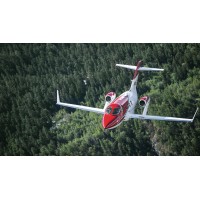


HondaJet private jet charter
Every other business jet mounts its engines on the rear fuselage or under the wing. HondaJet puts them on pylons above the wing, and that single decision explains most of what makes the aircraft worth chartering. It is the only production business jet with the configuration, it took Honda eighteen years to bring from sketch to certification, and it is the reason a very light jet ends up with a cabin, a baggage hold and a cruising altitude that belong to a larger class.
Honda Aircraft Company was founded in 2006 and builds at Greensboro, North Carolina. Cumulative deliveries passed 250 aircraft worldwide during 2024. The current production model is the HondaJet Elite II, which in February 2026 became the first production twin-turbine very light jet certified with Emergency Autoland. A larger aircraft, the HondaJet Echelon, is in flight test preparation.
For a quote, contact us via WhatsApp on +44 204 577-31-19 or by email at flight@private-jets.co.uk
The engines sit on top of the wings. Here is what that buys you.
Michimasa Fujino sketched the configuration in the late 1990s and Honda spent the following two decades proving it. The patented Over-The-Wing Engine Mount, OTWEM in Honda's shorthand, places each GE Honda HF120 turbofan on a pylon above the wing rather than bolting it to the rear fuselage.
Conventional rear-fuselage mounting forces a heavy structural carry-through frame across the back of the cabin. That frame eats cabin length, constrains the baggage hold and transmits engine noise directly into the passenger compartment. Moving the engines outboard and upward removes it entirely. What the passenger gets:
- A cabin longer than the class allows. With no engine mounting structure crossing the fuselage, the pressurised cabin runs further aft. The HondaJet has the largest cabin among very light jets;
- A proper baggage hold. Around 62 cubic feet, split between an aft external compartment and a forward hold, against roughly half that in several competitors;
- A rear lavatory that is genuinely enclosed, with a washbasin, because the space exists to fit one;
- Lower cabin noise. Engine noise reaches the cabin through structure as well as air. Removing the structural path is more effective than adding insulation to compensate for it;
- Less drag at high speed. Positioned correctly above the wing, the nacelles reduce wave drag in the transonic range rather than adding to it, which is the aerodynamic argument Fujino spent years validating in wind tunnels.
Two further design choices support it. The fuselage is all-composite, carbon fibre over honeycomb, which saves weight. The nose and wing use natural laminar flow profiles, keeping airflow attached further back along the surface and cutting drag again. None of this is styling. It is why a 11,100 lb aircraft cruises at 422 knots.

A very light jet that performs like a light jet
Classification puts the HondaJet in the VLJ bracket alongside the Citation Mustang and Phenom 100. Performance does not.
| HondaJet Elite II | Embraer Phenom 100EV | Cessna Citation M2 | |
| Max cruise | 422 kt | 406 kt | 404 kt |
| Service ceiling | 43,000 ft | 41,000 ft | 41,000 ft |
| NBAA IFR range | 1,547 nm | 1,178 nm | 1,550 nm |
| Engine position | Over the wing | Rear fuselage | Rear fuselage |
| Enclosed lavatory | Yes, with washbasin | Yes | Partial |
| London City certified | Yes, 5.5 degrees | No | No |
| Emergency Autoland | Yes, from 2026 | No | No |
| Typical UK rate | From £3,000/hr | From £2,200/hr | From £2,300/hr |
The 43,000 ft ceiling is the figure to notice. Most light jets stop at 41,000 ft, which puts the HondaJet above a good deal of European weather and above the traffic flows that generate delay. Cabin altitude at that height is around 7,900 ft, comparable to an airliner.
Where it does not win: cabin width. Six passengers fit, and four travel comfortably. The Phenom 300 and Citation CJ3 are larger aircraft in every dimension and cost less per hour to charter. The HondaJet is the choice when speed, altitude and airport access matter more than shoulder room.
Which HondaJet are you being offered?
Four variants have been built and operators rarely specify which one. The differences are worth asking about, and there is a useful shortcut: seat count is determined by serial number.
- HondaJet, sometimes called the Classic (2015 to 2018). The original HA-420. Serial numbers 42000011 to 42000125 are limited to seven seats in total, meaning six passengers with a single pilot. Garmin G3000 flight deck from the start;
- HondaJet Elite (2018). Added fuel capacity for around 17 per cent more range, aerodynamic refinements to the inlets for lower noise, and an updated interior. Serial 42000126 onwards carry eight total seats. This variant is not a medevac aircraft, despite a claim that circulates on several charter listings. Air ambulance operators including Wing Spirit in Hawaii bought Elites and fitted them out for medical work, which is not the same thing;
- HondaJet Elite S (2021). A further weight and performance increase, plus Honda's Advanced Steering Augmentation System for crosswind handling on the ground;
- HondaJet Elite II (2022 onwards). Current production. Autothrottle as standard, the first in a twin-turbine VLJ, along with an updated cabin and, from 2026, Emergency Autoland. Factory list price stood at 6.95 million dollars in mid-2025.
Honda also offers APMG and APMG S upgrade packages that retrofit later performance and system improvements to older Classic airframes, so a 2016 aircraft may not be to 2016 specification. Ask the operator.
Emergency Autoland, and what it actually does
On 4 February 2026 the FAA certified Emergency Autoland on the HondaJet Elite II, making it the first production twin-turbine very light business jet to carry the system. Certification flight testing had concluded the previous October. Honda is pursuing approval in other markets, so UK and European registered aircraft may not yet be equipped.
The system addresses the specific risk of single-pilot jet operations. If the pilot becomes incapacitated, a passenger presses one button, or the system activates automatically when it detects no pilot response. It then selects a suitable airport accounting for weather, terrain, fuel and runway length, transmits a distress signal to air traffic control, flies the approach, lands and brings the aircraft to a stop on the runway.
Emergency Autoland has been fitted to single-engine aircraft for several years and has been used in genuine emergencies. Bringing it to a twin-engine jet is the new part, and for a charter client flying single-pilot it is a meaningful difference from every competing VLJ, none of which currently offers it.
In a separate first, Honda flew a HondaJet on 100 per cent sustainable aviation fuel in October 2025, again ahead of any other twin-turbine VLJ manufacturer.

London City, and why it matters here
The HondaJet is certified for steep approaches up to 5.5 degrees, which is the London City Airport requirement. Very few aircraft of this size hold that approval, and it changes what the aeroplane is useful for.
A standard approach path is three degrees. London City sits inside the Docklands with a short runway and buildings on the approach, so aircraft must descend at nearly double the normal gradient, which demands specific certification covering handling, drag devices and pilot procedures. Most VLJs and a good many light jets do not have it.
For a client based in the City or Canary Wharf, departing from London City rather than Farnborough or Luton removes 60 to 90 minutes of road transfer at each end of the trip. On a two-hour sector that is a material share of the total journey. The same certification also opens Alpine and other constrained fields where steep approaches are published.
Confirm the specific airframe and operator approval when booking, since certification of the type does not automatically mean a given operator is approved for the airport.
Coming next: the HondaJet Echelon
Unveiled as the HondaJet 2600 Concept at NBAA in 2021 and formally named Echelon at NBAA-BACE in October 2023, this is a larger aircraft that will sit alongside the Elite II rather than replace it.
Published targets are eleven occupants, a range of 2,625 nautical miles, and transcontinental United States capability non-stop, which places it in the light jet class rather than the VLJ bracket. Honda states it will be substantially more fuel efficient than a midsize jet on a comparable mission and that it is designed for single-pilot operation.
Assembly of the first test aircraft began in February 2025 with the wing structure at Greensboro. First flight is targeted for 2026, type certification for 2028 and customer deliveries by the end of the decade. Honda reported close to 500 letters of intent by early 2026, which are non-binding but indicate genuine demand. It will not be available for charter before 2029 at the earliest.
Rates and UK availability
Indicative hourly rates in GBP for UK departures. Availability across Europe is improving as delivery volumes rise, but this remains a scarcer aircraft than a Phenom or a Citation.
| Variant | Years | Seats | Range | UK availability | From |
| HondaJet / Classic | 2015-2018 | 5-6 | ~1,220 nm | Occasional | £2,400/hr |
| Elite | 2018-2021 | 6 | ~1,437 nm | Occasional | £2,700/hr |
| Elite S | 2021-2022 | 6 | ~1,437 nm | Limited | £2,800/hr |
| Elite II | 2023 onwards | 6 | 1,547 nm | Limited | £3,000/hr |
Delivery volumes give a sense of how the charter pool is growing. Honda handed over 11 aircraft in 2024, expected 14 to 15 during 2025 and has guided to between 26 and 30 in 2026. Cumulative deliveries passed 250 in 2024. Most go to owner-operators rather than charter fleets, so European availability lags the production figures.
Repositioning flights on empty legs reduce these rates by 25 to 75 per cent. For rates across every manufacturer see the private jet price guide or browse the complete fleet. Comparable alternatives with deeper UK availability are covered on our Embraer and Cessna pages.
Sectors the HondaJet suits
- London City to Paris - from approximately £4,200 for 5 passengers, around 1 hour, using the steep approach certification at both ends;
- London to Geneva - from approximately £5,400, around 1 hour 25 minutes;
- London to Edinburgh - from approximately £4,500, around 1 hour 20 minutes;
- London to Dublin - from approximately £4,200, around 1 hour 10 minutes;
- London to Amsterdam - from approximately £4,300, around 1 hour 5 minutes;
- London to Nice - from approximately £7,500, around 2 hours;
- Manchester to Zurich - from approximately £6,000, around 1 hour 45 minutes.
Four passengers is the comfortable number. At six the cabin is full and baggage becomes the constraint before weight does.
Frequently asked questions
Why are the HondaJet engines mounted above the wings?
The Over-The-Wing Engine Mount is a patented Honda configuration designed by Michimasa Fujino and is unique to this aircraft in production business aviation. Rear-fuselage engines require a structural carry-through frame across the back of the cabin, which shortens the usable cabin, restricts the baggage hold and carries engine noise into the passenger compartment through the structure. Mounting the engines above the wing removes that frame, and positioned correctly the nacelles also reduce drag at high cruise speeds rather than adding to it.
When did the HondaJet first fly?
The proof-of-concept aircraft first flew on 3 December 2003. A production-conforming aircraft followed in December 2010 and FAA type certification was granted in December 2015, with first deliveries the same month. Charter listings that give 2015 as the first flight are describing the certification year.
Can a HondaJet land at London City Airport?
Yes. The type is certified for steep approaches up to 5.5 degrees, which is the London City requirement, and very few aircraft of this size hold that approval. For clients based in the City or Canary Wharf it removes 60 to 90 minutes of ground transfer against Farnborough or Luton. Confirm both the airframe and the operator's own approval at the time of booking.
Is the HondaJet Elite a medevac aircraft?
No. The Elite is the standard production variant introduced in 2018, adding fuel capacity, aerodynamic refinements and an updated interior over the original HondaJet. Some air ambulance operators, notably Wing Spirit in Hawaii, have bought Elites and equipped them for medical transport, but the aircraft itself is a conventional business jet.
How much does it cost to charter a HondaJet?
From approximately £2,400 per flight hour for an original HondaJet and from £3,000 for the current Elite II. London City to Paris costs from around £4,200 for five passengers and London to Geneva from around £5,400. Rates sit above a Citation M2 or Phenom 100 because the aircraft is faster, newer and scarcer.
What is the HondaJet Echelon?
A larger aircraft, formerly the HondaJet 2600 Concept and named Echelon at NBAA-BACE in October 2023. It is designed for eleven occupants with a range of 2,625 nautical miles, placing it in the light jet class above the Elite II, which it will be sold alongside rather than replace. Assembly of the first test aircraft began in February 2025, first flight is targeted for 2026 and type certification for 2028, with deliveries by the end of the decade.
How many HondaJets have been built?
Cumulative deliveries passed 250 aircraft worldwide during 2024. Annual output has been modest: 11 in 2024, an expected 14 to 15 in 2025 and guidance of 26 to 30 for 2026. Most go to owner-operators rather than charter fleets, which is why European charter availability is thinner than the total suggests.
Page last updated: July 2026. Emergency Autoland is FAA certified on the HondaJet Elite II; approval in other jurisdictions is in progress and individual airframes may not be equipped. Steep approach access depends on operator approval as well as type certification. Charter availability is confirmed at the time of enquiry.
HondaJet aircraft available for charter: