


Charter a Learjet 25
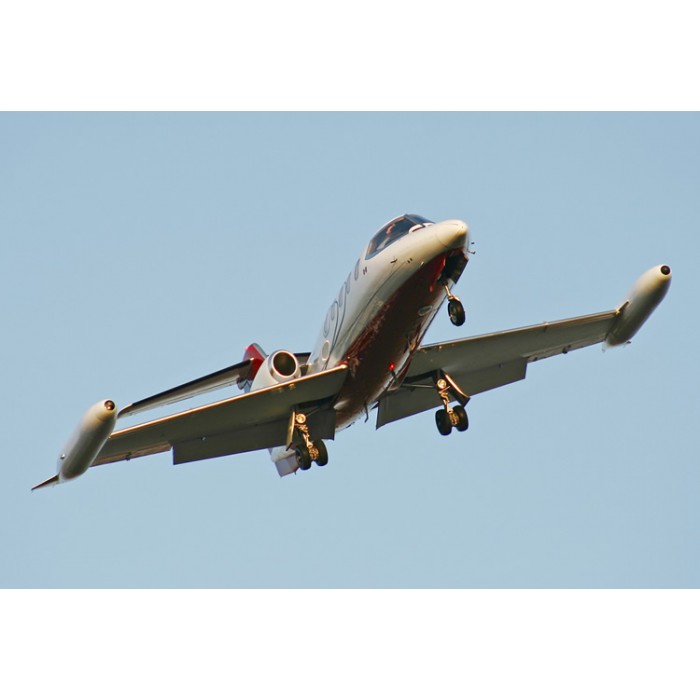


- Availability: Available for rent
Request aircraft information
The Learjet 25 is the aircraft that turned "Learjet" into a synonym for private jet - the stretched, higher-capacity development of the original Learjet 24 that became the best-selling model of the CJ610 turbojet era. The Learjet 25 first flew on 12 August 1966 and received FAA certification on 10 October 1967, with first deliveries in November 1967. Production ran across five main variants (25, 25B, 25C, 25D and 25G) until 1982, with 369 aircraft built in total. The Learjet 25 is similar to the Model 24 but is 1.27 m (4 ft 2 in) longer, allowing for three additional passengers. The Learjet 25D and 25G, the most capable variants, introduced the uprated GE CJ610-8A engines and a ceiling increase to 51,000 ft. Many Learjet 25 aircraft remain in regular use today, particularly in the United States, Mexico, and Canada.
The Learjet 25 is a pure turbojet aircraft - not a turbofan. The CJ610 turbojets burn substantially more fuel than any modern turbofan, and Vref around 137 KIAS demands current jet skills from a current jet pilot. The CJ610 engines are now considered non-compliant with Stage 3 noise regulations. While many Learjet 25s have been retired or replaced, several are still flying, particularly in private ownership, charter, or flight club environments. However, due to Stage 3 noise compliance regulations, many require hushkits to operate legally in noise-sensitive areas. These are important operational considerations for charter clients. Charter prices start from approximately £900 per flight hour on equipped aircraft. For the full fleet see our private jet price guide or browse our complete fleet.

Why charter the Learjet 25?
- 45,000-51,000 ft service ceiling; 6,050 ft/min climb rate - fighter-derived performance at legacy charter rates. Few aircraft offer a 45,000 ft service ceiling and 460+ knot cruise speeds at such a low acquisition price. The Learjet 25's performance heritage traces directly to the Swiss FFA P-16 fighter jet - Bill Lear's original Learjet 23 design borrowed its swept-wing, T-tail configuration from military aviation. The result is a climb rate of 6,050 ft/min at MTOW and a 45,000 ft ceiling (51,000 ft on 25D/G) that puts the aircraft above all commercial traffic and above virtually all weather on European and regional sectors. On short missions under 1 hour, the time-to-cruise-altitude performance of the Learjet 25 is comparable to aircraft twice its age and three times its current charter rate;
- 464 kt cruise at Mach 0.76; 500+ kt maximum speed - one of the fastest light jets ever built. The Learjet 25 was one of the first business jets to exceed 500 knots. ChooseMyPlane confirmed 464 kt typical cruise speed. At these speeds, a London to Edinburgh sector takes under 50 minutes and London to Geneva under 70 minutes. The pure turbojet CJ610 engines deliver this speed without the weight and complexity of turbofan bypass systems - the same characteristic that makes them fuel-thirsty at low altitude but exceptionally fast at high altitude cruise. For charter clients whose priority is elapsed time on short to medium sectors, the Learjet 25 remains competitive with aircraft built 40 years later;
- GE CJ610 turbojet engines - raw performance from an aviation icon; 5,000-hour inspection interval on CJ610-8A. Jet Advisors confirmed the CJ610-8A engines on the 25D produce 2,850-2,950 lbf each with a 5,000-hour inspection interval. The CJ610 is derived from the General Electric J85 military turbojet - the same basic engine family that powered the Northrop T-38 Talon supersonic trainer and the F-5 fighter. This military lineage gives the CJ610 a power-to-weight ratio and altitude capability that civilian-optimised turbofans of the same era could not match. The trade-off is higher fuel burn at lower altitudes and Stage 2 noise classification that restricts operations at some noise-sensitive airports without hushkits;
- Medevac, military and special-mission credentials - Mexican Navy, Bolivian Air Force, Peruvian Air Force operators. Wikipedia confirmed the Learjet 25's widespread military and government adoption: the Peruvian Air Force purchased two 25Bs with a belly pod that contained an aerial survey camera. Primary military operators include the Mexican Navy and Bolivian Air Force. The cabin interior can be converted to several different configurations to allow for cargo and medevacs. To become a medevac aircraft, the starboard seating is removed to allow for a stretcher as well as oxygen bottles and intravenous drip equipment. The 25D's 40 ft³ internal baggage compartment and flexible cabin layout support these diverse mission roles. For charter clients requiring an aircraft with flexible cabin configuration or medevac capability, the Learjet 25 offers established conversion options;
- Low acquisition cost; accessible charter rates; the lowest-cost entry point into the Learjet experience. Prices vary widely, with airworthy models typically ranging from $150,000 to $400,000, depending on engine hours, compliance upgrades, and avionics packages. This low pre-owned value translates directly to the lowest available Learjet charter rates. For groups of 4 to 6 on short UK regional and European sectors where the Learjet brand and performance are desired at minimum rates, the Learjet 25 is the most economical option in the Learjet family. The natural successor in the same identity is the Learjet 31, which retained the hot-rod handling but added TFE731-2 turbofans and Stage 3 compliance.
- 369 aircraft built; 25D the most traded variant; active fleet in North America, Mexico and Latin America. Production ran from 1966 through 1982 across the 25, 25B, 25C, 25D, and 25G variants, 369 airframes in total, making it by far the most successful CJ610-era Learjet. The 25D is the most commonly chartered and traded variant today, with the CJ610-8A engine upgrade providing the best performance and parts support within the type. Active operators are concentrated in North America, Mexico and Latin America where Stage 2 noise regulations are less restrictive than European airspace. UK and European operations require Stage 3 compliance via hushkit - confirm with the operator before booking.
Charter cost - Learjet 25 prices from UK airports
Hourly rates run from approximately £900 to £1,300 - the lowest in the Learjet family, reflecting the aircraft's 1960s-1980s production era, Stage 2 noise profile and smaller cabin. For groups of 4 to 6 on short UK and European sectors where the Learjet performance and heritage are valued at minimum rates, the Learjet 25 provides entry-level access to the Learjet experience.
Indicative one-way prices from UK airports (Stage 3-equipped aircraft):
- London to Edinburgh - from £1,080 (5 passengers, approximately 50 minutes);
- London to Paris - from £1,170 (5 passengers, approximately 55 minutes);
- London to Geneva - from £1,620 (5 passengers, approximately 1 hour 10 minutes);
- Edinburgh to Manchester - from £900 (5 passengers, approximately 40 minutes);
- London to Amsterdam - from £1,170 (5 passengers, approximately 50 minutes);
- London to Dublin - from £1,080 (5 passengers, approximately 55 minutes);
- Manchester to Nice - from £2,700 (5 passengers, approximately 2 hours).
Empty Leg flights appear on repositioning routes. See our Empty Legs page for current availability.

Ideal routes for the Learjet 25
Best matched to short UK regional and European sectors where 464 kt cruise, 45,000 ft ceiling and Learjet heritage serve groups of 4 to 6 at entry-level rates:
- Short UK and European day trips (45 to 90 minutes) where speed is the priority. Edinburgh, Manchester, Paris, Amsterdam and Geneva are all within 50 to 70 minutes at 464 kt cruise. The climb rate of 6,050 ft/min means the Learjet 25 reaches 45,000 ft quickly, maximising time at the efficient high-altitude cruise band. For groups of 4 to 5 on same-day returns where total elapsed time matters, the Learjet 25's speed is genuinely competitive with modern light jets at significantly lower charter rates;
- Owner-pilot and experienced jet crew operations - the Learjet 25 suits pilots who know it. Vref around 137 KIAS demands current jet skills from a current jet pilot. It is not an entry-level jet. The Learjet 25's handling - known as "hot-rod" by legacy operators - requires experienced crew with current Learjet type ratings. Charter operators running Learjet 25 aircraft maintain current-type crew. For aviation enthusiasts who appreciate the heritage and handling of the original Learjet era, the 25 provides the most authentic experience in the family at accessible rates;
- Budget-priority sectors where Stage 2 noise compliance is not a constraint. At airports and routes where Stage 2 noise is accepted or the aircraft is hushkit-equipped, the Learjet 25 provides the lowest charter rate of any twin-engine jet of comparable performance. For groups operating from smaller UK or European airfields where noise abatement is less restrictive, the Learjet 25's economics are compelling;
- Medevac and flexible-configuration missions. The Learjet 25's established medevac configuration - starboard seating removed for stretcher, oxygen and IV equipment - makes it relevant for medical transfer missions. The convertible cabin and established 25B/C/D medevac history provide a platform with proven medical mission credentials at lower operating cost than modern dedicated medevac jets;
- Short sectors within 1,246-1,437 nm where the Learjet 25D's range is sufficient. Jet Advisors confirmed the 25D range of 1,246 nm at typical cruise settings. London to Nice (approximately 700 nm), London to Madrid (approximately 800 nm) and London to Istanbul (approximately 1,550 nm at lighter loads) are all accessible. For groups whose itinerary stays within 1,200 nm and who want the lowest available jet rate, the Learjet 25 covers most UK and European missions.

Cabin and in-flight experience
The Learjet 25 cabin measures 4.2 m (13.8 ft) long, 1.50 m (4.9 ft) wide and 1.30 m (4.3 ft) high - compact, with a "sports car" rather than lounge character as ChooseMyPlane described. The Learjet 25D is normally configured for six passengers in a seating arrangement consisting of four individual forward facing seats, and a full-width bench seat aft of these. A baggage compartment of approximately 40 cu ft is located aft of the fold-down bench seat, and is accessible only from inside the cabin. The half-width lavatory is located along the forward starboard side of the cabin, across from the airstair door.
The 1.30 m cabin height does not allow standing - the Learjet 25 is a sit-down aircraft throughout. For groups of 4 to 6 on short sectors, the intimate cabin dimensions are not a practical limitation on flights under 2 hours. The avionics vary by aircraft and refurbishment: a typical 25D carries dual Collins VHF-20 comms, dual VIR-30 navs, Collins FD108 flight director, FC110 autopilot and Bendix RDS 81 colour weather radar. Many active aircraft have been updated to Garmin GNS 530 or equivalent GPS navigators. Confirm the avionics and Stage 3 compliance status with the operator before booking.
- Cabin. 4.2 m x 1.50 m x 1.30 m; pressurised; sit-down (no stand-up headroom);
- Layout. 4 forward individual seats + full-width aft bench = 6 standard; half-width forward lav;
- Baggage. 40 ft³ internal only (aft of bench seat; cabin access only);
- Engines. 2 x GE CJ610-8A (25D; 2,950 lbf each; 5,000-hr inspection interval);
- Noise. Stage 2 standard; Stage 3 hushkit available and required at many European airports;
- Avionics. Varies by aircraft; typical: Collins dual comms/navs; FC110 autopilot; many with Garmin GPS updates;
- Medevac. Convertible to stretcher configuration (starboard seating removed).
Technical specifications
| Manufacturer | Learjet / Gates Learjet, Wichita, Kansas |
| First flight | 12 August 1966 |
| FAA certification | 10 October 1967 |
| Production | 1967-1982; 369 aircraft built |
| Variants | 25, 25A, 25B, 25C, 25D (most common), 25G |
| Aircraft class | Light business jet (vintage) |
| Engines (25/25B/25C) | 2 x GE CJ610-6 (2,950 lbf each) |
| Engines (25D/25G) | 2 x GE CJ610-8A (2,950 lbf each; 5,000-hr inspection) |
| Engine type | Pure turbojet (not turbofan) |
| Cruise speed | 464 kt / 859 km/h (Mach 0.76) |
| Max speed | 500+ kt / 925 km/h |
| Climb rate | 6,050 ft/min |
| Service ceiling | 45,000 ft (25); 51,000 ft (25D/G) |
| Range | 1,246-1,437 nm / 2,308-2,661 km (25D) |
| Takeoff distance | 5,186 ft |
| Landing distance | 2,703 ft |
| MTOW | 15,000 lb / 6,805 kg |
| Noise standard | Stage 2 (hushkit required for Stage 3 compliance) |
| Cabin length | 4.2 m (13.8 ft) |
| Cabin width | 1.50 m (4.9 ft) |
| Cabin height | 1.30 m (4.3 ft; sit-down only) |
| Passengers | 6 standard (4 fwd + bench); 8 maximum |
| Baggage | 40 ft³ internal (cabin access only) |
| Wingspan | 13.35 m (43.8 ft) |
| Aircraft length | 14.52 m (47.7 ft) |
| Aircraft height | 3.72 m (12.2 ft) |

Learjet 25 vs similar aircraft
- Learjet 25 vs Learjet 31. The natural successor in the same identity is the Learjet 31, which retained the hot-rod handling but added TFE731-2 turbofans and Stage 3 compliance. The Learjet 31 has higher charter rates (typically 20 to 35% above the 25) but eliminates the Stage 2 noise restriction, provides better fuel economy from the turbofan engines, and includes Delta Fins that improved aerodynamic stability. For UK and European operations where Stage 3 compliance is required at all airports, the Learjet 31 is the practical successor. The Learjet 25 remains the choice where Stage 3 compliance is available via hushkit and the lowest possible rate is the priority;
- Learjet 25 vs Cessna Citation 501. The Citation 501 is the natural peer - also a 1970s-1980s vintage light jet, also active in charter, also at entry-level rates. The Citation 501 has a straight wing (shorter field, lower approach speed), quieter Stage 3 JT15D engines and lower fuel burn. The Learjet 25 counters with 464 kt cruise (vs Citation 501's 347 kt), 45,000 ft ceiling (vs 41,000 ft), the superior climb rate and the Learjet's fighter-derived high-altitude performance. For speed-priority short sectors, the Learjet 25 is faster; for airfield access and noise compliance, the Citation 501 is easier to operate;
- Learjet 25 vs Learjet 35. The Learjet 35 uses TFE731 turbofan engines - quieter, more fuel-efficient, Stage 3 compliant - with a similar cabin but considerably more range (over 2,000 nm vs 1,246 nm for the 25D). Charter rates for the Learjet 35 run approximately 20 to 40% above the Learjet 25. For any mission over 1,200 nm or any operation at a Stage 3-only European airport, the Learjet 35 is the practical choice. The Learjet 25 retains a niche where its lower rate and high-speed cruise are the priorities on short sectors.

Frequently asked questions - Learjet 25 charter
How much does it cost to charter a Learjet 25?
Charter rates run from approximately £900 to £1,300 per flight hour. London to Edinburgh costs from £1,080 for 5 passengers. London to Geneva costs from £1,620. Manchester to Nice costs from £2,700. All quotes from Private Jets UK are fully itemised with no hidden charges.
Is the Learjet 25 Stage 3 noise compliant?
The standard Learjet 25 with CJ610 turbojet engines is Stage 2 classified - the older noise standard that is restricted or prohibited at many European airports. Stage 3 compliance requires a hushkit modification. Confirm whether any specific aircraft carries a Stage 3 hushkit before booking for UK and European operations. Aircraft operating in North America under Part 91 rules may not carry hushkits.
How many passengers can fly on a Learjet 25?
Six in the standard configuration: four individual forward-facing seats and a full-width aft bench seat. Eight is the certified maximum. The cabin height of 1.30 m means passengers cannot stand up during flight - the Learjet 25 is a sit-down aircraft. The half-width lavatory is at the forward starboard position. Internal baggage capacity is 40 ft³, accessible only from inside the cabin.
What is the difference between the Learjet 25 and Learjet 25D?
The 25D is the most capable and most commonly chartered variant, introduced in 1976. It features the uprated GE CJ610-8A engines (vs CJ610-6 on earlier models), a re-contoured leading edge improving cruise performance and low-speed handling, a ceiling increase to 51,000 ft, and a 5,000-hour engine inspection interval. The 25D is the variant most traders and operators reference when discussing a "Learjet 25" today.
Why does the Learjet 25 have wing-tip fuel tanks?
The distinctive tip tanks are structural fuel containers that also serve as aerodynamic winglets, adding span without increasing the structural complexity of the wing root. They hold a significant portion of total usable fuel and are a defining visual characteristic of the original Learjet design - shared with the Learjet 23, 24, 25 and early 30 series. The tip tanks contribute to the aircraft's range and are integral to the aerodynamic balance of the T-tail low-wing design.

