


Charter a Learjet 70


- Availability: Available for rent
Request aircraft information
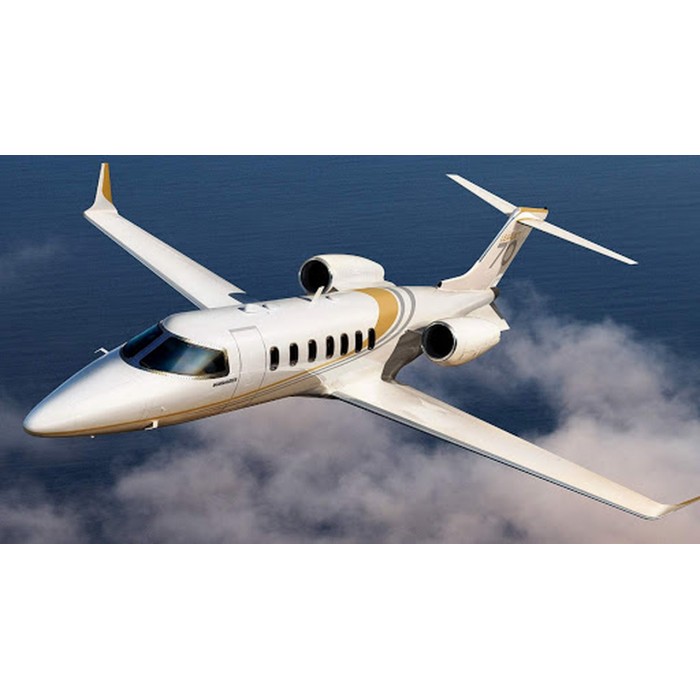
The Learjet 70 is a light business jet produced by Bombardier from 2013 to 2022 — the direct successor to the Learjet 40, announced in May 2012 and receiving FAA type certification in November 2013. It is the last generation of the Learjet line, sharing the Bombardier Vision flight deck with the Learjet 75 but in a shorter, six-passenger configuration. The Learjet 70 introduces three advances over the Learjet 40 series: Garmin G5000 touchscreen avionics with three 14-inch displays; canted winglets derived from the Bombardier Global 7500/8000 programme, reducing airframe drag by 2% and increasing range by 4%; and Honeywell TFE731-40BR engines at 3,850 lbf providing 10% more takeoff thrust and 4% lower fuel burn than the engines on the Learjet 40 and 45. The final Learjet — the Learjet 75 — was delivered on 28 March 2022, ending six decades of Learjet production.
The Learjet 70 cabin is 5.39 m long, 1.56 m wide and 1.50 m high, with a pocket door separating the flight deck from the passenger zone — reducing cockpit noise by 8 dB and making face-to-face conversation possible across the full cabin length at cruise. Seats are berthable; the Lufthansa Technik cabin management system provides high-definition entertainment and connectivity. An APU (Honeywell RE-100LJ) powers the aircraft on the ground without running the main engines. The Learjet 70 cruises at Mach 0.81 — cited by Air Charter Advisors as the highest high-speed cruise in its class — and maintains 6,000 ft cabin altitude at FL450. Charter prices start from approximately £2,200 per flight hour. For the full fleet see our private jet price guide or browse our complete fleet.

Why charter the Learjet 70?
- Mach 0.81 high-speed cruise — highest in the light jet class; canted winglets from Global 7500/8000. The Learjet 70 achieves Mach 0.81 (464 kt) at high-speed cruise — cited as the highest in its class among light business jets. The canted winglets incorporated from the Bombardier Global 7500/8000 ultra-long-range programme reduce airframe drag by 2% and deliver faster climb times, better short-field performance and improved hot-and-high capability versus the Learjet 40 series. At 51,000 ft maximum altitude the aircraft climbs above virtually all commercial traffic and weather on European and transatlantic sectors;
- Garmin G5000 Vision flight deck — three 14-inch touchscreen displays, first on a Learjet. The Bombardier Vision flight deck on the Learjet 70 features the Garmin G5000 avionics suite with three 14-inch high-resolution landscape touchscreen displays — a generational advance over the avionics on the Learjet 40 and 45 series. The G5000 integrates navigation, communication, weather and synthetic vision in a single touchscreen interface. The pocket door between flight deck and cabin reduces ambient noise by 8 dB, making the Learjet 70 one of the quietest cabins in the light jet category for face-to-face conversations;
- 6,000 ft cabin altitude at FL450 — low for a light jet. The Learjet 70 pressurisation system maintains 6,000 ft cabin altitude at FL450 — a notably low figure for the light jet category, where competing aircraft typically hold 6,000 to 8,000 ft at equivalent altitudes. SkyTough notes the system can maintain this cabin altitude with one engine throttled to idle. On 2 to 3-hour European sectors where cabin comfort matters, the low altitude reduces fatigue and dehydration meaningfully;
- Honeywell TFE731-40BR with APU — 10% more takeoff power, 4% lower fuel burn than Learjet 40/45. The TFE731-40BR engines at 3,850 lbf provide 10% more takeoff thrust than the engines on the Learjet 40 and 45, with 4% better fuel efficiency. The Honeywell RE-100LJ APU provides ground power and air conditioning without running main engines — relevant at noise-sensitive FBOs and for passenger boarding comfort in hot or cold conditions. Business Jet Traveler credited the new engines with faster climb times, better short-field performance and improved hot-and-high capability versus earlier Learjets;
- Pocket door cabin isolation and Lufthansa Technik CMS — quiet cabin, stow-away touchscreen entertainment. The pocket door between the Learjet 70 cockpit and cabin reduces passenger-perceived noise by 8 decibels — the difference between a loud office and a quiet room. The Lufthansa Technik cabin management system provides high-definition displays, integrated speakers and stow-away touchscreen monitors. Seats recline to full berths. Sidewall cutouts provide personal storage at each position. Wi-Fi connectivity is available on equipped aircraft;
- Access to shorter runways — 4,440 ft takeoff and Learjet short-field heritage. The 4,440 ft sea-level balanced field takeoff distance and 2,660 ft landing distance give the Learjet 70 access to secondary airports unavailable to larger light jets — Teterboro, Van Nuys, London City approaches and equivalent European secondary fields. The combination of short-field performance and Mach 0.81 high-speed cruise delivers the widest point-to-point network of any light jet in the class.
Charter cost — Learjet 70 prices from UK airports
Hourly rates run from approximately £2,200 to £2,800 — in the light jet category, above the Phenom 300 and comparable to the Citation CJ4, reflecting the Mach 0.81 cruise speed, Garmin G5000 avionics and 6,000 ft cabin altitude. For 4 to 6 passengers on UK regional and European business missions, the Learjet 70 provides the fastest light jet cruise available at rates well below any midsize jet.
Indicative one-way prices from UK airports:
- London to Edinburgh - from £2,640 (5 passengers, approximately 1 hour);
- London to Geneva - from £3,520 (5 passengers, approximately 1 hour 20 minutes);
- London to Paris - from £2,200 (5 passengers, approximately 50 minutes);
- London to Amsterdam - from £2,420 (5 passengers, approximately 55 minutes);
- London to Moscow - from £13,200 (5 passengers, non-stop, approximately 3 hours 30 minutes);
- London to Nice - from £3,960 (5 passengers, approximately 1 hour 40 minutes);
- Edinburgh to Zurich - from £4,400 (5 passengers, approximately 2 hours).
Empty Leg flights appear on repositioning routes. See our Empty Legs page for current availability.

Ideal routes for the Learjet 70
Best matched to UK regional and European missions where Mach 0.81 speed, 6,000 ft cabin altitude and secondary airport access serve groups of 4 to 6 at light jet rates:
- Short European business day trips (45 to 120 minutes) at the highest light jet cruise speed. Paris, Amsterdam, Brussels, Geneva, Zurich, Nice and Madrid are all within 45 to 120 minutes at Mach 0.81. The speed advantage over competing light jets at Mach 0.78 or below is approximately 10 to 15 minutes on these sectors — meaningful on same-day return trips where the total elapsed time determines feasibility. The Garmin G5000 touchscreen avionics provide the navigation and communication capability of a midsize jet flight deck on European instrument approaches;
- UK regional connections where speed and short-field access combine. Edinburgh, Manchester, Belfast, Inverness and Aberdeen are all within 45 to 75 minutes at Mach 0.81. The 4,440 ft takeoff and 2,660 ft landing distances open UK regional airfields with shorter runways alongside the major commercial airports. For corporate groups where the connection between a regional UK city and a European capital is the mission, the Learjet 70's speed and short-field access provide a unique combination;
- Longer European sectors to Iberia, Scandinavia and Eastern Europe (2 to 3.5 hours). Lisbon, Madrid, Oslo, Stockholm, Warsaw and Istanbul are all within range. The 6,000 ft cabin altitude at FL450 and the Lufthansa Technik cabin management system with stow-away entertainment screens make 2 to 3-hour sectors genuinely comfortable in berthable seats. Moscow (approximately 3 hours 30 minutes non-stop) is within range at 2,060 nm maximum;
- Owner-pilot and operator missions where Mach 0.81 makes the schedule work. The Learjet 70 has a loyal following among owner-operators who chose it for the speed advantage over the Phenom 300E and Citation CJ4 at comparable rates. For charter clients whose schedule requires the fastest possible light jet on a specific sector, the Mach 0.81 capability is the decisive selection criterion;
- Secondary airport departures where APU-powered boarding matters. The Honeywell RE-100LJ APU provides cabin air conditioning and power during boarding at noise-sensitive or remote FBOs where ground power is unavailable. For charter clients departing from smaller regional airfields without fixed ground power, the APU ensures the cabin is at temperature and the avionics are active before passengers board.

Cabin and in-flight experience
The Learjet 70 cabin measures 5.39 m long, 1.56 m wide and 1.50 m high — six passengers in a double-club layout with berthable reclining seats; a seventh position is available through the belted lavatory seat. A pocket door isolates the flight deck, reducing cockpit noise by 8 dB — sufficient for normal conversation across the full cabin. Window blinds are manually adjustable from fully open to full blackout. At FL450 cabin altitude is 6,000 ft.
The Lufthansa Technik cabin management system provides high-definition displays, integrated speakers and stow-away touchscreen monitors. Sidewall cutouts provide personal storage at every seat position. A forward galley serves the full group. The aft lavatory has its own window and a belted seat. External baggage is 50 ft³ (heated but not pressurised); a further 15 ft³ is accessible internally — 65 ft³ total. The Honeywell RE-100LJ APU powers the cabin on the ground. Wi-Fi is available on equipped aircraft.
- Cabin. 5.39 m × 1.56 m × 1.50 m; double-club; berthable seats; 6 passengers;
- Noise. Pocket door — 8 dB cockpit isolation; quiet for light jet class;
- Cabin altitude. 6,000 ft at FL450;
- CMS. Lufthansa Technik — HD displays; stow-away touchscreen monitors; integrated audio;
- Galley. Forward; pocket door from cabin;
- Lavatory. Aft with window and belted seat;
- Baggage. 50 ft³ external + 15 ft³ internal = 65 ft³ total;
- APU. Honeywell RE-100LJ (ground use); cabin conditioned pre-boarding;
- Avionics. Garmin G5000; 3× 14-inch touchscreen displays; synthetic vision; Bombardier Vision flight deck.
Technical specifications
| Manufacturer | Bombardier Learjet, Wichita, Kansas |
| Successor to | Learjet 40 |
| FAA certification | November 2013 |
| Production | 2013–2022; part of last Learjet generation (70/75) |
| Aircraft class | Light business jet |
| Engines | 2 × Honeywell TFE731-40BR (3,850 lbf each; +10% vs Lear 40/45; FADEC; thrust reversers) |
| APU | Honeywell RE-100LJ (ground use) |
| Avionics | Garmin G5000 (Bombardier Vision); 3× 14-inch touchscreen; SVT; pocket door (-8 dB) |
| Winglets | Canted design from Global 7500/8000; -2% drag; +4% range |
| Range (4 pax, NBAA IFR) | 2,060 nm / 3,815 km |
| Range (6 pax) | 1,849 nm / 3,424 km |
| High-speed cruise | Mach 0.81 / 464 kt (860 km/h) |
| Typical cruise | Mach 0.76 |
| Long-range cruise | Mach 0.75 / 430 kt |
| Maximum altitude | 51,000 ft (15,545 m) |
| Cabin altitude | 6,000 ft at FL450 |
| MTOW | 21,500 lb / 9,800 kg |
| Takeoff distance | 4,440 ft / 1,353 m (SL ISA) |
| Landing distance | 2,660 ft / 811 m |
| Cabin length | 5.39 m (17 ft 8 in) |
| Cabin width | 1.56 m (5 ft 1 in) |
| Cabin height | 1.50 m (4 ft 11 in) |
| Passengers | 6 standard; 7 maximum (belted lav seat) |
| Baggage | 65 ft³ total (50 ft³ external + 15 ft³ internal) |
| Wingspan | 15.51 m (50 ft 11 in) |
| Aircraft length | 16.93 m (55 ft 7 in) |
| Aircraft height | 4.28 m (14 ft 1 in) |

Learjet 70 vs similar aircraft
- Learjet 70 vs Embraer Phenom 300E. The Phenom 300E is the most-delivered business jet in the world since 2015, with longer range (approximately 2,010 nm vs 2,060 nm — comparable), modern Garmin G3000 avionics and a strong Embraer support network. The Learjet 70 counters with Mach 0.81 high-speed cruise (vs Phenom 300E's approximately Mach 0.78), the Garmin G5000 with three 14-inch displays (vs G3000's two), the 8 dB pocket door cabin isolation, 6,000 ft cabin altitude and the Global 7500/8000-derived canted winglets. For speed-sensitive European sectors the Learjet 70 is measurably faster;
- Learjet 70 vs Cessna Citation CJ4. The Citation CJ4 has comparable range and cruise speed, a strong Citation service network and single-pilot certification. The Learjet 70 counters with Mach 0.81 high-speed cruise (CJ4 is Mach 0.737 maximum), the Garmin G5000 touchscreen flight deck, the 8 dB pocket door cabin isolation, 6,000 ft cabin altitude and the Lufthansa Technik CMS. For clients who need the fastest available light jet and the most current Bombardier avionics, the Learjet 70 is the stronger performer;
- Learjet 70 vs Learjet 75. The Learjet 75 shares the same engines, avionics and winglets but has a longer cabin (6.05 m vs 5.39 m), more passengers (9 maximum vs 7) and higher charter rates (typically 15 to 25% more). The Learjet 70 is the appropriate choice for groups of 4 to 6 where the shorter cabin and lower rate are preferable. For groups of 7 to 9, the Learjet 75 is necessary.

Frequently asked questions — Learjet 70 charter
How much does it cost to charter a Learjet 70?
Charter rates run from approximately £2,200 to £2,800 per flight hour. London to Geneva costs from £3,520 for 5 passengers. London to Edinburgh costs from £2,640. London to Paris costs from £2,200. All quotes from Private Jets UK are fully itemised with no hidden charges.
How fast is the Learjet 70?
At Mach 0.81 (464 kt / 860 km/h) high-speed cruise, the Learjet 70 is cited as the fastest high-speed cruise in its light jet class. Typical cruise is Mach 0.76; long-range cruise is Mach 0.75 (430 kt). At 51,000 ft maximum altitude the aircraft operates above virtually all commercial traffic. London to Paris takes approximately 50 minutes; London to Geneva approximately 1 hour 20 minutes.
What are the winglets on the Learjet 70?
The Learjet 70 uses canted winglets derived from the Bombardier Global 7500/8000 ultra-long-range programme. The design reduces airframe drag by 2%, increases range by 4% versus the Learjet 40 series, and delivers faster climb times and better short-field and hot-and-high performance. They are visually distinctive on the ramp — a clear identifier of the 70/75 generation versus earlier Learjet models.
How many passengers can fly on a Learjet 70?
Six in the standard double-club configuration; seven with the belted lavatory seat. The 5.39 m cabin accommodates 4 to 6 passengers in berthable reclining seats with sidewall cutout personal storage, a pocket-door-isolated forward galley and an aft lavatory with its own window.
Is the Learjet 70 still in production?
No — Bombardier ended all Learjet production in 2022 when the final Learjet 75 was delivered on 28 March 2022, concluding six decades of production. The Learjet 70 was temporarily discontinued in 2016 due to low orders, with the Learjet 75 continuing until the programme's end. The Learjet 70 remains available on the charter market and pre-owned market from the aircraft produced during the 2013–2022 production period.

