


Charter a Learjet 75


- Availability: Available for rent
Request aircraft information
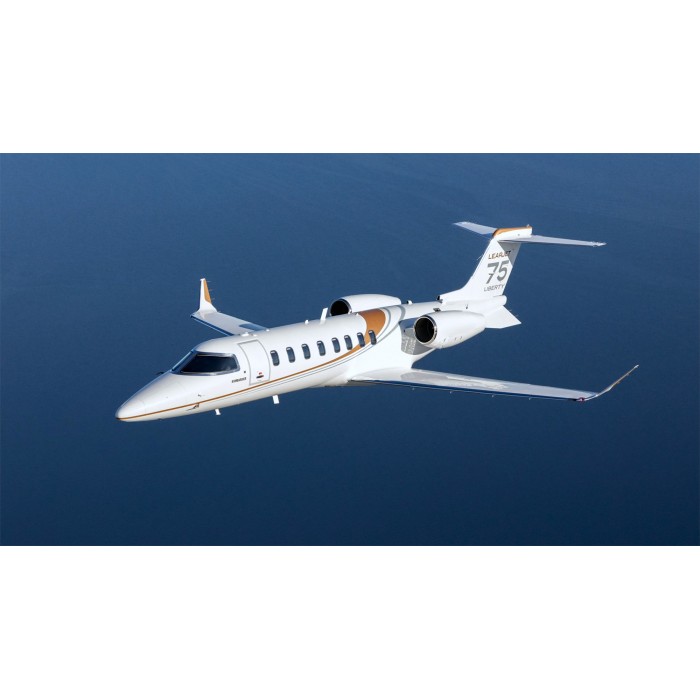
The Learjet 75 is the last Learjet ever built - the final aircraft from a line that began with the Learjet 23 in 1963 and that defined the private jet category for six decades. Unveiled at the EBACE show in May 2012, the Learjet 75 received FAA certification on 14 November 2013 and EASA certification in September 2014. The 100th Learjet 75 was delivered in June 2017. Bombardier announced the end of Learjet production in February 2021; the final Learjet 75 was delivered in January 2022. Approximately 154 to 156 aircraft were built in total across the standard Learjet 75 and the Learjet 75 Liberty variant (from 2020).
The Learjet 75 is essentially the Learjet 45XR updated with three specific improvements: Honeywell TFE731-40BR engines at 3,850 lbf each (10% more thrust than the 45XR's 3,500 lbf TFE731-20BR), Garmin G5000 three-screen touchscreen avionics replacing the Primus 1000, and canted winglets borrowed from the Bombardier Global 7500/8000 series. Wikipedia confirmed these changes lowered the design's drag by 2% and reduced nose section weight by 200 lb, resulting in 4% greater range than the Learjet 45XR and a balanced field length 12% shorter. The 415 ft³ flat-floor double-club cabin is confirmed by Jettly as "the only one in its category" with a flat floor. Charter prices start from approximately £2,400 per flight hour. For the full fleet see our private jet price guide or browse our complete fleet.

Why charter the Learjet 75?
- Garmin G5000 three-screen touchscreen avionics; Bombardier Vision flight deck; synthetic vision; triple FMS - the most advanced Learjet cockpit ever built. FlyCraft confirmed the Garmin G5000 suite provides three 14.1-inch LCD touchscreen displays with dual 5.7-inch controllers, each capable of operating independently as a primary flight display or multifunction display in a multi-pane mode. Bombardier Vision synthetic vision technology can be synced to a heads-up display. The triple-integrated FMS provides graphical flight planning, advanced weather radar and datalink capabilities. GlobalAir confirmed an avionics upgrade was applied to the Garmin G5000 suite in September 2018. This is the same Garmin G5000 platform used in the Learjet 70 and represents a complete generational leap over the Primus 1000 of the Learjet 45XR - touchscreen vs button-driven, 14.1-inch vs 8x10-inch displays, synthetic vision standard rather than optional;
- TFE731-40BR engines at 3,850 lbf - 10% more thrust than Learjet 45XR; TBO 6,000 hours; 12% shorter balanced field length; FL510 in under 20 minutes. Omni Aircraft Sales confirmed the TFE731-40BR engines provide 3,850 lbf each (vs 3,500 lbf on the 45XR's -20BR). TBO extends from 5,000 to 6,000 hours; mid-life interval from 2,500 to 3,000 hours. Wikipedia confirmed the Learjet 75 can take off "from a 4,500-foot runway with a full load of passengers and fuel and fly 1,800 nautical miles" - a 12% shorter balanced field length than the Learjet 45XR. For charter clients operating from shorter UK regional airfields or demanding summer-temperature European airports, the 40BR engines' additional thrust provides meaningful operational margin. The combined 7,700 lbf total thrust on an airframe of 21,500 lb MTOW is the most thrust-to-weight ratio in the Learjet line's history;
- Global 7500/8000 canted winglets; drag -2%; range +4% vs Learjet 45XR; flat-floor cabin - the only one in the super-light jet category. Wikipedia confirmed the canted winglets were "incorporated from the Bombardier Global 7500/8000" - the flagship ultra-long-range jets - and lowered design drag by 2% with 200 lb less nose section weight, delivering 4% greater range. Jettly confirmed the Learjet 75 flat-floor cabin is "the only one in its category." The flat floor runs throughout the 6.02 m double-club cabin, enabling movement between the two four-seat club sections without the step that some competing midsize designs require. The 16 cabin windows (more than any previous Learjet) fill the interior with natural light. These three improvements - Global series winglets, flat floor, more windows - directly address the comfort limitations of the Learjet 45 platform from which the 75 is derived;
- 2,026-2,080 nm NBAA IFR range; 464 kt maximum cruise; 51,000 ft ceiling; 8,000 ft cabin altitude at maximum altitude - the peak Learjet performance specification. Wikipedia confirmed a maximum range of 2,050 nm with four passengers and NBAA IFR reserves. BlackJet confirmed 464 ktas maximum cruise. The 51,000 ft certified ceiling is maintained across all Learjet 70/75 operations; the cabin altitude at FL510 is 8,000 ft - comparable to commercial airliner conditions. At 51,000 ft the Learjet 75 operates above all commercial airline traffic and above all weather on European and medium-range intercontinental sectors. The original HTML confirmed the Learjet 75 connects "Frankfurt and Cairo or Chicago and San Juan" non-stop at Mach 0.78 with four passengers - these are routes that require 2,000 nm+ range that no earlier Learjet in the 40/45 family could reliably achieve at full passenger loads;
- Learjet 75 Liberty (2020) - $9.9M vs standard 75's $13.8M; 6-seat executive suite configuration; Part 25; same engines and 2,080 nm range. Bombardier launched the Learjet 75 Liberty in June 2019 with first deliveries in October 2020. GlobalAir confirmed the $9.9 million list price versus $13.8 million for the standard 75. The Liberty achieves this by replacing the two forward aft-facing seats with fold-down ottomans and an executive suite configuration - reducing standard passenger count from 8 to 6 but increasing legroom. Wikipedia confirmed the Liberty retains Part 25 certification (not FAR Part 23), a maximum payload of 2,910 lb and 2,080 nm range. Options for omitting the APU and lavatory sink reduce further. For charter clients specifically flying 5 to 6 passengers, the Liberty's executive suite provides substantially more personal space per passenger at lower rates than the standard 75 configuration;
- Last Learjet ever built; 154-156 aircraft delivered 2013-2022; 137 active (Jetcraft 2023); the final chapter of a 60-year aviation lineage. Jettly confirmed Bombardier manufactured approximately 156 Learjet 75 aircraft before ceasing production. Jetcraft confirmed 137 in operation as of 2023. The Learjet 75 is the conclusive aircraft in a lineage that produced the original Learjet 23 in 1963 and revolutionised the concept of the private jet - a lineage that includes the Learjet 25 (the first jet celebrity culture associated with private aviation), the Learjet 35 (round-the-world speed record holder), the Learjet 55 (first stand-up Learjet), the Learjet 60 (the widest cabin) and now the Learjet 75 (the most advanced avionics and the Global-series winglets). Bombardier committed to ongoing OEM parts availability and maintenance programmes after production ended, stabilising pre-owned values for the active fleet.
Charter cost - Learjet 75 prices from UK airports
Hourly rates run from approximately £2,400 to £3,000 - the highest in the Learjet family, reflecting the Garmin G5000 avionics, TFE731-40BR engines, Global-series winglets, flat-floor cabin and the aircraft's status as the last and most advanced Learjet ever produced. For 6 to 9 passengers on short and medium European missions, the Learjet 75 provides the definitive Learjet charter experience.
Indicative one-way prices from UK airports:
- London to Edinburgh - from £2,880 (8 passengers, approximately 50 minutes);
- London to Geneva - from £4,320 (8 passengers, approximately 1 hour 10 minutes);
- London to Paris - from £3,000 (8 passengers, approximately 50 minutes);
- London to Nice - from £5,280 (8 passengers, approximately 1 hour 35 minutes);
- London to Istanbul - from £12,480 (8 passengers, non-stop, approximately 3 hours 30 minutes);
- Edinburgh to Cairo - from £14,400 (8 passengers, non-stop, approximately 4 hours 30 minutes);
- London to Dublin - from £2,880 (8 passengers, approximately 55 minutes).
Empty Leg flights appear on repositioning routes. See our Empty Legs page for current availability.

Ideal routes for the Learjet 75
Best matched to short and medium European missions where the Garmin G5000 avionics, flat-floor double-club cabin, Global-series winglets and 2,080 nm range represent the definitive Learjet experience for groups of 6 to 9:
- Short European day trips (50 to 100 minutes) where the Garmin G5000 and Global winglets deliver the most modern Learjet flight experience. For charter clients who want the most current avionics, smoothest ride (Global-series winglets provide best wing loading in the category) and latest Learjet configuration, the 75 is the answer. Paris, Geneva, Amsterdam and Nice are all within 50 to 100 minutes. The 4,500 ft balanced field length opens shorter European airfields not previously accessible at full passenger loads. The Garmin G5000 synthetic vision provides pilots with the most advanced approach capability in the Learjet family on any departure or arrival;
- Longer European sectors (2 to 4.5 hours) to Istanbul, Cairo and Frankfurt-Cairo where 2,026-2,080 nm range is the enabling specification. The original HTML confirmed Frankfurt to Cairo (approximately 1,800 nm) as an achievable non-stop sector at Mach 0.78 with four passengers. From UK airports the equivalent routes include London to Cairo (approximately 2,200 nm at lighter loads), Edinburgh to Istanbul (approximately 1,650 nm) and London to Marrakech (approximately 1,400 nm). The Learjet 75's 2,080 nm range with four passengers provides the non-stop capability that earlier Learjet 40/45 series aircraft could not achieve at comparable payloads;
- Full double-club 8-passenger missions where the flat floor and 16 cabin windows define the Learjet 75 cabin standard. For groups of 7 to 9, the Learjet 75's double-club configuration with flat floor, 180-degree swivel chairs and 16 cabin windows is the complete Learjet interior. Jettly confirmed the flat floor is "unique in its category." The 16 windows provide more natural light than any previous Learjet. The enclosed belted lavatory as a ninth seat, 65 ft³ baggage (50 ft³ external, 15 ft³ accessible in flight), APU standard and microwave galley create the most complete Learjet package in the family's history;
- Learjet 75 Liberty configuration for 5 to 6 passengers where the executive suite provides maximum per-person space. The Liberty's forward executive suite - two seats facing with fold-down ottomans and sidewall tables - provides a private working environment for two passengers at the front, with four club seats in the rear section. GlobalAir confirmed a pocket door between the suite and galley reduces cabin noise by 8 dB. For small groups of 4 to 6 where per-person comfort is the priority, the Liberty configuration delivers the most exclusive Learjet interior at a lower charter rate than the standard 75 configuration;
- Operations requiring Part 25 certification and two-pilot crew at the most demanding safety standards. Jettly confirmed "the aircraft holds FAA Part 25 transport-category certification and requires a two-pilot crew." AeroCorner confirmed the Learjet 75 Liberty is "certified with FAA Part 25 regulations compared with other rivals in its category that are only certified with FAA Part 23." For corporate flight departments and charter operators who specify Part 25 certification as a booking requirement, the Learjet 75 provides this at the top of the Learjet product range.

Cabin and in-flight experience
The Learjet 75 cabin measures 6.02 m (19 ft 10 in) long, 1.55 m (5.1 ft) wide and 1.50 m (4.9 ft) high - 415 ft³, flat floor throughout. Jettly confirmed the flat floor is "the only one in its category" of super-light to small midsize jets. Standard configuration: double-club eight seats, with four forward-facing seats in the front club and four seats in the rear club, plus a fully enclosed belted lavatory as a ninth certified seat. The 180-degree swivel chairs enable face-to-face and side-by-side working configurations. Sixteen cabin windows provide more natural light than any previous Learjet. APU is standard; galley provides microwave, drainable ice drawer and work surface with storage. The Learjet 75 Liberty variant replaces the two front aft-facing seats with an executive suite of facing seats, ottomans and sidewall tables, separated from the aft cabin by an optional pocket door reducing noise by 8 dB.
Baggage: 65 ft³ total (50 ft³ external heated, 15 ft³ internal accessible during flight). The Garmin G5000 Bombardier Vision cockpit provides three 14.1-inch touchscreen LCD displays, Bombardier Vision synthetic vision, triple FMS, graphical weather and datalink. TFE731-40BR engines at 3,850 lbf each; thrust reversers standard; 214 gph; 6,000-hr TBO. FL510 ceiling; 8,000 ft cabin altitude at FL510.
- Cabin. 6.02 m x 1.55 m x 1.50 m; 415 ft³; flat floor (unique in class); 16 windows;
- Layout. Double-club 8 standard; belted lavatory = 9th seat;
- Liberty layout. Forward executive suite (2 seats + ottomans) + aft 4-club = 6; pocket door -8 dB;
- APU. Standard (optional deletion on Liberty);
- Galley. Microwave; drainable ice drawer; work surface; storage;
- Baggage. 65 ft³ (50 ft³ external heated + 15 ft³ internal in-flight accessible);
- Avionics. Garmin G5000 (3x 14.1-inch touchscreen LCD; synthetic vision; triple FMS; graphical weather; datalink);
- Engines. 2 x TFE731-40BR (3,850 lbf each; thrust reversers standard; 6,000-hr TBO; 214 gph);
- Pressurisation. 8,000 ft cabin at FL510.
Technical specifications
| Manufacturer | Bombardier Learjet, Wichita, Kansas |
| Unveiled | May 2012 (EBACE) |
| FAA certification | 14 November 2013 |
| EASA certification | September 2014 |
| Production | 2013-2022; ~154-156 aircraft built; final delivery January 2022 |
| Learjet 75 Liberty | Launched June 2019; first delivery October 2020; $9.9M (vs $13.8M standard) |
| Design basis | Learjet 45XR + TFE731-40BR + Garmin G5000 + Global canted winglets |
| Aircraft class | Super-light / small midsize business jet (FAR Part 25) |
| Engines | 2 x Honeywell TFE731-40BR (3,850 lbf each; 10% more than 45XR; 6,000-hr TBO; 214 gph) |
| Avionics | Garmin G5000 Bombardier Vision (3x 14.1-inch touchscreen; synthetic vision; triple FMS; graphical weather) |
| Winglets | Canted; from Bombardier Global 7500/8000; drag -2%; range +4% vs 45XR |
| Max cruise speed | 464 kt (Mach 0.81); typical Mach 0.79 HSC; Mach 0.76 normal cruise |
| Long-range cruise | 430 kt (Mach 0.75) |
| Service ceiling | 51,000 ft |
| Cabin altitude | 8,000 ft at FL510 |
| Range (NBAA IFR 4 pax) | 2,026-2,080 nm / 3,752-3,852 km |
| Range (8 pax full capacity) | 1,805 nm |
| BFL | 4,440 ft (12% shorter than Learjet 45XR) |
| MTOW | 21,500 lb / 9,752 kg |
| Flat floor | Yes - unique in super-light/small midsize jet category |
| Cabin length | 6.02 m (19 ft 10 in) |
| Cabin width | 1.55 m (5.1 ft) |
| Cabin height | 1.50 m (4.9 ft) |
| Cabin volume | 415 ft³ |
| Cabin windows | 16 (more than any previous Learjet) |
| Passengers | 8 standard; 9 with belted lavatory; Liberty: 6 standard |
| Baggage | 65 ft³ (50 ft³ external heated + 15 ft³ internal) |
| Wingspan | 15.51 m (with canted winglets) |
| Aircraft length | 17.68 m |
| Aircraft height | 4.28 m |

Learjet 75 vs similar aircraft
- Learjet 75 vs Learjet 45XR. The Learjet 75 is the direct successor - same 45XR airframe with three upgrades: TFE731-40BR engines (+10% thrust; 12% shorter BFL; extended TBO), Garmin G5000 touchscreen avionics (replacing Primus 1000) and canted Global-series winglets (+4% range; -2% drag). Charter rates for the Learjet 75 run approximately 15 to 25% above the 45XR. For clients who want the most current Learjet avionics, the best short-field performance in the 40/45 family and 4% more range, the 75 is the selection; for comparable cabin at lower rates, the 45XR remains available;
- Learjet 75 vs Embraer Phenom 300E. The Phenom 300E has a larger cabin (4.92 m vs Learjet 75's 6.02 m - actually Learjet 75 is longer), modern Garmin G3000 avionics, lower fuel burn and stronger Embraer factory support. Charter rates are broadly comparable or slightly lower. The Learjet 75 counters with 464 kt max cruise (comparable), 2,080 nm range (comparable), the double-club 8-seat flat-floor cabin (vs Phenom 300E's 5-6 standard), the Global-series canted winglets, Part 25 certification and the 51,000 ft ceiling. For group size of 7 to 9 the Learjet 75's double-club layout is the clear advantage; for 5 to 6 passengers the Phenom 300E's lower rates and stronger support are the alternative;
- Learjet 75 vs Learjet 60XR. The Learjet 60XR has a wider cabin (1.81 m vs 75's 1.55 m), more range (2,405 nm vs 2,080 nm) and the same Pro Line 21 avionics generation as a competing glass cockpit. Charter rates for the 60XR run approximately 10 to 15% below the 75. The Learjet 75 counters with Garmin G5000 (newer generation than Pro Line 21), flat-floor cabin (unique in class), Global series canted winglets, TFE731-40BR engines with 6,000-hr TBO, 12% shorter balanced field length and the larger 415 ft³ volume. For cabin width the 60XR wins; for avionics currency, flat floor and short-field access the 75 is preferable.

Frequently asked questions - Learjet 75 charter
How much does it cost to charter a Learjet 75?
Charter rates run from approximately £2,400 to £3,000 per flight hour. London to Geneva costs from £4,320 for 8 passengers. London to Edinburgh costs from £2,880. Edinburgh to Cairo costs from £14,400 non-stop. All quotes from Private Jets UK are fully itemised with no hidden charges.
Is the Learjet 75 the last Learjet ever built?
Yes. Bombardier announced the end of Learjet production in February 2021 and the final Learjet 75 was delivered in January 2022. The Learjet 75 is the last aircraft in a lineage that began with the Learjet 23 in 1963 - approximately 60 years of continuous Learjet production ending with the most advanced model. Bombardier committed to ongoing OEM parts availability and maintenance support for the active fleet.
What are the differences between the Learjet 75 and Learjet 75 Liberty?
The Learjet 75 Liberty (from 2020) reduces the price from $13.8 million to $9.9 million by replacing the two forward aft-facing seats with fold-down ottomans and an executive suite configuration, reducing standard seating from 8 to 6 passengers. Optional deletions include the APU and lavatory sink. A pocket door between the executive suite and the aft cabin reduces cabin noise by 8 dB. Both variants use identical TFE731-40BR engines, Garmin G5000 avionics and the same 2,080 nm range under Part 25 certification.
What is the flat-floor cabin on the Learjet 75?
Jettly confirmed the Learjet 75's flat floor is "the only one in its category" of super-light to small midsize jets. The flat floor runs throughout the 6.02 m double-club cabin length, allowing free movement between the two four-seat club sections without stepping up or over any structural intrusion. This is the same flat-floor design that began with the Learjet 45 clean-sheet programme and is retained as a defining feature of the Learjet 75.
How does the Learjet 75 differ from the Learjet 45XR?
Three specific upgrades distinguish the Learjet 75 from the Learjet 45XR: TFE731-40BR engines at 3,850 lbf (10% more thrust; extended 6,000-hr TBO), Garmin G5000 three-screen touchscreen avionics (replacing the Primus 1000's button-driven interface), and canted Global-series winglets from the Bombardier Global 7500/8000 (reducing drag by 2% and increasing range by 4%). The balanced field length is 12% shorter than the Learjet 45XR. All other cabin dimensions and airframe characteristics are shared.

