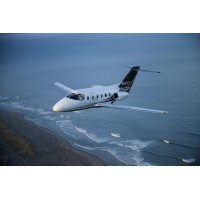


Nextant private jet charter
Nextant Aerospace does not build aircraft. It takes them apart and rebuilds them. Founded in 2007 by Kenneth Ricci and based in Cleveland, Ohio, the company strips a used business jet down to its bare airframe, replaces or overhauls every life-limited component to zero-time status, fits new engines and avionics, and delivers what the Aircraft Bluebook recognises as a new type. The result is roughly 88 per cent new by content and costs 40 to 50 per cent less than an equivalent new light jet.
Note the spelling: the company is Nextant, with a t. The aircraft you are most likely to be offered in Britain is the Nextant 400XTi, a rebuilt Beechjet 400A or Hawker 400XP. Two other types exist, and all three are covered below along with the question every client actually asks, which is how old the aeroplane really is.
For a quote, contact us via WhatsApp on +44 204 577-31-19 or by email at flight@private-jets.co.uk
What remanufactured actually means
This word gets used loosely across aviation, usually to describe a repaint and a new interior. Nextant's process is something else, and the distinction is worth understanding because it is the entire proposition.
A donor aircraft is reduced to its airframe. Every component with a certified life limit is either replaced outright or overhauled back to zero-time condition. New engines, new avionics, new wiring, new interior, new aerodynamic surfaces. A full rebuild consumes approximately 6,000 man-hours on a factory line designed for serialised production rather than one-off refurbishment.
What survives is the airframe itself, and it survives for a specific engineering reason: the structure carries no life limit. Aluminium airframes are maintained against corrosion and fatigue inspection programmes rather than retired at a fixed number of hours. That is why a 1990s Beechjet structure is an acceptable foundation and a 1990s engine is not.
| Rebuild time | Approximately 6,000 man-hours |
| New content | Approximately 88 per cent |
| Original content | The airframe structure, which carries no life limit |
| Life-limited parts | All returned to zero-time by replacement or overhaul |
| Classification | Recognised as a new type in the Aircraft Bluebook |
| Warranty | Two years, whole aircraft |
| Crew training | Standardised curriculum with Level D full-flight simulator |
| European service base | Milan Linate, alongside nine US centres |

So how old is the aircraft I would actually be flying on?
This is the fair question and it deserves a straight answer rather than marketing language.
The airframe is old. Beechjet 400A production ran through the 1990s and the Hawker 400XP into the 2000s, so a 400XTi typically sits on a structure built between 1990 and 2005. Registration history will show it. One 400XTi currently in charter service, for instance, carries a 1999 airframe and five previous registrations.
Almost nothing else is. Engines are new Williams FJ44-3AP units, not overhauled originals. Avionics are new Pro Line 21 installations. Wiring, interior, windows, winglets and control surfaces are new or zero-timed. Maintenance status resets, which matters because a buyer of a 30-year-old Beechjet inherits its accumulated cycle count on life-limited parts while a 400XTi buyer does not.
What this means in practice. The cabin you sit in will look and sound like a modern light jet, because it is one. The structure beneath it is older than you might expect and is maintained under the same corrosion and fatigue programmes that govern every other aluminium airliner and business jet in service. Airframe age is a routine part of continuing airworthiness rather than an exception.
Where it genuinely shows: cabin cross-section. That fuselage was designed in the early 1980s from the Mitsubishi Diamond II, and no amount of remanufacturing widens it. At roughly 4 ft 9 in of cabin height you sit rather than stand, and the cabin is narrower than a Phenom 300. If headroom matters to your group, this is the aircraft's real limitation, not its age.
The Nextant 400XTi
Development began on a Beechjet 400A airframe with a first test flight in March 2010. FAA certification followed in October 2011 and deliveries began the same month, the launch order coming from Flight Options. An updated version arrived in 2014, an extended-range variant with additional fuel tanks in 2015, and a stripped-back 400XTe aimed at charter and utility operators at the 2018 NBAA convention, priced around 4.5 million dollars against 5.4 million for the full XTi.
Two Williams International FJ44-3AP engines at 3,050 lb thrust each, under full authority digital engine control, replaced the original Pratt and Whitney JT15Ds. Aerodynamic work included a streamlined engine cowling, a redesigned engine beam and mounting system, and raked winglets with LED lighting. Avionics are Rockwell Collins Pro Line 21, and the cabin carries the Collins Venue management system.
Performance is the point. Cruise is around 460 knots and Nextant quotes roughly 2,000 nautical miles of maximum range, close to 50 per cent more than the Hawker 400XP it is built from, with practical NBAA IFR range nearer 1,500 nautical miles. That is enough for London to Athens or London to Ibiza without a stop. Climb rate improved substantially over the donor aircraft.
Cabin layouts vary. A common arrangement seats six or seven across a three-seat divan and four club seats, with a further seat in the enclosed lavatory, and the high-density 400XTe option takes nine. More than 80 aircraft have been delivered. As of July 2025 the programme had accumulated over 100,000 flight hours across operations in 13 countries, with around 20 per cent of the global Beechjet 400 fleet contracted for conversion.
The other two conversions
Nextant G90XT. A remanufactured Beechcraft King Air C90A, not the larger King Air 200 or 300 as several directories state. Two GE Aviation H75 turboprop engines replace the original Pratt and Whitney units, with Garmin G1000 avionics and a rebuilt cabin. It is a turboprop rather than a jet, seats four to six, and is scarce in European charter. For comparable and far more available alternatives see our Beechcraft King Air page.
Nextant 604XT. A remanufactured Bombardier Challenger 604, launched around 2017 and certified in 2019. Collins Aerospace Pro Line Fusion replaces the original flight deck, the two General Electric CF34-3B engines are retained and overhauled, and the aircraft cruises at 470 knots with a maximum range of 4,524 nautical miles at up to 45,000 feet. Typical charter configuration seats nine, with eleven as the maximum. Some listings claim nineteen seats, which confuses the 604 with a high-density regional configuration that does not exist in this aircraft. That original type is covered on our Bombardier page.

How a 400XTi compares with a new light jet
An honest comparison is against the aircraft a charter client would otherwise be quoted.
| Nextant 400XTi | Embraer Phenom 300E | Cessna Citation CJ3+ | |
| Max cruise | 460 kt | 464 kt | 416 kt |
| Max range | ~2,000 nm | 2,010 nm | 2,040 nm |
| Typical seats | 6-7, up to 9 | 7-8 | 6-7 |
| Cabin height | ~4 ft 9 in | 4 ft 11 in | 4 ft 9 in |
| Enclosed lavatory | Yes | Yes | Yes |
| Airframe origin | 1990-2005 donor | New build | New build |
| Typical UK charter rate | From £2,600/hr | From £2,500/hr | From £2,600/hr |
On paper the 400XTi matches its rivals on speed and range and undercuts them on acquisition cost by a wide margin, which is why charter operators buy them. It does not undercut them meaningfully on charter rate, because hourly pricing reflects crew, fuel, maintenance and positioning rather than what the operator paid for the aircraft. Where the 400XTi wins for a passenger is availability and, occasionally, price on a specific rotation. Where it loses is cabin width.
Worth noting for context: Textron Aviation responded to Nextant with its own factory upgrade for the same airframe, the Hawker 400XPR, first delivered in 2017. Both exist because the Beechjet 400 structure is sound enough to justify rebuilding around. Our Hawker page covers the original aircraft.
Rates, and finding one in Britain
Indicative hourly rates in GBP for UK departures.
| Aircraft | Donor airframe | Seats | UK availability | From |
| 400XT / 400XTi | Beechjet 400A / Hawker 400XP | 6-7, up to 9 | Occasional | £2,600/hr |
| G90XT | King Air C90A | 4-6 | Rare | £1,100/hr |
| 604XT | Challenger 604 | 9, up to 11 | Rare in Europe | £4,600/hr |
Availability in Britain is better than the small production numbers suggest, for a structural reason. Nextant sits inside Directional Aviation, the group that also owns Flexjet, Sentient Jet, FXAir and the London-based broker PrivateFly. Aircraft move within that ecosystem, and Nextant maintains a European service facility at Milan Linate alongside its nine centres in the United States, which keeps European-based airframes supported without a transatlantic ferry for maintenance.
Practical expectations when enquiring:
- Ask which variant. A 400XT, a 400XTi and a 400XTe differ in flight deck, interior specification and seat count. An XTe was built to a charter operator's budget and has a three-screen flight deck and no VIP interior;
- Expect substitution offers. With a fleet this size, an operator may propose a Citation CJ3, Phenom 300 or Hawker 400XP instead. On most missions those are equivalent aircraft;
- Positioning drives the quote. Where the nearest airframe sits will move the total price more than the hourly rate does.
Repositioning flights on empty legs reduce these rates by 25 to 75 per cent. For rates across every manufacturer see the private jet price guide or browse the complete fleet.
Sectors a 400XTi handles well
- London to Geneva - from approximately £6,500 for 7 passengers, around 1 hour 20 minutes;
- London to Paris - from approximately £4,000, around 1 hour;
- London to Edinburgh - from approximately £4,200, around 1 hour 15 minutes;
- London to Ibiza - from approximately £8,500, around 2 hours 20 minutes non-stop;
- London to Athens - from approximately £12,000, around 3 hours 30 minutes non-stop;
- Manchester to Nice - from approximately £9,000, around 2 hours 15 minutes;
- London to Dublin - from approximately £4,000, around 1 hour 10 minutes.
Frequently asked questions
Is a Nextant a new aircraft or an old one?
Both, and the distinction is precise. Its airframe structure is original and typically dates from between 1990 and 2005. Everything with a certified life limit has been replaced or overhauled to zero-time condition, including the engines, which are new Williams FJ44-3AP units rather than rebuilt originals. Nextant quotes the rebuild at approximately 88 per cent new content across around 6,000 man-hours, and the Aircraft Bluebook classifies the result as a new type. That airframe is retained because aluminium structures carry no life limit and are managed through corrosion and fatigue inspection programmes.
Is it Nextant or Nextan?
Nextant, with a t at the end. Nextant Aerospace, founded in 2007 by Kenneth Ricci and based in Cleveland, Ohio. It is part of Directional Aviation, the group that also owns Flexjet, Sentient Jet, FXAir, PrivateFly and Constant Aviation.
What aircraft is the Nextant 400XTi based on?
The Beechjet 400A, also sold as the Hawker 400XP. The original design descends from the Mitsubishi Diamond II. Nextant replaces the original Pratt and Whitney JT15D engines with Williams FJ44-3AP turbofans, fits Rockwell Collins Pro Line 21 avionics, adds raked winglets and rebuilds the cabin, lifting maximum range by roughly 50 per cent over the donor aircraft.
How much does it cost to charter a Nextant 400XTi?
From approximately £2,600 per flight hour in the UK, placing it alongside an Embraer Phenom 300 or Cessna Citation CJ3. London to Geneva costs from around £6,500 for seven passengers and London to Ibiza from around £8,500 non-stop. The aircraft's much lower acquisition cost benefits the operator rather than translating directly into a lower charter rate.
What is the Nextant G90XT based on?
The Beechcraft King Air C90A, fitted with GE Aviation H75 turboprop engines and Garmin G1000 avionics. Several aviation directories describe it as a rebuilt King Air 200 or 300, which is incorrect. It is a twin turboprop rather than a jet and is rare in European charter.
How many passengers does the Nextant 604XT carry?
Nine in typical charter configuration and eleven at maximum. Listings claiming nineteen seats are mistaken. It is a remanufactured Bombardier Challenger 604 with Collins Pro Line Fusion avionics, cruising at 470 knots with a maximum range of 4,524 nautical miles at up to 45,000 feet.
Can I charter a Nextant in the UK?
Yes, though availability is occasional rather than guaranteed and the 400XTi is the realistic option. More than 80 have been built and the programme had passed 100,000 flight hours across 13 countries by July 2025. European support runs through Nextant's Milan Linate facility. Allow longer lead time than for a Citation or Phenom booking, and expect operators to offer comparable light jets as alternatives.

Page last updated: July 2026. Nextant Aerospace remanufactures existing airframes rather than building new aircraft. Charter availability depends on the delivered fleet and is confirmed at the time of enquiry.
Nextant aircraft available for charter: