


Charter a Dassault Falcon 2000


- Availability: Available for rent
Request aircraft information
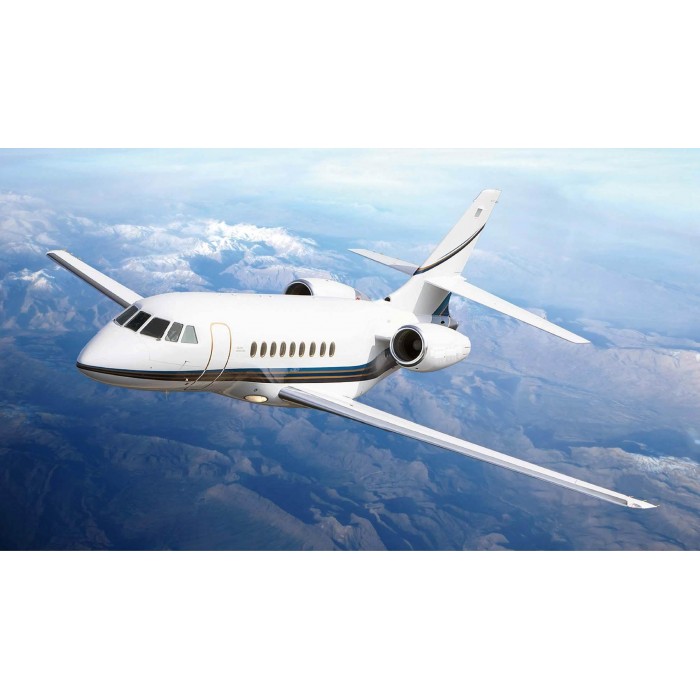
The Dassault Falcon 2000 is a large-cabin twin-engine business jet introduced in 1995, designed as a slightly smaller two-engine version of the three-engine Falcon 900. It inherits the supercritical wing first certified on the Falcon 50 - the aerodynamic foundation of the Dassault Falcon family - which gives the Falcon 2000 its 911 km/h cruise speed and fuel efficiency. Range is 5,778 km (3,120 nm) and maximum certified altitude is 16,556 m (54,300 ft), above the Falcon 7X (15,545 m) and Gulfstream G450 (15,545 m). The aircraft is tracked using the flight code F2TH in private aviation systems.
The 7.98 m cabin is 2.34 m wide - equal to the Falcon 900 and wider than the Gulfstream G550 (2.24 m). Standard layout provides club seating for four, two individual seats and a three-seat sofa. A full-service kitchen, private restroom and dressing room are standard. The luggage compartment holds nearly 4 m³ - one of the most generous in the large-cabin category. Maximum takeoff weight is 16,239 kg. Maximum passengers is 19; optimal charter group is 10. The Falcon 2000 is the entry point to the Dassault Falcon large-cabin family, providing the 2.34 m cabin width at rates below the Falcon 900.

Key performance figures
| Range | 3,120 nm / 5,778 km (transcontinental; London–New York non-stop) |
| Cruise speed | 911 km/h (same class as Falcon 900) |
| Maximum altitude | 16,556 m (54,300 ft) - above Falcon 7X and G450 |
| Maximum takeoff weight | 16,239 kg (35,800 lb) |
| Cabin width | 2.34 m - equal to Falcon 900; wider than G550 (2.24 m) |
| Luggage | ~4 m³ - generous for the large-cabin category |
| Flight code | F2TH |
| Family | Derived from Falcon 900; Falcon 50 supercritical wing |

Airframe dimensions
| Aircraft length | 20.21 m |
| Aircraft height | 7.55 m |
| Wingspan | 19.33 m |
Cabin dimensions and capacity
| Cabin length | 7.98 m |
| Cabin width | 2.34 m (= Falcon 900; wider than G550 2.24 m) |
| Cabin height | 1.88 m (full stand-up throughout) |
| Layout | Club (4) + individual (2) + sofa (3) |
| Optimal passengers | 10 |
| Maximum passengers | 19 |
| Kitchen | Full-service |
| Restroom | Private |
| Dressing room | Standard |
| Luggage | ~4 m³ |


Cabin features
- 7.98 m cabin; 2.34 m wide (= Falcon 900; wider than G550 2.24 m);
- 1.88 m full stand-up height throughout;
- Layout: club seating (4) + individual seats (2) + three-seat sofa;
- Full-service kitchen;
- Private restroom and dressing room;
- ~4 m³ luggage compartment - generous for large-cabin category;
- 911 km/h cruise; 16,556 m (54,300 ft) ceiling;
- Supercritical wing from Falcon 50 lineage via Falcon 900;
- Flight code F2TH in private jet tracking systems.


The Dassault Falcon 2000 is a large-cabin twin-engine business jet introduced in 1995, designed as a slightly smaller two-engine version of the three-engine Falcon 900 and inheriting the supercritical wing first certified on the Falcon 50. That wing - the aerodynamic signature of the entire Dassault Falcon family - gives the Falcon 2000 its 911 km/h cruise speed and the fuel efficiency behind its 5,778 km transcontinental range. The aircraft is known by the tracking code F2TH in private jet flight tracking systems. At 2.34 m cabin width the Falcon 2000 is among the widest in the large-cabin category - equal to the Falcon 900 and Falcon 7X and wider than the Gulfstream G550 (2.24 m).
The 7.98 m cabin seats 10 to 12 passengers in a configuration that includes club seating for four, two individual seats and a three-seat sofa. A full-service kitchen, private restroom and dressing room are standard. The luggage compartment measures nearly 4 m³ - generous for the class and sufficient for the full passenger complement with checked luggage. The Falcon 2000 accommodates up to 19 passengers at maximum load. At 16,556 m maximum altitude it operates above all commercial airline traffic. Charter prices start from approximately £4,200 per flight hour. For the full fleet see our private jet price guide or browse our complete fleet.
Why charter the Falcon 2000?
- 2.34 m cabin width - Falcon 900 standard in a twin-engine platform. This aircraft inherits the 2.34 m cabin width of the Falcon 900 in a smaller, more fuel-efficient two-engine aircraft. At 2.34 m it is wider than the Gulfstream G550 (2.24 m), Legacy 650 (2.08 m) and Challenger 605 (2.49 m - comparable). For groups of 8 to 12 on transcontinental sectors, this width provides genuinely comfortable face-to-face seating that narrower large-cabin jets cannot replicate;
- Club seating for four, two individual seats and a three-seat sofa - specific cabin configuration. The standard Falcon 2000 layout provides three operationally distinct seating areas: a four-place club zone for working meetings, two individual forward-facing seats and a three-seat sofa that can be used for rest on longer sectors. This specific configuration is more functional for mixed corporate and leisure groups than the uniform four-seat-club layouts typical in competing large-cabin jets;
- Full-service kitchen, restroom and dressing room - complete long-haul specification. The Falcon 2000 provides a full-service kitchen (not a galley), a private restroom and a dedicated dressing room. On transcontinental sectors of 5 to 7 hours this specification allows complete pre-arrival preparation. Most competing large-cabin jets provide a galley rather than a full-service kitchen at comparable rates;
- Nearly 4 m³ luggage compartment - more than most competing large-cabin jets. At nearly 4 m³ the Falcon 2000 luggage compartment is among the most generous in the category. For 10 to 12 passengers with checked luggage, sports equipment or business equipment cases, this hold capacity eliminates the compromise typical of large-cabin jets with restricted cargo space;
- 911 km/h cruise - same speed class as the Falcon 900. At 911 km/h the Falcon 2000 is faster than the Challenger 605 (851 km/h), Legacy 650 (870 km/h) and Gulfstream G450 (850 km/h). On a London to Dubai sector the speed advantage over an 851 km/h competitor saves approximately 40 minutes. The supercritical wing from the Falcon 50 lineage enables this cruise speed at twin-engine fuel efficiency;
- 16,556 m maximum altitude - above most competing large-cabin jets. At 16,556 m (54,300 ft) the Falcon 2000 ceiling exceeds the Challenger 605 (12,497 m), Legacy 650 (13,106 m) and Gulfstream G450 (15,545 m). This altitude places it above all commercial airline traffic and virtually all weather systems on its 5,778 km transcontinental range.
Charter cost - Falcon 2000 prices from UK airports
Hourly rates run from approximately £4,200 to £5,200 - in the large-cabin category, above the Challenger 605 and below the Falcon 900. For 8 to 12 passengers on Gulf and transcontinental missions, the Falcon 2000's 2.34 m cabin width, 911 km/h cruise and 4 m³ hold at these rates represent strong value.
Indicative one-way prices from UK airports:
- London to New York - from £36,000 (10 passengers, non-stop, approximately 7 hours 30 minutes);
- London to Dubai - from £30,000 (10 passengers, non-stop, approximately 6 hours 20 minutes);
- London to Geneva - from £10,000 (10 passengers, approximately 1 hour 20 minutes);
- London to Riyadh - from £26,000 (10 passengers, non-stop, approximately 5 hours 45 minutes);
- London to Athens - from £18,000 (10 passengers, approximately 3 hours 20 minutes);
- London to Lagos - from £32,000 (10 passengers, non-stop, approximately 6 hours 30 minutes);
- Edinburgh to Istanbul - from £20,000 (10 passengers, approximately 3 hours 30 minutes).
Empty Leg flights appear on repositioning routes. See our Empty Legs page for current availability.
Ideal routes for the Falcon 2000
The Falcon 2000 is best matched to transcontinental and Gulf missions where 2.34 m cabin width, 911 km/h speed and the specific club-plus-sofa cabin configuration are the selection criteria for groups of 8 to 12:
- UK to Gulf non-stop (5.5 to 6.5 hours). Dubai, Riyadh, Abu Dhabi and Doha are all within non-stop range. At 911 km/h the Falcon 2000 covers Gulf sectors approximately 40 minutes faster than an 851 km/h competitor. For 8 to 12 passengers, the three-area cabin configuration allows separate working and resting zones throughout the sector;
- Transatlantic non-stop (7 to 8 hours). London to New York is within range. The 5,778 km capability handles the transatlantic sector at large-cabin rates. The dressing room enables pre-arrival preparation directly relevant on New York morning arrival;
- UK to Mediterranean and Near East (2 to 4 hours). Athens, Istanbul, Cairo, Beirut and Tunis are all comfortably within range. For groups of 10 to 12 on Mediterranean missions where midsize jets are insufficient and large-cabin rates are acceptable, the Falcon 2000 provides the widest cabin in the large-cabin entry category;
- Groups with substantial luggage or equipment. The nearly 4 m³ hold handles 10 to 12 passengers' checked luggage plus sports equipment or business cases without cabin compromise. For golf groups, leisure travel with sports equipment and corporate groups with presentation materials, the Falcon 2000 hold capacity is a specific advantage over competitors with smaller holds;
- Clients who want Dassault Falcon quality at large-cabin entry rates. The Falcon 2000 is positioned as the entry point to the Dassault Falcon large-cabin family - the same 2.34 m cabin, the same supercritical wing lineage from the Falcon 50, the same Dassault engineering standard - at rates below the Falcon 900. For clients who have flown Falcon 900 or Falcon 7X and want the Dassault standard at lower cost on shorter-range missions, the Falcon 2000 is the appropriate choice.
Cabin and in-flight experience
The Falcon 2000 cabin measures 7.98 m long, 2.34 m wide and 1.88 m high - full stand-up headroom throughout. The standard layout provides club seating for four, two individual seats and a three-seat sofa. A full-service kitchen, private restroom and dressing room serve the full passenger group. The luggage compartment of nearly 4 m³ is accessible and one of the most generous in the large-cabin category.
At 911 km/h cruise and 16,556 m maximum altitude the Falcon 2000 operates in the upper performance band of the large-cabin category. The supercritical wing - inherited from the Falcon 50 via the Falcon 900 - provides the aerodynamic efficiency behind both the speed and the 5,778 km range. Passengers can be tracked using the flight code F2TH in private aviation tracking systems.
- Cabin. 7.98 m × 2.34 m × 1.88 m - full stand-up throughout;
- Layout. Club (4) + individual (2) + sofa (3);
- Kitchen. Full-service;
- Restroom. Private;
- Dressing room. Standard;
- Luggage. ~4 m³ - generous for the large-cabin category;
- Speed. 911 km/h - same class as Falcon 900;
- Altitude. 16,556 m (54,300 ft) - above Falcon 7X and G450;
- Flight code. F2TH (used in private jet tracking systems).
Technical specifications
| Manufacturer | Dassault Aviation, France |
| Introduced | 1995 |
| Family | Derived from Falcon 900; inherits Falcon 50 supercritical wing |
| Flight code | F2TH |
| Aircraft class | Large-cabin twin-engine business jet |
| Maximum passengers | 19 |
| Optimal passengers | 10 |
| Range | 3,120 nm / 5,778 km |
| Cruise speed | 911 km/h |
| Maximum altitude | 16,556 m (54,300 ft) |
| Maximum takeoff weight | 16,239 kg (35,800 lb) |
| Cabin layout | Club (4) + individual (2) + sofa (3) |
| Kitchen | Full-service |
| Dressing room | Standard |
| Luggage | ~4 m³ |
| Cabin length | 7.98 m |
| Cabin width | 2.34 m (= Falcon 900; wider than G550 at 2.24 m) |
| Cabin height | 1.88 m (full stand-up) |
| Wingspan | 19.33 m |
| Aircraft length | 20.21 m |
| Aircraft height | 7.55 m |
Falcon 2000 vs similar aircraft
- Falcon 2000 vs Challenger 605. The Challenger 605 is wider (2.49 m vs 2.34 m) (2.49 m vs 2.34 m), more range (6,852 km vs 5,778 km) and lower cruise speed (851 km/h vs 911 km/h). Charter rates are broadly comparable. The Falcon 2000 counters with 60 km/h higher cruise speed, a 16,556 m ceiling versus the Challenger 605's 12,497 m and the full-service kitchen plus dressing room. For missions requiring Challenger 605's extra range, that aircraft is preferable. For clients prioritising speed, ceiling and cabin specification, the Falcon 2000 is the stronger choice;
- Falcon 2000 vs Falcon 900. The Falcon 900 has greater range (8,334 km vs 5,778 km), a larger cabin (10.11 m vs 7.98 m), three engines and a higher practical ceiling (17,000 m vs 16,556 m). Charter rates for the Falcon 900 run approximately 30 to 40% higher. For missions within this range where the 7.98 m cabin is sufficient, it provides the same 2.34 m width and Dassault engineering at significantly lower rates. The Falcon 900 is necessary only when range or cabin length require it;
- Falcon 2000 vs Gulfstream G450. The G450 has comparable range (7,408 km vs 5,778 km - G450 has more), 12 passengers in VIP layout and the Gulfstream engineering standard. Charter rates are broadly comparable. The Falcon 2000 counters with a wider cabin (2.34 m vs 2.24 m for the G450), higher ceiling (16,556 m vs 15,545 m) and the specific club-plus-sofa layout versus the G450's three-zone configuration. For clients who prefer the Falcon 2000's layout and Dassault standard, it is competitive at similar rates.
Frequently asked questions - Falcon 2000 charter
How much does it cost to charter a Dassault Falcon 2000?
Charter rates run from approximately £4,200 to £5,200 per flight hour. London to New York non-stop costs from £36,000 for 10 passengers. London to Dubai costs from £30,000. London to Geneva costs from £10,000. All quotes from Private Jets UK are fully itemised with no hidden charges.
What is the Falcon 2000 cabin layout?
The standard layout offers club seating for four, two individual seats and a three-seat sofa. The three-area arrangement provides separate zones for meetings, individual work and rest within the 7.98 m, 2.34 m-wide cabin. A full-service kitchen, private restroom and dressing room complete the specification.
How is the Falcon 2000 related to the Falcon 900?
It was specifically designed as a slightly smaller, twin-engine version of the three-engine Falcon 900. It shares the 2.34 m cabin width, the supercritical wing lineage from the Falcon 50 and the Dassault engineering standard. The primary differences are two engines versus three, a shorter cabin (7.98 m vs 10.11 m) and less range (5,778 km vs 8,334 km).
What is the F2TH flight code?
F2TH is the type code used in private jet flight tracking systems. When tracking a Falcon 2000 charter on FlightAware, FlightRadar24 or similar services, the aircraft appears under the F2TH designation. This is the same convention used across the Falcon family: F900 for the Falcon 900, F7X for the Falcon 7X and so on.
How many passengers can fly on a Falcon 2000?
Up to 19. The standard configuration accommodates 10 to 12 passengers in the club-plus-sofa layout. The optimal charter group for most missions is 8 to 10 passengers, providing comfortable use of all three cabin areas with full luggage allocation.