


Charter a Learjet 55
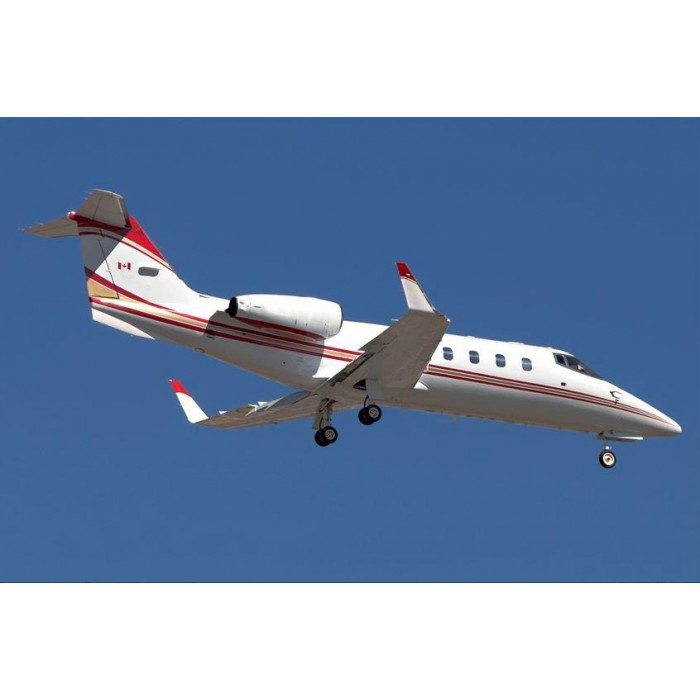


- Availability: Available for rent
Request aircraft information
The Learjet 55 "Longhorn" is the aircraft that transformed Learjet - the first Learjet with a stand-up cabin, the widest Learjet cabin of its era, and the design that established the Longhorn identity that later underpinned the Learjet 31 and 45 series. The Learjet 50 series was announced at the 1977 Paris Air Show as a departure from the cramped cabins of the 20 and 30 series; the prototype first flew on 19 April 1979; FAA certification was granted in 1981; and deliveries began in March 1981. The "Longhorn" nickname came from the NASA-developed winglets - the first winglets on a production Learjet - which extended the wing profile visually like longhorn cattle horns. The same Longhorn wing was later adopted on the Learjet 28, 29 and 31. Approximately 147 aircraft were built across all variants before production ended in 1993. Three main variants were produced: the original 55 (1981-1986), the 55B (from 1986, with digital EFIS cockpit and higher MTOW) and the 55C (from 1987, with Delta Fins for stability and improved runway performance), plus the extended-range 55C/ER and long-range 55C/LR sub-variants.
Two Honeywell (Garrett) TFE731-3A-2B turbofan engines at 3,700 lbf each power the Learjet 55 - 200 lbf more per engine than the TFE731-2 family used in the Learjet 31 and 35 series. The cabin measures 5.09 m long, 1.80 m (5 ft 11 in) wide and 1.74-1.77 m (5 ft 8 in) high - genuine stand-up headroom throughout. The 1.80 m cabin width was the widest in the Learjet family when introduced and remains wider than the Learjet 45XR and 40XR. Air Charter Service confirmed the landing distance with four passengers is just 2,800 ft - exceptional short-field performance. Charter prices start from approximately £1,800 per flight hour. For the full fleet see our private jet price guide or browse our complete fleet.

Why charter the Learjet 55?
- First Learjet with a stand-up cabin - 1.77 m (5 ft 8 in) height throughout; the defining upgrade over the entire 25/31/35 series. The Learjet 55 was the first Learjet in which a passenger could stand upright throughout the cabin. The 1.77 m cabin height is genuine stand-up headroom - compared to the Learjet 35A's 1.31 m and the Learjet 31A's 1.32 m, both of which require seated positions throughout. Air Charter Advisors confirmed the Learjet 55 provides "a comfortable standup cabin (5 ft 7 in)." FlyEliteJets confirmed the height "provid[es] genuine stand-up room for exceptional freedom of movement." This single dimensional change transformed the in-flight experience for groups of 6 to 8 on sectors of 2 to 4 hours - the Learjet 55 operates in the midsize cabin category that its 35A and 31A predecessors could not approach on cabin comfort;
- 1.80 m (5 ft 11 in) cabin width - widest in the Learjet family when introduced; wider than Learjet 45XR (1.55 m) and 40XR (1.55 m). The Learjet 55's 1.80 m cabin width is paradoxically wider than the later Learjet 45XR and 40XR despite the 45/40 series being a more recent clean-sheet design. Grokipedia confirmed the 55 incorporated "the widest cabin in the Learjet lineup at the time" when introduced in 1981. The wider cabin provides more elbow room in the club seating layout and enables a more spacious divan configuration than the later narrower Learjet 45 platform. For groups who specifically value cabin width in the midsize category, the Learjet 55 is the widest Learjet available in charter;
- NASA-developed Longhorn winglets - the innovation behind the nickname; first production Learjet with winglets; wing from Learjet 25 series. Business Air News confirmed the Learjet 55 was "a low wing cantilever monoplane with winglets developed by NASA." These winglets - the first on any production Learjet - provided drag reduction and better high-altitude performance. The winglets gave the Learjet 55 its "Longhorn" nickname: the extended tip devices resembled longhorn cattle horns. The same Longhorn wing design was subsequently adopted on the Learjet 28, 29 and 31, with the 31's Delta Fins complementing the Longhorn wing from the 55. Wikipedia confirmed the wing design drew on the Learjet 25 series with the NASA winglet modification, creating the performance basis for later Learjet designs;
- TFE731-3A-2B at 3,700 lbf - 200 lbf more per engine than Learjet 31/35/40/45 series; 470 kt maximum speed; 51,000 ft ceiling. The TFE731-3A-2B engines on the Learjet 55 produce 3,700 lbf each - 200 lbf above the 3,500 lbf -2 and -20 series engines used in the Learjet 31A, 35A, 40XR and 45XR. Grokipedia confirmed a maximum speed of 470 kt (541 mph) and range of 2,040 nm with four passengers. The 51,000 ft service ceiling matches the Learjet 31A, 40XR and 45XR at the top of the Learjet performance ceiling. Air Charter Advisors confirmed a "non-stop range of more than 2,000 nautical miles." The higher-thrust TFE731-3A-2B provides a marginally higher maximum speed than the -20BR-powered 45XR (465 kt) at comparable range;
- 55C Delta Fins - docile low-speed handling and shorter runway requirements; same innovation later adopted on Learjet 31. The Learjet 55C (from 1987) introduced Delta Fins to the lower rear fuselage - the same aerodynamic device later central to the Learjet 31's marketing. Air Charter Advisors confirmed the 55C "featured delta fins to reduce landing speed and increase stability." Air Charter Service confirmed a landing distance of just 2,800 ft with four passengers - exceptional for a midsize jet of the 55's capability. The Delta Fins eliminated the need for the stick pusher that earlier Learjets required for stall certification and improved directional stability at all speeds. For 55C charter specifically, this provides better handling margins at short European airfields;
- ~147 aircraft built; active medevac and European charter fleet; $595K-$995K pre-owned; lowest acquisition-cost midsize stand-up Learjet. Air Charter Service confirmed "nearly 150 jets were delivered." Business Air News confirmed 147 aircraft. The fleet is operated today by European charter operators (Quick-Air Jet Charter, Jet Executive International Charter in Germany), medevac services and specialist charter firms. Air Charter Advisors noted "most of them have been completely refurbished with new plush interiors and beautiful paint jobs." Pre-owned values of $595,000 to $995,000 make the Learjet 55 the lowest-acquisition-cost midsize stand-up Learjet available, providing a significant cost advantage at comparable cabin volume versus newer midsize designs.
Charter cost - Learjet 55 prices from UK airports
Hourly rates run from approximately £1,800 to £2,400 - in the midsize category, below the Learjet 45XR (smaller cabin, 8 seats) and broadly comparable to the Hawker 800XP, reflecting the 55's wider cabin (1.80 m vs 45XR's 1.55 m), genuine stand-up headroom and midsize positioning at a vintage aircraft rate. For 5 to 8 passengers on short and medium European missions where stand-up headroom and the widest Learjet cabin are priorities, the Learjet 55 provides a cabin advantage over the entire 40/45 series at comparable or lower rates.
Indicative one-way prices from UK airports:
- London to Edinburgh - from £2,160 (7 passengers, approximately 50 minutes);
- London to Paris - from £2,160 (7 passengers, approximately 50 minutes);
- London to Geneva - from £2,880 (7 passengers, approximately 1 hour 10 minutes);
- London to Nice - from £3,960 (7 passengers, approximately 1 hour 35 minutes);
- London to Milan - from £3,600 (7 passengers, approximately 1 hour 35 minutes);
- Edinburgh to Istanbul - from £9,000 (7 passengers, non-stop, approximately 3 hours 30 minutes);
- London to Dublin - from £2,160 (7 passengers, approximately 55 minutes).
Empty Leg flights appear on repositioning routes. See our Empty Legs page for current availability.

Ideal routes for the Learjet 55
Best matched to short and medium European missions where the stand-up 1.80 m wide cabin, 470 kt speed and 2,040+ nm range serve groups of 5 to 8 at midsize rates:
- European sectors (1 to 4 hours) where stand-up headroom is the defining cabin requirement. For charter clients who have experienced the Learjet 31A or 35A and want the upgrade to stand-up headroom, the Learjet 55 is the Learjet-family choice. At 1.77 m, passengers can stand throughout the 5.09 m cabin length. The club-four seating with divan and enclosed lavatory is the complete midsize cabin package. Paris, Geneva, Nice, Milan and Istanbul are all within 50 minutes to 3.5 hours at 470 kt;
- Groups of 7 or 8 where the 1.80 m cabin width provides more elbow room than any Learjet 40/45 series aircraft. The Learjet 55's 1.80 m width is 0.25 m wider than the Learjet 45XR's 1.55 m - a difference that is immediately perceptible in the club seating arrangement. For groups of 7 or 8 on 2 to 3-hour European sectors, the Learjet 55's cabin width advantage over the 45 series is the selection argument at comparable or lower charter rates;
- London to Athens, Marrakech and long-haul European sectors within 2,040-2,125 nm range. FlyEliteJets confirmed "London to Athens or New York to Aspen" as representative Learjet 55 missions. London to Athens (approximately 1,500 nm), Edinburgh to Marrakech (approximately 1,600 nm) and London to Istanbul (approximately 1,550 nm) are all achievable. The 55C/ER and 55C/LR variants with additional tail cone fuel tank extend range further for the most demanding European sectors;
- Short-field access missions where the 55C's 2,800 ft landing distance opens regional UK and European airfields. Air Charter Service confirmed the Learjet 55's landing distance of 2,800 ft with four passengers - exceptional for the midsize cabin category. This short-field landing performance enables direct access to UK regional airfields and European strips that larger midsize jets cannot use. For charter clients who want midsize cabin comfort from a short-runway regional departure point, the Learjet 55 combines both capabilities;
- Value-focused midsize missions where the Learjet 55's pre-owned economics provide midsize performance at lower rates. Air Charter Advisors documented pre-owned values of $595,000 to $995,000 - well below new-generation midsize jets. These low acquisition costs allow operators to offer the Learjet 55 at charter rates below most comparable stand-up midsize alternatives. For clients who want midsize cabin comfort without midsize jet rates, the Learjet 55 provides the most economical access to a stand-up midsize Learjet cabin.

Cabin and in-flight experience
The Learjet 55 cabin measures 5.09 m (16.7 ft) long, 1.80 m (5 ft 11 in) wide and 1.74-1.77 m (5 ft 8 in) high - genuine stand-up headroom throughout. The standard configuration seats seven to eight passengers in a club-four arrangement or club-four plus divan, with a fully enclosed belted lavatory (usable as an additional seat). Air Charter Service confirmed "the cabin of a Bombardier Learjet 55 is usually configured for seven or eight passengers, but can be arranged to seat 10 people in a high-density layout." The hold accommodates approximately six suitcases. FlyEliteJets described "a forward-facing club-four arrangement perfect for executive meetings or family conversations" plus the option of a "comfortable side-facing divan."
Avionics on the 55B and 55C include a multi-tube EFIS digital cockpit replacing the original 55's analogue instruments. The 55C cockpit carries King 90A GPS, dual Collins VHF20A communications, dual Collins TDR90 transponders, Collins colour weather radar, Global FMS GNS/XLS, DME40 and TCAS. Two TFE731-3A-2B engines at 3,700 lbf each; landing distance 2,800 ft with four passengers (55C with Delta Fins); 51,000 ft ceiling.
- Cabin. 5.09 m x 1.80 m x 1.77 m; stand-up throughout; widest in the Learjet family;
- Layout. Club-4 or club-4 + divan; 7-8 standard; 10 maximum; enclosed belted lavatory;
- Avionics (55B/55C). Multi-tube EFIS; Collins weather radar; Global FMS; TCAS; King GPS;
- Engines. 2 x Honeywell TFE731-3A-2B (3,700 lbf each; 200 lbf more than 31/35/40/45 series);
- 55C Delta Fins. Improved stall; shorter runway; no stick pusher needed;
- Landing (55C). 2,800 ft with 4 passengers - exceptional for the midsize category.
Technical specifications
| Manufacturer | Learjet Inc. / Bombardier Learjet, Wichita, Kansas |
| Announced | 1977 Paris Air Show |
| First flight | 19 April 1979 |
| FAA certification | 1981 |
| Service entry | March 1981 |
| Production | 1981-1993; approximately 147 aircraft built |
| Variants | 55 (1981); 55B (1986; EFIS, higher MTOW); 55C (1987; Delta Fins); 55C/ER; 55C/LR |
| Aircraft class | Midsize business jet |
| Nickname | Longhorn (from NASA-developed winglets) |
| Engines | 2 x Honeywell TFE731-3A-2B (3,700 lbf each; 200 lbf above 40/45 series) |
| Max speed | 470 kt (541 mph) |
| Cruise speed | Mach 0.81 / 456-465 kt |
| Range (NBAA IFR 4 pax) | 2,040 nm / 3,778 km |
| Service ceiling | 51,000 ft / 15,545 m |
| Landing distance | 2,800 ft (55C; 4 passengers) |
| MTOW (55) | 21,000 lb / 9,525 kg |
| MTOW (55B/55C) | 21,500 lb / 9,752 kg |
| Cabin length | 5.09 m (16 ft 7 in) |
| Cabin width | 1.80 m (5 ft 11 in) - widest Learjet cabin |
| Cabin height | 1.74-1.77 m (5 ft 8 in) - genuine stand-up |
| Passengers | 7-8 standard; 10 maximum |
| Wingspan | 13.36 m (43 ft 10 in) |
| Aircraft length | 16.80 m (55 ft 1 in) |
| Aircraft height | 4.47-4.48 m (14 ft 8 in) |

Learjet 55 vs similar aircraft
- Learjet 55 vs Learjet 45XR. The Learjet 45XR is newer (2004-2012 vs 1981-1993), has modern Primus 1000 avionics, APU standard and a 410 ft³ cabin. The Learjet 55 counters with a 1.80 m cabin width (vs 45XR's 1.55 m - 16% wider), genuine 1.77 m stand-up height (same as 45XR's 1.50 m - actually taller), 3,700 lbf engines (vs 3,500 lbf), and lower charter rates reflecting its age. Charter rates for the 45XR run approximately 20 to 30% above the 55. For groups where the wider cabin and lower rates are the priorities, the Learjet 55 is the choice; for groups who need modern avionics, APU and the larger 410 ft³ volume, the 45XR is preferable;
- Learjet 55 vs Hawker 800XP. The Hawker 800XP is the natural midsize competitor - wider cabin (1.83 m vs 55's 1.80 m), longer cabin (5.59 m vs 5.09 m), Collins Pro Line 21 avionics and 2,540 nm range (vs 55's 2,040 nm). Charter rates are broadly comparable. The Learjet 55 counters with higher cruise speed (470 kt vs 800XP's 447 kt), the 51,000 ft ceiling (vs 800XP's 41,000 ft) and lower pre-owned acquisition cost. For clients where speed and ceiling matter on European missions, the Learjet 55 has the advantage; for longer range and a larger cabin the 800XP is preferable;
- Learjet 55 vs Learjet 35A. The Learjet 35A is the immediate predecessor in the Learjet family - 1.31 m cabin height (no stand-up), 1.49 m width (vs 55's 1.80 m) and lower charter rates (20 to 30% below the 55). The Learjet 55 provides the stand-up cabin, wider interior and enclosed lavatory that the 35A lacks. For any sector over 90 minutes where standing and moving around the cabin during flight is desired, the Learjet 55 is the appropriate choice over the 35A.

Frequently asked questions - Learjet 55 charter
How much does it cost to charter a Learjet 55?
Charter rates run from approximately £1,800 to £2,400 per flight hour. London to Edinburgh costs from £2,160 for 7 passengers. London to Geneva costs from £2,880. Edinburgh to Istanbul costs from £9,000 non-stop. All quotes from Private Jets UK are fully itemised with no hidden charges.
Why is the Learjet 55 called the "Longhorn"?
The Learjet 55 was nicknamed "Longhorn" because of its NASA-developed winglets - the first winglets fitted to any production Learjet. Business Air News confirmed the aircraft was "a low wing cantilever monoplane with winglets developed by NASA." The extended winglet tips resembled longhorn cattle horns. The Longhorn wing design was subsequently used on the Learjet 28, 29 and 31 models.
What is the difference between the Learjet 55, 55B and 55C?
The original Learjet 55 (1981-1986) had analogue cockpit instruments. The 55B (from 1986) introduced a multi-tube EFIS digital cockpit, improved range, modified wings and higher standard MTOW. The 55C (from 1987) added Delta Fins on the lower rear fuselage, providing improved stall characteristics, better directional stability and shorter landing distance. The 55C/ER added an extended-range fuel tank in the tail cone; the 55C/LR introduced further fuel capacity for maximum range missions.
Does the Learjet 55 have a stand-up cabin?
Yes - the Learjet 55 was the first Learjet with a stand-up cabin, at 1.74-1.77 m (5 ft 8 in) height throughout. FlyEliteJets confirmed it "provid[es] genuine stand-up room for exceptional freedom of movement." This distinguishes it from the Learjet 31A (1.32 m) and Learjet 35A (1.31 m), neither of which allows standing during flight.
How does the Learjet 55 cabin compare to the Learjet 45XR?
The Learjet 55 is notably wider: 1.80 m vs the 45XR's 1.55 m (16% wider). The height is similar: 1.77 m vs 45XR's 1.50 m (slightly taller in the 55). The 55's cabin is shorter (5.09 m vs 6.02 m) and total volume is smaller. The 55 is older and lacks the 45XR's APU, modern avionics and Dee Howard thrust reversers. However, the 55 is wider, taller and cheaper per hour. For groups where elbow room is the priority, the Learjet 55 is the wider Learjet option.

