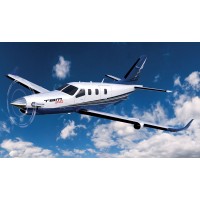


Daher private jet charter
Daher is a French industrial group whose aircraft division builds two turboprops with almost nothing in common. The TBM 960, assembled at Tarbes in south-west France, cruises at 330 knots and is the fastest single-engine turboprop ever certified. The Kodiak, built at Sandpoint in Idaho, is unpressurised, gets airborne in 1,015 feet and carries freight through a cargo door. One is built for speed, the other for access, and both are propeller aircraft rather than jets.
Daher delivered 76 aircraft in 2025: 51 TBM 960s and 25 Kodiaks. By 31 December 2025 the company had delivered 1,294 TBMs since the family entered service in 1990 and 390 Kodiaks, with roughly three million flight hours accumulated across the global fleet. Charter availability in the United Kingdom is genuinely limited, for reasons set out further down this page, and worth understanding before you enquire.
For a quote, contact us via WhatsApp on +44 204 577-31-19 or by email at flight@private-jets.co.uk
330 knots: the number that defines the TBM
Daher publishes a maximum cruise speed of 330 KTAS at 28,000 feet for the TBM 960. No other single-engine turboprop in production matches it. That figure matters because it puts a propeller aircraft into speed territory normally occupied by jets, and on shorter sectors that changes the calculation.
| Aircraft | Type | Max cruise | Ceiling |
| Daher TBM 960 | Single turboprop | 330 kt | 31,000 ft |
| Pilatus PC-12 PRO | Single turboprop | 290 kt | 30,000 ft |
| Beechcraft King Air 360 | Twin turboprop | 303 kt | 35,000 ft |
| Cessna Citation Mustang | Very light jet | 340 kt | 41,000 ft |
| Embraer Phenom 300E | Light jet | 464 kt | 45,000 ft |
Reaching that speed took a specific engineering answer. This aircraft uses the Pratt and Whitney Canada PT6E-66XT producing 895 shaft horsepower, turning a five-blade Hartzell Raptor composite propeller. It was among the first FADEC-controlled PT6 installations in service, managed by a dual-channel Engine and Propeller Electronic Control System that Daher calls EPECS. In practice the pilot moves one lever and the system protects every engine limit behind it.
Climb to 31,000 feet takes 18 minutes 45 seconds. Takeoff distance over a 50-foot obstacle is 2,535 feet and landing distance 2,430 feet, which is short-field performance a light jet cannot match. Range is 1,730 nautical miles at long-range cruise with NBAA reserves. At Daher's recommended economy setting the aircraft holds 308 knots on roughly 57 US gallons per hour, a fuel figure no jet in any category approaches.

Where a TBM beats a light jet, and where it does not
Speed comparisons on a specification sheet mislead, because a jet spends the first portion of any flight climbing to an altitude where its speed advantage exists. On short sectors it never fully gets there. An honest breakdown:
- Under 300 nautical miles. London to Manchester, Edinburgh to Aberdeen, London to Paris. A TBM 960 is competitive on block time with a very light jet and close behind a light jet, at roughly half to two thirds of the hourly rate. This is the bracket where the aircraft was designed to win;
- 300 to 700 nautical miles. London to Geneva, London to Dublin, Edinburgh to Jersey. A light jet pulls ahead, typically by 20 to 40 minutes. Whether that matters depends on whether the schedule is tight and how many passengers are travelling;
- Beyond 700 nautical miles. The jet wins decisively. On a London to Nice sector a Phenom 300E arrives roughly an hour before a TBM. Its 1,730 nm range makes the trip possible; it does not make it sensible;
- Any sector above four passengers. It seats four to six, and six is tight with luggage. Beyond four passengers plus bags, a PC-12 or King Air is the better tool.
Altitude is the other consideration. The aircraft cruises at up to 31,000 feet against 41,000 to 45,000 feet for a jet. Over northern Europe in winter that difference means more time in weather rather than above it. Pressurisation and de-icing are both fitted, so this is a comfort question rather than a safety one, but it is real.
Where it genuinely wins on capability rather than economics is field performance. At 2,535 feet of takeoff distance it uses regional and private airfields that a light jet cannot, while still cruising at 330 knots once airborne.
TBM generations: what changed and when
Charter operators describe their aircraft simply as a TBM, and the differences between generations are substantial. Lineage runs from Socata, which traces to Morane-Saulnier, founded in 1911 by Leon and Robert Morane with Raymond Saulnier. Daher acquired the business and the Socata name was retired in favour of Daher alone.
700 and 850 (1990 to 2013)
A TBM 700 entered service in 1990 with a Pratt and Whitney Canada PT6A-64 producing 700 shaft horsepower, which is where the designation came from. The 850 followed in 2006 with the PT6A-66D at 850 shp. Both are long out of production. A handful remain in charter use at the lowest Daher rates, with older analogue-era cockpits and 1990s cabin standards.
900, 910 and 930 (2014 to 2022)
A significant aerodynamic revision in 2014 brought winglets, a five-blade propeller and a redesigned engine air inlet, lifting cruise to 330 knots for the first time. Models 910 and 930 split the line in 2017 into a Garmin G1000 NXi version and a Garmin G3000 touchscreen version. More than 600 aircraft in the 900 series had been delivered by 2025, making it the most numerous TBM generation.
940 (2019 to 2022)
Introduced autothrottle and the HomeSafe emergency autoland system, Daher's implementation of Garmin Emergency Autoland. Activated by a single button, or automatically if the system detects pilot incapacitation, it selects a suitable runway, flies the approach and lands the aircraft. Worth correcting a claim that circulates widely: the 900 did not have Autoland. That capability arrived with the 940 generation.
960 (2022 onwards)
Current production aircraft, and the one most likely to appear on a modern charter quote. PT6E-66XT with EPECS dual-channel digital control, Garmin G3000 flight deck with the GTC 580 touchscreen controller, and the GWX 8000 Doppler weather radar with automatic threat analysis, lightning and hail prediction and turbulence detection. The e-copilot suite adds icing protection and flight envelope monitoring alongside HomeSafe. A Prestige cabin brought the new interior standard. More than 200 had been delivered by the end of 2025.
The other Daher: Kodiak 100 and Kodiak 900
Kodiak came from a different company entirely. Quest Aircraft developed it in Idaho with missionary and humanitarian operators in mind, and Daher acquired the programme in 2019. It shares no design DNA with the TBM and answers the opposite question: not how fast, but where.
Kodiak 100, in service since 2008 and now in Series III, is a 750 shp PT6A-34 utility aircraft on fixed gear with a large cargo door. It is unpressurised, seats up to ten and is built to work from gravel, grass and float installations. Our Quest Kodiak 100 charter page covers the type in detail.
Kodiak 900, unveiled in 2022, is the stretched and faster development. A PT6A-140A and a five-blade Hartzell composite propeller give it more power and notably lower noise, which matters at noise-restricted airfields. It gets off the ground in 1,015 feet while clearing a 50-foot obstacle at its 8,000 lb maximum takeoff weight, climbs at 1,724 feet per minute and reaches a certified ceiling of 25,000 feet. It remains unpressurised, with built-in oxygen.
Both Kodiaks are chosen for mission work more often than for passenger charter. Daher reported that around 30 per cent of 2025 Kodiak deliveries went to multi-mission roles, with aircraft going to the Virginia State Police, New York State Police, San Jose Police Department, the Maricopa County Sheriff's Office and the Montana Department of Natural Resources for firefighting support.

A word on availability before you enquire
Most brand pages imply an unlimited fleet. On Daher aircraft that would be misleading, and it is better to say so plainly.
These are predominantly owner-flown aircraft. A TBM is designed around single-pilot operation and the majority are bought by individuals who fly them personally rather than by charter operators. Of the 51 TBM 960s delivered in 2025, Europe accounted for 23 per cent, or 12 aircraft. Across the whole of Europe, that is a very small annual addition to any potential charter pool.
What this means practically:
- Lead time. Allow longer than the 48 to 72 hours that a King Air or Citation booking typically needs. A week is more realistic for a specific TBM;
- Aircraft substitution. An operator quoting a TBM may propose a Pilatus PC-12 or a King Air if the specific airframe becomes unavailable. Establish at the outset whether the aircraft type or the mission capability is what matters to you;
- Generation matters. A quote for a TBM may mean a 2007 TBM 850 or a 2024 TBM 960. Differences in cabin, avionics and noise are considerable. Ask which;
- Kodiaks are rarer still. UK passenger charter availability is very limited and most airframes are in utility or mission work.
If a TBM is not available for your dates, the closest alternatives on capability are the Pilatus PC-12, which trades 40 knots of speed for a larger cabin and unpaved runway approval, and the Beechcraft King Air, which adds a second engine and more seats at a lower rate.
Rates and what drives them
Indicative hourly rates in GBP for UK departures. Daher aircraft price above twin turboprops of similar size because they are newer, in demand and scarce on charter certificates.
| Aircraft | Seats | Cruise | Range | Notes | From |
| 850 | 4-5 | 320 kt | ~1,500 nm | Out of production; oldest on charter | £1,600/hr |
| 900 / 910 / 930 | 4-6 | 330 kt | ~1,700 nm | Most common generation | £1,800/hr |
| 940 | 4-6 | 330 kt | ~1,730 nm | Autothrottle; HomeSafe autoland | £1,900/hr |
| 960 | 4-6 | 330 kt | 1,730 nm | Current model; G3000; limited availability | £2,000/hr |
| Kodiak 100 | Up to 10 | 174 kt | ~1,100 nm | Unpressurised; cargo door; scarce on charter | £1,200/hr |
| Kodiak 900 | Up to 10 | 210 kt | ~1,100 nm | Unpressurised; 1,015 ft takeoff; very scarce | £1,400/hr |
Three things move these figures. Generation is the largest single factor, with a 960 commanding roughly 25 per cent more than an 850. Positioning matters more than usual because the UK fleet is thin and the aircraft may need to fly in empty. And on Kodiaks, whether the operator holds a passenger charter approval at all rather than a utility one.
Repositioning flights on empty legs reduce these rates by 25 to 75 per cent. For the wider market see the private jet price guide or browse the complete fleet.
Missions these aircraft suit
Rather than a route list, the useful framing for Daher is mission type, because these aircraft are specialists rather than generalists.
- Two to four people, short sector, tight schedule. London to Manchester in a TBM 960 takes roughly 50 minutes and costs from around £2,000. A light jet saves perhaps five minutes and costs half as much again. This is the TBM's strongest case;
- Regional airfield to regional airfield. A 2,535 ft takeoff requirement opens runways that light jets cannot use, while the cruise speed keeps the sector time down. Oxford, Gloucestershire, Cambridge, Wycombe and comparable European fields;
- Day return where the aircraft waits. Lower fuel burn and lower daily minimums make a TBM cheaper than a jet on a trip where the aircraft sits on the ground for six hours;
- Cross-Channel and Irish Sea sectors. London to Paris in approximately 1 hour 15 minutes, London to Dublin in roughly 1 hour 30 minutes, from around £2,600 and £3,000 respectively;
- Alpine and Highland fields in summer. The TBM's short-field performance suits fields where a jet is marginal, though for unpaved surfaces a PC-24 or PC-12 holds certification the TBM does not;
- Outsize or awkward loads with few passengers. This is Kodiak territory rather than TBM, subject to finding an operator with passenger approval.
Frequently asked questions
Is the Daher TBM a private jet?
No. The TBM is a single-engine turboprop, driven by a five-blade propeller rather than turbofan thrust. It is pressurised, single-pilot certified and seats four to six passengers. At 330 knots it is the fastest single-engine turboprop ever certified and is quicker than a Citation Mustang on many short sectors once climb time is included, but it is not a jet. Daher does not build jets at all; the Kodiak is also a turboprop.
How fast is the TBM 960 really?
Daher publishes 330 KTAS maximum cruise at 28,000 feet. Owners typically report 315 to 325 knots in normal cruise between 24,000 and 26,000 feet, and Daher's recommended economy setting gives 308 knots on roughly 57 US gallons per hour. Climb to the 31,000 ft certified ceiling takes 18 minutes 45 seconds.
Does the TBM have an emergency autoland system?
The 940 and 960 do. HomeSafe, Daher's implementation of Garmin Emergency Autoland, will select a runway, fly the approach and land the aircraft if the pilot becomes incapacitated, activated by one button or automatically. The 900 does not have it, despite the claim appearing on several charter and directory sites. If autoland matters to you, specify a 940 or 960 at the enquiry stage.
How much does it cost to charter a Daher TBM?
From approximately £1,600 per flight hour for an older TBM 850 and from approximately £2,000 for a current TBM 960. London to Paris costs from around £2,600 and London to Dublin from around £3,000. Rates sit above a King Air of comparable size because the aircraft are newer, faster and scarce on UK charter certificates.
What is the difference between the TBM and the Kodiak?
They are opposites built by the same owner. A TBM is pressurised, retractable-gear and built for 330-knot cruise from Tarbes in France. The Kodiak is unpressurised, fixed-gear, carries up to ten with a cargo door, cruises at 174 to 210 knots and is built at Sandpoint in Idaho for short and rough strips. Daher acquired the Kodiak programme from Quest Aircraft in 2019.
Can a Daher land on a grass runway?
The Kodiak is designed for gravel, grass and unimproved surfaces and does so routinely. It has excellent short-field performance at 2,535 feet but is a pressurised, retractable-gear aircraft primarily operated from paved surfaces; unpaved use depends entirely on the specific strip and the operator's authorisation. If unpaved access is the requirement, a Pilatus PC-12 or PC-24 holds explicit certification for it.
Why is UK charter availability so limited?
TBMs are designed around single-pilot owner operation and most are privately flown rather than placed on charter certificates. Europe took 23 per cent of the 51 TBM 960s delivered in 2025, or 12 aircraft. Kodiaks are scarcer still in passenger charter, with around 30 per cent of 2025 deliveries going to police, firefighting and other mission roles. Allow longer lead times than for a King Air or Citation booking.
Page last updated: July 2026. Daher builds two turboprop families and no jets. TBM production is at Tarbes, France; Kodiak production at Sandpoint, Idaho. UK charter availability is limited and confirmed at the time of enquiry.
Daher aircraft available for charter:
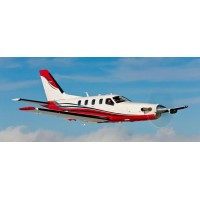
Daher Socata TBM 850
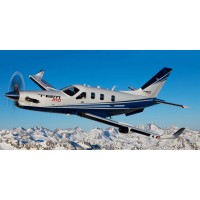
Daher Socata TBM 910
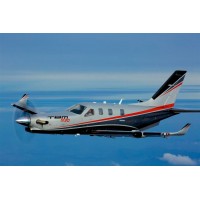
Daher Socata TBM 930