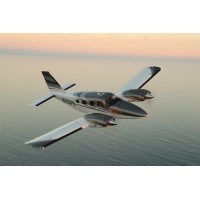


Piper private jet charter
Piper has built more aeroplanes than almost any manufacturer in history and has never built a jet. Both halves of that sentence matter to anyone searching for Piper charter. The company counts 134,000 aircraft across 87 years of production, a figure Cessna's entire Citation jet line does not approach, yet not one of them has been a production jet. The single attempt, the PiperJet, produced one prototype and was cancelled in 2011.
What that leaves for charter is a narrow and specific slice: a handful of ageing piston twins that still work commercially, and a range of modern pressurised singles that are difficult to book in Britain for regulatory reasons set out below. This page explains what is realistically available, what it costs, and when a Piper is the right call rather than a compromise.
For a quote, contact us via WhatsApp on +44 204 577-31-19 or by email at flight@private-jets.co.uk
Piper by the numbers
| Aircraft built since 1937 | Approximately 134,000 |
| Production jets built | None |
| PiperJet prototypes flown | One, cancelled October 2011 |
| Headquarters and factory | Vero Beach, Florida |
| Owner | Ministry of Finance, Brunei Darussalam, since late 2011 |
| Current flagship | M700 Fury, certified 29 February 2024 |
| Fastest Piper ever built | M700 Fury, 301 KTAS |
| Notable world first | First manufacturer to certify Garmin Autoland, M600/SLS, 2020 |
| Wing configuration | Low-wing across the M-Class and twins |
This last line is worth stating because the opposite claim circulates widely. The M-Class, the Seneca, the Seminole and the Navajo are all low-wing designs. High-wing aircraft are Cessna and Kodiak territory, not Piper.
The jet that was never built
Announced in October 2006, the PA-47 PiperJet was an unusual design: a single turbofan in a pod mounted on the tail fin, the first proposed civilian aircraft to use that arrangement. It first flew on 30 July 2008 and was aimed squarely at the Eclipse 500 and Cessna Citation Mustang at around 2.6 million dollars.
Then the ownership changed. American Capital sold the company in 2009 to Imprimis, a Singapore-based investment fund backed by Brunei, and the new owners ordered a redesign. A redesigned aircraft, the PiperJet Altaire, appeared as a mock-up at the 2010 NBAA convention with a larger circular fuselage, four extra inches of headroom and a projected range of 1,200 to 1,300 nautical miles for five passengers. More than 140 engineers were added and built a 75,000 square foot assembly facility for it.
On 24 October 2011 the company announced it would indefinitely suspend the programme, laying off around 150 employees and releasing 55 contractors. A collapsed light jet market had removed the demand the aircraft was designed for. Two months later Imprimis divested entirely and ownership passed to the Brunei Ministry of Finance, where it remains.
Only one airframe was ever built. It was never certified and never delivered. Charter listings that describe it as a competitor to the Mustang are describing an aircraft that does not exist in service.
What you can actually charter
This divides cleanly in two.
Readily available: the piston twins. The Navajo, Chieftain, Aztec and Seneca have worked as air taxis for decades and remain on UK operator certificates. These are not luxurious aircraft. They are unpressurised or lightly pressurised, noisier than a turboprop and typically 30 to 50 years old. What they offer is the lowest available price for a private flight with two engines and a professional crew.
Restricted: the modern singles. The M350, M500, M600/SLS and M700 Fury are excellent aircraft, and the overwhelming majority in Europe are privately owned and flown by their owners rather than placed on charter certificates. Where they do appear commercially, it is under specific operator approvals discussed in the next section.
Not available at all: anything described as a Piper jet. There isn't one.
Why single-engine models are hard to book in Britain
This deserves explanation rather than a vague note about availability, because it affects the Pilatus PC-12 and Daher TBM in the same way and is the single most common source of confusion when clients enquire about turboprop singles.
Commercial passenger flights in single-engine turbine aircraft, in cloud or at night, were prohibited across Europe for many years. EASA opened the door in 2017, and such flights are now permitted, but only under a specific operator approval covering engine reliability monitoring, route planning over suitable terrain, and crew procedures. Obtaining and maintaining that approval is a substantial undertaking for an operator.
Consequences for anyone enquiring about an M-Class Piper:
- Most M-Class aircraft in the UK are not on a charter certificate at all. They are private aircraft flown by their owners under private operating rules, and cannot legally be chartered however willing the owner might be;
- The operators who do hold the approval overwhelmingly fly PC-12s or TBMs rather than M-Class Pipers, because the larger cabin justifies the compliance burden. Our Pilatus and Daher pages cover both;
- A twin sidesteps the issue entirely. The Seneca, Aztec, Navajo and Cheyenne carry two engines and fall outside the single-engine restriction, which is a large part of why elderly Piper twins remain in commercial service while newer singles do not;
- Allow real lead time. If an M600 or M700 specifically is what you want, expect a search across Europe rather than a same-week UK booking.
The M-Class: M350 to M700 Fury
Everything in the M-Class descends from one airframe. The PA-46-310P Malibu was certified in 1983 as the first pressurised piston single, designed to outperform Cessna's pressurised 210. Forty years of development later, the same basic fuselage carries a 700 horsepower turbine.
M350
Piston member of the family, formerly the Malibu Mirage, rebranded when Piper created the M-Class in 2015. Pressurised, six seats, around 213 knots. Almost entirely an owner-flown aircraft; commercial availability is negligible.
M500
Formerly the Meridian, and historically important as Piper's first single-engine turbine aircraft, first delivered at the end of 2000. A 500 shaft horsepower PT6A gives roughly 260 knots. It remains in production as the entry point to turbine ownership for pilots stepping up from pistons. From £1,300 per flight hour where an approved operator can be found.
M600 and M600/SLS
This was the 2016 model that changed the family. Piper fitted an entirely new wing carrying 90 more US gallons of fuel than the Meridian, a 600 shaft horsepower PT6A-42A, and the Garmin G3000 touchscreen flight deck, a first for a single-engine turboprop. Maximum cruise reached 274 knots with a 30,000 ft ceiling.
Its genuine claim to significance came in 2020. The M600/SLS received FAA type certification for the HALO safety system, making it the first aircraft in the world certified with Garmin Autoland. Pressed by pilot or passenger, or triggered automatically if the pilot becomes incapacitated, the system selects an airport, flies the approach, lands and stops the aircraft. Every subsequent Autoland installation on any aircraft type followed this certification. From £1,500 per flight hour.
M700 Fury
Announced on 6 February 2024 and FAA certified on 29 February 2024, with deliveries from that April and EASA and UK validation during the second half of the year. Designated PA-46-701TP, it replaces the M600/SLS with a 700 shaft horsepower PT6A-52 and a five-blade Hartzell composite propeller, along with a redesigned intake plenum and exhaust arrangement to extract residual thrust.
At 301 KTAS it is the fastest aircraft Piper has ever built. Range is 1,149 nautical miles at maximum cruise or 1,424 nautical miles at normal cruise, and the manufacturer claims a 30 per cent improvement in climb rate over the M600. Garmin G3000 with the HALO system including Autoland is standard, and maximum takeoff weight stays at 6,000 lb. List price is approximately 4.1 million dollars. Programme launch was September 2021, first flight 31 August 2022, and certification testing ran to 731 flight hours. From £1,700 per flight hour, subject to availability.

The twins still working for hire
These are the aircraft you are most likely to be offered, and understanding what they are prevents disappointment. All are out of production. All are low-wing piston twins with two crew seats and a cabin entered by climbing onto the wing. None has a lavatory. What they have is two engines, a professional pilot and a price no turboprop can match.
- Piper Seneca (PA-34). Six seats including the pilot, two Continental or Lycoming pistons, roughly 190 knots. The Seneca V remains in production for the private market. Commonly the cheapest twin-engine private flight available in the UK. From £500 per flight hour;
- Piper Aztec (PA-23). A rugged six-seat twin produced from 1959 to 1981, still flying commercially in small numbers for air taxi and utility work. From £600 per flight hour;
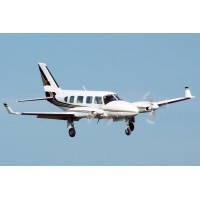
- Piper Navajo and Chieftain (PA-31). This is the serious one. Cabin-class with an airstair door, seating six to eight passengers, and the Chieftain stretch is the larger of the two. For decades the Navajo family was the backbone of British and Irish air taxi work, and a good number remain active. From £700 per flight hour;
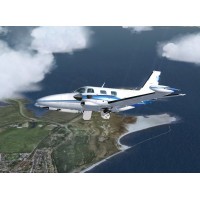
- Piper Cheyenne (PA-31T). A turboprop development of the Navajo airframe with two PT6A engines, pressurised, faster and quieter than the piston twins. Scarce now but occasionally available. From £900 per flight hour.
For comparison, a Beechcraft King Air starts from around £900 to £1,200 per hour and offers a pressurised, quieter cabin with an enclosed lavatory on the larger models. If budget allows the step, it is usually worth taking.
Rates and realistic expectations
Indicative hourly rates in GBP for UK departures. Piper aircraft occupy the lowest rungs of the private charter ladder, and the figures reflect that.
| Aircraft | Type | Seats | UK availability | From |
| Seneca | Twin piston | 4-5 | Reasonable | £500/hr |
| Aztec | Twin piston | 5 | Limited | £600/hr |
| Navajo / Chieftain | Twin piston, cabin class | 6-8 | Reasonable | £700/hr |
| Cheyenne | Twin turboprop | 6-7 | Scarce | £900/hr |
| M500 | Single turboprop | 4-5 | Very limited | £1,300/hr |
| M600 / SLS | Single turboprop | 4-5 | Very limited | £1,500/hr |
| M700 Fury | Single turboprop | 5 | Rare in charter | £1,700/hr |
Three points worth setting out honestly before booking one of these twins:
- Comfort is basic. Cabin noise is high, most are unpressurised, and flight levels are low enough that weather is flown through rather than over. On a clear day across the Irish Sea this is fine. On a rough winter afternoon it is not a comfortable way to travel;
- Speed is modest. At 180 to 200 knots a Navajo takes around two hours from London to Edinburgh against 50 minutes in a light jet. For short sectors the door-to-door saving over driving or scheduled travel is still substantial;
- The economics are genuinely different. A London to Isle of Man return for five people in a Navajo can cost less than five business class tickets on a scheduled routing, which is not true of any jet.
Repositioning flights on empty legs reduce these rates further. For the wider market see the private jet price guide or browse the complete fleet.
When these aircraft are the right choice
- Short UK and Irish sectors on a tight budget. London to Isle of Man, Manchester to Belfast, Edinburgh to Newcastle. A Navajo costs a fraction of a light jet and lands at the same regional fields;
- Groups of five to eight where a jet is out of budget. The Navajo Chieftain cabin takes eight with an airstair door, which no other aircraft at this rate offers;
- Small regional and island airfields. Piper twins operate comfortably from short runways that light jets cannot use, and unlike single-engine aircraft they carry a second engine over water;
- Positioning and connection flights. Reaching a hub to join a long-haul departure, where the aircraft is a means to an end rather than the experience;
- Not suitable for: sectors above two hours, anyone who needs a lavatory in flight, or trips where cabin comfort matters. For those, a King Air or light jet is the honest recommendation.
Frequently asked questions
Does Piper make a private jet?
No, and it never has. The single-engine PA-47 PiperJet was announced in October 2006 and flew one prototype on 30 July 2008. Redesigned as the PiperJet Altaire, the programme was indefinitely suspended on 24 October 2011 when the light jet market collapsed after the financial crisis. No production aircraft was built and the type was never certified. Everything the company builds is a piston or turboprop aircraft.
What is the fastest Piper?
The M700 Fury, at 301 KTAS, certified on 29 February 2024. It is powered by a 700 shaft horsepower Pratt and Whitney Canada PT6A-52 driving a five-blade Hartzell composite propeller, and is the fastest aircraft in Piper's 87-year production history. Range is 1,149 nautical miles at maximum cruise and 1,424 nautical miles at normal cruise.
Which Piper was the first aircraft in the world with Garmin Autoland?
The Piper M600/SLS. It received FAA type certification for its HALO safety system in 2020, making Piper the first general aviation manufacturer to certify Garmin Autoland on any aircraft. It can be activated by the pilot or a passenger, or triggers automatically if it detects pilot incapacitation, then selects an airport, flies the approach and lands. Autoland is now standard on the M700 Fury.
How much does it cost to charter a Piper?
From approximately £500 per flight hour for a Piper Seneca and £700 for a Navajo or Chieftain, which are the most commonly available types in UK charter. Turboprop M-Class singles run from around £1,300 to £1,700 per hour where an approved operator is available. These twins are typically the least expensive private charter option flying from UK airports.
Why can I not charter a Piper M600 or M700 easily in the UK?
Two reasons. Most M-Class aircraft in Europe are privately owned and flown by their owners under private operating rules, which means they cannot legally be chartered. Separately, commercial passenger flights in single-engine turbine aircraft in cloud or at night require a specific operator approval, permitted in Europe since 2017 but held by relatively few operators, most of whom fly larger PC-12s or TBMs instead. Twin-engine models are unaffected by this restriction.
Are Piper aircraft high-wing or low-wing?
Low-wing, across the M-Class, the Seneca, the Seminole, the Navajo and the Archer. The claim that the company builds high-wing turboprops appears on several aviation directory pages and is incorrect. High-wing designs in this market come from Cessna and from Daher's Kodiak line.
Who owns Piper Aircraft?
The Ministry of Finance of Brunei Darussalam. American Capital sold the business in 2009 to Imprimis, a Singapore-based investment fund backed by Brunei. Imprimis divested in October 2011, shortly after the Altaire jet programme was cancelled, and transferred its management rights and equity interests to the Brunei government. Piper remains headquartered and manufactured at Vero Beach, Florida.
Page last updated: July 2026. Piper has never built a production jet. Single-engine turbine commercial passenger charter requires specific operator approval and availability in the UK is limited. Charter availability is confirmed at the time of enquiry.
Piper aircraft available for charter:
Piper Aztec
Piper Cheyenne
Piper Navajo