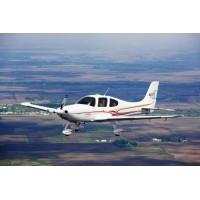


Cirrus private jet charter
Cirrus builds aircraft with a parachute attached to the whole airframe, and it has done so since 1998. By the end of 2024 that system had been credited with saving 269 lives across 132 deployments, a record no other certified manufacturer can offer because no other certified manufacturer fits one as standard.
Founded in 1984 by brothers Alan and Dale Klapmeier in a barn on the family farm at Baraboo, Wisconsin, Cirrus is now headquartered at Duluth, Minnesota with a second campus at Knoxville, Tennessee. It builds only single-engine aircraft: the SR series pistons and the Vision Jet, the only single-engine civilian jet in production anywhere. In 2025 the company delivered 691 SR aircraft and a record 106 Vision Jets, and handed over its 11,000th SR series airframe.
For UK charter purposes only one of those matters, and this page explains which and why.
For a quote, contact us via WhatsApp on +44 204 577-31-19 or by email at flight@private-jets.co.uk
269 lives, 132 deployments: the Cirrus parachute
In 1985 Alan Klapmeier was flying a training sortie when another aircraft hit him in mid-air. He survived. The other pilot did not survive. His conclusion was not that flying should be restricted but that pilots need an option that does not depend on flying the aeroplane out of the situation.
This system has been standard equipment on every aircraft the company has delivered since 1998. It weighs around 75 lb. A solid-propellant rocket fires through the upper fuselage, extracts a canopy attached to the airframe structure rather than to the occupants, and lowers the entire aircraft under it. An occupant cell rated to 26G sits beneath it with energy-absorbing seats and crumple zones beneath, because the parachute reduces the descent to a survivable impact rather than eliminating it.
AOPA, citing Cirrus data, records 269 lives saved across 132 deployments as of 31 December 2024. Individual cases show the range of what it covers. In August 2010 at Horton in the United Kingdom a pilot lost control and activated the system at 187 knots indicated, well above the published deployment speed, and both occupants walked away uninjured. In 2011 an SR22 struck a glider over Germany and came down under canopy with structural damage to the wing. In 2020 a passenger with no flying experience deployed the system after the pilot became incapacitated.
Limits deserve stating as plainly as the successes. CAPS needs height and it needs speed control. On the piston aircraft the guidance is above roughly 500 ft above ground level and below approximately 140 knots for full deployment. Outside that envelope the canopy may not have time to inflate or may fail on opening. On the Vision Jet the engineering problem was harder still, because the aircraft weighs about 6,000 lb against 3,600 lb for an SR22 and flies faster; the system there is qualified to 300 knots indicated.
The world's only single-engine jet
Every other civilian jet in production has at least two engines. A Vision Jet SF50 has one Williams International FJ33-5A mounted above the fuselage, feeding into a V-tail that keeps the surfaces clear of the exhaust.
Development began in 2006, the SJ50 prototype flew in 2008, and FAA certification came in 2016 after an ownership change and a long delay. It won the 2017 Collier Trophy, American aviation's most prestigious annual award, presented in 2018.
What it delivers: 311 knots maximum cruise, a 31,000 ft service ceiling and around 1,275 nautical miles of range with four occupants at long-range cruise. Those figures make it the slowest and lowest-flying jet in production. They also make it the cheapest to run, at roughly half the hourly operating cost of a twin-engine light jet, and it lands in a fraction of the distance.
Certification permits up to seven occupants, meaning one pilot with five adults and two children. Standard executive layouts carry four adults and the pilot comfortably. Carbon fibre composite structure and the Perspective Touch+ flight deck, built on the Garmin G3000 platform, complete a package designed around owner-pilots moving up from an SR22 rather than around professional crews.
| Cirrus Vision Jet G2+ | Cessna Citation M2 | Embraer Phenom 100EV | |
| Engines | One Williams FJ33-5A | Two Williams FJ44 | Two Pratt and Whitney PW617 |
| Max cruise | 311 kt | 404 kt | 406 kt |
| Service ceiling | 31,000 ft | 41,000 ft | 41,000 ft |
| Range | ~1,275 nm | 1,550 nm | 1,178 nm |
| Whole-airframe parachute | Yes | No | No |
| Emergency autoland | Yes, from G2+ | No | No |
| Typical UK rate | From £2,000/hr | From £2,300/hr | From £2,200/hr |
Read across that table and the trade is clear. You give up 90 knots and 10,000 feet, and you gain two independent safety systems that no twin-engine competitor offers at any price, at the lowest hourly rate in the jet category.
Commercially the aircraft has been a considerable success. Cirrus delivered its 600th Vision Jet in December 2024 and a record 106 during 2025 alone. It has been the best-selling jet in general aviation for eight consecutive years and the most-delivered business jet of any kind every year since 2018.
Vision Jet generations, G1 to G3
Four specifications exist and the differences are substantial enough to ask about.
- G1 (2016 to 2018). The original certified aircraft, ceiling limited to 28,000 ft. Pre-owned examples trade around 1.8 million dollars;
- G2 (January 2019). RVSM equipment raised the ceiling to 31,000 ft, range improved beyond 1,200 nautical miles, and autothrottle arrived along with an updated flight deck;
- G2+ (2021). Optimised engine performance for better takeoff figures, Gogo in-flight connectivity, and Safe Return emergency autoland, initially a 170,000 dollar option and subsequently standard;
- G3 (February 2026). Redesigned cabin seating six adults plus a child, controller-pilot datalink communications and improved taxi guidance. Base price around 3.6 million dollars.
A charter quote naming simply a Vision Jet could be any of these. Practical differences that matter to a passenger are ceiling, which affects how much weather you fly through, and whether Safe Return is fitted.
Safe Return: what happens when nobody is flying
Cirrus was first to certify emergency autoland on a jet. Developed with Garmin, it is activated by a single button that any passenger can reach, or automatically if it detects that the pilot has stopped responding.
Once triggered it evaluates weather, terrain, fuel remaining and runway length, selects an airport, broadcasts a distress signal on the appropriate frequency, and flies the approach, landing and rollout to a full stop with the brakes applied. Cabin displays talk the passengers through what is happening.
In 2025 Cirrus extended it to the piston line with the SR series G7+, so a single-engine piston aircraft now carries the same capability. Combined with CAPS, a modern Cirrus offers a passenger two independent responses to pilot incapacitation, which is a genuinely unusual position for an aircraft flown by one pilot.
The HondaJet Elite II received FAA certification for a comparable system in February 2026, making it the first twin-turbine very light jet to carry one. Cirrus got there first, on a jet, by several years.
11,000 aircraft you will not be offered
Cirrus SR20, SR22 and SR22T are the best-selling high-performance single-engine piston aircraft in the world and have held that position for 24 consecutive years. Cirrus passed 11,000 deliveries during 2025. Almost none of them will ever appear on a charter quote, and the reason is regulatory rather than commercial.
These are single-engine piston aircraft. Commercial passenger transport in that category is restricted across the United Kingdom and Europe to daylight visual conditions, which rules out the schedule reliability any charter client requires. In practice the SR fleet exists for flight training, private owners and self-fly hire. An operator offering to fly you somewhere in an SR22 for money is almost certainly operating outside the terms of a commercial air transport approval.
Two points of correction, since both appear on charter listings elsewhere. The SR20 and SR22 are propeller aircraft with piston engines and are not jets of any description; descriptions such as very light jet or propeller-driven jet are simply wrong. And the SR22 has been in production since 2001, not 2011.
A Vision Jet faces a lighter version of the same constraint. Commercial passenger flights in single-engine turbine aircraft in cloud or at night have been permitted in Europe since 2017 but require a specific operator approval, which is why availability is thinner than the delivery numbers suggest. That same rule shapes availability of the Piper M-Class and similar types.
Rates and availability
Indicative hourly rates in GBP for UK departures.
| Aircraft | Type | Seats | Range | UK charter | From |
| Vision Jet G1 | Single-engine jet | 4-5 | ~1,100 nm | Occasional | £1,900/hr |
| Vision Jet G2 / G2+ | Single-engine jet | 4-6 | ~1,275 nm | Limited | £2,000/hr |
| Vision Jet G3 | Single-engine jet | 4-6 | ~1,275 nm | Rare, new type | £2,200/hr |
| SR20 / SR22 / SR22T | Single-engine piston | 4 | ~1,050 nm | Not offered commercially | Not applicable |
This is the least expensive jet charter available from UK airports, which is the point of it. Against a HondaJet at £2,400 per hour it gives up around 110 knots of cruise and 12,000 feet of ceiling; against a Citation Mustang it gives up speed but gains a newer cabin, the parachute and autoland.
Availability is the constraint rather than price. Most Vision Jets are owner-flown, several charter examples sit on leaseback arrangements, and the European pool is small. Allow longer than the 48 to 72 hours a Citation or Phenom booking typically needs.
Repositioning flights on empty legs reduce these rates further. For the wider market see the private jet price guide or browse the complete fleet.
Where the range takes you
Range of around 1,275 nautical miles and a cruise of 311 knots define the useful envelope. This is a short-sector aircraft flown by one pilot, and it is at its best where a light jet would be over-specified.
- London to Paris - from approximately £2,800 for 4 passengers, around 1 hour 15 minutes;
- London to Edinburgh - from approximately £3,200, around 1 hour 35 minutes;
- London to Dublin - from approximately £2,900, around 1 hour 25 minutes;
- London to Amsterdam - from approximately £2,900, around 1 hour 20 minutes;
- London to Geneva - from approximately £4,200, around 2 hours;
- Manchester to Jersey - from approximately £3,000, around 1 hour 30 minutes;
- Edinburgh to London - from approximately £3,200, around 1 hour 35 minutes.
Beyond about two hours the arithmetic turns against it. A Phenom 100 or Citation M2 costs more per hour but arrives sooner, and on a three-hour sector the difference in total cost narrows considerably.
Frequently asked questions
Do Cirrus aircraft really have a parachute?
Yes, on every aircraft the company has built since 1998. The Cirrus Airframe Parachute System is a whole-airframe ballistic recovery system: a rocket extracts a canopy attached to the aircraft structure and lowers the entire aeroplane. AOPA, citing Cirrus figures, records 269 lives saved across 132 deployments as of 31 December 2024. It has height and speed limits, generally above 500 ft above ground level and below about 140 knots on the piston aircraft, and up to 300 knots on the Vision Jet.
Is the Cirrus SR22 a jet?
No. The SR20, SR22 and SR22T are single-engine piston aircraft driving a propeller. The SR22 uses a 310 hp Continental IO-550-N and the SR22T a turbocharged variant. They are the best-selling high-performance piston singles in the world, in production since 2001, but they are not jets and are not available for commercial charter in the UK.
Can I charter a Cirrus in the UK?
Only the Vision Jet, and availability is limited. Commercial passenger transport in single-engine piston aircraft is restricted to daylight visual conditions across the UK and Europe, which effectively excludes the SR series from charter. The Vision Jet is a turbine aircraft and can be operated commercially, but requires a specific operator approval for flight in cloud or at night, so relatively few sit on charter certificates.
How much does it cost to charter a Cirrus Vision Jet?
From approximately £1,900 to £2,200 per flight hour depending on generation, making it the least expensive jet charter available from UK airports. London to Paris costs from around £2,800 for four passengers and London to Edinburgh from around £3,200. Operating economics are roughly half those of a twin-engine light jet.
What is Safe Return and which Cirrus aircraft have it?
Safe Return is Garmin emergency autoland, and the Vision Jet was the first jet in the world certified with it. A passenger presses one button, or the system activates automatically if the pilot stops responding, and the aircraft then selects an airport, transmits a distress call, flies the approach and lands itself to a full stop. It arrived on the Vision Jet G2+ in 2021 and reached the SR piston series with the G7+ in 2025.
How many Vision Jets have been built?
Number 600 was delivered in December 2024 and a record 106 followed during 2025. It has been the best-selling jet in general aviation for eight consecutive years and the most-delivered business jet of any type every year since 2018. Over 1,275 people hold a Vision Jet type rating.
Who owns Cirrus Aircraft?
China Aviation Industry General Aircraft, part of the AVIC group, acquired Cirrus in 2011 following the financial difficulties that hit the company after the 2008 crisis. Design, manufacturing and headquarters remain in the United States at Duluth, Minnesota, with a second campus at Knoxville, Tennessee and composite production in North Dakota.
Page last updated: July 2026. Cirrus builds only single-engine aircraft. The SR series is not available for commercial passenger charter in the UK. Vision Jet charter requires an operator holding the relevant single-engine turbine approval and availability is confirmed at the time of enquiry.
Cirrus aircraft available for charter: