


Charter a Bombardier Challenger 350
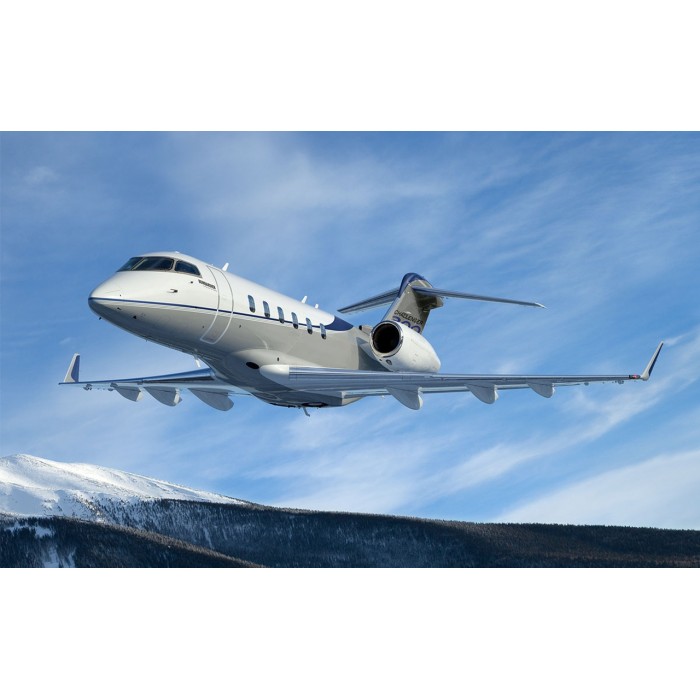


- Availability: Available for rent
Request aircraft information
The Bombardier Challenger 350 entered service in 2014 as the successor to the Challenger 300, incorporating a series of targeted improvements to engines, aerodynamics, avionics and cabin design. The primary powerplant change is the replacement of the HTF7000 engines with the Honeywell HTF7350, delivering 7% more thrust (an increase of approximately 230 kg per engine) while maintaining improved fuel efficiency. The updated engines allow the maximum takeoff weight to increase to 18,416 kg while still providing faster climb performance to cruise altitude.
The most visible aerodynamic change is the redesigned winglets, angled more steeply relative to the wing plane than those on the Challenger 300. The steeper angle improves drag reduction and effectively increases wing span by 158 cm, contributing to the improved climb rate and the 100 nm range increase over the predecessor. The fuselage is unchanged except for the cabin windows, which are 5 cm longer than the Challenger 300's portholes, admitting 12% more natural light into the cabin. Avionics are an updated version of the Rockwell Collins Pro Line 21 suite, with enhanced displays and integrated flight management.

Key performance figures
| Range | 3,200 nm / 5,926 km |
| Cruising speed | 882 km/h (Mach 0.85) |
| Maximum altitude | 12,500 m (41,000 ft) |
| Engines | 2 x Honeywell HTF7350 |
| Engine thrust increase vs Challenger 300 | +7% (approximately +230 kg per engine) |
| Maximum takeoff weight | 18,416 kg (40,600 lb) |
| Avionics | Rockwell Collins Pro Line 21 (updated) |
| Winglet span increase vs Challenger 300 | +158 cm effective wingspan |

Airframe dimensions
| Aircraft length | 20.92 m |
| Aircraft height | 6.10 m |
| Wingspan (with winglets) | 21.00 m |
Cabin dimensions and capacity
| Cabin length | 8.72 m |
| Cabin width | 2.49 m |
| Cabin height | Full stand-up throughout |
| Optimal passengers | 8 |
| Maximum passengers | 10 |
| Seat configuration | Club seats + 3-seat convertible sofa |
| Flat-bed conversion | Yes - all seats and sofa |
| Baggage hold | In-flight accessible, pressurised |
| Window size vs Challenger 300 | +5 cm longer, +12% more natural light |


Cabin features
- Full stand-up cabin throughout 8.72 m length - one of the largest in the super-midsize category;
- 8 to 9 passengers standard; up to 10 maximum;
- Three-seat convertible sofa in the aft section - extends to a sleeping surface;
- All club seats recline to full sleeping positions;
- Larger windows than Challenger 300 - 5 cm longer, admitting 12% more natural light;
- NetJet-style tablets at each seat for entertainment and cabin control;
- Mobile-technology IFE system with individual screens and audio;
- Hot drink machine and microwave standard;
- Satellite Wi-Fi available on most charter examples (confirm at booking);
- Forward galley with full hot beverage service; pre-ordered catering available;
- Enclosed private lavatory in the aft section;
- In-flight accessible pressurised baggage hold.


The Bombardier Challenger 350 is the current-generation super-midsize business jet from Bombardier Aerospace, introduced in 2014 as the successor to the Challenger 300. It brought a meaningful set of improvements over its predecessor: updated Honeywell HTF7350 engines delivering 7% more thrust with better fuel efficiency, redesigned winglets at a steeper angle for improved aerodynamic performance, larger cabin windows letting in 12% more natural light, and a comprehensively upgraded interior. With a range of 3,200 nm (5,926 km) and a cruise speed of 882 km/h, it connects London to Dubai non-stop and covers virtually every European and Middle Eastern destination from any UK airport.
In the UK charter market, the Challenger 350 is among the most frequently requested aircraft in the super-midsize category, consistently available from UK and European operators and widely based across the continent. Charter prices start from approximately £4,900 per flight hour. Private Jets UK arranges charters from all UK airports with a fully itemised quote in 15 minutes. For the full range of aircraft and pricing see our private jet price guide, or browse our complete private jet fleet.
Why charter the Challenger 350?
- Fleet depth and European availability. Since replacing the Challenger 300 in 2014, the 350 has become the dominant aircraft in its category across the European charter market, more widely available from UK and European operators than the Gulfstream G280 or Falcon 50EX. That availability translates into better options on short notice and consistently competitive pricing;
- Stand-up cabin throughout. At 8.72 m long with a full-length stand-up cabin, it provides a working and resting environment comparable to aircraft one class above it. On sectors of 3 to 7 hours this matters considerably;
- Non-stop to Dubai from any UK airport. At 3,200 nm range, it comfortably covers London to Dubai (approximately 3,000 nm) and connects every UK airport to the Gulf non-stop, a meaningful advantage over midsize alternatives that require a fuel stop;
- Updated Honeywell HTF7350 engines. Seven percent more thrust than the Challenger 300's HTF7000, combined with improved fuel efficiency. The steeper-angle winglets add effective span and reduce drag, allowing faster climb to cruise altitude despite the increased MTOW of 18,416 kg;
- Larger windows. At 5 cm longer than the Challenger 300's portholes, the updated cabin windows admit 12% more natural light, a noticeable difference on a day flight over the Alps or Mediterranean;
- Up to 10 passengers. The standard configuration seats 8 to 9 including a convertible sofa; a 10th seat is available. Accessories include a hot drink machine, microwave, seat-mounted tablets and a mobile-technology-based entertainment system.
Charter cost - Challenger 350 prices from UK airports
Hourly rates run from approximately £4,900 to £5,800 depending on the operator, aircraft age and positioning. The Challenger 350's high availability across the European market keeps pricing competitive; well-positioned aircraft from London, Paris or Amsterdam bases are frequently available, reducing positioning costs on the most popular routes.
Indicative one-way prices from UK airports:
- London to Geneva - from £9,800 (9 passengers, approximately 1 hour 20 minutes);
- London to Dubai - from £40,000 (9 passengers, non-stop, approximately 7 hours 10 minutes);
- London to New York - from £66,000 (9 passengers, one fuel stop, approximately 9 hours total);
- London to Palma de Mallorca - from £14,200 (9 passengers, approximately 2 hours);
- Edinburgh to Rome - from £14,800 (9 passengers, approximately 2 hours 30 minutes);
- Manchester to Athens - from £22,400 (9 passengers, approximately 3 hours 30 minutes);
- Glasgow to Dubai - from £43,000 (9 passengers, non-stop, approximately 7 hours 30 minutes).
Empty Leg flights on the Challenger 350 are among the most frequently available in the European super-midsize market. See our Empty Legs page for current routes.
Ideal routes for the Challenger 350
This aircraft is at its best on sectors of 2 to 7 hours where stand-up cabin comfort, non-stop Gulf range and reliable European availability all point in the same direction:
- UK to Mediterranean and Southern Europe (2 to 3.5 hours). Palma, Ibiza, Mykonos, Santorini, Rome, Athens, Istanbul. The stand-up cabin on a 3-hour sector with 8 passengers is noticeably more comfortable than a midsize jet, and the range means even the most distant Mediterranean island destinations are non-stop from any UK airport;
- UK to Gulf (6.5 to 7.5 hours, non-stop). Dubai, Abu Dhabi, Riyadh, Doha, Muscat. The 5,926 km range covers these routes non-stop from London, one of the key advantages over the Challenger 300, which requires a fuel stop on the London to Dubai sector with a full passenger load;
- UK to North Africa (3 to 4 hours). Marrakech, Casablanca, Algiers, Tunis, Cairo. The range comfortably covers all North African destinations non-stop from any UK airport;
- Corporate same-day returns across Europe. London to Geneva, Zurich, Frankfurt, Amsterdam, Madrid. The Challenger 350 is chosen over the Citation XLS on same-day corporate returns when the group is 7 to 9 passengers or when a working environment with full stand-up headroom is required during the flight;
- Transatlantic with one fuel stop. New York, Boston, Miami from UK airports with a fuel stop at Reykjavik or Shannon. For fully non-stop transatlantic, a Global 5000 or Gulfstream G550 is required.
Cabin and in-flight experience
The Challenger 350 cabin measures 8.72 m long, 2.49 m wide and provides full stand-up headroom throughout. The updated interior introduced with the 350 variant features larger windows, refined seat designs with improved lumbar support and a cleaner aesthetic compared to the Challenger 300. The convertible sofa in the aft section seats three and extends to a sleeping surface, useful on Gulf overnight sectors.
- Seating. Standard 8 to 9 passengers including a three-seat convertible sofa. All seats recline to full sleeping positions. A 10th seat is available on some examples;
- Technology. Seat-mounted tablets at each position for entertainment and cabin control. Mobile-technology-based IFE system with individual screens. Hot drink machine and microwave standard;
- Connectivity. Satellite Wi-Fi available on most European charter examples; confirm at booking;
- Galley. Forward galley with hot drink service and microwave. Pre-ordered catering from the departure FBO available for all sectors;
- Lavatory. Enclosed private lavatory in the aft section;
- Baggage. In-flight accessible pressurised baggage hold, comfortably accommodating 8 to 10 full-size suitcases for a standard passenger load.
Technical specifications
| Manufacturer | Bombardier Aerospace (Canada) |
| Aircraft class | Super-midsize jet |
| Service entry | 2014 (successor to Challenger 300) |
| Maximum passengers | 10 |
| Optimal passengers | 8 |
| Range | 3,200 nm / 5,926 km |
| Cruise speed | 882 km/h (Mach 0.85) |
| Maximum altitude | 12,500 m (41,000 ft) |
| Engines | 2 x Honeywell HTF7350 |
| Maximum takeoff weight | 18,416 kg (40,600 lb) |
| Avionics | Rockwell Collins Pro Line 21 (updated) |
| Cabin length | 8.72 m |
| Cabin width | 2.49 m |
| Cabin height | Stand-up throughout |
| Wingspan | 21.00 m (with winglets) |
| Aircraft length | 20.92 m |
| Aircraft height | 6.10 m |
Challenger 350 vs similar aircraft
- Challenger 350 vs Challenger 300. It is the direct successor. Key improvements: Honeywell HTF7350 engines with 7% more thrust and better fuel efficiency; steeper winglets for improved aerodynamics and 158 cm more effective wingspan; larger cabin windows admitting 12% more light; updated interior with seat-mounted tablets; 100 nm more range. Charter rates run approximately 5 to 10% higher. For most UK to European and Gulf missions both aircraft perform similarly. The 350 becomes the clearly superior choice on the London to Dubai sector where the extra range eliminates the fuel stop the Challenger 300 requires at full load;
- Challenger 350 vs Gulfstream G280. The G280 is a close competitor with comparable range and a similarly sized cabin. It is generally considered to have superior short-field performance; the Challenger 350 counters with higher UK charter availability, a more established European operator network and a slightly larger cabin volume. Pricing is broadly comparable and availability at the time of booking often determines the choice;
- Challenger 350 vs Citation Longitude. The Cessna Citation Longitude entered service in 2019 with comparable range and a stand-up cabin. It offers a slightly quieter cabin and more modern avionics at broadly similar charter rates. European availability is more limited than the Challenger 350 at present. For clients who prioritise the quietest possible cabin on a long sector, it is worth checking alongside the 350.
Frequently asked questions - Challenger 350 charter
How much does it cost to charter a Bombardier Challenger 350?
Rates run from approximately £4,900 to £5,800 per flight hour. London to Geneva costs from £9,800 for 9 passengers. London to Dubai non-stop costs from £40,000. London to Palma costs from £14,200. All quotes from Private Jets UK are fully itemised and include aircraft, crew, fuel, landing fees and standard catering.
How many passengers can fly on a Challenger 350?
Up to 10 passengers. The standard configuration is 8 to 9, including a three-seat convertible sofa in the aft section. All seats recline to sleeping positions. For groups of 9 or more, confirm exact seat configuration with your consultant at the time of booking.
Can the Challenger 350 fly non-stop from London to Dubai?
Yes. With a range of 3,200 nm it covers the London to Dubai sector of approximately 3,000 nm non-stop with a standard passenger load. This is one of its key advantages over the Challenger 300, which requires a fuel stop on the same sector at full load.
What is the difference between the Challenger 350 and Challenger 300?
The 350 is the updated successor introduced in 2014. Main differences: Honeywell HTF7350 engines with 7% more thrust and better fuel efficiency; steeper winglets adding 158 cm of effective wingspan; larger cabin windows (12% more light); updated interior. Range increases by approximately 100 nm. Charter rates are 5 to 10% higher.
Does the Challenger 350 have a stand-up cabin?
Yes. It provides full stand-up headroom throughout the 8.72 m cabin length. This distinguishes it from midsize jets such as the Citation XLS or Hawker 850XP and makes it a genuinely comfortable environment for sectors of 3 to 7 hours.