


Charter a Dassault Falcon 7X


- Availability: Available for rent
Request aircraft information
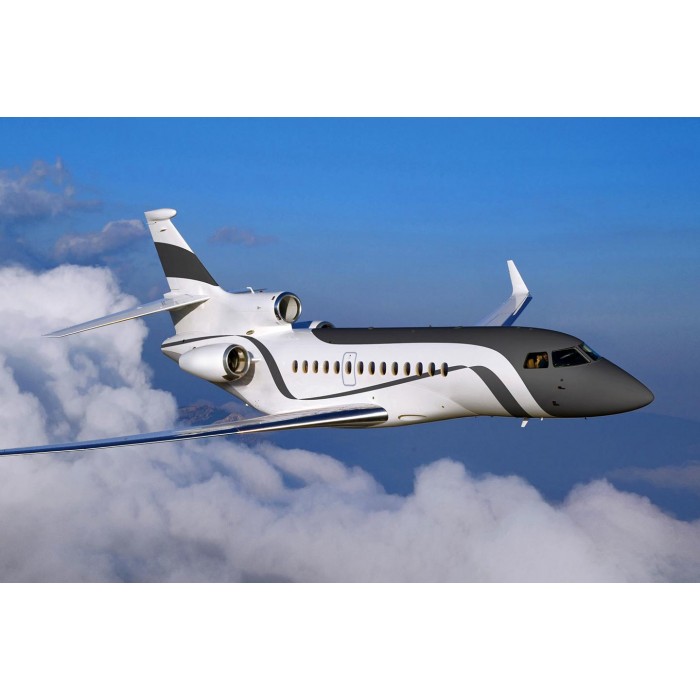
The Dassault Falcon 7X is an ultra-long-range trijet business jet delivered from 2007, notable for two firsts: the first business jet to use a digital fly-by-wire flight control system, and the first Dassault aircraft to be fully designed and tested in a virtual environment. It is powered by three Pratt & Whitney Canada PW307A engines - the same trijet philosophy as the Falcon 900 and Falcon 8X - which eliminate ETOPS overwater routing restrictions and allow direct polar and oceanic great-circle routing. Range is 11,020 km (5,950 nm), covering London to Tokyo and Hong Kong non-stop. Maximum speed is 1,100 km/h and maximum altitude is 15,545 m (51,000 ft).
The 11.91 m cabin was designed by BMW Group Designworks USA and features 28 large windows (14 per side), ergonomic seats that convert to full flat beds, a spacious hanging closet, a full kitchen and two lavatories - a first in the nose and a second in the tail with a dedicated dressing room and in-flight-accessible baggage compartment. The climate system maintains constant temperature and humidity. Cabin noise at cruise is less than 50 dB - below city street noise (65 dB). Maximum passengers is 14; optimal charter group is 8. Maximum takeoff weight is 31,751 kg.

Key performance figures
| Range | 5,950 nm / 11,020 km (London–Tokyo and Hong Kong non-stop) |
| Maximum speed | 1,100 km/h |
| Maximum altitude | 15,545 m (51,000 ft) |
| Maximum takeoff weight | 31,751 kg (70,000 lb) |
| Engines | 3 x Pratt & Whitney Canada PW307A (trijet) - no ETOPS |
| Distinction | First biz jet with digital fly-by-wire; first Dassault virtual design |
| Interior design | BMW Group Designworks USA |
| Cabin noise | <50 dB at cruise (city street 65 dB; metro 100 dB) |

Airframe dimensions
| Aircraft length | 23.38 m |
| Aircraft height | 7.96 m |
| Wingspan | 26.21 m |
Cabin dimensions and capacity
| Cabin length | 11.91 m |
| Cabin width | 2.34 m |
| Cabin height | 1.88 m (full stand-up throughout) |
| Optimal passengers | 8 |
| Maximum passengers | 14 (10-16 in various configurations) |
| Interior design | BMW Group Designworks USA |
| Windows | 28 (14 per side) |
| Seats | Ergonomic, convert to full flat beds |
| Lavatories | 2 - nose (forward) + tail (with dressing room) |
| Closet | Hanging garments throughout flight |
| Noise | <50 dB at cruise |
| Climate | Constant temperature and humidity maintained |


Cabin features
- 11.91 m cabin designed by BMW Group Designworks USA;
- 28 large windows (14 per side) - more than most ultra-long-range competitors;
- Ergonomic seats converting to full flat beds;
- Cabin noise <50 dB at cruise (city street 65 dB; metro 100 dB);
- Constant temperature and humidity climate system;
- Two lavatories: nose (forward) and tail (with dressing room + baggage access);
- Spacious hanging closet accessible in flight;
- Full kitchen forward;
- Three PW307A engines (trijet) - no ETOPS overwater restrictions;
- First business jet with digital fly-by-wire flight controls;
- 11,020 km range; 15,545 m (51,000 ft) ceiling.


The Dassault Falcon 7X is a trijet ultra-long-range business jet notable for two engineering firsts within the Falcon family: it was the first Dassault aircraft to be fully designed and tested in a virtual environment, and the first business jet to use a digital fly-by-wire flight control system as standard equipment. Delivered from 2007, the Falcon 7X uses three Pratt & Whitney Canada PW307A engines rather than the two used by most competing ultra-long-range jets - the same trijet philosophy that defines the Falcon 900 and Falcon 8X. The three PW307A engines reduce cabin noise and vibration compared to the earlier Falcon 900 powerplant and contribute to the Falcon 7X's sub-50 dB interior noise level at cruise.
The 11.91 m cabin was designed by BMW Group Designworks USA - the same studio responsible for BMW and Rolls-Royce automotive interiors. It features 28 windows (14 per side), ergonomic seats that convert to full flat beds, a spacious kitchen, two lavatories (forward in the nose and aft with a dressing room), and an in-flight accessible baggage compartment. The climate system maintains constant temperature and humidity throughout. At 11,020 km range the Falcon 7X covers London to Tokyo non-stop, London to Hong Kong non-stop and London to Singapore with one short stop or non-stop with favourable routing. Charter prices start from approximately £8,200 per flight hour. For the full fleet see our private jet price guide or browse our complete fleet.
Why charter the Falcon 7X?
- First business jet with digital fly-by-wire flight controls. This aircraft was the first business jet to use a digital fly-by-wire flight control system - the same technology that underpins modern Airbus and military aircraft. Fly-by-wire eliminates mechanical control runs, reduces pilot workload on long-haul sectors and provides envelope protection that prevents the aircraft from exceeding its structural limits regardless of pilot input. On a 12-hour intercontinental sector, this technology reduces pilot fatigue meaningfully;
- First Dassault aircraft fully designed in a virtual environment. The Falcon 7X was the first aircraft Dassault designed and tested entirely in a virtual environment before physical prototype construction. This process allowed Dassault engineers to optimise aerodynamics, systems integration and cabin layout with a precision not achievable with traditional design methods. The result is an aircraft that outperforms its class specifications in range, noise and efficiency;
- Sub-50 dB cabin noise - quieter than a city street. The Falcon 7X cabin noise level at cruise is less than 50 dB - below city street noise (65 dB) and dramatically below metro noise (100 dB). The three PW307A engines and advanced sound insulation system achieve this standard. For passengers on 10 to 12-hour overnight sectors, this acoustic level makes the difference between restorative sleep and disrupted rest;
- BMW Group Designworks USA interior - 28 windows, ergonomic flat beds. The Falcon 7X cabin interior was designed by BMW Group Designworks USA - the studio behind BMW and Rolls-Royce interiors. The specification includes 28 large windows (14 per side), ergonomic seats that convert to full flat beds, a spacious closet for hanging garments and a climate system maintaining constant temperature and humidity. No other business jet in this range class uses BMW Group design as its interior standard;
- 11,020 km range - London to Tokyo and Hong Kong non-stop. The Falcon 7X covers London to Tokyo (9,500 km), London to Hong Kong (9,640 km) and London to Los Angeles non-stop. The trijet configuration eliminates ETOPS overwater routing restrictions, allowing direct polar and oceanic great-circle routes that twin-engine competitors cannot follow without diversion airport requirements;
- Two lavatories - forward in nose, aft with dressing room. The Falcon 7X provides two separate lavatory facilities: a first lavatory in the nose and a second with a dedicated dressing room in the tail, adjacent to the in-flight-accessible baggage compartment. On a 12-hour sector with 10 to 14 passengers, two lavatories substantially reduce congestion compared to single-lavatory alternatives.
Charter cost - Falcon 7X prices from UK airports
Hourly rates run from approximately £8,200 to £10,000 - in the ultra-long-range category, above the Falcon 900LX and below the Falcon 8X. For 6 to 10 passengers on Asia-Pacific and Americas intercontinental missions, the Falcon 7X's combination of fly-by-wire, BMW interior and sub-50 dB noise at these rates represents the strongest combination in the Dassault family for this price point.
Indicative one-way prices from UK airports:
- London to New York - from £64,000 (8 passengers, non-stop, approximately 7 hours 30 minutes);
- London to Dubai - from £48,000 (8 passengers, non-stop, approximately 6 hours 30 minutes);
- London to Tokyo - from £104,000 (8 passengers, non-stop, approximately 11 hours 30 minutes);
- London to Hong Kong - from £102,000 (8 passengers, non-stop, approximately 11 hours);
- London to Los Angeles - from £92,000 (8 passengers, non-stop, approximately 11 hours);
- London to Geneva - from £15,000 (8 passengers, approximately 1 hour 20 minutes);
- London to Singapore - from £108,000 (8 passengers, non-stop with favourable winds, approximately 12 hours).
Empty Leg flights appear on intercontinental repositioning routes. See our Empty Legs page for current availability.
Ideal routes for the Falcon 7X
The Falcon 7X is designed for intercontinental missions where fly-by-wire precision, sub-50 dB acoustics, BMW-designed flat beds and three-engine routing freedom are all operationally relevant:
- London to Asia-Pacific non-stop (10 to 12 hours). Tokyo, Hong Kong, Beijing, Mumbai, Bangkok and Kuala Lumpur are all within non-stop or near-non-stop range. The trijet eliminates ETOPS restrictions and enables direct polar routing. For clients on weekly Asia schedules, non-stop versus one-stop saves 2 to 3 hours per sector. The sub-50 dB cabin makes the overnight sleep sector substantially more restorative than in louder competing aircraft;
- London to Americas non-stop (8 to 12 hours). New York, Miami, Los Angeles, San Francisco and Toronto are all within range non-stop. The fly-by-wire flight controls reduce pilot workload and fatigue on these long sectors, contributing to operational reliability on time-sensitive missions;
- Overnight intercontinental with flat-bed sleep. The Falcon 7X's BMW-designed ergonomic seats convert to full flat beds. On London to Tokyo, London to Los Angeles and London to Singapore overnight sectors, flat-bed sleep allows passengers to arrive in meeting condition. The sub-50 dB noise floor makes sleep at cruise altitude genuinely restorative;
- Groups of 10 to 14 on intercontinental missions. The Falcon 7X carries 10 to 16 passengers comfortably across its 11.91 m cabin. For larger corporate groups on Asia and Americas missions where two smaller jets would otherwise be required, the Falcon 7X handles the full group in a single aircraft at lower per-seat cost;
- Clients who specifically request BMW Group Designworks interiors. The BMW Group Designworks USA design specification is a known brand in the corporate aviation market. Clients who have experienced the Falcon 7X interior and specifically request it for subsequent bookings - a common pattern among regular Asia-Pacific travellers - find no equivalent in this range class.
Cabin and in-flight experience
This aircraft cabin measures 11.91 m long, 2.34 m wide and 1.88 m high - full stand-up headroom throughout. The interior was designed by BMW Group Designworks USA and features 28 large windows (14 per side) - more than most competing ultra-long-range jets. Ergonomic seats convert to full flat beds. A spacious closet in the cabin allows hanging garments - coats, jackets and dresses - accessible throughout the flight.
A full kitchen is equipped forward. Two lavatories serve the full passenger group: a first in the nose and a second in the tail with a dedicated dressing room and in-flight-accessible luggage compartment. The climate system maintains constant temperature and humidity throughout long-haul sectors. Cabin noise is less than 50 dB at cruise - below city street level. The Falcon 7X operates at 15,545 m (51,000 ft) maximum altitude and carries 10 to 16 passengers (14 maximum for charter purposes).
- Cabin. 11.91 m × 2.34 m × 1.88 m - full stand-up throughout;
- Design. BMW Group Designworks USA;
- Windows. 28 (14 per side) - more than most ultra-long-range competitors;
- Seats. Ergonomic, convert to full flat beds;
- Noise. <50 dB at cruise (city street 65 dB; metro 100 dB);
- Climate. Constant temperature and humidity maintained throughout;
- Lavatories. Two - nose (forward) and tail (with dressing room);
- Closet. Hanging garments throughout flight;
- Engines. Three PW307A (trijet) - no ETOPS restrictions;
- Altitude. 15,545 m (51,000 ft) maximum certified.
Technical specifications
| Manufacturer | Dassault Aviation, France |
| Delivered from | 2007 |
| Distinction | First biz jet with digital fly-by-wire; first Dassault virtual design |
| Engines | 3 x Pratt & Whitney Canada PW307A (trijet) |
| Interior design | BMW Group Designworks USA |
| Aircraft class | Ultra-long-range large-cabin business jet |
| Maximum passengers | 14 (10-16 in various configurations) |
| Optimal passengers | 8 |
| Range | 5,950 nm / 11,020 km |
| Maximum speed | 1,100 km/h |
| Maximum altitude | 15,545 m (51,000 ft) |
| Maximum takeoff weight | 31,751 kg (70,000 lb) |
| Cabin noise | <50 dB at cruise |
| Windows | 28 (14 per side) |
| Lavatories | 2 (nose + tail with dressing room) |
| Cabin length | 11.91 m |
| Cabin width | 2.34 m |
| Cabin height | 1.88 m |
| Wingspan | 26.21 m |
| Aircraft length | 23.38 m |
| Aircraft height | 7.96 m |
Falcon 7X vs similar aircraft
- Falcon 7X vs Falcon 8X. The Falcon 8X has greater range (6,450 nm vs 5,950 nm), a longer cabin (13 m vs 11.91 m) and 30+ cabin layouts versus the 7X's extensive but fixed specification. Charter rates for the Falcon 8X run approximately 10 to 20% higher. For missions within this range envelope where the 11.91 m BMW-designed cabin is sufficient, it provides the same trijet philosophy and fly-by-wire technology at a lower rate. For Asia-Pacific non-stop missions at the extreme range limit and overnight configurations requiring more than the Falcon 7X provides, the Falcon 8X is preferable;
- Falcon 7X vs Gulfstream G650. The G650 has similar range (7,000 nm vs 5,950 nm), a wider cabin (2.59 m vs 2.34 m) and twin engines. Charter rates are broadly comparable. The Falcon 7X counters with three engines (no ETOPS polar routing restrictions), fly-by-wire flight controls, sub-50 dB cabin noise and BMW Group Designworks interior. For clients who prioritise cabin width, the G650 is stronger. For trijet routing freedom and Dassault acoustic engineering, the Falcon 7X is preferable;
- Falcon 7X vs Falcon 900LX. The Falcon 900LX has shorter range (4,750 nm vs 5,950 nm) and a shorter cabin (10.11 m vs 11.91 m). Both are Dassault trijets with no ETOPS restrictions and fly-by-wire. Charter rates for the Falcon 7X run approximately 15 to 20% higher. For missions within Falcon 900LX range, it is the more economical choice. For non-stop Asia-Pacific sectors and the additional cabin length, the Falcon 7X is appropriate.
Frequently asked questions - Falcon 7X charter
How much does it cost to charter a Dassault Falcon 7X?
Charter rates run from approximately £8,200 to £10,000 per flight hour. London to New York non-stop costs from £64,000 for 8 passengers. London to Tokyo non-stop costs from £104,000. London to Geneva costs from £15,000. All quotes from Private Jets UK are fully itemised with no hidden charges.
What is fly-by-wire on the Falcon 7X?
Digital fly-by-wire replaces the mechanical cables and pulleys that link the pilot's controls to the flight surfaces with a digital computer system. The Falcon 7X was the first business jet to use this technology as standard. On long-haul sectors it reduces pilot workload and provides automatic envelope protection. On intercontinental missions of 10 to 12 hours, the reduction in pilot fatigue contributes to operational reliability.
Who designed the Falcon 7X interior?
BMW Group Designworks USA - the studio also responsible for BMW and Rolls-Royce automotive interiors. The specification includes 28 large windows (14 per side), ergonomic seats that convert to flat beds, a hanging closet, two lavatories with dressing room in the tail, a full kitchen and a constant-humidity climate system. No other business jet in this range class uses BMW Group design as its interior standard.
How many passengers can fly on a Falcon 7X?
Up to 16 depending on configuration; 10 to 16 passengers depending on configuration; the maximum for charter purposes is 14. The optimal charter group is 8 passengers. The 11.91 m cabin divides into a work area and seating area with two lavatories serving the full group.
Is the Falcon 7X quieter than competing jets?
Yes - at under 50 dB, at cruise is less than 50 dB. City street noise is 65 dB; metro noise is 100 dB. The sub-50 dB level results from the three PW307A engines and the advanced sound insulation system, and is meaningfully quieter than most competing ultra-long-range jets at the same cruise altitude. On overnight intercontinental sectors this acoustic standard directly affects sleep quality.