


Charter a Learjet 45XR
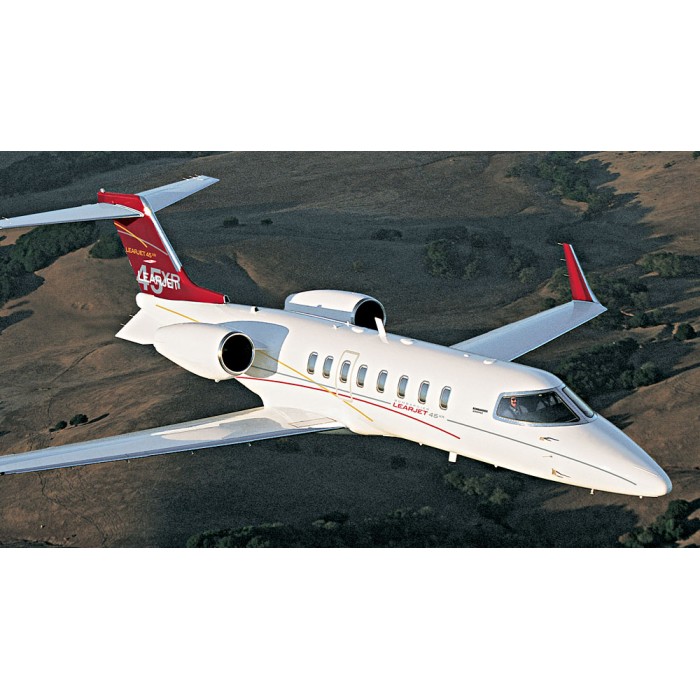


- Availability: Available for rent
Request aircraft information
The Learjet 45 and Learjet 45XR represent the most significant leap in Learjet history - the first completely clean-sheet Learjet design since the original Model 23 of 1963, and the world's first business jet fully designed and manufactured using computer-aided engineering. Development was announced on 14 September 1992; the prototype first flew on 7 October 1995; FAA type certification was granted on 22 September 1997; and first customer deliveries began in mid-1998. The Learjet 45XR, introduced in June 2004, upgraded the base 45's TFE731-20AR engines to TFE731-20BR specification, adding 1,000 lb of maximum takeoff weight, better hot-and-high performance and a restyled cabin with more legroom and better lighting. Business Jet Traveler confirmed that out of Aspen, Colorado, with eight passengers aboard, the XR "will fly almost 1,000 nautical miles farther than a standard Learjet 45." Production of the 45XR ended in 2012 with 208 aircraft built; 207 remain in active operation. The Learjet 75 - the final Learjet ever produced - is essentially the 45XR with TFE731-40BR engines, Garmin G5000 avionics and redesigned winglets.
The Learjet 45XR is positioned in what Wikipedia described as the "super-light" category - offering light business jet operating economics combined with mid-size business jet performance. The 410 ft³ flat-floor cabin with double-club eight-seat layout plus a fully enclosed lavatory (usable as a ninth seat) provides a complete cabin package. Massive Dee Howard thrust reversers, trailing-link main landing gear and electronic braking provide short-field stopping performance. Delta Fins from the Learjet 31 lineage are retained. Charter prices start from approximately £2,200 per flight hour. For the full fleet see our private jet price guide or browse our complete fleet.

Why charter the Learjet 45XR?
- First clean-sheet Learjet since 1963; first business jet designed entirely with CAE; 500+ delivered - the most successful modern Learjet. Wikipedia confirmed the Learjet 45 was "the first all-new design since the original Learjet" and "the world's first business jet fully designed and manufactured using computer-aided engineering." This complete redesign - rather than the fuselage extensions and wing substitutions of the 31, 35 and 40 series - allowed Bombardier to optimise the airframe for the double-club cabin layout, flat floor and FAR Part 25 certification from the outset. By November 2010 over 500 of the Model 45 and 45XR combined had been delivered - the most successful new-design Learjet programme. The Learjet 45XR directly led to the Learjet 75 (essentially the same airframe with better engines and Garmin G5000 avionics), confirming the 45XR platform's longevity as Bombardier's light jet reference design for nearly 30 years;
- TFE731-20BR engines flat-rated to 104°F - superior hot-and-high versus base 45; up to 1,000 nm more range from demanding airports. Wikipedia confirmed the Learjet 45XR's TFE731-20BR engines are "flat-rated to 3,500 pounds thrust, even at 104 degrees Fahrenheit" - versus 88°F for the base 45's TFE731-20AR. This higher temperature flat-rating directly reduces balanced field length in hot conditions, improves climb performance and extends range at challenging airports. Business Jet Traveler confirmed the XR's performance advantage "can be dramatic: out of Aspen, the XR with eight passengers will fly almost 1,000 nautical miles farther than a standard Learjet 45." The same engines power the Learjet 40XR - the BR configuration is the defining upgrade across the 40/45 XR family. The 5,000-hour TBO provides strong long-term maintenance economics across the 207-strong active fleet;
- 410 ft³ flat-floor double-club cabin - largest volume in its class; 9 certified seats including belted lavatory; more legroom than Learjet 40XR. GlobalAir confirmed the Learjet 45XR cabin volume of 410 ft³ - 13% more than the Learjet 40XR's 363 ft³ and the largest in the super-light jet category. Wikipedia confirmed the design uses "a non-circular cross-section for additional headroom" - 1.50 m throughout. The double-club seating arrangement of eight individual seats plus a fully enclosed belted lavatory (ninth seat) provides a complete group seating solution. Dee Howard thrust reversers, trailing-link landing gear and electronic braking provide short-field performance: BFL capability from 4,000-foot runways at lighter loads, as confirmed by Wikipedia. The XR's cabin update also included more comfortable seats, additional legroom and better lighting versus the original 45;
- APU standard on 45XR; Dee Howard thrust reversers; trailing-link gear - the most equipped Learjet light jet cabin in the 40/45 series. Omni Aircraft Sales confirmed the Learjet 45XR "comes standard with the Honeywell RE100 Auxiliary Power Unit" - the APU was optional on the base Learjet 45. The APU provides independent electrical power and air conditioning on the ground, enabling fully pre-conditioned cabin temperature without ground power equipment. Business Jet Traveler confirmed the "massive Dee Howard thrust reversers combine for soft landings and sure-footed stopping." The electronic braking system further reduces landing roll. The Learjet 45XR is consequently the most operationally self-sufficient aircraft in the 40/45 series, enabling operations at airports without ground support infrastructure;
- 465 kt / Mach 0.81 high-speed cruise; 51,000 ft ceiling; 1,830-2,049 nm NBAA IFR range; short runway access from 4,000 ft. FlyRadius confirmed high-speed cruise of 465 kt (861 km/h) at Mach 0.81 and long-range cruise of 432 kt. Wikipedia confirmed a 51,000 ft service ceiling and 1,971 nm range at Mach 0.81 with four passengers. At 51,000 ft the Learjet 45XR operates above all commercial traffic and above all weather on European sectors. The sea-level cabin is maintained to 25,700 ft; maximum cabin altitude is 7,800 ft at 51,000 ft. The 4,000-foot runway capability at lighter loads (Wikipedia confirmed) opens regional European airfields to the 45XR that larger super-midsize jets cannot access at equivalent payload;
- 208 aircraft built; 207 in operation; direct ancestor of Learjet 75; global active fleet. Jetcraft confirmed 208 Learjet 45XRs built with 207 remaining in active operation - a 99.5% retention rate. The Learjet 45XR remained the Learjet Division's principal product from 2004 to 2012, with the subsequent Learjet 75 directly built upon its airframe, engines and type certificate. Omni Aircraft Sales confirmed 232 total Learjet 45/45XR still active. Fleet concentration: 71% North America, 10% South America. Ryanair notably operates three Learjet 45s for crew and parts ferrying - an endorsement of the type's operational economics. Pre-owned values of $1.5 to $4.9 million (Wikipedia, 2018) reflect a stable mid-market position.
Charter cost - Learjet 45XR prices from UK airports
Hourly rates run from approximately £2,200 to £2,800 - above the Learjet 40XR (smaller cabin, 6 seats) and broadly comparable to the Embraer Phenom 300E, reflecting the 45XR's larger 410 ft³ double-club cabin, nine-seat capacity, APU standard, Dee Howard thrust reversers and 465 kt cruise. For 6 to 9 passengers on short and medium European missions where a full double-club layout, enclosed lavatory and APU are priorities, the Learjet 45XR provides the most complete Learjet cabin in its weight class.
Indicative one-way prices from UK airports:
- London to Edinburgh - from £2,640 (8 passengers, approximately 50 minutes);
- London to Paris - from £2,750 (8 passengers, approximately 50 minutes);
- London to Geneva - from £3,740 (8 passengers, approximately 1 hour 10 minutes);
- London to Nice - from £4,620 (8 passengers, approximately 1 hour 35 minutes);
- London to Madrid - from £5,060 (8 passengers, approximately 1 hour 50 minutes);
- Edinburgh to Istanbul - from £11,440 (8 passengers, non-stop, approximately 3 hours 30 minutes);
- London to Dublin - from £2,640 (8 passengers, approximately 55 minutes).
Empty Leg flights appear on repositioning routes. See our Empty Legs page for current availability.

Ideal routes for the Learjet 45XR
Best matched to short and medium European missions where the double-club eight-seat cabin, APU, 465 kt cruise and 51,000 ft ceiling serve groups of 6 to 9:
- Full-group European day trips (50 to 100 minutes) for 7 to 9 passengers in double-club layout. For groups of 7, 8 or 9 the Learjet 45XR is the appropriate Learjet - the double-club eight-seat plus belted lavatory layout is designed for this group size. The Learjet 40XR accommodates 6 standard; the 45XR accommodates 8 standard. Paris, Geneva, Amsterdam, Barcelona and Nice are all within 50 to 100 minutes at 465 kt. The APU means the cabin is pre-conditioned at the aircraft before boarding - no ground power truck required;
- Working meetings for 6 to 8 in double-club configuration with fold-out tables and flat floor. The double-club layout creates a natural face-to-face configuration for four people at the forward club and four at the rear club. Fold-out tables provide work surfaces at all positions. The flat floor allows free movement throughout the cabin. The 410 ft³ volume provides adequate space for 8 people on European sectors up to 3 hours. The Honeywell Primus 1000 weather radar, TCAS and EGPWS give the crew complete situational awareness on working meeting sectors;
- Hot-and-high airport departures (Geneva, Innsbruck, Madrid, Aspen) where TFE731-20BR flat-rating at 104°F matters. Business Jet Traveler documented the XR's dramatic performance advantage in hot-and-high conditions: out of Aspen with 8 passengers, the XR carries almost 1,000 nm more range than the base Learjet 45. For European charter from Geneva, Madrid or Innsbruck in summer conditions, the BR engines' 104°F flat-rating provides a meaningful operational margin over the base 45's 88°F threshold. The 4,000-foot short-field capability at lighter loads also enables access to Alpine airstrips unavailable to heavier midsize jets;
- Longer European sectors (2 to 3.5 hours) within 1,830-2,049 nm range to Istanbul, Athens and North Africa. London to Istanbul (approximately 1,550 nm), Edinburgh to Athens (approximately 1,650 nm), London to Marrakech (approximately 1,400 nm) and London to the Canaries (approximately 1,850 nm) are all within range. The 51,000 ft ceiling provides weather avoidance on these longer sectors. The fully enclosed lavatory makes the 45XR comfortable for up to 3.5-hour sectors for all 8 passengers;
- Remote base operations where APU independence from ground power is operationally important. The Honeywell RE100 APU standard on the Learjet 45XR (optional on the base 45) provides electrical power and cabin air conditioning without requiring ground power equipment or external pre-conditioning. For operations at remote UK regional airfields, Scottish strips or European airports without full ground support infrastructure, the APU ensures cabin readiness and crew comfort at any ground location.

Cabin and in-flight experience
The Learjet 45XR cabin measures 6.02 m (19 ft 9 in) long, 1.55 m (5.1 ft) wide and 1.50 m (4.9 ft) high - 410 ft³, flat floor throughout, with a non-circular fuselage cross-section designed to maximise headroom. The standard configuration is double-club: four forward-facing seats in the forward club and four seats in the rear club, with a fully enclosed belted lavatory (usable as a ninth seat) and a 15 ft³ wardrobe compartment alongside it. The XR-updated cabin introduced more comfortable seats, additional legroom versus the original 45 and improved lighting. The Dee Howard thrust reversers are a defining operational feature: Business Jet Traveler described them as "massive," contributing to soft landings and short landing roll.
Baggage capacity totals 65 ft³: 50 ft³ in the external aft compartment (ground-accessible) and 15 ft³ in the lavatory wardrobe. The Honeywell Primus 1000 avionics provide four EFIS screens, TCAS, EGPWS, colour weather radar and digital engine control. The Honeywell RE100 APU is standard on the 45XR. Sea-level cabin is maintained to 25,700 ft; maximum cabin altitude is 7,800 ft at the 51,000 ft ceiling. Two TFE731-20BR engines at 3,500 lbf each; 204 gph fuel burn; 5,000-hr TBO.
- Cabin. 6.02 m x 1.55 m x 1.50 m; 410 ft³; flat floor; non-circular cross-section;
- Layout. Double-club 8 standard; belted lavatory = 9th certified seat;
- XR cabin updates. More comfortable seats; additional legroom vs base 45; improved lighting;
- Lavatory. Fully enclosed; belted seat; 15 ft³ wardrobe;
- Baggage. 65 ft³ total (50 ft³ external aft + 15 ft³ wardrobe);
- APU. Honeywell RE100 (standard on XR; optional on base 45);
- Thrust reversers. Dee Howard (standard; massive; short landing roll);
- Engines. 2 x Honeywell TFE731-20BR (3,500 lbf; flat-rated to 104°F; 5,000-hr TBO; 204 gph);
- Avionics. Honeywell Primus 1000 (4 EFIS screens; TCAS; EGPWS; weather radar);
- Pressurisation. Sea-level to 25,700 ft; 7,800 ft cabin at 51,000 ft.
Technical specifications
| Manufacturer | Bombardier Learjet, Wichita, Kansas |
| LJ45 first flight | 7 October 1995 |
| LJ45 FAA certification | 22 September 1997 |
| LJ45 service entry | Mid-1998; ended 2006/2007 |
| LJ45XR introduced | June 2004; ended 2012 |
| Production | 208 Learjet 45XR built; 207 in operation |
| Design | First clean-sheet Learjet since 1963; first CAE business jet; direct basis for Learjet 75 |
| Aircraft class | Super-light / light with midsize performance (FAR Part 25) |
| Engines (45XR) | 2 x Honeywell TFE731-20BR (3,500 lbf; flat-rated to 104°F; 5,000-hr TBO; 204 gph) |
| Engines (45) | 2 x Honeywell TFE731-20AR (3,500 lbf; flat-rated to 88°F) |
| Avionics | Honeywell Primus 1000 (4 EFIS; TCAS; EGPWS; weather radar) |
| APU | Honeywell RE100 (standard on XR) |
| Max cruise speed | 465 kt / 861 km/h (Mach 0.81) |
| Long-range cruise | 432 kt / 800 km/h (Mach 0.75) |
| Service ceiling | 51,000 ft / 15,550 m |
| Pressurisation | Sea-level to 25,700 ft; 7,800 ft at 51,000 ft |
| Range (NBAA IFR 4 pax) | 1,830-2,049 nm / 3,389-3,795 km |
| Range (8 pax) | 1,685-1,900 nm (load dependent) |
| MTOW (45XR) | 21,500 lb / 9,752 kg (+1,000 lb vs base LJ45) |
| Runway (loaded) | From 4,000 ft (lighter loads); 5,040 ft BFL at MTOW |
| Thrust reversers | Dee Howard (standard) |
| Landing gear | Trailing-link main gear; electronic braking |
| Cabin length | 6.02 m (19 ft 9 in) |
| Cabin width | 1.55 m (5.1 ft) |
| Cabin height | 1.50 m (4.9 ft) |
| Cabin volume | 410 ft³ (13% more than Learjet 40XR) |
| Passengers | 8 standard (double-club); 9 with belted lavatory seat |
| Baggage | 65 ft³ total (50 ft³ external + 15 ft³ wardrobe) |
| Wingspan | 14.56 m (with winglets) |
| Aircraft length | 17.56 m |
| Aircraft height | 4.31 m |

Learjet 45XR vs similar aircraft
- Learjet 45XR vs Learjet 40XR. The Learjet 40XR is the direct sibling - same clean-sheet wing and fuselage cross-section, same TFE731-20BR engines, but 24.5 inches shorter cabin, two fewer seats (6 vs 8 standard), 100 gal less fuel and approximately 170 nm less range. Charter rates for the 40XR run approximately 15 to 20% below the 45XR. For groups of exactly 6 passengers on shorter sectors, the 40XR provides the same speed and ceiling at lower rates; for groups of 7 to 9 or sectors over 1,800 nm, the 45XR is the necessary choice. The 45XR also adds the APU as standard and Dee Howard thrust reversers;
- Learjet 45XR vs Embraer Phenom 300E. The Phenom 300E has modern Garmin G3000 avionics, lower fuel burn, stronger Embraer factory support and a lighter acquisition price. Charter rates are broadly comparable. The Learjet 45XR counters with 465 kt cruise (comparable), 410 ft³ cabin (vs Phenom 300E's approximately 311 ft³ - 32% more), double-club 8-seat layout (vs Phenom 300E's 6-7 standard), APU standard, Dee Howard thrust reversers, 51,000 ft ceiling and 9 certified seats including lavatory. For groups of 7 to 9 the 45XR's cabin volume advantage is decisive; for groups of 5 to 6 the Phenom 300E offers modern avionics at lower rates;
- Learjet 45XR vs Learjet 75. The Learjet 75 is the direct successor - same 45XR airframe with TFE731-40BR engines (3,850 lbf; 10% more thrust), Garmin G5000 avionics, redesigned winglets and 12% shorter balanced field length. Charter rates for the Learjet 75 run approximately 15 to 25% above the 45XR. The 45XR counters with lower rates, the same 51,000 ft ceiling, comparable range and the well-established 207-aircraft active fleet. For clients who want the most current Learjet avionics (Garmin G5000 vs Primus 1000) the 75 is preferable; for comparable performance at lower rates the 45XR is the practical choice.

Frequently asked questions - Learjet 45XR charter
How much does it cost to charter a Learjet 45XR?
Charter rates run from approximately £2,200 to £2,800 per flight hour. London to Geneva costs from £3,740 for 8 passengers. London to Edinburgh costs from £2,640. Edinburgh to Istanbul costs from £11,440 non-stop. All quotes from Private Jets UK are fully itemised with no hidden charges.
What is the difference between the Learjet 45 and Learjet 45XR?
The primary difference is the engines: the Learjet 45 uses TFE731-20AR engines flat-rated to 3,500 lbf at up to 88°F, while the Learjet 45XR uses TFE731-20BR engines flat-rated to the same 3,500 lbf at up to 104°F. The higher temperature flat-rating significantly improves hot-and-high performance - Business Jet Traveler confirmed the XR can fly almost 1,000 nm farther than the base 45 out of Aspen with 8 passengers. The XR also adds 1,000 lb of MTOW, the APU as standard, and a restyled cabin with more legroom and better lighting.
Is the Learjet 45XR the predecessor of the Learjet 75?
Yes - the Learjet 75 is essentially the Learjet 45XR with three upgrades: TFE731-40BR engines (3,850 lbf vs 3,500 lbf; 10% more thrust), Garmin G5000 avionics (vs Honeywell Primus 1000) and redesigned winglets. Wikipedia confirmed the Learjet 75 "is essentially a Model 45XR with more modern engines, engine systems and Garmin 5000 avionics and more efficient winglets." The 45XR's type certificate forms the basis for the Learjet 75 certification.
How many passengers can fly on a Learjet 45XR?
Eight in the standard double-club configuration; nine with the fully enclosed belted lavatory seat occupied. FlyRadius confirmed 11 total certified seats (2 crew + 9 passengers). The cabin volume of 410 ft³ with 6.02 m length makes the 45XR the most spacious aircraft in the 40/45 Learjet series for charter groups of 7 to 9 passengers.
Does the Learjet 45XR have an APU?
Yes - the Honeywell RE100 APU is standard equipment on the Learjet 45XR, whereas it was an optional extra on the base Learjet 45. The APU provides independent electrical power and air conditioning without requiring ground power equipment or external air-conditioning units. This makes the 45XR operationally self-sufficient at any ground location, including remote UK regional airfields.

