


Charter a Piper Seneca (PA34)


- Availability: Available for rent
Request aircraft information
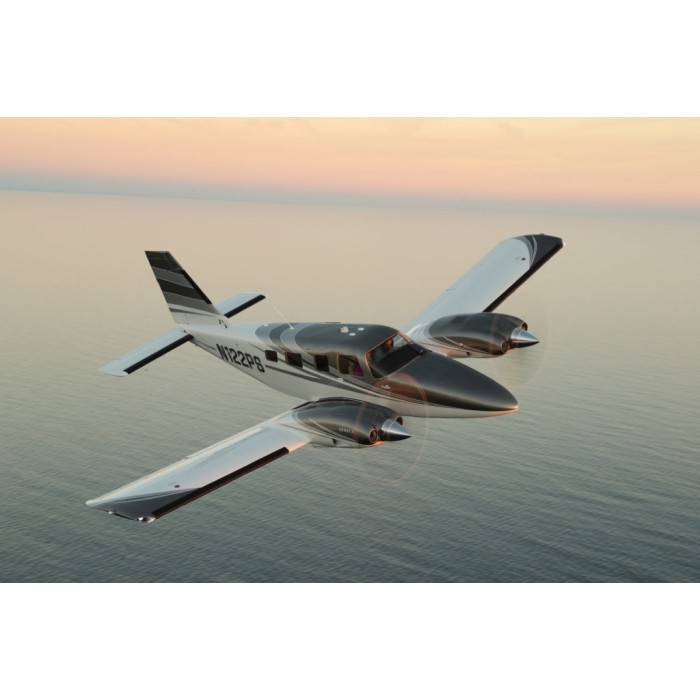
The Piper PA-34 Seneca is one of the most successful twin-engine light aircraft ever built and one of aviation's longest-running production programmes - certified in May 1971 and with the final Seneca V deliveries reported in 2019-2020, it remained in production for nearly five decades. Approximately 5,000 Senecas were built across five variants, with licence production adding further aircraft through Embraer in Brazil (EMB-810, 680 built) and PZL-Mielec in Poland (M-20 Mewa). The Seneca began as a twin-engine development of the Piper Cherokee Six, and the prototype famously flew as a tri-motor aircraft - with a nose engine retained alongside the two wing-mounted engines - before the three-engine configuration was abandoned. Wikipedia confirmed the original Seneca I used counter-rotating Lycoming IO-360 engines "to eliminate the critical engine limitations of other light twins," making the Seneca safer and more controllable in single-engine scenarios from its first variant. The current Seneca V (PA-34-220T, certified December 1996, produced as a 1997 model) added intercooled Continental TSIO-360-RB engines at 220 hp each and the Garmin G1000 integrated glass cockpit from 2013.
The Piper PA-34 Seneca is a twin-engine piston aircraft - not pressurised, not a turboprop and not a jet. The 7,620 m (25,000 ft) service ceiling and Garmin G1000 avionics on the Seneca V provide modern capability at the lowest available twin-engine charter rate. Air Charter Service confirmed the Seneca is "designed for short flights like London to Edinburgh or New York to Boston" and is popular "with air charter companies and small feeder airlines." Charter prices start from approximately £500 per flight hour. For the full fleet see our private jet price guide or browse our complete fleet.

Why charter the Piper Seneca?
- Counter-rotating propellers eliminate the "critical engine" - safer single-engine handling than most light twins. Wikipedia confirmed the original Seneca's counter-rotating Lycoming IO-360 engines - one turning clockwise, the other anti-clockwise - were specifically designed to "eliminate the critical engine limitations of other light twins." In a conventional light twin with both propellers turning the same direction, failure of one engine creates significantly more asymmetric thrust and yaw than the other. The counter-rotating configuration means either engine can fail and the asymmetric handling difficulty is equivalent - there is no "critical" engine to lose. The Seneca V retains counter-rotating McCauley three-blade propellers on the Continental TSIO-360-RB engines. This safety engineering - unusual in a piston twin at this charter rate - is a meaningful differentiator over comparable single-rotation light twins and makes the Seneca a preferred platform for multi-engine IFR training and commercial charter operations;
- Garmin G1000 glass cockpit (Seneca V from 2013); GFC 700 autopilot; synthetic vision; digital audio panels - current-generation avionics at piston twin rates. Airforce Technology confirmed the Seneca V cockpit carries "Garmin G1000 avionics suite integrating state-of-the-art communication and navigation systems" including "GFC 700 autopilot system, digital audio panels, Garmin FliteCharts, transponder, electronic flight displays, air data computers and a yaw damper system." Grokipedia confirmed the G1000 was introduced on the Seneca V in 2013 with "synthetic vision, autopilot integration via the GFC 700, and digital engine monitoring for reduced pilot workload." For a piston twin at £500/hr charter rates, the Garmin G1000 provides genuinely modern glass cockpit capability - the same avionics generation as the King Air C90GTi at £900/hr. For charter clients who value current avionics and IFR safety systems at the lowest available twin-engine rate, the Seneca V G1000 is the argument;
- ~5,000 built 1971-2020; Embraer EMB-810 (Brazil); PZL M-20 Mewa (Poland); Brazilian Air Force U-7 - global fleet with deep parts and MRO support. Grokipedia confirmed approximately 5,000 Senecas across the production run. Wikipedia confirmed licence production in Brazil (EMB-810; 680 built) and Poland (M-20 Mewa). The Brazilian Air Force designation U-7 reflects military adoption of the EMB-810C variant. The depth of this global fleet - with Lycoming IO-360 and Continental TSIO-360 engines supported by global overhaul networks - means parts and MRO availability for the Seneca is comprehensive across Europe, North America and South America. Air Charter Service documented Seneca availability with operators across the UK and Europe. For charter clients who value fleet depth and parts support in an economical piston twin, the Seneca's global installed base is unmatched in its class;
- 25,000 ft service ceiling; 370 km/h max speed; turbocharged TSIO-360-RB intercooled engines; single-engine ceiling 17,400 ft - meaningful altitude capability. Airforce Technology confirmed the Seneca V's 7,620 m (25,000 ft) service ceiling and 370 km/h maximum speed. The Continental TSIO-360-RB engines are both turbocharged and intercooled - the intercooler cools the compressed intake air before it enters the cylinders, improving power retention at altitude versus non-intercooled turbocharged engines. The single-engine service ceiling of 17,400 ft provides significant weather avoidance capability even on one engine - meaningfully higher than the Piper Aztec's 18,944 ft normal ceiling and comparable on single-engine. At 25,000 ft the Seneca V operates above most European convective weather. Airforce Technology confirmed a climb rate of 1,455 ft/min and takeoff ground roll of 520 m (1,706 ft);
- Rear double door; 520 m takeoff and 664 m landing; short-field access; London to Edinburgh non-stop - designed for regional short-sector missions. Airforce Technology confirmed takeoff distance of 520 m and landing distance of 664 m. Air Charter Service confirmed the Seneca "can fly non-stop for up to 1,296 km" and is "designed for short flights like London to Edinburgh or New York to Boston." The rear double door provides easy passenger access and baggage loading at small regional airfields. For charter clients who need to reach a destination airfield with a 600 to 800 m runway, the Seneca's short-field capability combined with IFR certification and Garmin G1000 avionics opens access to UK and European regional strips that jet and turboprop charter aircraft cannot match at comparable rates;
- Longest production run of any light piston twin - nearly 50 years; Seneca V the current standard; pre-owned from $150,000; lowest available IFR-capable twin rate. From 1971 certification to 2020 final deliveries, the Seneca's nearly 50-year production run is the longest of any light piston twin in aviation history. Aviator Tells confirmed pre-owned values of $150,000 to $700,000 depending on variant and condition. Air Charter Service confirmed the Seneca V typically features Garmin G1000 avionics. For charter clients whose budget is below the Piper Aztec or Baron 58 rate but who want IFR-capable twin-engine piston flying with modern avionics, the Seneca provides the entry point in the Private Jets UK fleet.
Charter cost - Piper Seneca prices from UK airports
Hourly rates run from approximately £500 to £700 - the lowest in the Private Jets UK fleet, reflecting the Seneca's piston engine configuration, smaller cabin dimensions and lower acquisition cost versus the Baron 58 and Aztec. Zadra Aviation Charter confirmed charter rates of €300 to €600 per hour for the Seneca in the European market. For groups of 3 to 4 on short UK regional sectors under 400 nm, the Piper Seneca provides IFR-capable twin-engine safety at entry-level pricing.
Indicative one-way prices from UK airports:
- London to Edinburgh - from £600 (4 passengers, approximately 1 hour 30 minutes);
- London to Paris - from £625 (4 passengers, approximately 1 hour 30 minutes);
- Edinburgh to Inverness - from £500 (4 passengers, approximately 40 minutes);
- London to Amsterdam - from £650 (4 passengers, approximately 1 hour 30 minutes);
- London to Dublin - from £600 (4 passengers, approximately 1 hour 20 minutes);
- Manchester to Belfast - from £525 (4 passengers, approximately 45 minutes);
- London to Geneva - from £1,000 (4 passengers, approximately 2 hours 15 minutes).
Empty Leg flights appear on repositioning routes. See our Empty Legs page for current availability.

Ideal routes for the Piper Seneca
Best matched to short UK regional and European missions under 400 nm where the lowest available twin-engine IFR rate, counter-rotating propeller safety, Garmin G1000 avionics and short-field access serve groups of 3 to 4:
- Short UK regional sectors where the lowest available twin-engine rate is the priority. Edinburgh to Inverness, London to Belfast, Manchester to Cardiff, London to Bristol and other sub-90-minute UK hops are the Seneca's natural territory. At £500-600/hr the Seneca is at or below the Piper Aztec's charter rate with the advantage of Garmin G1000 avionics on Seneca V aircraft. For budget-constrained corporate groups on UK domestic routes, the Seneca provides IFR twin-engine capability at the minimum available rate;
- Short European day trips (1 to 2 hours) to Paris, Amsterdam and Dublin within 700 nm typical range. London to Paris (approximately 210 nm), London to Amsterdam (approximately 250 nm) and London to Dublin (approximately 220 nm) are all comfortably within the Seneca's range. At 177 kt cruise these sectors take 75 to 90 minutes. For 3 to 4 passengers where the £600-650 sector cost is the selection criterion, the Seneca provides the lowest twin-engine option for these standard European day trips;
- Short-field and small airfield access where the 520 m takeoff roll opens runways below 800 m. The Seneca's 520 m takeoff ground roll enables operations from regional UK strips, Highland approaches and small European airfields with 600 to 800 m runways. For charter clients whose destination has a constrained runway and whose group is 3 to 4 people, the Seneca's combination of twin-engine IFR certification and short-field performance provides access at a rate below the Aztec or Baron 58;
- Multi-engine IFR training and dual-purpose charter-training operations. Grokipedia confirmed the Seneca is "a preferred choice for obtaining multi-engine ratings and instrument qualifications" with flight schools across North America. In Europe the Seneca serves dual roles: charter operations for 3 to 4 passengers on short sectors, and multi-engine IFR training for pilots seeking type ratings. This dual-purpose market means a deeper active fleet of Senecas across UK and European FBOs than the Aztec or Baron 58, improving availability for charter bookings at short notice;
- Groups of 3 to 4 where the Seneca's compact cabin is adequate for short-sector missions. Air Charter Service confirmed the Seneca "is typically laid out for four passengers" in charter configuration, with a fifth possible if the aircraft is owner-operated (not in charter). For groups of exactly 3 to 4 on sectors under 90 minutes, the cabin dimensions (3.15 m × 1.23 m × 1.06 m) are adequate. The rear double door makes loading and unloading straightforward at small regional airfields. The baggage hold provides space for approximately four suitcases.

Cabin and in-flight experience
The Piper Seneca V cabin measures 3.15 m (10.3 ft) long, 1.23 m (4.0 ft) wide and 1.06 m (3.5 ft) high - compact for four passengers in a forward club arrangement. Air Charter Service confirmed the cabin is "typically laid out for four passengers." Newer and retrofitted models include leather seats, carpets, power sockets, lighting controls, beverage holders, fold-out work tables and individual seat controls. The rear double door provides practical passenger and baggage access at small regional airfields. Baggage space accommodates approximately four standard suitcases. The cabin is not pressurised; the 25,000 ft service ceiling is the maximum approved altitude without supplemental oxygen for passengers above 12,500 ft for extended periods - for typical cruising altitudes of 8,000 to 12,000 ft on short sectors this is not a practical limitation.
The Seneca V cockpit carries the Garmin G1000 suite (from 2013 model year): two 10.4-inch PFD/MFD displays, GFC 700 autopilot, synthetic vision, Garmin FliteCharts, digital audio panels, yaw damper and ADS-B. Earlier Seneca V aircraft carry analogue instruments. Confirm the avionics standard with the operator before booking. Two Continental TSIO-360-RB engines with counter-rotating McCauley three-blade propellers; 220 hp each; 1,455 ft/min climb rate; fuel burn approximately 20-24 gph total.
- Cabin. 3.15 m x 1.23 m x 1.06 m; 4 passengers standard charter; not pressurised;
- Layout. Forward club-4; rear double door; 4 suitcases baggage;
- Propellers. Counter-rotating (no critical engine) - key safety feature;
- Engines (Seneca V). 2 x Continental TSIO-360-RB (220 hp each; turbocharged + intercooled; ~20-24 gph total);
- Avionics (Seneca V from 2013). Garmin G1000 (2x PFD/MFD; GFC 700 autopilot; synthetic vision; yaw damper);
- Short-field. 520 m takeoff ground roll; 664 m landing ground roll.
Technical specifications
| Manufacturer | Piper Aircraft, Vero Beach, Florida |
| FAA certification | 7 May 1971 (Seneca I); Seneca V: 11 December 1996 |
| Production | 1971-2020 (non-continuous); ~5,000 built; Seneca V from 1997 |
| Licence production | Embraer EMB-810 (Brazil; 680 built); PZL M-20 Mewa (Poland) |
| Variants | Seneca I (IO-360; 1971); II (TSIO-360; 1975); III (1981); IV (1994); V (TSIO-360-RB; 1997) |
| Aircraft class | Light twin-engine piston (not turboprop; not jet; not pressurised) |
| Engines (Seneca V) | 2 x Continental TSIO-360-RB (220 hp each; turbocharged + intercooled; counter-rotating) |
| Propellers | McCauley 3-blade counter-rotating; full-feathering; constant-speed |
| Counter-rotating | Yes - eliminates critical engine; unique safety feature for light twin |
| Max speed | 370 km/h (200 kt) |
| Cruise speed | 177 kt / 328-348 km/h |
| Climb rate | 1,455 ft/min (two engines) |
| Single-engine ceiling | 17,400 ft / 5,303 m |
| Service ceiling | 25,000 ft / 7,620 m |
| Pressurised | No |
| Range (with 45-min reserve) | 1,534 km / 828 nm (Seneca V) |
| Takeoff ground roll | 520 m (1,706 ft) |
| Landing ground roll | 664 m (2,178 ft) |
| MTOW | 4,750 lb / 2,155 kg |
| Useful load (standard) | 1,331 lb / 604 kg |
| Avionics (Seneca V from 2013) | Garmin G1000 (2x PFD/MFD; GFC 700 autopilot; synthetic vision; yaw damper) |
| Cabin length | 3.15 m (10.3 ft) |
| Cabin width | 1.23 m (4.0 ft) |
| Cabin height | 1.06 m (3.5 ft) |
| Passengers | 4 standard charter; 5 maximum |
| Baggage | ~4 suitcases; rear double door access |
| Wingspan | 11.86 m (38.9 ft) |
| Aircraft length | 8.72 m (28.6 ft) |
| Aircraft height | 3.02 m (9.9 ft) |

Piper Seneca vs similar aircraft
- Piper Seneca vs Piper Aztec. The Aztec has a longer cabin (3.30 m vs 3.15 m), higher 1,600 lb payload (vs Seneca V's 1,331 lb standard), and an 820-foot takeoff roll (vs Seneca's 1,706 ft) for short-strip access. The Seneca V counters with the Garmin G1000 avionics on post-2013 aircraft (vs analogue on most Aztecs), counter-rotating propellers (no critical engine vs standard-rotation on Aztec), more modern construction and typically comparable charter rates. For groups requiring the shortest-strip access or highest payload, the Aztec is preferable; for clients who want modern glass cockpit avionics at comparable rates, the Seneca V is the choice;
- Piper Seneca vs Beechcraft Baron 58. The Baron 58 has a dedicated club-four cabin layout, London City certification (G58), Garmin G1000 NXi (G58) and a longer production run with deeper charter availability. Charter rates are broadly comparable (Baron 58 at £700/hr vs Seneca at £500/hr - Baron 58 approximately 30% higher). The Seneca counters with lower rates, counter-rotating propellers and typically comparable mission performance on short sectors. For groups where charter rate minimisation is the binding constraint and London City access is not required, the Seneca at £500/hr is the lowest available entry point;
- Piper Seneca vs Piper Cheyenne. The Piper Cheyenne II is a pressurised turboprop at £900/hr - 80% above the Seneca. The Cheyenne provides 283 kt cruise (vs 177 kt Seneca), 35,800 ft pressurised ceiling (vs Seneca's 25,000 ft unpressurised) and King Air-comparable range. For any mission where pressurisation, 35,000 ft cruise altitude or sectors over 400 nm are required, the Cheyenne is the appropriate step up. The Seneca remains the choice for short UK sectors where minimum rate and modern glass cockpit at piston-twin prices are the priorities.

Frequently asked questions - Piper Seneca charter
How much does it cost to charter a Piper Seneca?
Charter rates run from approximately £500 to £700 per flight hour. London to Edinburgh costs from £600 for 4 passengers. London to Paris costs from £625. London to Geneva costs from £1,000. All quotes from Private Jets UK are fully itemised with no hidden charges.
What makes the Piper Seneca's counter-rotating propellers significant?
Wikipedia confirmed the original Seneca's counter-rotating engines were designed to "eliminate the critical engine limitations of other light twins." In a standard light twin both propellers turn the same direction, meaning failure of one engine (the "critical engine") creates significantly more asymmetric thrust than the other. Counter-rotating propellers mean either engine can fail with equivalent handling difficulty - there is no more dangerous engine to lose. The Seneca V retains this design with counter-rotating McCauley propellers on the Continental TSIO-360-RB engines.
Is the Piper Seneca pressurised?
No - the Piper Seneca in all production variants is unpressurised. The 25,000 ft service ceiling is the maximum approved altitude. For short-sector cruising at 8,000 to 12,000 ft this is not a practical limitation. For any mission where pressurisation is required - winter Alpine crossings, extended high-altitude operations, or passenger health requirements - the Piper Cheyenne II is the appropriate step up at £900/hr.
What avionics does the Piper Seneca V have?
Seneca V aircraft built from 2013 onwards carry the Garmin G1000 suite with two 10.4-inch PFD/MFD displays, GFC 700 autopilot, synthetic vision, Garmin FliteCharts, digital audio panels, yaw damper and ADS-B. Earlier Seneca V aircraft (pre-2013) carry analogue instruments. Confirm the specific avionics fit with the operator before booking if G1000 capability is a requirement.
How does the Piper Seneca differ from the Piper Aztec?
The Aztec has a longer cabin (3.30 m vs 3.15 m), significantly higher payload at 1,600 lb (vs Seneca's 1,331 lb), a much shorter 820-foot takeoff roll (vs Seneca's 1,706 ft) and is typically cheaper or comparable in charter rate. The Seneca V counters with the Garmin G1000 glass cockpit on post-2013 aircraft (vs analogue on most Aztecs), counter-rotating propellers and more modern construction from a 50-year production lineage. For ultra-short strip access and maximum payload the Aztec is preferable; for modern avionics at minimum rates the Seneca V is the choice.

