


Charter a Quest Kodiak 100


- Availability: Available for rent
Request aircraft information
The Quest Kodiak 100 is one of the most capable and versatile single-engine turboprop utility aircraft ever built - a clean-sheet design conceived on the back of a napkin by two founders in the late 1990s, first flown on 16 October 2004, and FAA Part 23 type-certified on 31 May 2007, 32 months after first flight. The first delivery went to Spirit Air in January 2008. Aviation Consumer confirmed "the Kodiak came to life to fill the need for a modern-day bush airplane" that could serve humanitarian groups in tight, unimproved strips. Wikipedia confirmed the 200th aircraft was delivered in December 2016 and 300 aircraft by 2021. In April 2017 the Kodiak 100 received EASA type certification, opening European operations. In May 2018 Quest unveiled the Series II at $2.15 million with Garmin G1000 NXi avionics, single-point refuelling and numerous refinements. In 2019 Daher - manufacturer of the TBM turboprop family - acquired Quest Aircraft, bringing the Kodiak into the same product family as the TBM 910, 930 and 940. The stretched Kodiak 900 (PT6A-140A engine, 900 shp, 3.9 ft longer fuselage) received its EASA type certificate in April 2023.
The Quest Kodiak 100 is an unpressurised single-engine turboprop optimised for STOL performance and utility operations - not a corporate aircraft by design, but available in the Summit executive interior that provides club seating, cabinetry and a business meeting environment en route to remote destinations. JetAV confirmed the Kodiak "can take off in less than 700 feet at full gross takeoff weight" and "climb at over 1,500 feet per minute." Charter prices start from approximately £700 per flight hour. For the full fleet see our private jet price guide or browse our complete fleet.

Why charter the Quest Kodiak 100?
- Sub-700-foot takeoff at full gross weight; 1,500 ft/min climb; reversible Hartzell 4-blade propeller; STOL access to unimproved grass, gravel and dirt strips impossible for any other 10-seat aircraft. JetAV confirmed the Kodiak "can take off in less than 700 feet at full gross takeoff weight of 6,750 pounds and climb at over 1,500 feet per minute." The 96-inch Hartzell 4-blade reversible propeller enables aggressive braking on short landing rolls - reversible pitch propellers are standard on the Kodiak and allow the pilot to shorten landing distances significantly beyond conventional brake-only stops. Flying Magazine confirmed STOL operations from strips like Mineral Canyon in Utah where "the bushes closed in on the strip" and "the ground near the end of the runway was loose and sandy" posed no operational concern. The high-wing configuration provides propeller clearance over vegetation and uneven terrain. For charter clients whose destination has a 500 to 1,000-foot unimproved strip - an estate airfield, island approach, ski resort grass strip or remote highland access - the Kodiak 100 is the only 10-seat aircraft capable of operating from it at full passenger load;
- 10 passengers (track-mounted removable seats); large left-side cargo door; 3,535 lb useful load; optional cargo pod; quick conversion from passenger to cargo in under 30 minutes. Wikipedia confirmed the Kodiak seats "up to ten people with its track-mounted removable seats" and that "the cabin can be configured to several layouts." JetAV confirmed "cabin volume is 214 cu ft." Flying Magazine confirmed seat removal takes "about 30 seconds" per seat, enabling rapid conversion between passenger and cargo configurations. The large port-side cargo door and double-leaf aft hatch enable loading of oversized items. Global Air confirmed a "maximum useful load of around 3,535 pounds" - enabling the Kodiak to carry 10 passengers with limited baggage, or fewer passengers with significant freight simultaneously. The optional external cargo pod provides additional storage without reducing cabin capacity. For charter clients who need both passenger and freight capacity on the same flight to a remote location, the Kodiak's flexible cabin is uniquely capable;
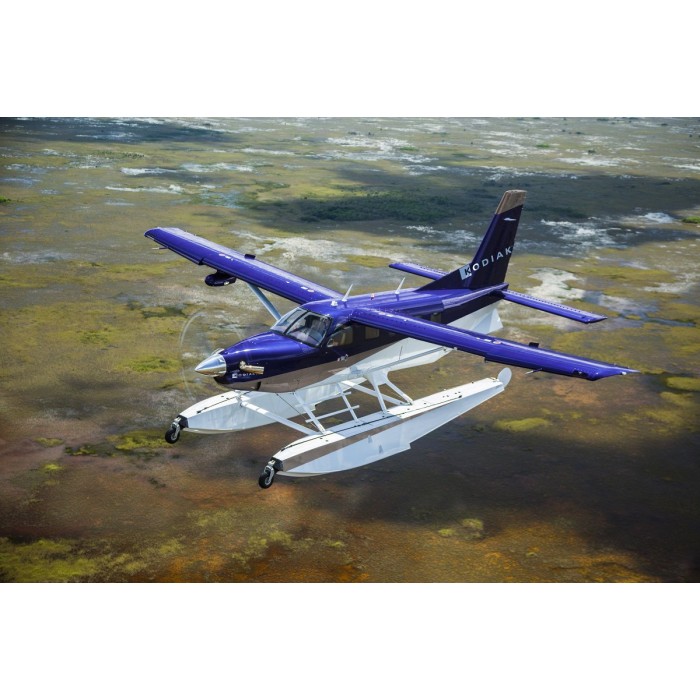
- Float operations without structural upgrade; Aerocet carbon-fiber amphibious floats; Wipaire Wipline 7000 STC; seaplane access to lakes, rivers and coastal waters unavailable to any other 10-seat aircraft. Aviation Consumer confirmed "floats can be added without structural upgrades" and that the Aerocet carbon-fiber amphibious floats "weigh a touch over 1,200 pounds." Wikipedia confirmed Wipaire received Supplemental Type Certification in June 2010 for Wipline 7000 amphibious floats. Aviation Consumer confirmed Clay Lacy Aviation added Kodiaks to its charter fleet specifically for New York East River to Hamptons operations "on floats." Wikipedia confirmed SpiceJet placed a 100-aircraft order for amphibious Kodiaks to connect Indian populations by water and unimproved runway access. The carbon fibre float option adds approximately $400,000 to the aircraft price but opens waterway access impossible for any fixed-gear land plane. For charter clients who want seaplane operations or amphibious access to lake and river destinations, the Kodiak on floats is the most capable 10-seat platform available;
- Garmin G1000 NXi (Series II from 2018); Flight Stream wireless connectivity; three interior options (Tundra/Timberline/Summit); skydive jump package approved; Northrop Grumman surveillance variant - extraordinary mission flexibility. The official Daher Series II brochure confirmed the G1000 NXi "suite with features like synthetic vision and vertical situation display" is standard. Aviation Consumer confirmed "the Series II is equipped with Garmin's Flight Stream wireless hub for tablet connectivity." Three interior packages: Tundra (lightweight, charter-optimised, utility); Timberline (carpet, leather seats, 30-second seat removal, cup holders, storage pockets); Summit (club seating, cabinetry, individual headset jacks, oxygen, LED lighting, AC control, charging ports). Wikipedia confirmed a skydive jump package and a Northrop Grumman surveillance modification with FLIR Systems Star Safire sensor and Persistent Surveillance Systems Hawkeye wide-area sensor. Optional equipment includes TKS de-icing, GWX 68 weather radar, StormScope, Garmin GTS 800 TCAS, parachute ejection package, dual-zone air conditioning and external cargo pod - enabling the Kodiak to be equipped for virtually any mission category;
- PT6A-34 at 750 shp; 320-gallon wet-wing fuel capacity; 48 gph at 174 KTAS / 33 gph at 135 KTAS economy; lowest overhaul cost of any PT6A variant; optimised for 12,000 ft operations. Aviation Consumer confirmed the PT6A-34 is "tuned to operate at lower altitudes and optimised for ops in the 12,000-foot range." Aviation Consumer confirmed the PT6A-34 overhaul cost of approximately $240,000 is lower than the PT6A-114A used in the Cessna 208 Caravan (approximately $250,000 with shorter TBO). The official Kodiak performance data confirms fuel burn of 48 gph at 174 KTAS at 12,000 ft and 33 gph at 135 KTAS economy cruise. The 320-gallon wet-wing fuel system stores all fuel behind the main spar, creating a fire-resistant crumple zone. Aviation Consumer noted inflatable door seals on the Series II eliminate jet exhaust ingress that affected earlier models, and significantly reduce cabin noise. For charter operators who need a reliable workhorse turboprop with the lowest lifecycle cost in its utility class, the PT6A-34 in the Kodiak provides it;
- Daher ownership since 2019; KodiakCare programme (2-year airframe warranty; 24/7 technical support); EASA certified April 2017; 300+ delivered; humanitarian mission heritage; the most capable single-engine utility turboprop available in Europe. Wikipedia confirmed Daher acquired Quest Aircraft from Setouchi Holdings in 2019, integrating the Kodiak into the same product family as the TBM series. The KodiakCare programme provides a two-year airframe warranty and 24-hour technical support. Wikipedia confirmed 300 aircraft delivered by 2021, with multiple missions including Mission Aviation Fellowship, JAARS, charter, cargo, skydiving and government surveillance. For European charter operators and clients, EASA certification (April 2017) is confirmed by Wikipedia. The Kodiak 100 is the only EASA-certified single-engine turboprop STOL utility aircraft currently available with float capability, cargo door, 10-seat capacity and Daher OEM support in its category.
Charter cost - Quest Kodiak 100 prices from UK airports
Hourly rates run from approximately £700 to £1,000 - reflecting the Kodiak's utility turboprop positioning, 10-seat capacity and STOL access credentials that no other aircraft at this rate provides. The $2.15 million new price for a Series II positions the Kodiak well below pressurised turboprops of comparable seat count. For groups of 6 to 10 on short UK regional or remote access sectors where no other aircraft can reach the destination, the Kodiak provides unique access at competitive group-per-person rates.
Indicative one-way prices from UK airports:
- London to Edinburgh - from £840 (8 passengers, approximately 1 hour 30 minutes);
- Edinburgh to Stornoway - from £700 (8 passengers, approximately 55 minutes);
- London to Dublin - from £770 (8 passengers, approximately 1 hour 20 minutes);
- London to Paris - from £910 (8 passengers, approximately 1 hour 30 minutes);
- Edinburgh to Inverness - from £700 (8 passengers, approximately 40 minutes);
- Manchester to Belfast - from £700 (8 passengers, approximately 45 minutes);
- London to Amsterdam - from £840 (8 passengers, approximately 1 hour 30 minutes).
Empty Leg flights appear on repositioning routes. See our Empty Legs page for current availability.

Ideal routes for the Quest Kodiak 100
Best matched to short UK regional and European missions where STOL access to unimproved strips, 10-seat capacity, cargo flexibility and amphibious float capability open destinations unavailable to any other aircraft in the Private Jets UK fleet:
- Scottish Highland, island and remote UK airstrips where the sub-700-foot takeoff and reversible propeller open access to strips under 1,000 feet. Barra beach landing strip, Tiree, Campbeltown, Broadford and other Scottish island and Highland airfields with short or soft surfaces are natural Kodiak territory. No other 10-seat aircraft in the Private Jets UK fleet can operate from these locations at full passenger load. For groups of 6 to 10 accessing remote Scottish island destinations, the Kodiak provides direct access that any other aircraft in the fleet cannot match;
- Amphibious float operations connecting waterside estates, loch access and coastal approaches impossible for land-based aircraft. On Aerocet amphibious floats, the Kodiak can land on any suitably calm water body - Scottish lochs, Irish coastal inlets, Norwegian fjords, Mediterranean harbours. Aviation Consumer confirmed Clay Lacy Aviation operates Kodiaks on floats for charter between New York's East River and the Hamptons. For charter clients whose destination has water access but no runway, or who want to arrive by seaplane at a loch-side estate in Scotland, the Kodiak on floats is the unique solution in the fleet;
- Groups of 8 to 10 on short UK regional sectors where the Kodiak provides the most seats per hour at the lowest group rate in the fleet. Edinburgh to Inverness, Manchester to Belfast, London to Dublin and similar sub-90-minute UK regional hops with groups of 8 to 10 are well suited to the Kodiak's 10-seat capacity. At 8 to 10 passengers the per-person cost for a Kodiak charter compares favourably with any private aircraft option and approaches commercial scheduled fares - without airport queues, baggage restrictions or fixed schedules;
- Mixed passenger-cargo missions where the large cargo door, 3,535 lb useful load and removable seats enable combined loads. For missions where a group of 4 to 6 passengers needs to travel with oversized equipment - medical supplies, survey equipment, scientific instruments, ski equipment and large bags - the Kodiak's large port-side cargo door and removable rear seats create a configuration unavailable in any pressurised turboprop. The optional external cargo pod adds further capacity without reducing cabin passenger space;
- Skydiving and specialist operations where the jump package approval and extraordinary STOL access create unique operational capability. The Quest Kodiak is approved for jump operations - Wikipedia confirmed the "jump package approved" as a milestone in the Kodiak's development programme. The high-wing configuration provides excellent exit clearance. For skydiving charter, the Kodiak's combination of jump approval, 10-seat capacity, STOL access from drop zones with short grass strips, and Daher OEM support makes it the preferred utility turboprop for specialist operators.

Cabin and in-flight experience
The Quest Kodiak 100 cabin measures 4.80 m (15.7 ft) long, 1.63 m (5.3 ft) wide and 1.37 m (4.5 ft) high - one of the widest single-engine turboprop cabins available, wider than the King Air 90 (1.37 m) at the same width and significantly wider than the TBM series (1.21 m). JetAV confirmed cabin volume of 214 cu ft. The cabin is not pressurised; the service ceiling is 25,000 ft. Three interior packages are available:
- Tundra. Lightweight base interior for charter and utility operations; heavy-use resistant; easy to clean;
- Timberline. Carpet (button-attached for quick removal), leather seats, storage pockets, cup holders, LED reading lights, 30-second seat removal for cargo conversion;
- Summit. Top-of-line executive: club seating, cabinetry, carpet, individual headset jacks, oxygen, LED lighting, AC control, charging ports for electronic devices.
Track-mounted seats remove in approximately 30 seconds each and fit in the optional external cargo pod when not in use. The large port-side cargo door enables loading of oversized items. Series II additions include Garmin Flight Stream wireless tablet connectivity, LEMO connectors for Bose headsets, improved Rosen sun visors and redesigned cargo sill. Fuel capacity is 320 gallons in a wet-wing design with all fuel stored behind the main spar. Optional equipment: dual-zone air conditioning, TKS de-icing, GWX 68 weather radar, StormScope, Garmin GTS 800 TCAS, parachute ejection package, external cargo pod, Aerocet carbon-fibre amphibious floats.
Technical specifications
| Manufacturer | Quest Aircraft Company, Sandpoint, Idaho (owned by Daher since 2019) |
| First flight | 16 October 2004 |
| FAA type certification | 31 May 2007 |
| EASA type certification | April 2017 |
| Series II | May 2018; G1000 NXi; single-point refuelling; $2.15 million |
| Production | Ongoing; 300+ delivered by 2021 |
| Aircraft class | Single-engine utility turboprop; STOL; unpressurised |
| Engine | Pratt and Whitney Canada PT6A-34 (750 shp takeoff / 700 shp continuous) |
| Propeller | Hartzell 4-blade constant-speed reversible; 96 in (2.44 m) diameter |
| Cruise speed | 174 KTAS / 322 km/h at 12,000 ft (48 gph) |
| Economy cruise | 135 KTAS / 250 km/h (33 gph; 1,132 nm range) |
| Climb rate | 1,500+ ft/min |
| Service ceiling | 25,000 ft / 7,620 m |
| Pressurised | No |
| Takeoff distance | Under 700 ft at MTOW on paved surface |
| Range (174 KTAS) | 1,005 nm / 1,861 km |
| Range (135 KTAS economy) | 1,132 nm / 2,096 km |
| Fuel capacity | 320 gal (wet-wing; all behind main spar) |
| MTOW | 6,750 lb / 3,062 kg |
| Useful load | 3,535 lb / 1,603 kg |
| Avionics (Series II) | Garmin G1000 NXi (SVT; vertical situation display; Flight Stream wireless) |
| Floats | Aerocet carbon-fibre amphibious (no structural upgrade); Wipaire Wipline 7000 STC |
| Cabin length | 4.80 m (15.7 ft) |
| Cabin width | 1.63 m (5.3 ft) |
| Cabin height | 1.37 m (4.5 ft) |
| Passengers | 10 standard (13 on export); track-mounted removable seats |
| Cargo volume | 214 cu ft; large port-side cargo door; optional external pod |
| Wingspan | 15.87 m (52.1 ft) |
| Aircraft length | 12.67 m (41.6 ft) |
| Aircraft height | 4.60 m (15.1 ft) |

Quest Kodiak 100 vs similar aircraft
- Quest Kodiak 100 vs Cessna 208 Caravan. The Cessna 208 Caravan is the Kodiak's closest direct competitor - a single-engine utility turboprop of similar capacity and mission profile. The Caravan uses the PT6A-114A (675 shp on the standard 208; 867 shp on the EX Grand Caravan) versus the Kodiak's PT6A-34 at 750 shp. Aviation Consumer confirmed the Kodiak's PT6A-34 overhaul costs are lower than the Caravan's PT6A-114A. The Kodiak counters the Caravan with higher cruise speed (174 KTAS vs approximately 155 KTAS Caravan), better STOL performance, float capability without structural upgrade, and the Daher OEM support network. For European operators, the Kodiak's EASA certification since 2017 places it on equal footing with the Caravan in regulatory terms;
- Quest Kodiak 100 vs Piper Navajo Chieftain. The Navajo Chieftain is a twin-engine piston with 10-seat capacity at comparable charter rates (£600-800/hr). The Chieftain provides twin-engine safety redundancy; the Kodiak provides STOL access, float capability and turboprop reliability. For groups of 6 to 8 on short sectors where the destination has a paved runway above 1,500 ft, the Chieftain's twin-engine credibility may be preferable; for any mission involving short or unimproved strips, floats or cargo loading, the Kodiak has no twin-piston competitor;
- Quest Kodiak 100 vs King Air 90. The King Air C90GTi is a pressurised twin turboprop at £900/hr with 275 kt cruise (vs 174 KTAS Kodiak), 30,000 ft ceiling and Collins Pro Line 21 avionics. The Kodiak counters with sub-700-foot takeoff (vs approximately 2,300 ft for the KA90), float capability, 10-seat capacity, cargo door and utility access that the King Air 90's pressurised cabin design cannot accommodate. For pressurised turboprop performance on standard runway sectors, the King Air 90 is the choice; for STOL, float and utility missions, the Kodiak has no equivalent.

Frequently asked questions - Quest Kodiak 100 charter
How much does it cost to charter a Quest Kodiak 100?
Charter rates run from approximately £700 to £1,000 per flight hour. Edinburgh to Stornoway costs from £700 for 8 passengers. London to Edinburgh costs from £840. London to Paris costs from £910. All quotes from Private Jets UK are fully itemised with no hidden charges.
What makes the Kodiak 100's STOL performance exceptional?
JetAV confirmed the Kodiak "can take off in less than 700 feet at full gross takeoff weight of 6,750 pounds." The Hartzell 4-blade reversible propeller shortens landing rolls significantly. The high-wing configuration provides propeller clearance over rough terrain. Flying Magazine confirmed operations from strips where bushes close in on the runway boundary and sandy or loose ground presents no obstacle. For charter clients whose destination has a strip under 1,000 feet, the Kodiak is the only 10-seat aircraft capable of operating from it.
Can the Kodiak 100 operate on water?
Yes - amphibious floats can be installed without structural upgrades. Aerocet carbon-fibre floats (approximately $400,000 option) and Wipaire Wipline 7000 floats (Supplemental Type Certificate from June 2010) are available. Aviation Consumer confirmed Clay Lacy Aviation operates Kodiaks on floats for charter between New York and the Hamptons. For UK operations, Scottish loch, coastal and river approaches are possible with appropriate float installation.
Is the Kodiak 100 pressurised?
No - the Kodiak 100 is unpressurised with a 25,000 ft service ceiling. Cabin altitude equals actual flight altitude above sea level. The aircraft is optimised for operations at 12,000 ft and below, where the PT6A-34 engine delivers its best efficiency. For pressurised single-engine turboprop operations the TBM series in the Private Jets UK fleet provides the alternative.
What are the three Kodiak 100 interior options?
Tundra is the lightweight base interior for charter and utility operations, easy to clean and heavy-use resistant. Timberline is the middle option with carpet (button-attached for quick removal), leather seats with 30-second removal capability, storage pockets and LED lighting - confirmed by Flying Magazine as the standard on most charter aircraft. Summit is the executive top-of-line interior with club seating, cabinetry, individual headset jacks, oxygen, LED lighting, AC control and charging ports for electronic devices.

