


Charter a TBM 850


- Availability: Available for rent
Request aircraft information
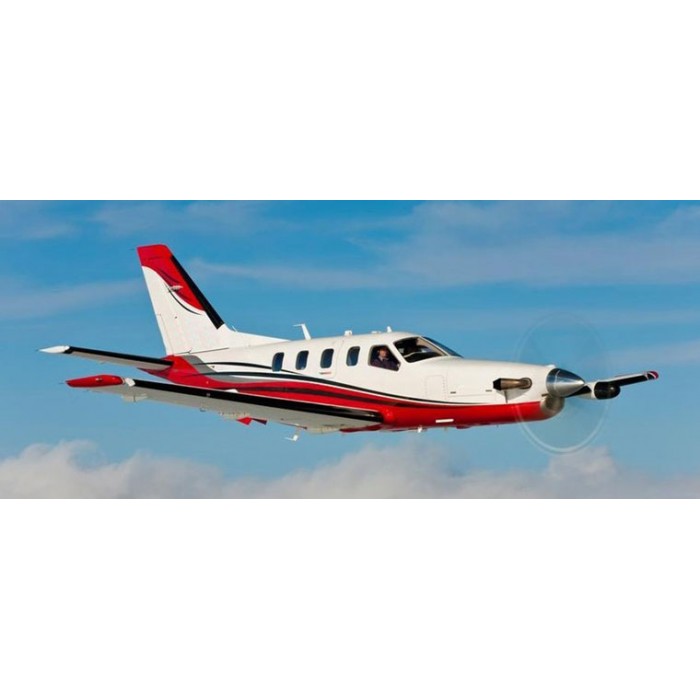
The Daher-Socata TBM 850 was the world's fastest single-engine turboprop when it entered service in 2006 - a title it held until the TBM 900 succeeded it in 2014 - and it remains the defining "anti-VLJ" benchmark in private aviation. EADS Socata developed the TBM 850 (formally the TBM 700N) as a direct competitive response to the Very Light Jet era: the Pratt and Whitney Canada PT6A-66D engine rated at 1,825 eshp but flat-rated to 850 shp in cruise (700 shp at takeoff for certification simplicity) produces 320 KTAS at FL260 - comparable block times to twin-engine VLJs on 500 nm sectors, at half the fuel burn. AOPA confirmed the TBM 850 "can climb from sea level to FL260 in just 15 minutes, and to FL310 in 20 minutes" - a 25% improvement over the TBM 700 and faster than most competing VLJs reaching their optimal cruise altitudes. EASA certification was received in 2005 and deliveries began in Q1 2006. The 2008 update introduced the Garmin G1000 integrated avionics suite; the 2009 update added Synthetic Vision Technology. Air Charter Advisors confirmed 338 TBM 850 aircraft delivered before the TBM 900 replaced it in 2014.
The TBM 850 is a pressurised single-engine turboprop - not a twin, not a jet, but pressurised throughout its 31,000 ft service ceiling, providing weather avoidance and cabin comfort unavailable in any unpressurised piston single. Business Jet Traveler confirmed the TBM 850 "will burn only about half the fuel" of comparable twin-engine VLJs on 500 nm sectors. Charter prices start from approximately £1,500 per flight hour. For the full fleet see our private jet price guide or browse our complete fleet.

Why charter the TBM 850?
- 320 KTAS at FL260 - world's fastest single-engine turboprop 2006-2014; comparable block time to twin-engine VLJs on 500 nm sectors; half the fuel burn. AOPA confirmed the TBM 850's maximum cruise of 317-320 KTAS at FL260 - 28 knots faster than the TBM 700 it replaced, and comparable to twin-engine VLJs (Embraer Phenom 100: 390 kt cruise vs TBM 850's 320 kt, but the TBM 850 cruises in the mid-20s where ATC traffic is lighter and routing is more direct). Business Jet Traveler confirmed the TBM 850 "will carry more payload, fly farther and typically complete a 500-mile trip about as quickly as a twinjet VLJ" while burning "only about half the fuel." Business Air News confirmed the HTML comparison: "the TBM 850 will take 1 hour and 1 minute to reach Pittsburgh from White Plains, 6 minutes longer than the Embraer Phenom 100" - but "the Embraer Phenom 100 will use 35% more fuel." At 320 KTAS the TBM 850 is approximately 130 kt faster than the King Air 200 on the same sector, approaching the speed of the Learjet 25 turbojet. For clients who want near-jet speed at single-turboprop operating cost, no production aircraft delivers this combination more effectively than the TBM 850;
- PT6A-66D at 1,825 eshp flat-rated to 850 shp; FL260 in 15 minutes; FL310 in 20 minutes; 25% faster climb than TBM 700; hot-and-high "not an issue". Business Air News confirmed the PT6A-66D "delivers 1,825 eshp flat-rated to 850 shp for the TBM 850" with takeoff power reduced to 700 shp for certification simplification. AOPA confirmed "a TBM 850 can climb from sea level to FL260 in just 15 minutes, and to FL310 in 20 minutes, under standard conditions. These represent 25% improvements over the TBM 700's climb performance." Business Air News confirmed that "at an altitude of FL310 in ISA+20°C conditions, cruise performance increases by more than 55 knots over the TBM 700C2" and "hot and high performance is not an issue." The Hartzell four-blade propeller - carried from the TBM 700 - provides efficient power absorption throughout the climb. For charter clients departing from hot-weather or high-elevation European airports in summer, or who want the fastest possible climb above commercial traffic, the TBM 850's PT6A-66D performance is unmatched in a single-engine turboprop of its era;
- Pressurised to 31,000 ft; RVSM-capable with option; single-engine piston-comparable operating cost with pressurised jet-altitude cabin comfort. RocketRoute confirmed the TBM 850 meets "Reduced Vertical Separation Minima standards allowing operation in RVSM airspace" when suitably equipped - enabling flight above FL290 in European controlled airspace. The 31,000 ft service ceiling provides weather avoidance above virtually all European convective weather. At altitude the TBM 850 is RVSM-capable, operating in the same controlled airspace as commercial jets and large business aircraft. AOPA noted the TBM 850 "thrives in the mid-20s, an altitude range that allows the airplane to fly at its top speeds, unencumbered by airliners, free of the need to wear an oxygen mask (a requirement for single-pilot flight above 35,000 feet)." For charter clients who want pressurised cabin comfort and jet-altitude operation at the lowest operating cost available in a pressurised single, the TBM 850 provides it;
- Garmin G1000 (from 2008); Synthetic Vision Technology (from 2009); dual-zone HVAC; noise-reduction technology; "quietest turboprop" reputation. Air Charter Advisors confirmed the 2008 update replaced the original cockpit with the Garmin G1000 avionics suite, adding synthetic vision from 2009. Stratos Jets confirmed the G1000 "lessened pilot workload" and "freed up more storage space in the aircraft's nose" - enough for "two sets of golf clubs" according to Stratos. Jetlevel confirmed "dual-zone heating and cooling system" keeps passengers and crew comfortable. The cabin uses noise-reduction technology that Business Jet Traveler described as "quiet for a turboprop, but still noisier than a jet." The Garmin G1000 includes colour weather radar, Terrain Avoidance System and two digital Air Data Computers. For single-pilot charter operations the G1000's integrated situational awareness is the key workload management tool;
- 2,100-foot landing capability; short-field access to alpine ski resorts and remote European airfields unavailable to VLJs. Stratos Jets confirmed the TBM 850 "can land on short 2,100-foot runways, making it the perfect aircraft for charter flights to luxury ski resorts in the mountains." The single-engine turboprop configuration - with lower approach speed than twin-engine jets - provides short-field access to European mountain airstrips, private airfields and regional airports that VLJs cannot use at equivalent weights. For charter clients whose itinerary includes Courchevel, Innsbruck, Megève or similar alpine airfields, the TBM 850's short-field performance combined with 31,000 ft cruise altitude creates a unique combination unavailable in any twin-engine VLJ;
- 338 delivered 2006-2014; "anti-VLJ" positioning vindicated; TBM family 1,500+ total; owner-pilot brand loyalty; replaced by TBM 900 in 2014. Air Charter Advisors confirmed 338 TBM 850s delivered. Business Jet Traveler documented the aircraft's strong owner-pilot loyalty, typical of the TBM brand: "the airplanes are largely flown by owner-pilots, who are very brand loyal." The TBM 850's commercial success validated EADS Socata's "anti-VLJ" strategy - the Eclipse 500 VLJ competitor was bankrupt by 2008, while the TBM 850 continued in production until replaced by the faster TBM 900 (330 KTAS) in 2014. The TBM family has produced 1,500+ aircraft total across all variants (TBM 700/850/900/910/940/960), making Daher (formerly Socata) the world's most successful high-performance single-engine turboprop manufacturer.
Charter cost - TBM 850 prices from UK airports
Hourly rates run from approximately £1,500 to £2,000 - in the turboprop category, above the King Air 200 (slower, lower ceiling) and comparable to entry-level light jets, reflecting the TBM 850's 320 KTAS near-jet cruise speed, 31,000 ft pressurised ceiling and RVSM capability at single-engine turboprop operating cost. Air Charter Advisors confirmed charter rates of $2,200-$2,800 per hour in the US market.
Indicative one-way prices from UK airports:
- London to Edinburgh - from £1,800 (4 passengers, approximately 45 minutes);
- London to Paris - from £1,875 (4 passengers, approximately 40 minutes);
- London to Geneva - from £2,500 (4 passengers, approximately 1 hour);
- London to Nice - from £3,250 (4 passengers, approximately 1 hour 20 minutes);
- London to Madrid - from £3,750 (4 passengers, approximately 1 hour 35 minutes);
- Edinburgh to Geneva - from £3,125 (4 passengers, approximately 1 hour 20 minutes);
- London to Dublin - from £1,875 (4 passengers, approximately 40 minutes).
Empty Leg flights appear on repositioning routes. See our Empty Legs page for current availability.

Ideal routes for the TBM 850
Best matched to short and medium European sectors where 320 KTAS near-jet speed, 31,000 ft pressurised ceiling, 2,100-foot short-field access and single-engine turboprop economics serve groups of 2 to 4:
- Short European sectors (40 to 90 minutes) where 320 KTAS makes the TBM 850 faster than any other turboprop and comparable to entry-level jets. London to Paris (approximately 40 minutes at 320 KTAS), London to Geneva (approximately 1 hour) and London to Edinburgh (approximately 45 minutes) are all faster in the TBM 850 than in any other turboprop in the Private Jets UK fleet. At 320 KTAS the TBM 850 covers 100 nm in under 19 minutes - meaningfully faster than the King Air 200 at 310 kt or the Piper Cheyenne at 283 kt. For clients whose priority is the fastest possible turboprop for short European day trips, the TBM 850 is the choice;
- Alpine ski resort access where 2,100-foot landing capability and 31,000 ft climb combine uniquely. Courchevel (880 m runway), Innsbruck, Megève and other alpine airfields are accessible to the TBM 850's short-field performance. The 31,000 ft ceiling enables approach over Alpine terrain with maximum weather avoidance margin. No twin-engine VLJ combines these short-field and ceiling capabilities at the TBM 850's operating cost. For ski season charter to alpine destinations with demanding runways, the TBM 850 is the aircraft that covers both requirements;
- Medium European sectors within 1,000-1,500 nm where the TBM 850's range exceeds most King Airs. London to Marrakech (approximately 1,400 nm), London to Istanbul (approximately 1,550 nm at lighter loads), Edinburgh to Tenerife (approximately 1,700 nm) and London to the Canaries (approximately 1,850 nm) are within or approaching the TBM 850's range. The 31,000 ft ceiling provides weather avoidance on these longer sectors. For groups of 2 to 4 on these medium European sectors where jet-speed arrival matters, the TBM 850 provides the performance;
- Speed-priority missions where single-engine turboprop rates at near-jet speed are the combination required. The TBM 850 is the only aircraft in the Private Jets UK fleet that provides 320 KTAS cruise at single-engine turboprop rates. It is faster than the King Air 200 (310 kt), King Air 300 (320 kt comparable) and all King Air 90/100 variants. It approaches the speed of the Learjet 25 (464 kt) and Hawker 700 series at turboprop operating cost. For charter clients who have been quoted light jet rates and want to explore whether a near-jet-speed turboprop is available at lower rates, the TBM 850 is the answer;
- Groups of 2 to 4 where the double-club executive cabin layout with individual power outlets and fold-out tables provides working environment on short sectors. Jetlevel confirmed four seats in a double-club configuration with folding armrests, adjustable backrests, fresh-air vents and reading lights. Power outlets and fold-out executive tables are standard. The dual-zone HVAC system maintains cabin temperature independently for front and rear sections. For groups of 2 to 4 on short European working missions, the TBM 850 cabin provides the essentials at near-jet speed.

Cabin and in-flight experience
The TBM 850 cabin measures 4.05 m (13.3 ft) long, 1.21 m (4 ft) wide and 1.22 m (4 ft) high - a sit-down cabin throughout, but pressurised to the 31,000 ft service ceiling. Jetlevel confirmed four seats in a double-club configuration with folding armrests, adjustable backrests, individual fresh-air vents and reading lights. Air Charter Advisors confirmed a two-piece rear bench seat as an option, bringing maximum seating to six. Power outlets are available throughout the cabin. A single club table deploys from the right-hand sidewall. Business Jet Traveler confirmed "that leaves a narrow 11-inch wide aisle" - the cabin is compact for four adults but functional for short European sectors. Baggage totals 30 ft³ combined: internal storage behind the rear seats (30 ft³, 249 kg maximum) plus small external compartments in the nose (tool kit, tow bar) and aft. Stratos confirmed the nose baggage area holds "two sets of golf clubs."
The Garmin G1000 cockpit (from 2008) provides a 15-inch colour MFD, engine monitoring, Synthetic Vision Technology (from 2009), weather radar, Terrain Avoidance System and dual Air Data Computers. The PT6A-66D delivers 850 shp cruise / 700 shp takeoff. Hartzell four-blade composite propeller. Dual-zone HVAC. RVSM-capable with option. The 2008 TBM 850 Elite added four forward-facing seats and increased cargo space.
- Cabin. 4.05 m x 1.21 m x 1.22 m; pressurised to 31,000 ft; sit-down; 11-inch centre aisle;
- Layout. Double-club 4 standard; rear bench = 6 max; fold-out sidewall table;
- Baggage. 30 ft³ total; internal behind rear seats; nose external (golf clubs);
- Engine. Pratt and Whitney Canada PT6A-66D (1,825 eshp; flat-rated 850 shp cruise; 700 shp takeoff);
- Propeller. Hartzell 4-blade composite;
- Avionics. Garmin G1000 (15-inch MFD; SVT from 2009; weather radar; TAWS; dual ADC);
- HVAC. Dual-zone; noise-reduction technology;
- RVSM. Capable with option (above FL290 in European airspace).
Technical specifications
| Manufacturer | EADS Socata / Daher-Socata, Tarbes, France |
| Formal designation | TBM 700N (production name: TBM 850) |
| First flight | February 2005 |
| EASA certification | 2005 |
| Service entry | Q1 2006; replaced by TBM 900 in 2014 |
| Production | 338 TBM 850 delivered 2006-2014 |
| 2008 update | Garmin G1000 avionics; fuel tank extension; TBM 850 Elite variant |
| 2009 update | Synthetic Vision Technology added to G1000 |
| Aircraft class | Single-engine pressurised turboprop |
| Positioning | "Anti-VLJ" - near-jet speed at single-engine turboprop operating cost |
| Engine | Pratt and Whitney Canada PT6A-66D (1,825 eshp; flat-rated 850 shp cruise; 700 shp takeoff) |
| Propeller | Hartzell 4-blade composite |
| Max cruise speed | 320 KTAS / 592 km/h at FL260 |
| Service ceiling | 31,000 ft / 9,449 m |
| RVSM | Capable with option (above FL290) |
| Climb to FL260 | 15 minutes from sea level |
| Climb to FL310 | 20 minutes from sea level |
| Range (max) | ~1,500-1,585 nm / 2,780-2,935 km |
| Range (4 pax, NBAA IFR) | ~967-1,000 nm / 1,792-1,852 km |
| Fuel vs VLJ | ~50% less fuel than twin-engine VLJ on 500 nm sector |
| Short-field landing | 2,100 ft (640 m) |
| MTOW | 7,394 lb / 3,354 kg |
| Cabin length | 4.05 m (13.3 ft) |
| Cabin width | 1.21 m (4.0 ft) |
| Cabin height | 1.22 m (4.0 ft) |
| Passengers | 4 standard (double-club); 6 maximum |
| Baggage | 30 ft³ total (internal + external nose) |
| Wingspan | 12.68 m (41.6 ft) |
| Aircraft length | 10.64 m (34.9 ft) |
| Aircraft height | 4.36 m (14.3 ft) |

TBM 850 vs similar aircraft
- TBM 850 vs King Air 200. The King Air 200 uses PT6A-42 engines at 850 shp (vs TBM 850's 850 shp), but in a twin-engine configuration that delivers 297-310 kt cruise (vs 320 KTAS TBM 850), a 35,000 ft ceiling (vs 31,000 ft) and 964+ active aircraft availability. Charter rates for the King Air 200 run approximately 15 to 20% below the TBM 850. The TBM 850 counters with higher cruise speed (10+ kt faster than KA200), shorter field performance (2,100 ft vs 3,300 ft for KA200), and the single-engine operating cost advantage. For speed-priority missions the TBM 850 is faster; for twin-engine safety policy requirements the KA200 is the choice;
- TBM 850 vs Pilatus PC-12 NGX. The Pilatus PC-12 NGX is a single-engine pressurised turboprop at comparable charter rates with a larger flat-floor cabin (more volume than TBM 850), 290 kt cruise (vs 320 KTAS TBM 850) and BMW-designed interior. The TBM 850 counters with 30 kt faster cruise, higher service ceiling (31,000 vs 30,000 ft) and the near-jet speed positioning. For cabin space and flat floor the PC-12 is preferable; for maximum speed in a single-engine pressurised turboprop the TBM 850 is the choice;
- TBM 850 vs Embraer Phenom 100 (entry VLJ). Business Jet Traveler confirmed the TBM 850 completes a 500 nm trip within 6 minutes of the Phenom 100's block time at half the fuel burn. The Phenom 100 has a pressurised jet cabin at higher ceiling (41,000 ft vs 31,000 ft), jet engines (no propeller vibration), and twin-engine VLJ certification. Charter rates for the Phenom 100 run approximately 30 to 40% above the TBM 850. For pure speed and jet ceiling the Phenom 100 is preferable; for matching jet block times at turboprop operating cost on 500 nm sectors the TBM 850 delivers the value.

Frequently asked questions - TBM 850 charter
How much does it cost to charter a TBM 850?
Charter rates run from approximately £1,500 to £2,000 per flight hour. London to Edinburgh costs from £1,800 for 4 passengers. London to Geneva costs from £2,500. London to Nice costs from £3,250. All quotes from Private Jets UK are fully itemised with no hidden charges.
Was the TBM 850 really the world's fastest single-engine turboprop?
Yes - at 320 KTAS at FL260, the TBM 850 held the title of world's fastest single-engine turboprop from its service entry in 2006 until the TBM 900 reached 330 KTAS in 2014. Air Charter Advisors confirmed it was the "fastest civilian turboprop in the world during its run." The 320 KTAS figure is confirmed by AOPA and Business Air News and corresponds to the 592 km/h cited in the specifications.
How does the TBM 850 compare to the Embraer Phenom 100 VLJ?
Business Jet Traveler confirmed the TBM 850 "will carry more payload, fly farther and typically complete a 500-mile trip about as quickly as a twinjet VLJ" while burning "only about half the fuel." The specific comparison: White Plains to Pittsburgh, TBM 850 takes 1 hour 1 minute vs the Phenom 100's 55 minutes - a 6-minute difference - but the Phenom 100 uses 35% more fuel. The TBM 850 was explicitly marketed as the "anti-VLJ" by EADS Socata on this basis.
Why is the TBM 850 limited to 700 shp at takeoff if it has an 850 shp engine?
The PT6A-66D engine is rated at 1,825 eshp but flat-rated to 850 shp for cruise operations. At takeoff the power is further reduced to 700 shp. Business Air News confirmed this was "in order to simplify certification" - keeping the takeoff power at the same 700 shp as the predecessor TBM 700 simplified the type certificate amendment and reduced the certification workload. The full 850 shp is available in cruise, where it delivers the 320 KTAS performance advantage.
Does the TBM 850 have an external baggage door?
The TBM 850 has several storage locations: the main baggage area behind the rear seats (internal); a small external compartment in the nose with its own door (typically used for golf clubs - two sets fit - or pilot's overnight bag at 77 lb capacity); and a small forward external compartment for the tow bar and engine covers. Total baggage is approximately 30 ft³ / 249 kg. Most baggage is loaded through the main aft passenger door and stored behind the last row of seats.

