


Charter a Daher Socata TBM 940


- Availability: Available for rent
Request aircraft information
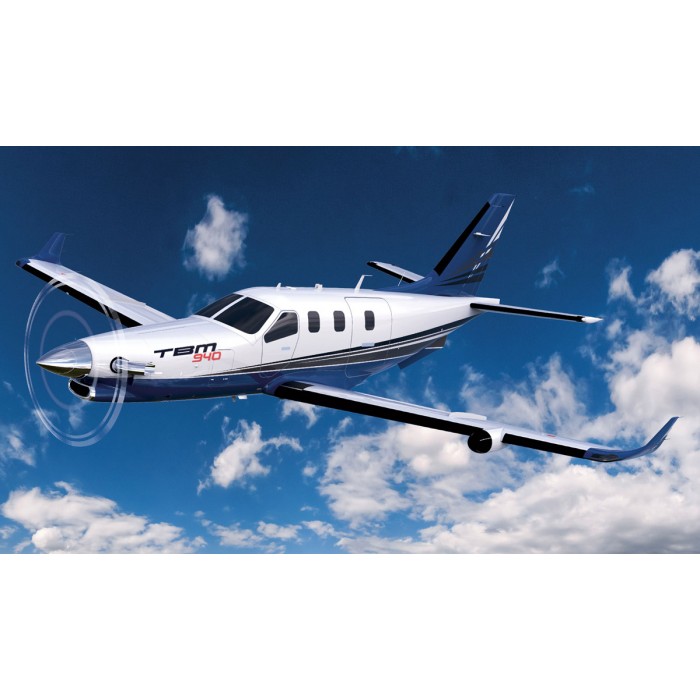
The Daher Socata TBM 940 is the automation flagship of the TBM 900 series - introduced on March 7, 2019 at the TBM Owners and Pilots Association Safety Seminar in Pompano Beach, Florida, it brought two firsts to an aircraft weighing under 12,500 lb: a factory-standard integrated autothrottle and an automatic de-icing system. Business Jet Traveler confirmed "the TBM 940 is the first turboprop weighing less than 12,500 pounds to offer a standard, factory-installed integrated autothrottle and automatic deicing." FLYER confirmed EASA and FAA certification was received in time for Aero Friedrichshafen in April 2019. The TBM 940 replaced the TBM 930 as the upper-end TBM at a new price of approximately $4.13 million - $400,000 above the TBM 930 - with the same G3000 touchscreen avionics and identical flight performance of 330 KTAS at FL280, 1,730 nm maximum range and 31,000 ft certified ceiling. Daher's Senior Vice President Nicolas Chabbert confirmed: "The TBM 940 redefines the ultimate private aircraft: user-friendly, safe and efficient for both pilots and passengers." TBM 940 production has since closed; the TBM 910 and TBM 960 are the current production variants.
The Daher Socata TBM 940 is a pressurised single-engine turboprop with the same PT6A-66D engine, G3000 avionics and performance as the TBM 930, with the addition of autothrottle and automatic de-icing that eliminate two of the most workload-intensive aspects of single-pilot turboprop operations. Charter prices start from approximately £1,500 per flight hour. For the full fleet see our private jet price guide or browse our complete fleet.

Why charter the Daher Socata TBM 940?
- World's first autothrottle on a standard-production turboprop under 12,500 lb - single power lever from climb-out to landing; automatically prevents speed exceedances; operates PT6A-66D at approved power limits. AOPA confirmed the TBM 940's autothrottle as the "first ever installed on a standard production turboprop weighing less than 12,500 lbs." The single power lever combines the functions of thrust management and condition lever through an H-pattern gate. Aviation Pros confirmed "the autothrottle enables the TBM 940 to be operated to the edge of approved power regimes for the Pratt and Whitney Canada PT6A-66D turboprop engine, providing optimum performance and efficiency." AOPA's test pilot described the system in practice: "passing through 95 knots, the autothrottle added power to preserve airspeed" during a simulated stall approach, and "the 940's autothrottle honours airspeed limitations for flap and landing gear extension - try to fly so fast that you are on the way to exceeding those limits, and the autothrottle will automatically dial back the power." The engine parameters display is simplified through an intuitive single smart gauge on the G3000. For single-pilot charter operations the autothrottle eliminates one of the most demanding ongoing tasks - manually adjusting fuel flow for changing altitude, temperature and barometric pressure - and replaces it with automatic speed management from takeoff to the final approach fix;
- Automatic de-icing system - first in its aircraft category; Goodrich ice detection probe; auto-activates airframe boots, propeller, windshield and engine particle separator; no pilot action required. AOPA confirmed the automatic de-icing system uses "an industry-standard Goodrich ice detection probe mounted on the vertical stabilizer" that "vibrates at a high frequency; when ice accretes on the probe the change in this frequency triggers the ice protection system." FLYER confirmed the system "is automatically activated for deicing of the airframe, windshield, propeller and the engine's particle separator when icing or ice accretion is detected and the pilot does not take action." An amber CAS (Crew Alerting System) message advises the pilot when automatic activation has occurred. The automatic de-icing and autothrottle together align with Daher's e-copilot strategy: Aviation Pros confirmed "the automatic deicing protection and autothrottle are fully aligned with Daher's e-copilot strategy of introducing functionality for improved operational safety." For charter clients flying UK and European winter sectors where icing is a routine encounter, the TBM 940's automatic de-icing eliminates a significant single-pilot workload and decision-making burden;
- Garmin G3000 + FlightStream 510 + ADS-B In/Out + FIS-B + SurfaceWatch + Mid-Continent MD302 backup display - the most complete avionics suite in the TBM 900 family. AOPA confirmed the TBM 940 carries "G3000 avionics suite, FlightStream 510 Wi-Fi/Bluetooth tablet information exchange connectivity, ADS-B In and Out, FIS-B capability, and SurfaceWatch runway advisory callouts and depictions" as standard. The Mid-Continent MD302 is a two-screen attitude/airspeed/altitude/heading backup display with its own independent battery pack and magnetometer - AOPA noted "having the latter allowed Daher to eliminate the old-school, glareshield-mounted magnetic compass." The three 12-inch G3000 screens with GTC 580 touchscreen controller, Emergency Descent Mode (EDM), ESP/USP and stick-shaker are all standard as on the TBM 930. For charter clients who specify the most complete avionics fit available in a single-engine pressurised turboprop, the TBM 940 is the peak of the TBM 900 series;
- 330 KTAS at FL280; 31,000 ft; 1,730 nm; same performance as TBM 910 and TBM 930 with autothrottle operating PT6A-66D at power limits throughout the flight profile. Business Jet Traveler confirmed the TBM 940's "top cruise speed of 330 knots" and Business Air News confirmed "more than 1,260 TBMs have been produced overall in six variants since the type's 1990 service entry." The performance figures are identical to the TBM 930, but the autothrottle enables the PT6A-66D to be operated efficiently at its approved power limits throughout the entire flight profile rather than with the conservative margins a pilot manually managing power would typically apply. Aviation Pros confirmed "in addition to reducing pilot workload, the autothrottle enables a TBM 940 to be operated to the edge of approved power regimes, providing optimum performance and efficiency from the powerplant." The practical result is consistent cruise speed maintenance without the manual torque adjustments required on the TBM 930 and earlier variants;
- Cabin enhancements over TBM 930 - redesigned seats; additional thermal insulation; central shelf with side storage; 9 USB ports total (6 passenger + 3 pilot); 115V socket at right rear seat. FLYER confirmed the TBM 940 cabin "incorporates ergonomic and style upgrades that include redesigned seats, additional thermal insulation for the cabin sidewalls, a new central shelf with side storage, an additional 115V electrical outlet at the right rear seat panel, and USB ports bringing the overall total of USB ports to six for passengers and three for the pilots." AOPA noted the total of nine USB ports (six passenger, three pilot). The standard configuration seats 1 pilot plus 5 passengers. The Elite Privacy lavatory option is available as on the TBM 930. For charter clients who fly the TBM 940 versus TBM 930, the additional USB charging points and enhanced thermal insulation are the cabin-level improvements alongside the autothrottle and automatic de-icing that define the 940;
- French Defence Ministry heritage - TBM 940 designation originally military; civilian TBM 940 benefits from military-requirement development rigour. Simple Flying confirmed that "after the 2016 introduction of the TBM 930, the Defense Ministry contracted Daher to buy new TBMs based on the TBM 930" and that the military variant was designated TBM 940. The civilian TBM 940 that launched in 2019 incorporated the same autothrottle and automatic de-icing features that Daher developed through this military programme, with none of the changes considered proprietary by the French Defence Ministry. The military-to-civilian transfer of the TBM 940 designation reflects Daher's practice of developing safety and automation systems to defence-standard robustness before incorporating them in the civilian product.
Charter cost - Daher Socata TBM 940 prices from UK airports
Hourly rates run from approximately £1,500 to £2,100 - at the top of the TBM 900 series charter range, reflecting the autothrottle, automatic de-icing and complete avionics suite that represent the highest specification available in a single-engine pressurised turboprop. Performance figures (330 KTAS, 1,730 nm, 31,000 ft) are identical to the TBM 910 and TBM 930. The $4.13 million new price (approximately $400,000 above the TBM 930) drives a modest premium on comparable charter missions.
Indicative one-way prices from UK airports:
- London to Edinburgh - from £1,875 (4 passengers, approximately 40 minutes);
- London to Paris - from £1,875 (4 passengers, approximately 38 minutes);
- London to Geneva - from £2,500 (4 passengers, approximately 55 minutes);
- London to Nice - from £3,150 (4 passengers, approximately 1 hour 15 minutes);
- London to Madrid - from £3,780 (4 passengers, approximately 1 hour 30 minutes);
- Edinburgh to Geneva - from £3,150 (4 passengers, approximately 1 hour 15 minutes);
- London to Dublin - from £1,875 (4 passengers, approximately 38 minutes).
Empty Leg flights appear on repositioning routes. See our Empty Legs page for current availability.

Ideal routes for the Daher Socata TBM 940
Best matched to short and medium European sectors where 330 KTAS speed, 31,000 ft pressurised ceiling, autothrottle workload reduction and automatic de-icing serve single-pilot and groups of 2 to 5 on demanding winter and mountain missions:
- UK and Northern European winter sectors where automatic de-icing eliminates the most demanding single-pilot workload task in icing conditions. The TBM 940's automatic de-icing system removes the pilot decision and action burden of managing ice protection during single-pilot IFR operations in winter UK, Scottish Highland and Northern European weather. The Goodrich probe detects ice onset automatically; the system activates without pilot input. For charter clients who fly UK to Amsterdam, Edinburgh to Oslo, or London to Copenhagen in winter where icing encounters are routine, the TBM 940's automatic de-icing is the decisive safety argument over the TBM 930 (manual de-icing activation required) and TBM 910;
- Alpine and mountain approach routes where autothrottle manages speed on the approach and automatic de-icing protects on the descent. The TBM 940's autothrottle "honours airspeed limitations for flap and landing gear extension" automatically (AOPA) - relevant on Alpine approaches to Courchevel, Innsbruck and Chambéry where managing speed, flap and gear deployment simultaneously with the approach is a single-pilot workload peak. The automatic de-icing protects on the descent through Alpine cloud layers. For ski season TBM 940 charter, the autothrottle and automatic de-icing together provide the most complete safety specification available in a single-engine turboprop on demanding short-runway alpine approaches;
- Medium European sectors to 1,730 nm where autothrottle maintains optimum engine efficiency throughout the cruise. Business Jet Traveler confirmed the autothrottle "allows the TBM 940 to be operated safely and efficiently" by "using software to analyze many aircraft and atmospheric variables and automatically control engine power." On medium sectors to Marrakech (approximately 1,400 nm), Madrid (approximately 900 nm) or Lisbon (approximately 980 nm), the autothrottle continuously optimises PT6A-66D power output without manual intervention - providing fuel efficiency and consistent cruise speed that manual power management cannot match over 2 to 3-hour sectors;
- Owner-pilots and high-workload single-pilot operations where the full TBM e-copilot, autothrottle and automatic de-icing package provides the maximum available automation for a certified turboprop. AOPA confirmed "together with the G3000 avionics suite, FlightStream 510, ADS-B In and Out, FIS-B, SurfaceWatch, and autothrottle, you probably have one of the most feature-rich panels on the general aviation market today." The combination of EDM, ESP/USP, stick-shaker, autothrottle, automatic de-icing, SurfaceWatch runway advisories and MD302 backup display represents the maximum available safety and automation for a certified single-engine turboprop of any weight class as of 2019. For single-pilot charter operations on demanding sectors, the TBM 940 is the complete specification;
- Groups of 4 to 5 where 9 USB ports, 115V socket, redesigned seats and enhanced thermal insulation provide the best TBM cabin environment. The TBM 940's nine USB ports (six passenger, three pilot) and 115V socket at the right rear seat panel are the highest connectivity specification in the TBM 900 series. The enhanced thermal insulation reduces cabin noise and temperature variation on longer sectors. For groups of 4 to 5 on sectors over 1 hour where cabin connectivity and comfort are relevant to productivity, the TBM 940 provides these at 330 KTAS cruise.

Cabin and in-flight experience
The Daher Socata TBM 940 cabin measures 4.39 m (14.4 ft) long including the baggage area, 1.21 m (4.0 ft) wide and 1.22 m (4.0 ft) high - identical dimensions to the TBM 910 and TBM 930 throughout. The standard configuration seats 1 pilot plus 5 passengers. Cabin enhancements over the TBM 930 include redesigned seats, additional thermal insulation for sidewalls, a new central shelf with side storage, nine USB ports (six passenger, three pilot) and a 115V socket at the right rear seat panel. FLYER confirmed all these additions are standard equipment. The Elite Privacy lavatory option converts the aft bench position to an electric flushing toilet with pop-up privacy surround. The electric main door with gas-charged springs and folding staircase with railings is standard.
- Cabin. 4.39 m x 1.21 m x 1.22 m; pressurised to 31,000 ft; sit-down; electric door;
- Layout. 1 pilot + 5 passengers standard; Elite Privacy option available;
- Engine. PT6A-66D (850 shp; flat-rated ISA+49°C);
- Autothrottle. First on any production turboprop under 12,500 lb; single power lever; manages climb-out to landing; honours flap/gear speed limits;
- Automatic de-icing. Goodrich probe on vertical stabilizer; auto-activates airframe, propeller, windshield and particle separator;
- Avionics. Garmin G3000 (3x 12-inch screens; GTC 580 touchscreen; SVT; EDM; SurfaceWatch; MD302 backup);
- Safety. ESP; USP; AOA; EDM; stick-shaker; autothrottle envelope protection;
- Connectivity. 9 USB ports; 115V socket; FlightStream 510; ADS-B In/Out; FIS-B; satellite phone;
- Fuel burn. 37 gph economy cruise.
Technical specifications
| Manufacturer | Daher (formerly EADS Socata), Tarbes, France |
| Unveiled | 7 March 2019 (TBMOPA Safety Seminar, Pompano Beach, Florida) |
| EASA / FAA certification | April 2019 (Aero Friedrichshafen) |
| Production status | Closed; TBM 910 and TBM 960 in current production |
| TBM 940 vs TBM 930 | Same G3000 and performance; adds autothrottle, automatic de-icing, 9 USB ports, MD302 backup display |
| Aircraft class | Single-engine pressurised turboprop |
| Engine | Pratt and Whitney Canada PT6A-66D (850 shp; flat-rated ISA+49°C) |
| Autothrottle | Yes - first on any production turboprop under 12,500 lb; single power lever |
| Automatic de-icing | Yes - Goodrich probe; auto-activates airframe, propeller, windshield, particle separator |
| Max cruise speed | 330 KTAS / 611 km/h at FL280 |
| Economy cruise | 252 KTAS / 467 km/h (long-range settings) |
| Service ceiling | 31,000 ft / 9,449 m |
| Climb to FL310 | Under 20 minutes from sea level at MTOW |
| Max range | 1,730 nm / 3,203 km |
| Fuel burn (economy) | 37 gph |
| Takeoff distance | 2,380 ft (ISA, MTOW, no wind, 50-ft obstacle) |
| MTOW | 7,394 lb / 3,354 kg |
| Avionics | Garmin G3000; GTC 580 touchscreen; SVT; EDM; SurfaceWatch; MD302 backup; ADS-B In/Out; FIS-B |
| Safety systems | ESP; USP; AOA; EDM; stick-shaker; autothrottle; automatic de-icing |
| USB ports | 9 total (6 passenger + 3 pilot) |
| Cabin length | 4.39 m (14.4 ft incl. baggage area) |
| Cabin width | 1.21 m (4.0 ft) |
| Cabin height | 1.22 m (4.0 ft) |
| Passengers | 1 pilot + 5 passengers standard; 6 maximum |
| Wingspan | 12.83 m (42.1 ft) |
| Aircraft length | 10.73 m (35.2 ft) |
| Aircraft height | 4.35 m (14.3 ft) |

Daher Socata TBM 940 vs similar aircraft
- Daher Socata TBM 940 vs Daher Socata TBM 930. Identical G3000 avionics, PT6A-66D engine and flight performance (330 KTAS, 1,730 nm, 31,000 ft). The TBM 940 adds autothrottle (first on any turboprop under 12,500 lb), automatic de-icing (Goodrich probe; auto-activates all surfaces), 9 USB ports (vs 6 on TBM 930), MD302 backup display and enhanced cabin thermal insulation. Charter rates run approximately 5 to 10% above TBM 930 on comparable missions. For winter missions or demanding single-pilot operations, the TBM 940's automation is the decisive upgrade;
- Daher Socata TBM 940 vs Daher Socata TBM 960. The TBM 960 (launched 2022) is the current-production successor to the TBM 940 with a PT6E-66XT engine (autofeather, autorestart, FADEC-like electronic engine control), five-blade Hartzell Raptor composite propeller, G3000 Prime avionics and additional safety systems. Charter rates for the TBM 960 run above the TBM 940. For the full Daher automation philosophy at the production-current standard, the TBM 960 is the choice; for the TBM 940's complete autothrottle and auto de-icing package on pre-owned aircraft, the rate advantage over the TBM 960 is meaningful;
- Daher Socata TBM 940 vs King Air 200. The King Air 200 is a twin-engine turboprop with a larger cabin (5.08 m × 1.37 m), 35,000 ft ceiling and PT6A-42 twin engines at comparable or lower charter rates. The TBM 940 counters with 330 KTAS (vs 297-310 kt KA200), single-engine operating economy, autothrottle, automatic de-icing, 2,380-foot takeoff (vs 3,300 ft KA200) and the most advanced safety systems in a single-engine turboprop. For twin-engine policy requirements the King Air 200 is appropriate; for maximum automation and speed in a single-engine turboprop, the TBM 940 is the peak of the category as produced.

Frequently asked questions - Daher Socata TBM 940 charter
How much does it cost to charter a Daher Socata TBM 940?
Charter rates run from approximately £1,500 to £2,100 per flight hour. London to Edinburgh costs from £1,875 for 4 passengers. London to Geneva costs from £2,500. London to Nice costs from £3,150. All quotes from Private Jets UK are fully itemised with no hidden charges.
What makes the TBM 940's autothrottle significant?
Business Jet Traveler confirmed the TBM 940 is the "first turboprop weighing less than 12,500 pounds to offer a standard, factory-installed integrated autothrottle." The single power lever combines thrust management and condition lever through an H-pattern gate, automatically adjusting speed from climb-out to landing approach. AOPA confirmed the autothrottle also "honours airspeed limitations for flap and landing gear extension" - automatically preventing overspeed during configuration changes. Without autothrottle, a single pilot must continuously adjust fuel flow for changing altitude, temperature and barometric pressure throughout the flight.
How does the TBM 940's automatic de-icing work?
AOPA confirmed the system uses "an industry-standard Goodrich ice detection probe mounted on the vertical stabilizer that vibrates at a high frequency; when ice accretes on the probe the change in this frequency triggers the ice protection system." FLYER confirmed the system automatically activates de-icing of the airframe, windshield, propeller and engine particle separator without pilot input. An amber CAS message alerts the pilot when automatic activation has occurred. The pilot can also manually activate or override the system.
What is the difference between the TBM 940 and TBM 960?
The TBM 960 (launched 2022) uses the PT6E-66XT engine with electronic engine control (autofeather, autorestart, FADEC-like management), a five-blade Hartzell Raptor composite propeller and G3000 Prime avionics with additional software features. The TBM 940 uses the PT6A-66D with autothrottle and G3000. Both have automatic de-icing. The TBM 960 is the current production variant; the TBM 940 is available on the pre-owned market.
Is the TBM 940 still in production?
No - Daher has closed production of the TBM 940 along with the TBM 850, 900 and 930. Current production variants are the TBM 910 (G1000NXi) and TBM 960 (PT6E-66XT engine, G3000 Prime, five-blade Hartzell Raptor propeller). Pre-owned TBM 940 aircraft remain fully supported by Daher's global service and maintenance network.

