


Charter a Pilatus PC-12


- Availability: Available for rent
Request aircraft information
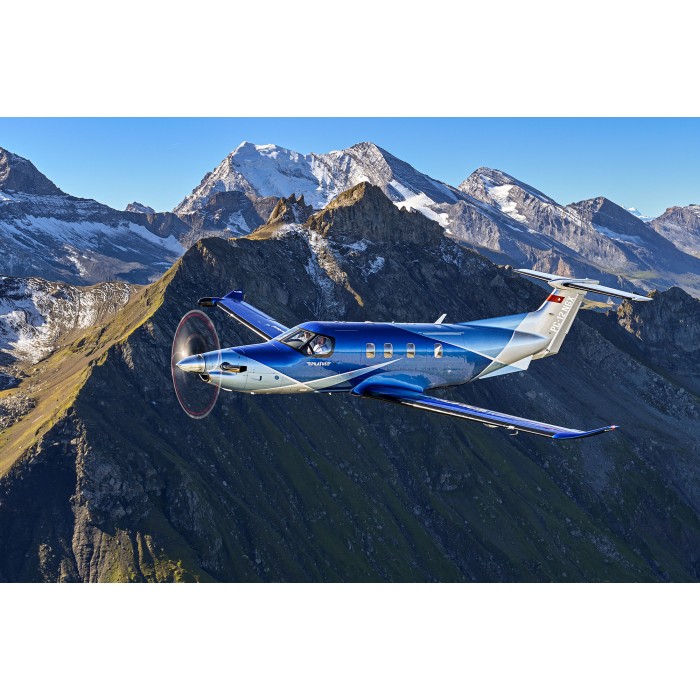
The Pilatus PC-12 is the world's most successful single-engine business turboprop - a Swiss-built pressurised aircraft designed from the outset to bridge the gap between rugged utility and executive travel. The first prototype flew on 31 May 1991; Swiss type certification was granted on 30 March 1994 and FAA approval followed on 15 July 1994. In May 2023, Pilatus delivered the 2,000th PC-12, with the global fleet surpassing 10 million flight hours. Three production variants have followed the original: the PC-12/47 (2005), the PC-12/47E known as the PC-12 NG (certified 28 March 2008) and the current PC-12 NGX (announced NBAA October 2019, deliveries from April 2020). The PC-12 PRO was announced on 14 March 2025 with deliveries expected in autumn 2025 and features Garmin G3000 Prime avionics with Emergency Autoland.
The PC-12 is powered by a single Pratt and Whitney Canada PT6E-67XP turboprop engine on the NGX (replacing the PT6A-67P of the NG) - the first single-engine business turboprop to feature FADEC, autothrottle and a low-speed propeller mode that reduces cabin noise. The PC-12 NGX reaches 290 kt TAS (537 km/h) cruise and accesses 21,300 airports worldwide - compared to 11,600 for its closest competitor. The flat floor throughout the 7.0 m cabin is unique in the turboprop category. BMW Designworks designed the NGX interior; windows are 10% larger than on the NG. Charter prices start from approximately £1,500 per flight hour. For the full fleet see our private jet price guide or browse our complete fleet.

Why charter the Pilatus PC-12?
- 21,300 airports worldwide - 83% more than the nearest competitor; unpaved and grass strips at full MTOW. FlyCraft confirmed the PC-12 NGX can reach 21,300 airports worldwide versus 11,600 for its closest competitor. The PC-12's short-field performance allows operations from unpaved and grass strips at full MTOW - a capability unique among pressurised turboprops. Quantum Jets confirmed a minimum runway of 2,485 ft (758 m) is sufficient for takeoff. For UK charter clients, this means direct access to private airstrips, Scottish Highland strips, Alpine airports and short coastal fields unavailable to any jet or pressurised twin turboprop of comparable cabin size. The aft cargo door loads oversized items that would not fit through standard cabin doors;
- Flat floor throughout the cabin - the only turboprop in class with a flat floor; 10% more cabin volume than King Air 250. FlyCraft noted the PC-12's flat floor is a feature "you will only start to commonly see in medium sized jets." The flat floor runs the full 7.0 m cabin length, allowing unrestricted movement, easier baggage access and cabin reconfiguration mid-flight. Quantum Jets confirmed 10% more cabin volume than the King Air 250. The flat floor combined with the aft cargo door enables genuine combi operations - passengers and cargo simultaneously - with the cargo door loading from ground level without requiring aircraft tilting. No competing single-engine turboprop or pressurised King Air offers a flat floor throughout;
- PT6E-67XP FADEC with autothrottle and low-speed propeller mode - quieter, smarter, more efficient than PT6A. The PC-12 NGX engine is the first single-engine turboprop to carry FADEC (Full Authority Digital Engine Control), enabling autothrottle functionality - previously available only on business jets. Wikipedia confirmed the low-speed propeller mode "significantly reduces cabin noise." Ready for Takeoff noted the FADEC enables operation "without fuel anti-icing additives." Guardian Jet documented fuel burn at 77 gph and $1,152/hr total variable cost at 300 hours. The PT6E-67XP scheduled maintenance extends to 600 flight hours (vs 300 hrs on NG) and TBO extends from 4,000 to 5,000 hours - reducing maintenance interruptions and cost per flight hour;
- 2,000 aircraft delivered; 10 million fleet flight hours - the deepest single-engine turboprop support network. The May 2023 delivery of the 2,000th PC-12 marks a fleet depth no competing single-engine turboprop approaches. Ready for Takeoff confirmed the global fleet has surpassed 10 million flight hours. Operators include the Australian Royal Flying Doctor Service (32 aircraft), Royal Canadian Mounted Police, US Air Force, Red Cross and major fractional operators including Tradewind Aviation. Quantum Jets confirmed 80 to 85% value retention after 10 years at average use - better than comparable turboprop offerings. The Pilatus worldwide dealer network provides global MRO access consistent with the fleet's scale;
- BMW Designworks interior with Honeywell ACE avionics - autothrottle, synthetic vision, touchscreen, CVFDR standard. FlyCraft described the BMW Designworks partnership as producing "a stunning interior" with "design inspiration clearly taken from the PC-24." The Honeywell Advanced Cockpit Environment (ACE) on the NGX provides touchscreen displays, cursor control device, autothrottle (industry-first for single-engine turboprop), synthetic vision and a standard cockpit voice and flight data recorder. Windows are 10% larger than on the NG. Seats are BMW-designed, fully reclining. The PC-12 PRO (announced March 2025) replaces the Honeywell ACE with Garmin G3000 Prime, adds Garmin Emergency Autoland - an industry first for single-engine turboprops;
- Larger cabin than the Cessna Citation Mustang (VLJ); pressurised at 30,000 ft; 1,803 nm range. FlyCraft confirmed the PC-12 NGX "is larger than the Cessna Citation Mustang (jet aircraft) and the King Air 250 (twin engine prop)." At 7.0 m cabin length and 330 ft³ cabin volume, the PC-12 provides more interior space than many light jets at turboprop operating economics. FlyUSA confirmed 1,803 nm (3,339 km) range with four passengers on the NG; the NGX provides comparable range. The 30,000 ft service ceiling operates above most weather on European and regional UK sectors. Flying magazine in 2006 described the PC-12 as "more economical to operate than any turbine airplane of similar size."
Charter cost - Pilatus PC-12 prices from UK airports
Hourly rates run from approximately £1,500 to £2,000 - in the turboprop category, above the King Air 300 but below any comparable jet. For 5 to 9 passengers on UK regional, European and longer missions where 21,300-airport access, flat floor, pressurised cabin and single-engine economics are priorities, the PC-12 provides the most capable single-engine option available.
Indicative one-way prices from UK airports:
- London to Edinburgh - from £1,800 (8 passengers, approximately 1 hour 20 minutes);
- London to Geneva - from £3,000 (8 passengers, approximately 1 hour 50 minutes);
- London to Paris - from £2,250 (8 passengers, approximately 1 hour 30 minutes);
- London to Nice - from £3,750 (8 passengers, approximately 2 hours 10 minutes);
- Edinburgh to private strip (Scottish Highlands) - from £1,500 (8 passengers, approximately 40 minutes);
- London to Dublin - from £2,250 (8 passengers, approximately 1 hour 20 minutes);
- Manchester to Amsterdam - from £2,250 (8 passengers, approximately 1 hour 30 minutes).
Empty Leg flights appear on repositioning routes. See our Empty Legs page for current availability.

Ideal routes for the Pilatus PC-12
Best matched to missions where 21,300-airport access, flat floor cargo versatility and pressurised single-engine economics serve groups of 5 to 9:
- Short UK regional and private strips (20 to 90 minutes) - the PC-12's defining short-field advantage. With a 2,485 ft minimum takeoff distance, the PC-12 opens private airstrips, grass fields and Highland strips unavailable to all jets and most pressurised twins. For groups departing from a private estate, rural airfield or coastal strip, the PC-12 delivers pressurised comfort from runways that no comparable aircraft can use. Scottish Highland estates, Welsh and Irish country strips and Channel Island fields all fall within this category;
- Alpine airports (Sion, Chambery, Innsbruck, Courchevel) where short-field performance and gradient approaches matter. Sion (Switzerland), Chambery (France), Innsbruck (Austria) and Courchevel (France, 1850 ft grass strip) all have specific runway length or gradient constraints. The PC-12's performance envelope handles these airports at standard loads where jets cannot operate without significant payload penalties. For ski travel requiring direct access to an Alpine resort airfield, the PC-12 is the pressurised turboprop of choice;
- Long UK and European sectors (2 to 6 hours) where 1,803 nm range and 30,000 ft ceiling provide weather avoidance. Paris, Amsterdam, Geneva, Nice, Rome, Istanbul and Morocco are all within range. At 30,000 ft the PC-12 operates above most convective weather and most commercial traffic on these European sectors. The 7.0 m flat floor cabin with pressurisation at 30,000 ft provides executive comfort throughout. For groups of 5 to 7, the per-seat economics on these longer sectors are significantly below any comparable jet;
- Cargo and combi missions - aft cargo door; flat floor; 2,236 lb maximum payload. The PC-12's standard aft cargo door (18 sq ft), flat floor and 2,236 lb maximum payload make it the most versatile cargo-capable turboprop available for charter. Mixed passenger and freight loads are straightforward - the cargo door loads from ground level, the flat floor allows cargo to be positioned anywhere in the cabin, and the pressurised environment maintains freight quality at altitude. For charter clients with specific cargo requirements alongside passenger transport, the PC-12 is the operational standard in this category;
- Medical and humanitarian missions - Royal Flying Doctor Service (32 aircraft); Red Cross operator; air ambulance configured. The Australian Royal Flying Doctor Service operates 32 PC-12s as its primary aeromedical platform - the largest dedicated PC-12 air ambulance fleet globally. The pressurised cabin maintains patient comfort at altitude; the flat floor accommodates litters; the aft cargo door simplifies loading. For charter clients who need medical evacuation capability, the PC-12 is the reference single-engine air ambulance aircraft worldwide.

Cabin and in-flight experience
The PC-12 NGX cabin measures 7.0 m long, 1.57 m (5.1 ft) wide and 1.50 m (4.9 ft) high - 330 ft³, with a flat floor throughout. This flat floor is unique in the single-engine turboprop category and exceeds the feature specification of many light jets. Six to nine passengers in executive configuration with fully reclining BMW-designed seats; or up to nine in higher-density layout with the right-hand cockpit seat available as a tenth. Four-seat executive layouts, eight-seat commuter layouts and combi (passenger-cargo) configurations all use the same flat floor without modification.
The aft cargo door (18 sq ft) is standard and loads from ground level. A private forward lavatory is fitted. Large cabin windows (10% bigger than NG) with tinted glass bring natural light throughout. The Honeywell ACE avionics suite provides autothrottle, synthetic vision, touchscreen and cursor-controlled navigation, with a standard CVFDR. Garmin GTN 750 and GTN 625 WAAS GPS are fitted on many aircraft (as noted in the original technical description). WiFi connectivity and entertainment systems are available as options. The FADEC PT6E-67XP engine with its low-speed propeller mode delivers a measurably quieter cabin than any earlier PC-12 variant or comparable turboprop.
- Cabin. 7.0 m x 1.57 m x 1.50 m; 330 ft³; flat floor; pressurised; 30,000 ft ceiling;
- Seats. BMW Designworks; fully reclining; 6-9 executive; 10th in cockpit right seat;
- Windows. 10% larger than NG; tinted; natural light throughout;
- Lavatory. Private; forward;
- Cargo door. Standard aft; 18 sq ft; ground level loading;
- Engine. Single PT6E-67XP (FADEC; autothrottle; low-speed prop mode; 77 gph; 5,000-hr TBO);
- Avionics. Honeywell ACE (Epic 2.0); autothrottle; synthetic vision; touchscreen; CVFDR standard;
- Access. 21,300 airports; 2,485 ft minimum takeoff; unpaved and grass capable.
Technical specifications
| Manufacturer | Pilatus Aircraft Ltd, Stans, Switzerland |
| First flight | 31 May 1991 |
| Swiss certification | 30 March 1994 |
| FAA certification | 15 July 1994 |
| Delivered | 2,000th aircraft May 2023; >10 million fleet flight hours |
| Current variant | PC-12 NGX (from April 2020); PC-12 PRO (autumn 2025) |
| Aircraft class | Single-engine pressurised turboprop |
| Engine | Single Pratt and Whitney Canada PT6E-67XP (FADEC; autothrottle; 77 gph; 5,000-hr TBO) |
| Avionics | Honeywell ACE (Epic 2.0); autothrottle; synthetic vision; touchscreen; CVFDR |
| Max cruise (NGX) | 290 kt TAS / 537 km/h |
| Max cruise (NG) | 280 kt TAS / 519 km/h |
| Range (4 pax) | 1,803 nm / 3,339 km (NG); NGX comparable |
| Service ceiling | 30,000 ft / 9,145 m |
| Airport access | 21,300 airports worldwide; 2,485 ft min takeoff; unpaved capable |
| MTOW | 4,740 kg (10,450 lb) - PC-12/47 and later |
| Max payload | 2,236 lb (1,014 kg) |
| Fuel burn | 77 gph |
| Cabin length | 7.0 m (23 ft) - longest in class |
| Cabin width | 1.57 m (5.1 ft) |
| Cabin height | 1.50 m (4.9 ft) |
| Cabin volume | 330 ft³ (10% more than King Air 250) |
| Cabin floor | Flat throughout - unique in single-engine turboprop class |
| Passengers | 6-9 standard; 10 with cockpit right seat |
| Cargo door | Standard aft; 18 sq ft; ground level |
| Wingspan | 16.23 m |
| Aircraft length | 14.40 m |
| Aircraft height | 4.26 m |
| Value retention | 80-85% after 10 years at average use |

Pilatus PC-12 vs similar aircraft
- Pilatus PC-12 vs Beechcraft King Air 300. The King Air 300 is a pressurised twin turboprop with 35,000 ft ceiling (vs PC-12's 30,000 ft), 320 kt cruise (vs 290 kt) and twin-engine redundancy. Charter rates for the King Air 300 run approximately 10 to 20% below the PC-12. The PC-12 counters with a flat floor (King Air 300 has a stepped floor), 10% more cabin volume, 21,300 airport access (vs King Air's shorter-strip limitations at high weight), the standard aft cargo door, a single FADEC engine with 5,000-hr TBO and the BMW Designworks interior. For standard executive European missions, both are comparable; for short-strip access and cargo operations, the PC-12 is superior;
- Pilatus PC-12 vs Cessna Citation Mustang. FlyCraft confirmed the PC-12 NGX "is larger than the Cessna Citation Mustang." The Citation Mustang is a jet with 340 kt cruise (faster), but a smaller cabin (3.84 m vs 7.0 m) and higher charter rates. The PC-12 counters with the 7.0 m flat-floor cabin (more than double the Mustang's length), 21,300-airport short-field access, standard cargo door, and lower charter rates. For groups of 6 to 9 where cabin space matters more than maximum speed, the PC-12 provides substantially more interior at lower rates;
- Pilatus PC-12 vs Pilatus PC-24. The PC-24 is the PC-12's twin-jet sibling - 440 kt cruise, 1,525 nm range, 501 ft³ cabin and jet certification. Charter rates for the PC-24 run approximately 40 to 60% above the PC-12. The PC-12 counters with 21,300-airport access (the PC-24's jet performance requires longer runways), lower charter rates and the FADEC single-engine economics. For shorter sectors and remote-airfield missions the PC-12 is the more capable choice; for longer intercontinental sectors and maximum speed the PC-24 is preferable.

Frequently asked questions - Pilatus PC-12 charter
How much does it cost to charter a Pilatus PC-12?
Charter rates run from approximately £1,500 to £2,000 per flight hour. London to Edinburgh costs from £1,800 for 8 passengers. London to Geneva costs from £3,000. London to Paris costs from £2,250. All quotes from Private Jets UK are fully itemised with no hidden charges.
How many airports can the Pilatus PC-12 access?
FlyCraft confirmed the PC-12 NGX can reach 21,300 airports worldwide - 83% more than its closest competitor. The minimum takeoff distance is 2,485 ft (758 m) and the aircraft can operate from unpaved and grass strips at full MTOW. For UK charter clients this includes private estate airstrips, Highland strips, Alpine airports and short coastal fields unavailable to any jet or pressurised twin turboprop.
What is the difference between the PC-12 NG and PC-12 NGX?
Wikipedia confirmed the NGX introduces the PT6E-67XP engine with FADEC and autothrottle (vs the NG's PT6A-67P), increasing cruise speed to 290 kt (vs 280 kt), reducing cabin noise via a low-speed propeller mode, extending maintenance intervals to 600 flight hours (vs 300) and TBO to 5,000 hours (vs 4,000). The NGX also adds 10% larger cabin windows, a BMW Designworks interior and Honeywell ACE (Epic 2.0) avionics with touchscreen and standard CVFDR.
Is the Pilatus PC-12 single-pilot certified?
Yes - the PC-12 is certified for single-pilot IFR operations. The right-hand cockpit seat can be occupied by a passenger when a single pilot is operating the aircraft, providing an optional tenth seat position. The FADEC PT6E-67XP engine and Honeywell ACE autothrottle reduce pilot workload on the NGX.
What is the Pilatus PC-12 PRO?
Announced on 14 March 2025 with deliveries expected in autumn 2025, the PC-12 PRO replaces the Honeywell ACE avionics of the NGX with a Garmin G3000 Prime Integrated Flight Deck - an industry first for the PC-12. It adds Garmin Emergency Autoland and Smart Glide (both industry firsts for single-engine turboprops), a +100 lb useful load increase, a BMW Designworks restyled cabin with new materials and an updated control yoke adapted from the PC-24.

