


Spectrum S-33 Independence
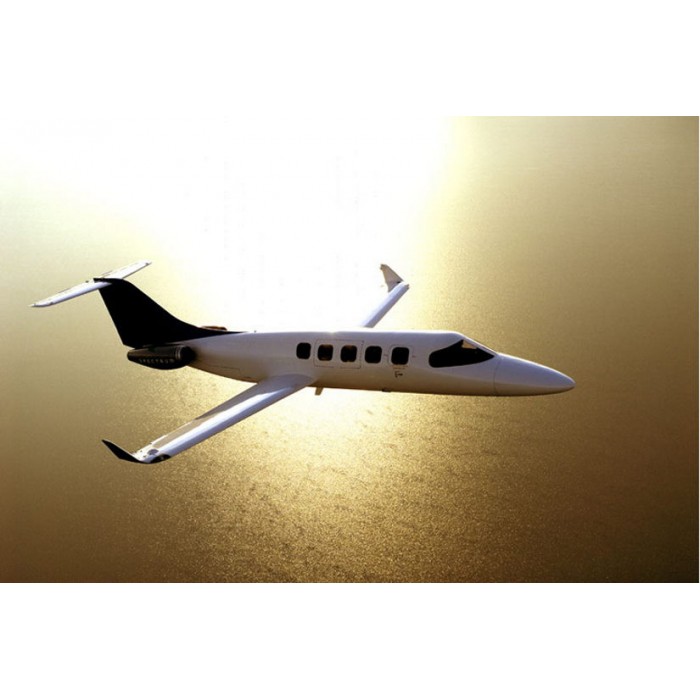


- Availability: Available for rent
Request aircraft information
The Spectrum S-33 Independence is a very light jet prototype developed by Spectrum Aeronautical of Carlsbad, California - one of the most technically ambitious VLJ designs of the mid-2000s, and one that never reached production. Development began in 1998 under design engineer Dan Cooney; a proof-of-technique airframe was constructed prior to formal announcement at the NBAA Convention in November 2005. The sole prototype (N332LA) made its first flight on 7 January 2006 after systems integration delays. On 25 July 2006, during takeoff, the prototype was destroyed in a crash attributed to misrigged aileron controls following maintenance; both pilots were killed. The aircraft was renamed the S-33 Independence in October 2006. FAA and JAA type certifications were expected to be completed in 2009, then pushed back to 2010, and were never achieved. Spectrum Aeronautical ceased operations in January 2021. The S-33 therefore represents a historically significant VLJ concept that never entered service.
The S-33 was designed around a full carbon fiber composite construction process that Spectrum claimed would make the aircraft weigh approximately two-thirds as much as a comparably sized aluminium-frame aircraft, using about half the fuel. Two Williams FJ33-4A-19 turbofan engines at 1,500 lbf each (upgraded from the -15 variant during the programme, per Flight Global) were specified. Design performance targets included 415 kt / Mach 0.72 maximum cruise, 45,000 ft service ceiling and up to 2,000 nm range. Five to six executive passengers would travel in a 5.49 m cabin with side-stick controls and flat-screen MFD avionics at the front. Charter of an S-33 is not available. Private Jets UK can arrange comparable VLJ alternatives. For the full fleet see our private jet price guide or browse our complete fleet.

Spectrum S-33 Independence - design and programme history
- Carbon fiber composite construction - designed to weigh two-thirds of an equivalent aluminium aircraft. Spectrum Aeronautical's founding technological claim for the S-33 was full carbon fiber composite construction throughout the airframe - a process the company stated would produce an aircraft weighing approximately two-thirds as much as a comparable aluminium-frame VLJ, consuming about half the fuel. In the mid-2000s VLJ market, where the Eclipse 500 and Adam A700 were competing for the same category, the S-33's composite weight reduction was intended as the primary differentiator. The carbon fiber construction technique was verified on the proof-of-technique airframe built before the programme's November 2005 formal announcement at NBAA. Flight testing of the single prototype confirmed the handling and climb performance claims before the 25 July 2006 crash ended the first flight test programme;
- Williams FJ33-4A-19 engines upgraded from -15 during programme - 1,500 lbf each; same family as Cirrus SF50. Flight Global reported that Spectrum upgraded the S-33 engine specification from the Williams FJ33-4A-15 to the -19, delivering more thrust at lower specific fuel consumption. Each FJ33-4A-19 produces 1,500 lbf. The FJ33 engine family is the same series subsequently used in the certified Cirrus Vision SF50, establishing the engine's certification pedigree. At 3,000 lbf total thrust on a 7,300 lb MTOW airframe, the S-33's thrust-to-weight ratio was designed for the "stunning takeoff and climb performance" that Spectrum's own evaluation confirmed in early 2006 flight testing;
- 45,000 ft service ceiling at Mach 0.72 - above all commercial traffic; 2,000 nm design range. Spectrum's published design specifications called for a 45,000 ft service ceiling at Mach 0.72 (415 kt) cruise speed, with a design range of 1,600 to 2,000 nm. At 45,000 ft the S-33 would have operated above all commercial airline traffic and above the jet stream on most European sectors. The 2,000 nm design range was comparable to the Hawker 800XP at lower acquisition cost and substantially lower fuel burn. These performance targets were consistent with the aircraft's carbon fiber weight reduction: the lighter airframe enabled the same engines to achieve higher altitude and longer range than on a heavier aluminium airframe;
- Side-stick controls and flat-screen MFD cockpit - single-pilot FAR Part 23 certification planned. Spectrum's own documentation confirmed the S-33 cockpit would feature side-stick controls, exceptional forward visibility and a flat-screen Multi-functional Display avionics suite. FAR Part 23 single-pilot certification was planned throughout the envelope. The side-stick control column - unusual in business aviation outside the Dassault Falcon family - reflects the S-33's design philosophy of minimising weight and instrument panel complexity. Single-pilot certification would have reduced per-hour operating costs to turboprop levels for owner-operators, mirroring the commercial rationale of the Cessna Citation I/SP;
- S-40 Freedom companion programme; $3.65M price target vs $6.2M for the larger S-40. Flight Global confirmed Spectrum was simultaneously developing the larger S-40 Freedom midsize jet at $6.2 million alongside the S-33 at $3.65 million. At NBAA 2008, company president Austin Blue confirmed focus had shifted to the S-40 due to "greater market differentiation between the S-40 and its competitors in the mid-size class." Wikipedia confirmed both programmes were casualties of the 2008-2009 Great Recession and the prototype crash. Neither aircraft was certified. The S-33's $3.65 million target price, if achieved, would have positioned it as the most affordable composite VLJ in the market by a significant margin;
- Programme end - prototype crashed July 2006; certification never achieved; Spectrum closed January 2021. Wikipedia documented the complete programme history: the sole S-33 prototype was destroyed on 25 July 2006 in a takeoff accident attributed to misrigged aileron controls following maintenance; both pilots died. Certification dates were postponed repeatedly from 2007 through 2010 and beyond. Spectrum Aeronautical provided no public explanation for the delays. The company ultimately ceased operations in January 2021 without certifying either the S-33 or the S-40. Jane's confirmed only one S-33 prototype was built. The S-33 represents the highest-profile uncertified composite VLJ of the 2000s era alongside the Adam A700 AdamJet.
Spectrum S-33 Independence - charter and comparable alternatives
The Spectrum S-33 Independence was never certified for production and no production aircraft exist. Charter is not available. Private Jets UK can arrange comparable very light jet alternatives for groups of 4 to 6 on similar missions.
Comparable VLJ alternatives from UK airports:
- London to Edinburgh - from £2,200 (5 passengers, Cirrus Vision SF50 or Citation CJ2, approximately 1 hour);
- London to Geneva - from £3,300 (5 passengers, approximately 1 hour 20 minutes);
- London to Paris - from £1,800 (5 passengers, approximately 55 minutes);
- London to Amsterdam - from £2,000 (5 passengers, approximately 55 minutes);
- London to Dublin - from £2,200 (5 passengers, approximately 1 hour 15 minutes);
- London to Nice - from £3,600 (5 passengers, approximately 1 hour 45 minutes);
- Edinburgh to Zurich - from £4,200 (5 passengers, approximately 2 hours).
See our Empty Legs page for current availability on comparable aircraft.


S-33 design specification
The S-33 cabin was designed at 5.49 m long, 1.47 m wide and 1.47 m high - a square cross-section unusual in the VLJ category, providing equal width and height throughout. Six executive passengers with full-size private lavatory aft, forward refreshment galley and large cabin windows. The Spectrum documentation confirmed "docile handling characteristics and stunning takeoff and climb performance" from the February 2006 flight test sessions. The carbon fiber composite airframe was constructed using pre-preg carbon fiber panels, with the process verified on a proof-of-technique airframe before the production prototype was built.
The single prototype (N332LA, named for lead composites engineer Larry Ashton) flew 7 January 2006 at Spanish Fork, Utah. The crash on 25 July 2006 was attributed by investigators to misrigged aileron controls following maintenance before the takeoff in which both pilots died. Jane's All the World's Aircraft documented the programme delays: four conforming prototypes were planned for completion by end of 2006; the second prototype first flight was rescheduled from 2006 to August 2007; none of these plans were realised.
- Construction. All-composite carbon fiber prepreg; ~2/3 weight of equivalent aluminium airframe;
- Engines. 2 x Williams FJ33-4A-19 (1,500 lbf each; upgraded from -15 during programme);
- Design cruise. Mach 0.72 / 415 kt at 45,000 ft;
- Design range. 1,600-2,000 nm / 2,960-3,700 km;
- MTOW (design). 7,300-7,500 lb / 3,300-3,400 kg;
- Cabin. 5.49 m x 1.47 m x 1.47 m; 6 passengers; full-size aft lavatory;
- Cockpit. Side-stick controls; flat-screen MFD; single-pilot FAR Pt 23 planned;
- Status. Never certified; programme ended January 2021.
Technical specifications
| Developer | Spectrum Aeronautical, Carlsbad, California / Spanish Fork, Utah |
| Design engineer | Dan Cooney |
| Development start | 1998 |
| NBAA announcement | November 2005 |
| Prototype first flight | 7 January 2006 (N332LA, Spanish Fork, Utah) |
| Prototype destroyed | 25 July 2006 (takeoff crash; misrigged aileron controls; 2 pilots killed) |
| Production aircraft | None - never certified; 1 prototype built |
| Programme end | Spectrum Aeronautical closed January 2021 |
| Aircraft class | Very Light Jet (VLJ) - uncertified prototype |
| Engines (design) | 2 x Williams FJ33-4A-19 (1,500 lbf each; upgraded from -15 during programme) |
| Construction | All-composite carbon fiber prepreg; ~2/3 weight of equivalent aluminium |
| Max cruise (design) | Mach 0.72 / 415 kt (770 km/h) |
| Service ceiling (design) | 45,000 ft / 13,716 m |
| Range (design) | 1,600-2,000 nm / 2,960-3,700 km |
| MTOW (design) | 7,300-7,500 lb / 3,300-3,400 kg |
| Cabin length | 5.49 m (18 ft) |
| Cabin width | 1.47 m (5 ft 0 in) |
| Cabin height | 1.47 m (5 ft 0 in) - square cross-section |
| Passengers | 5-6 executive; full-size aft lavatory |
| Cockpit | Side-stick controls; flat-screen MFD; single-pilot FAR Pt 23 planned |
| Price target | $3.65 million new (vs $6.2M for the S-40 Freedom) |
| Wingspan | 13.2 m (43 ft 3 in) |
| Aircraft length | 13.99 m (45 ft 11 in) |
| Aircraft height | 3.3 m (10 ft 8 in) |

Spectrum S-33 vs similar uncertified VLJ designs of the same era
- Spectrum S-33 vs Adam A700 AdamJet. The Adam A700 AdamJet was the S-33's closest contemporary in the uncertified VLJ category - also an all-composite design, also Williams FJ33-powered, also never certified, with Adam Aircraft filing for bankruptcy in February 2008. The A700 had a longer development history (2003-2008 vs the S-33's 1998-2006 active flight testing period) and two prototypes versus the S-33's one. Both were casualties of the same 2000s VLJ boom that produced far more programmes than the market could sustain. The S-33 had a more ambitious design performance (Mach 0.72 vs A700's Mach 0.70; 45,000 ft vs 41,000 ft) and a lower price target ($3.65M vs approximately $5M A700 projected);
- Spectrum S-33 vs Cirrus Vision SF50. The Cirrus Vision SF50 is the certified VLJ that reached production where the S-33 did not - also composite construction, also Williams FJ33-powered (FJ33-5A), also single-pilot certified. The SF50 carries the CAPS whole-aircraft parachute safety system and has delivered over 500 aircraft. The S-33 had a longer cabin (5.49 m vs SF50's 3.50 m), higher design ceiling (45,000 ft vs SF50's 31,000 ft) and greater range (2,000 nm vs SF50's 1,200 nm). Both Williams FJ33-powered VLJs represent the same composite-construction category with fundamentally different outcomes: the SF50 achieved certification; the S-33 did not. See our aircraft fleet for the Cirrus Vision SF50 and comparable alternatives;
- Spectrum S-33 vs Eclipse 500. The Eclipse 500 was the best-known VLJ of the same 2000s era - conventional aluminium construction, Williams EJ22 then Pratt and Whitney Canada PW610F engines, and FAA certification in 2006. Approximately 260 Eclipse 500s were delivered before Eclipse Aviation's December 2008 bankruptcy. The S-33 countered with composite construction (lighter, claimed lower fuel burn), higher ceiling (45,000 ft vs Eclipse's 41,000 ft) and a lower price target. The Eclipse 500 certification in 2006 was directly contemporaneous with the S-33 prototype crash in July 2006 - highlighting the divergent outcomes of two programmes that began in the same VLJ category at the same time.

Frequently asked questions - Spectrum S-33 Independence
Is the Spectrum S-33 available to charter?
No - the Spectrum S-33 Independence was never certified for production and no production aircraft exist. Only one prototype was built; it was destroyed in a crash on 25 July 2006. Spectrum Aeronautical ceased operations in January 2021 without achieving FAA or JAA type certification. Private Jets UK can arrange comparable VLJ alternatives - the Cirrus Vision SF50, Citation CJ2 or Emivest SJ30-2 - for groups of 4 to 6.
Why did the Spectrum S-33 never reach production?
The sole prototype was destroyed in a crash on 25 July 2006 attributed to misrigged aileron controls. Wikipedia confirmed this setback, combined with the Great Recession reducing business jet demand, caused repeated certification delays. FAA and JAA type certifications expected in 2009 were never achieved. Flight Global reported Spectrum shifted focus to the larger S-40 Freedom in 2008. Spectrum Aeronautical ceased operations entirely in January 2021.
What engines were specified for the Spectrum S-33?
Two Williams FJ33-4A-19 turbofans at 1,500 lbf each. Flight Global confirmed Spectrum upgraded the specification from the -15 to the -19 variant during the programme for more thrust at lower specific fuel consumption. The Williams FJ33 family subsequently certified in the Cirrus Vision SF50, confirming the engine's production pedigree beyond the Spectrum programme.
What made the Spectrum S-33 design unusual?
Three features: all-composite carbon fiber construction producing ~two-thirds the weight of an equivalent aluminium VLJ; side-stick flight controls (unusual in business aviation); and a square 1.47 m x 1.47 m cabin cross-section providing equal width and height. The composite construction was central to the claimed 50% fuel saving versus aluminium-frame competitors. Spectrum's own evaluation described "stunning takeoff and climb performance" from the prototype's early 2006 test flights.
What happened to Spectrum Aeronautical?
Spectrum Aeronautical ceased operations in January 2021 after approximately 23 years of development without achieving type certification for either the S-33 or the larger S-40 Freedom. Wikipedia documented repeated financing difficulties, the 2006 prototype crash, and the impact of the Great Recession on business jet demand. All company operations ended and no further development is planned.

