


Charter a Piaggio Avanti P180 II


- Availability: Available for rent
Request aircraft information
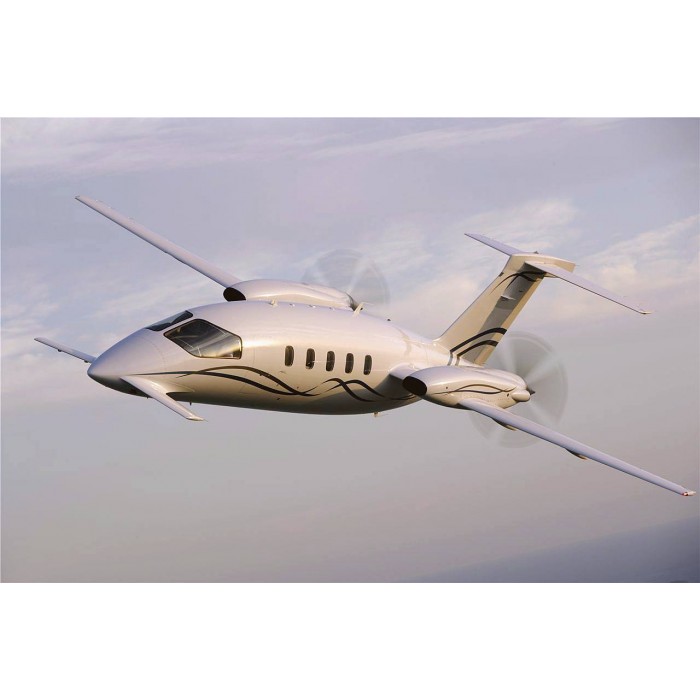
The Piaggio P.180 Avanti II is an Italian executive turboprop with a design unlike any other certified business aircraft: three lifting surfaces (a forward canard foreplane, main wing and conventional T-tail), twin PT6A-66B pusher turboprops mounted behind the wing, and a cabin that is wider and taller than most light jets. Development began in 1979 at Piaggio's Genoa facilities; the first prototype flew in 1986; Italian certification followed in March 1990 and US FAA certification in October 1990. Production was halted in the mid-1990s but relaunched in 2000 following investment led by Piero Ferrari (vice-president of Ferrari). The Avanti II variant - with uprated PT6A-66B engines replacing the original PT6A-66 and an entirely new Collins Pro Line 21 glass cockpit - received EASA certification in October 2005 and FAA certification in March 2006. The Avanti EVO followed in 2014 with winglets, composite propellers and an additional 60-gallon fuel tank. The FAI lists the Avanti family as the world's fastest propeller-driven aircraft, with a record speed of 927.4 km/h (500.8 kt).
The three-surface configuration is the core of the Avanti's aerodynamic engineering: the forward canard provides positive lift and pushes the nose up (unlike a conventional stabiliser which pulls the tail down), allowing the main wing to be moved aft to create a larger unobstructed cabin. The result is a cabin measuring 4.55 m long, 1.85 m wide and 1.75 m high - wider and taller than most light jets at 393 ft³ - with the pusher propellers behind the passenger zone delivering a 68 dBA cabin noise level. Airport Technology confirmed the 9 psi pressurisation differential maintains a sea-level cabin to 24,000 ft and a 41,000 ft operational ceiling. Charter prices start from approximately £2,000 per flight hour. For the full fleet see our private jet price guide or browse our complete fleet.

Why charter the Piaggio Avanti P180 II?
- Three-surface canard layout - the only certified business aircraft with this configuration; FAI fastest propeller aircraft record. The Avanti's three lifting surfaces are unique in certified business aviation: the forward canard foreplane, main wing and T-tail work together differently from any conventional twin. Airport Technology confirmed the canard "provides a positive lift component in addition to that produced by the main wing," while allowing the main wing to be moved aft to create the full-width unobstructed cabin interior. The FAI lists the Avanti family as the world's fastest propeller-driven aircraft at 927.4 km/h (500.8 kt). The uninterrupted aerodynamic curve from nose to tail reduces drag and improves laminar flow. No competing turboprop or business aircraft uses this configuration;
- 400 kt max cruise - fastest turboprop in production; at FL380 delivers 380 kt on 600 lb/hr. AOPA confirmed "with the hammer down and in the low 30s, Avanti IIs can hit 400 KTAS on 800 pounds per hour" and "at FL380, you can expect 380 KTAS on 600 pounds per hour." Paramount Business Jets confirmed 402 ktas maximum cruise. The Avanti II's combination of speed and fuel efficiency at altitude - faster than many competing light jets and more economical than turbofans at comparable speeds - defines its commercial positioning. AOPA noted the aircraft "surpasses the average high-speed cruise distance of competing jets" and is "even faster than many jet competitors." The laminar flow airfoils described by their designer as "the first of the new breed" of high-performance transonic airfoils contribute directly to this cruise efficiency;
- Pusher propellers behind the cabin - 68 dBA speech interference level; quietest interior of any turboprop. Airport Technology confirmed the Avanti II cabin is rated at 68 dBA speech interference level - achieved because the pusher PT6A-66B engines are mounted well behind the passenger zone, directing propeller wash and exhaust noise toward the tail. Air Charter Service described "very little vibration or noise while flying." AOPA confirmed "inside, the cabin is conversationally quiet since the propellers are way behind the cabin." This stands in contrast to conventional turboprops where the propellers are forward of or level with the passenger cabin. The combined wing-engine-fuselage design provides additional vibration reduction. The 68 dBA standard is comparable to light jet cabin noise levels, making the Avanti II the quietest turboprop in charter service;
- 393 ft³ cabin - wider and taller than most light jets; Italian custom interior with Spinneybeck leather. AvBuyer confirmed the Avanti II cabin volume of 393 ft³ with dimensions of 6.1 ft wide, 5.8 ft high and 14.9 ft long - "rivalling several Light Jets and some Mid-Size Jets for volume." Air Charter Service described the interior as featuring "subtle overhead LEDs, custom-designed silk carpets and Spinneybeck Espana leather seat cushions." The standard configuration of five forward leather chairs plus a two-seat divan provides seven passenger positions; an eighth is available in the enclosed lavatory. Broadband connectivity, RosenView in-flight entertainment and an adjustable atmospheric lighting system are available on equipped aircraft. The 41,000 ft operational ceiling combined with the large cabin provides executive comfort at high altitude on European and intercontinental sectors;
- 9 psi pressurisation differential - sea-level cabin to 24,000 ft; 41,000 ft operational ceiling. Airport Technology confirmed the 9 psi cabin differential - an above-average pressurisation standard that maintains a sea-level atmosphere to 24,000 ft and a comfortable cabin altitude at the 41,000 ft ceiling. At FL380 to FL410 the Avanti II operates above most commercial traffic and most weather on European sectors, combining this altitude capability with the 380 to 400 kt cruise speeds that make the sector times competitive with light jets. The operational ceiling is equal to or above most competing King Air variants and the Pilatus PC-12, while delivering a wider cabin than any of them;
- Piero Ferrari relaunch investment; 100+ P180 and 120+ Avanti II ordered; Avantair fractional fleet of 57 aircraft. Air Charter Service confirmed the project was relaunched in 1998 "with a group of investors led by Ferrari vice-president Piero Ferrari." Airport Technology confirmed more than 120 Avanti II aircraft were ordered. AOPA noted that Avantair's adoption of the design "put the Avanti thoroughly on the map in the United States" with 57 aircraft at the programme's peak. The Collins Pro Line 21 glass cockpit with three 10-inch LCD displays, FMS-3000 flight management, WXR-840 weather radar and full Collins navigation suite provides a modern avionics standard. Avanti II is certified for single-pilot operation throughout the envelope.
Charter cost - Piaggio Avanti P180 II prices from UK airports
Hourly rates run from approximately £2,000 to £2,600 - in the turboprop category, above the King Air 300 and Pilatus PC-12, reflecting the Avanti II's jet-competitive 400 kt cruise, Italian custom interior and unique three-surface aerodynamics. For 5 to 7 passengers on UK regional and European missions where maximum speed at turboprop economics is the priority, the Avanti II is without equal in the turboprop category.
Indicative one-way prices from UK airports:
- London to Edinburgh - from £2,400 (6 passengers, approximately 1 hour);
- London to Geneva - from £3,600 (6 passengers, approximately 1 hour 20 minutes);
- London to Paris - from £2,600 (6 passengers, approximately 55 minutes);
- London to Nice - from £3,800 (6 passengers, approximately 1 hour 35 minutes);
- London to Milan - from £3,800 (6 passengers, approximately 1 hour 35 minutes);
- Edinburgh to Istanbul - from £10,000 (6 passengers, approximately 3 hours 20 minutes);
- London to Dublin - from £2,600 (6 passengers, approximately 1 hour 10 minutes).
Empty Leg flights appear on repositioning routes. See our Empty Legs page for current availability.

Ideal routes for the Piaggio Avanti P180 II
Best matched to short and medium European missions where 400 kt cruise at turboprop economics, the quietest turboprop cabin and 393 ft³ Italian interior serve groups of 5 to 7:
- Short European day trips (50 to 90 minutes) where 400 kt is the priority. Paris, Geneva, Amsterdam, Nice and Milan are all within 55 to 100 minutes at 400 kt cruise - times comparable to a light jet and 30 to 60 minutes faster than a King Air 300. For corporate clients on same-day return missions where minimising total elapsed time is the constraint, the Avanti II provides the fastest turboprop option with no compromise on cabin comfort. At FL380 the 380 kt cruise on 600 lb/hr makes these short sectors highly fuel-efficient;
- UK to Italian destinations - Milan, Rome, Florence, Venice; the aircraft's Italian heritage adds appeal. The Piaggio Avanti II is built in Genoa, Italy. For clients travelling to Italian business or leisure destinations, the aircraft's origin adds a narrative dimension beyond pure performance. Milan, Rome, Florence and Venice are all within 1.5 to 2.5 hours at 400 kt. The Italian custom interior - silk carpets, Spinneybeck leather, adjustable atmospheric lighting - provides a cabin aesthetic consistent with the destination;
- Longer European sectors (2 to 3.5 hours) at FL380-FL410 where turboprop economics vs jet rates matter. Istanbul, Athens, Reykjavik, Warsaw and Morocco are all within the Avanti II's range at lighter loads. AOPA confirmed "getting the Avanti up to FL410 and cruising about 300 KTAS will yield a near-1,500 nautical mile range while still cruising as fast as the competition." The 41,000 ft ceiling provides weather avoidance above most convective activity on these longer sectors. At turboprop charter rates approximately 15 to 25% below a comparable light jet on the same sector, the Avanti II's European range is commercially compelling;
- Speed-sensitive missions where the Avanti II is faster than competing turboprops by a significant margin. The Avanti II cruises at 400 kt versus the King Air 300's 320 kt and the Pilatus PC-12 NGX's 290 kt - a difference of 80 to 110 kt that equates to 15 to 25% shorter flight times on comparable sectors. For corporate clients whose schedule is time-critical and who prefer turboprop economics over jet rates, the Avanti II is the only turboprop that closes this gap sufficiently to be competitive with light jet sector times;
- Groups of 5 to 7 where a 393 ft³ cabin at turboprop rates matters more than maximum range. The Avanti II's 393 ft³ cabin with 6.1 ft width and 5.8 ft height provides midsize jet cabin volume at turboprop rates. AvBuyer confirmed the dimensions "rival several Light Jets and some Mid-Size Jets for volume." For groups where cabin space at the lowest available turboprop rate is the primary selection argument, the Avanti II provides more interior volume than any competing King Air or Pilatus PC-12 at comparable per-hour rates.

Cabin and in-flight experience
The Avanti II cabin measures 4.55 m long, 1.85 m wide and 1.75 m high - 393 ft³, pressurised to 9 psi differential maintaining sea-level atmosphere to 24,000 ft. Airport Technology confirmed the 68 dBA speech interference level - comparable to a light jet - achieved by the pusher propeller configuration mounting the engines well behind the passenger zone. The standard configuration provides five fully-adjustable leather chairs plus a two-seat divan for seven passengers; an eighth seat is available in the enclosed lavatory. Air Charter Service described the custom Italian interior: subtle overhead LEDs, custom silk carpets and Spinneybeck Espana leather seat cushions. Broadband connectivity, RosenView entertainment and adjustable atmospheric lighting with window shade control are available on equipped aircraft.
The Collins Pro Line 21 cockpit provides three 10×8-inch LCD displays, FMS-3000 flight management, AHS-3000 attitude reference, WXR-840 colour weather radar and a full Collins navigation suite. Single-pilot certification is valid throughout the envelope, though most aircraft operate with two pilots per AOPA. Two PT6A-66B engines at 850 shp each in pusher configuration. 41,000 ft operational ceiling.
- Cabin. 4.55 m x 1.85 m x 1.75 m; 393 ft³; pressurised; 68 dBA; sea-level to 24,000 ft;
- Layout. 5 leather chairs + 2-seat divan = 7 standard; 8th in enclosed lavatory;
- Interior. Custom silk carpets; Spinneybeck Espana leather; adjustable atmospheric LED lighting;
- Connectivity. Broadband Wi-Fi; RosenView entertainment; window shade control;
- Engines. 2 x PT6A-66B (850 shp each; pusher configuration; behind cabin);
- Avionics. Collins Pro Line 21; 3x 10x8-inch LCD; FMS-3000; WXR-840 radar; AHS-3000;
- Pressurisation. 9 psi; sea-level to 24,000 ft; 41,000 ft ceiling;
- Noise. 68 dBA (pusher engines aft of cabin).
Technical specifications
| Manufacturer | Piaggio Aero Industries, Genoa and Villanova d'Albenga, Italy |
| Development | 1979; first prototype flight 1986 |
| Italian certification | March 1990 (P180); October 2005 (Avanti II) |
| FAA certification | October 1990 (P180); March 2006 (Avanti II) |
| Avanti EVO | 2014 (winglets; composite props; +60 gal fuel) |
| Aircraft class | Executive turboprop; three-surface configuration |
| Configuration | Three-surface: canard foreplane + main wing (aft) + T-tail; pusher props |
| Engines | 2 x Pratt and Whitney Canada PT6A-66B (850 shp each; pusher; aft-mounted) |
| Avionics | Collins Pro Line 21; 3x 10x8-inch LCD; FMS-3000; WXR-840; AHS-3000 |
| FAI speed record | 927.4 km/h (500.8 kt) - fastest propeller-driven aircraft |
| Max cruise speed | 400 kt / 741 km/h at altitude |
| Cruise @ FL380 | 380 kt / 600 lb/hr fuel |
| Long-range cruise | 300 kt @ FL410 (~1,470 nm range) |
| Range (4 pax) | 1,364-1,470 nm / 2,527-2,722 km |
| Service ceiling | 41,000 ft |
| Pressurisation | 9 psi; sea-level to 24,000 ft |
| Takeoff (50 ft obstacle) | 3,262 ft / 994 m |
| Landing distance | 4,417 ft |
| MTOW | 12,100 lb / 5,489 kg |
| Cabin length | 4.55 m (14 ft 11 in) |
| Cabin width | 1.85 m (6.1 ft) |
| Cabin height | 1.75 m (5.8 ft) |
| Cabin volume | 393 ft³ |
| Cabin noise | 68 dBA speech interference level |
| Passengers | 7 standard (5 chairs + 2-divan); 8 with lavatory seat |
| Baggage | 44.15 ft³ external; 16 ft³ internal |
| Wingspan | 14.03 m (46 ft 1 in) |
| Aircraft length | 14.41 m (47 ft 3 in) |
| Aircraft height | 3.97 m (13 ft 1 in) |

Piaggio Avanti P180 II vs similar aircraft
- Piaggio Avanti II vs Pilatus PC-12 NGX. The PC-12 NGX is a single-engine turboprop with a flat floor (unique in its class), 21,300-airport access, aft cargo door and BMW interior. Charter rates are approximately 15 to 25% below the Avanti II. The Avanti II counters with 400 kt cruise (vs PC-12's 290 kt), the quietest turboprop cabin at 68 dBA (pusher vs PC-12's forward-mounted engine noise), 393 ft³ cabin volume (vs PC-12's 330 ft³), twin-engine redundancy and the FAI speed record pedigree. For speed-sensitive European missions the Avanti II is substantially faster; for short-strip and cargo access the PC-12 is more capable;
- Piaggio Avanti II vs Beechcraft King Air 300. The King Air 300 is a pressurised twin turboprop with twin-engine redundancy, 35,000 ft ceiling and 320 kt cruise. Charter rates run approximately 15 to 25% below the Avanti II. The Avanti II counters with 400 kt cruise (25% faster), the 41,000 ft ceiling (vs 35,000 ft), 393 ft³ cabin (vs King Air 300's 356 ft³), 68 dBA (quieter), the canard three-surface laminar flow efficiency and the Italian custom interior. For European missions where speed matters, the Avanti II is the only turboprop that meaningfully closes the gap with light jets;
- Piaggio Avanti II vs Embraer Phenom 300E. The Phenom 300E is a light jet at 447 kt with Garmin G3000 avionics, a 4.92 m cabin and strong factory support. Charter rates are broadly comparable. The Avanti II counters with lower fuel cost at comparable speed (turboprop economics vs turbofan), 393 ft³ cabin volume at comparable rates (Phenom 300E's cabin is narrower at under 1.5 m width), the 68 dBA noise level, the unique three-surface canard design and the Italian bespoke interior. Flying magazine described the Avanti II as "a jet with props" - the commercial comparison with the Phenom 300E is the intended one.

Frequently asked questions - Piaggio Avanti P180 II charter
How much does it cost to charter a Piaggio Avanti P180 II?
Charter rates run from approximately £2,000 to £2,600 per flight hour. London to Geneva costs from £3,600 for 6 passengers. London to Edinburgh costs from £2,400. London to Nice costs from £3,800. All quotes from Private Jets UK are fully itemised with no hidden charges.
Why does the Piaggio Avanti have a canard wing at the front?
Airport Technology confirmed the forward canard "provides a positive lift component" and allows the main wing to be moved further aft so it does not compromise cabin interior space. Unlike a conventional stabiliser which produces downward force on the tail, the canard produces upward force at the nose - reducing the total lift required from the main wing and reducing drag. This, combined with the laminar flow airfoils, is why the Avanti achieves 400 kt on 850 shp per engine where a conventional turboprop would need more power for the same speed.
Is the Piaggio Avanti II quieter than a conventional turboprop?
Yes in the cabin - the pusher configuration mounts the propellers well behind the passenger zone, directing propeller wash and exhaust noise toward the tail. Airport Technology confirmed the 68 dBA speech interference level, with AOPA describing it as "conversationally quiet." However, AOPA also noted the Avanti's "overflight noise footprint is on the high scale, which is typical of pusher designs" - the aircraft can sound distinctive on approach and departure at airports, despite the quiet cabin interior.
What is the Piaggio Avanti EVO?
The Avanti EVO (2014) adds winglets, composite curved propellers and a 60-gallon additional fuel tank to the Avanti II platform. Air Charter Service confirmed the composite propellers increase maximum speed while reducing cabin noise levels further. Only approximately six EVO aircraft were produced. The EVO is the most current production Avanti variant.
How many passengers can fly on a Piaggio Avanti P180 II?
Seven in the standard configuration: five fully-adjustable leather chairs plus a two-seat divan. An eighth seat is available in the enclosed aft lavatory. Single-pilot certification applies throughout the envelope, though most charter flights operate with two pilots. Air Charter Service confirmed: "It is capable of carrying a maximum of nine passengers" - this includes the two cockpit positions.

