


Charter a Mitsubishi MU-300 Diamond
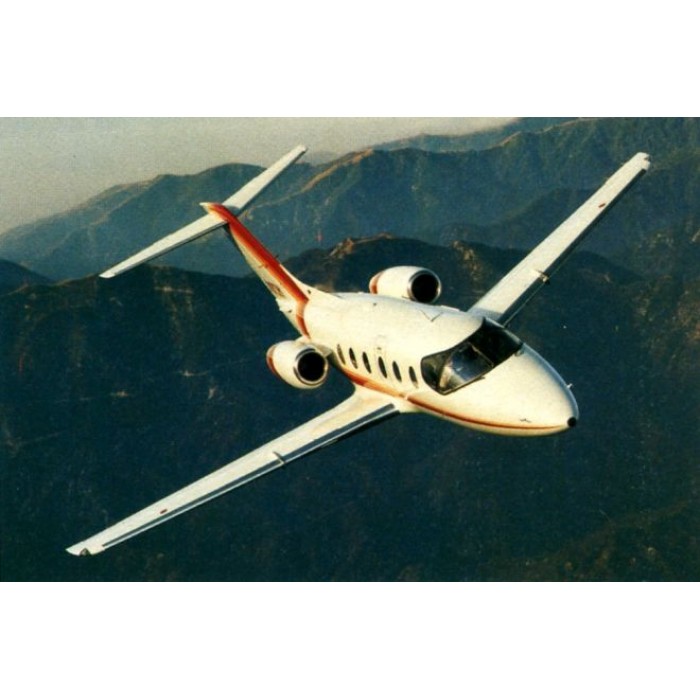


- Availability: Available for rent
Request aircraft information
The Mitsubishi MU-300 Diamond is a light business jet developed by Mitsubishi Heavy Industries from 1977 — the company's first purpose-built jet aircraft, designed to compete directly with the Cessna Citation and Learjet 25. The MU-300 first flew on 29 August 1978 and received FAA Part 25 type certification on 6 November 1981, assembled at Mitsubishi's San Angelo, Texas facility from components produced in Nagoya, Japan. Three variants were built: the Diamond I (89 aircraft, 1981–1984), the Diamond IA (11 aircraft, 1984–1985, with JT15D-4D engines flat-rated to 25°C for improved hot-and-high performance) and the Diamond II (11 aircraft, with JT15D-5 engines at 2,900 lbf). In 1985 Mitsubishi sold the MU-300 design rights and remaining airframes to Beech Aircraft Company, which rebranded the type as the Beechjet 400 — the founding airframe of the Beechjet 400A, Hawker 400 and Hawker 400XP product line that followed over 30 years.
The MU-300 Diamond cabin is among the largest in its class: an all-metal pressurised fuselage with a computer-designed supercritical wing, T-tail and two Pratt & Whitney Canada JT15D turbofans mounted on the rear fuselage. The cabin seats seven to eight passengers with an aft lavatory and baggage compartment. Two pilots operate the aircraft. The Diamond IA specification added the Sperry EDZ-600 electronic flight display option alongside the standard Sperry SPZ-900 avionics package. Charter prices start from approximately £1,500 per flight hour. For the full fleet see our private jet price guide or browse our complete fleet.

Why charter the Mitsubishi MU-300 Diamond?
- Founding airframe of the Beechjet 400 and Hawker 400 line — 30 years of proven platform evolution. The MU-300 Diamond is the direct progenitor of the Beechjet 400, Beechjet 400A, Hawker 400 and Hawker 400XP — a lineage that accumulated over 700 production aircraft and three decades of continuous development. The basic airframe geometry, supercritical wing and rear-mounted JT15D turbofan configuration established by Mitsubishi in 1978 proved so sound that Beechcraft, Raytheon and Hawker Beechcraft carried it forward unchanged in essentials to 2022. For charter clients, this means the MU-300 operates on a platform whose engineering has been validated across an exceptionally large descendant fleet;
- Largest cabin in its class at introduction — 7.41 m long, seats 7 to 8 with aft lavatory. When the Diamond I entered service in 1981, its cabin was among the most spacious available in the light jet category. At 7.41 m long, 1.83 m wide and 1.77 m high, the MU-300 provides stand-up height and a genuine double-club layout for seven to eight passengers with an aft lavatory and separate baggage compartment. The Quantum Jets buyer's guide notes these dimensions established the cabin standard that carried forward unchanged into the Beechjet 400 family;
- Computer-designed supercritical wing — minimises drag at high cruise speeds. Mitsubishi's engineers used a computer-designed supercritical aerofoil section for the MU-300 wing — an advanced design choice for a business jet of the late 1970s, more commonly associated with larger commercial transports at the time. The supercritical profile minimises wave drag at cruise Mach numbers, contributing to the 459 kt maximum cruise speed and enabling efficient operation at altitudes up to 41,000 ft on missions where legacy designs with conventional wing sections would be significantly less efficient;
- Diamond IA: JT15D-4D engines flat-rated to 25°C — improved hot-and-high performance. The Diamond IA variant addressed the principal criticism of the original Diamond I — limited hot-and-high performance caused by certification weight growth of 600 lb above the original design target. The JT15D-4D engines on the IA were flat-rated to 25°C, maintaining full 2,500 lbf takeoff thrust over a wider temperature range and restoring the performance at high-altitude and high-temperature airports that the original specification promised. The Sperry EDZ-600 electronic flight display option and an additional left-side cabin window were also introduced on the Diamond IA;
- Diamond II: JT15D-5 engines at 2,900 lbf with thrust reversers — higher cruise and increased range. The Diamond II, announced October 1983, introduced JT15D-5 engines at 2,900 lbf with thrust reversers, increased fuel capacity from 2,370 to 2,786 litres, raised cruise speed to approximately 439 kt and extended range to 1,460 nm. The thrust reversers were a practical operational addition, shortening landing distances and reducing brake wear on the shorter strips that the Diamond's performance envelope made accessible. An optional digital flight control system was available on the Diamond II at customer request;
- Leather seats, lavatory, mini-bar and tables — complete business cabin specification. The MU-300 Diamond cabin was equipped to a full business specification at the time of production: soft leather armchairs, aft lavatory, mini-bar and fold-out tables. The light interior finish — noted in period evaluations — gave the cabin a sense of spaciousness above what the external dimensions suggested. For a charter aircraft of this vintage, the standard amenities compare favourably with light jets produced a decade later.
Charter cost — Mitsubishi MU-300 Diamond prices from UK airports
Hourly rates run from approximately £1,500 to £2,000 — among the more affordable jet charter options, reflecting the MU-300's vintage and the pre-owned market availability of the type. For 4 to 7 passengers on UK regional and short European missions where the large cabin and proven platform matter more than the latest avionics, the Diamond provides genuine value.
Indicative one-way prices from UK airports:
- London to Edinburgh - from £1,800 (6 passengers, approximately 1 hour);
- London to Geneva - from £3,000 (6 passengers, approximately 1 hour 20 minutes);
- London to Paris - from £1,875 (6 passengers, approximately 55 minutes);
- London to Amsterdam - from £2,100 (6 passengers, approximately 55 minutes);
- London to Dublin - from £2,250 (6 passengers, approximately 1 hour 20 minutes);
- London to Nice - from £3,375 (6 passengers, approximately 1 hour 45 minutes);
- Edinburgh to Zurich - from £3,750 (6 passengers, approximately 2 hours).
Empty Leg flights appear on repositioning routes. See our Empty Legs page for current availability.

Ideal routes for the Mitsubishi MU-300 Diamond
Best matched to UK regional and short European missions where the large vintage cabin, proven JT15D reliability and competitive rates serve groups of 4 to 7:
- UK regional connections (45 to 90 minutes) — large cabin at accessible rates. Edinburgh, Manchester, Belfast, Cardiff and Inverness are all comfortably within range. The 7.41 m cabin provides a working environment for 6 to 7 passengers on UK domestic sectors at rates well below modern light jets of equivalent capacity. The T-tail and rear-engine configuration give the Diamond a quiet cabin relative to earlier wing-mounted engine designs;
- Short European business day trips (1 to 2 hours). Paris, Amsterdam, Brussels, Geneva and Nice are all within the Diamond's range. For groups of 5 to 7 on day-return European business missions, the double-club layout with fold-out tables provides a functional working environment. The aft lavatory eliminates the need to land for facilities on 2-hour sectors;
- Groups of 6 to 7 where cabin space matters at lower rates. For charter clients who need to seat 6 to 7 passengers in genuine comfort and cannot justify large-cabin jet rates, the MU-300 Diamond's 7.41 m × 1.83 m cabin at vintage rates is the specific combination that makes it relevant. The stand-up 1.77 m height allows movement along the full cabin length;
- Aviation history and collector interest — the aircraft that became the Hawker 400. The MU-300 Diamond holds an unusual position in business aviation: a Japanese-built light jet that became the direct ancestor of the Beechjet 400, the T-1A Jayhawk USAF trainer and the Hawker 400XP. For clients with an interest in aviation history, chartering the original Mitsubishi-built Diamond I or IA is a specific experience unavailable from any other aircraft;
- Budget-conscious groups where jet performance is required. At approximately £1,500 to £2,000 per hour, the MU-300 Diamond provides 41,000 ft ceiling, 459 kt cruise and a seven-to-eight-seat cabin at rates that approach the turboprop category. For clients who need jet performance and jet altitude for weather avoidance on sectors where the cabin size is secondary, the Diamond's economics are compelling.

Cabin and in-flight experience
The MU-300 Diamond cabin measures 7.41 m long, 1.83 m wide and 1.77 m high — stand-up height throughout — with soft leather armchairs in a club configuration, fold-out tables, mini-bar and aft lavatory. Seven to eight passengers travel in a double-club layout; the light interior finish gives a sense of spaciousness above what the cross-section dimensions alone suggest. An aft baggage compartment is accessible from the cabin. The two-pilot crew occupies a separate forward flight deck.
The standard Sperry SPZ-900 avionics package with APZ-500 flight director and Primus 300SL colour weather radar provides instrument navigation. The Diamond IA adds the Sperry EDZ-600 electronic flight display option and an extra left-side cabin window. Two JT15D turbofans mounted on the rear fuselage keep engine noise away from the passenger zone. Maximum altitude is 41,000 ft; takeoff weight is 7,361 kg.
- Cabin. 7.41 m × 1.83 m × 1.77 m; stand-up; double-club leather seats;
- Passengers. 7–8; double-club with aft lavatory and baggage;
- Amenities. Leather seats; mini-bar; fold-out tables; aft lavatory;
- Avionics. Sperry SPZ-900 autopilot; APZ-500 flight director; Primus 300SL weather radar;
- Diamond IA. Sperry EDZ-600 electronic flight display option; additional left-side window;
- Engines. 2 × P&W Canada JT15D-4 (2,500 lbf); Diamond II: JT15D-5 (2,900 lbf + thrust reversers);
- Construction. All-metal; supercritical low wing; T-tail; rear-mounted engines.
Technical specifications
| Manufacturer | Mitsubishi Heavy Industries, Nagoya / San Angelo TX |
| First flight | 29 August 1978 |
| FAA certification | 6 November 1981 (FAR Part 25) |
| Production | 1981–1985; Diamond I: 89 built; Diamond IA: 11; Diamond II: 11 |
| Successor | Beechjet 400 (Beechcraft, 1986); Hawker 400XP |
| Aircraft class | Light business jet |
| Engines (Diamond I/IA) | 2 × P&W Canada JT15D-4 / 4D (2,500 lbf each) |
| Engines (Diamond II) | 2 × P&W Canada JT15D-5 (2,900 lbf each; thrust reversers) |
| Max cruise speed | 459 kt (850 km/h) |
| Range | 1,566 nm / 2,900 km (Diamond I/IA); 1,460 nm / 2,704 km (Diamond II) |
| Maximum altitude | 41,000 ft (12,497 m) |
| MTOW | 7,361 kg (16,230 lb) |
| Fuel capacity (Diamond II) | 2,786 L (increased from 2,370 L) |
| Cabin length | 7.41 m |
| Cabin width | 1.83 m |
| Cabin height | 1.77 m (stand-up) |
| Passengers | 7–8 standard; crew of 2 |
| Avionics | Sperry SPZ-900; APZ-500; Primus 300SL; EDZ-600 option (IA) |
| Wingspan | 13.25 m |
| Aircraft length | 14.75 m |
| Aircraft height | 4.20 m |
| Wing | Computer-designed supercritical aerofoil; low-wing; T-tail |
| Construction | All-metal (aluminium and aerospace alloys) |

Mitsubishi MU-300 Diamond vs similar aircraft
- Mitsubishi MU-300 Diamond vs Beechjet 400 / Hawker 400XP. The Beechjet 400 is the direct successor — Beechcraft rebranded the Diamond IA as the Beechjet 400 in 1986 and subsequently developed the 400A and Hawker 400XP with higher MTOW, glass cockpit and Hawker 800XP-derived improvements. The Hawker 400XP has substantially more modern avionics, greater range and a stronger support network. The MU-300 Diamond offers lower charter rates and the historical distinction of the original Mitsubishi-built airframe. For clients who specifically want the Japanese-built original, the Diamond I or IA is the correct aircraft;
- Mitsubishi MU-300 Diamond vs Cessna Citation II. The Citation II was the MU-300's primary US market competitor at introduction — lower cruise speed (approximately 400 kt vs 459 kt) but a simpler, lower-cost operation and a far larger service network. The MU-300 Diamond counters with higher cruise speed, a larger cabin (7.41 m vs approximately 4.8 m) and the supercritical wing aerodynamics that Cessna did not introduce to the Citation line until later variants. For charter clients comparing vintage options in this category, the Diamond's cabin size is the decisive advantage;
- Mitsubishi MU-300 Diamond vs Learjet 25. The Learjet 25 was the other primary competitor at the Diamond's introduction — faster (Mach 0.83 vs Mach 0.77 typical) but with a significantly narrower, lower cabin. The MU-300 counters with a substantially more spacious 7.41 m cabin that seats 7 to 8 passengers in stand-up height, versus the Learjet 25's cramped tube. For groups where cabin comfort matters more than maximum speed, the Diamond's dimensions were — and remain — the stronger offering.
Frequently asked questions — Mitsubishi MU-300 Diamond charter
How much does it cost to charter a Mitsubishi MU-300 Diamond?
Charter rates run from approximately £1,500 to £2,000 per flight hour. London to Geneva costs from £3,000 for 6 passengers. London to Edinburgh costs from £1,800. London to Paris costs from £1,875. All quotes from Private Jets UK are fully itemised with no hidden charges.
What is the connection between the MU-300 Diamond and the Hawker 400?
The Hawker 400XP is the direct descendant of the MU-300 Diamond. In 1985 Mitsubishi sold the design rights and remaining unfinished airframes to Beech Aircraft Company, which rebranded the Diamond IA as the Beechjet 400. Beechcraft subsequently developed the 400A with higher MTOW and a glass cockpit; Raytheon then renamed it the Hawker 400, and Hawker Beechcraft produced the Hawker 400XP until 2012. The same basic airframe, supercritical wing and rear-mounted JT15D configuration persisted throughout the entire lineage.
What are the differences between the Diamond I, Diamond IA and Diamond II?
The Diamond I (89 built, 1981–1984) used JT15D-4 engines at 2,500 lbf. The Diamond IA (11 built, 1984–1985) added JT15D-4D engines flat-rated to 25°C for improved hot-and-high performance, an extra left-side cabin window and the Sperry EDZ-600 electronic flight display option. The Diamond II (11 built, from 1983) used JT15D-5 engines at 2,900 lbf with thrust reversers, increased fuel capacity from 2,370 to 2,786 litres and an optional digital flight control system.
How many passengers can fly on a Mitsubishi MU-300 Diamond?
Seven to eight in standard configuration with a crew of two pilots. The 7.41 m cabin with stand-up 1.77 m height accommodates a double-club layout of seven passengers plus an aft lavatory and baggage compartment. The cabin width of 1.83 m provides genuine shoulder room for all passengers in the club seating arrangement.
Is the Mitsubishi MU-300 Diamond still supported?
Parts compatibility exists with the Beechjet 400/Hawker 400 family where the airframes have not diverged through later modifications, and Textron Aviation continues to support the Hawker 400 platform. Original Mitsubishi-specific components may be more difficult to source. Operators of the Diamond I and IA typically maintain aircraft through specialists familiar with the JT15D engine family, which remains in widespread service across multiple business jet types.