


Charter a HondaJet HA-420
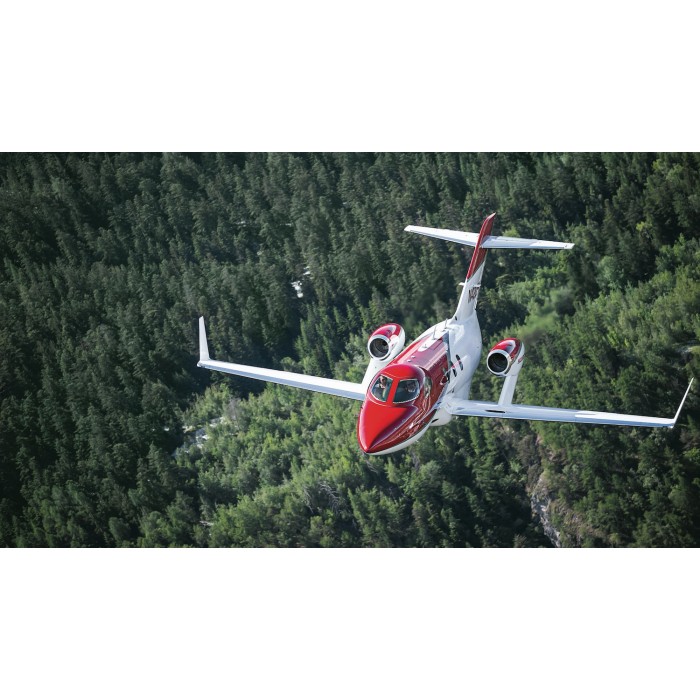


- Availability: Available for rent
Request aircraft information
The HondaJet HA-420 is the world's most technologically innovative very light jet - the first aircraft developed by Honda Aircraft Company, a wholly-owned subsidiary of Honda Motor Company founded in August 2006 by aeronautical engineer Michimasa Fujino. Honda researched compact business jets from 1986, locked in the design concept in 1999, flew the first proof-of-concept in 2003 and received FAA type certification in December 2015. The aircraft was an immediate disruptor: Quantum Jets confirmed it was "faster, quieter, and more fuel-efficient than competing Cessna and Embraer VLJs." The HondaJet was the top-selling twin-engine light business jet in 2017 with 43 deliveries globally. The current production variant, the HondaJet Elite II, received FAA certification on 2 November 2022 at a base price of $6.95 million. It delivers 1,547 nm NBAA IFR range, 422 kt maximum cruise at FL300 and a 43,000 ft operational ceiling. Over 200 HondaJets of all variants had been delivered by the end of 2021.
Two defining engineering decisions shape the HondaJet: the Over-The-Wing Engine Mount (OTWEM) and Natural Laminar Flow (NLF) design. Placing the GE Honda HF120-H1A turbofan engines on pylons above the wing rather than on the rear fuselage eliminates the structural frames that rear-mounted engines require, allowing the full fuselage length to be used for cabin space. Wikipedia confirmed the engine placement at 75% of the wing chord creates "favorable interference" where airflow over the wing is superimposed with airflow around the engine to minimise wave drag at high speed. The laminar flow nose and wing design reduces drag across the speed envelope. These two innovations combined deliver 20% better fuel efficiency than comparable aircraft. Charter prices start from approximately £2,500 per flight hour. For the full fleet see our private jet price guide or browse our complete fleet.

Why charter the HondaJet HA-420?
- Over-The-Wing Engine Mount (OTWEM) - the engineering breakthrough that defines the HondaJet and maximises cabin space. Jetcraft confirmed the over-wing engine mount "was engineered and proven by Honda after more than 20 years of extensive research and development." By mounting the engines on pylons above the wing rather than on the rear fuselage, Honda eliminated the structural support frames that conventional rear-fuselage engine mounts require. The freed fuselage volume converts directly to cabin length. Wikipedia confirmed the engine position at 75% of the wing chord creates "favorable interference" - the airflow over the wing superimposed with airflow around the engine minimises wave drag at high speed. This was the fundamental problem the VFW-Fokker 614 (the only previous over-wing jet) could not solve; Honda's solution using computer analysis and wind tunnel testing took 20 years to perfect;
- Natural Laminar Flow nose and wing - reduces drag across the full speed envelope; 20% better fuel efficiency than comparable aircraft. Honda confirmed the NLF design covers both the nose and wing, producing laminar airflow over a larger surface area than conventional designs. Wikipedia confirmed Honda claims "the combination of lightweight materials, aerodynamics and efficient engines gave the HondaJet up to 20% better fuel efficiency than similar aircraft." Business and Commercial Aviation's testing confirmed for a 1,000 nm 4-passenger mission, the HondaJet Elite uses 1,872 lb of fuel - 3% less than the Phenom 100EV and 8% less than the Citation M2. On a 300 nm mission the gap widens to 11% and 18% respectively. This efficiency advantage is consistent across all mission lengths and improves at shorter sectors where the efficiency contrast with turbofan competitors is most pronounced;
- GE Honda HF120-H1A turbofans - a co-developed engine unique to the HondaJet; Garmin G3000 with Emergency Autoland standard on Elite II. The GE Honda HF120-H1A was jointly developed by GE Aviation and Honda - a turbofan unique to the HondaJet and not used in any other certified aircraft. Each engine produces 2,050 lbf. The Garmin G3000 avionics suite on the Elite II provides three 14-inch full-colour touchscreen displays, GFC 700 autopilot, dual GIA-64E navigators, GWX-8000 weather radar, TCAS I, ADS-B and autothrottle (from H1 2023). Garmin Emergency Autoland - which can autonomously land the aircraft without pilot input - became available on the Elite II during 2023. Quantum Jets noted London City Airport (LCY) certification is available for the Elite II, "rare in this class";
- 422 kt cruise at FL300; 43,000 ft ceiling; cabin altitude 7,927 ft - fastest in the VLJ class. Aviation Week confirmed the HondaJet Elite II achieves 422 kt maximum cruise speed at FL300 in ISA conditions - the highest cruise speed in the VLJ category. At 43,000 ft maximum operating altitude, the HondaJet operates above all commercial airline traffic and above most weather on European sectors. The cabin altitude at maximum ceiling is 7,927 ft per Quantum Jets - comparable to commercial airliner conditions. Mach 0.72 MMO and 270 kt VMO define the operating envelope. On a 300 nm European sector at 422 kt, the HondaJet Elite II is approximately 10% faster than a Phenom 100EV at comparable cruise speed settings;
- 1,547 nm NBAA IFR range - London to Istanbul, New York to Los Angeles non-stop at VLJ rates. Aviation Week confirmed 1,547 nm with four occupants and NBAA IFR reserves for the Elite II - a 45% range increase over the original HA-420's 1,065 nm. Quantum Jets confirmed "Los Angeles to Chicago (1,512 nm) with reasonable headwind margins" and nearly all US transcontinental pairs. From UK airports the equivalent range covers London to Istanbul, Edinburgh to Istanbul and all European capitals non-stop. The 471.62 gal usable fuel capacity and the NLF/OTWEM efficiency combine to deliver this range at 104 gph total fuel burn;
- Top-selling twin-engine light jet 2017; 200+ delivered by 2021; HondaJet Echelon (2026) follow-on. Air Charter Service confirmed the HondaJet was "the top-selling twin-engine light business jet of 2017, with 43 aircraft delivered." Over 200 had been delivered globally by end of 2021. Honda Aircraft Company won multiple industry awards including for the OTWEM and composite fuselage. Honda announced the HondaJet Echelon (HA-480) in June 2023: Williams FJ44-4C engines; 2,625 nm range; 11 seats; 47,000 ft ceiling; first flight planned for late 2026. This confirms the programme's ongoing development trajectory and the factory support commitment behind the existing Elite II fleet.
Charter cost - HondaJet HA-420 prices from UK airports
Hourly rates run from approximately £2,500 to £3,200 - in the VLJ category, above the Cessna Citation CJ1+ and Embraer Phenom 100EV, reflecting the HondaJet's 422 kt speed advantage, 1,547 nm range, Garmin G3000 with Emergency Autoland and the OTWEM configuration that provides a larger cabin than most VLJ competitors at comparable rates. Quantum Jets confirmed charter rates of $3,500 to $4,500 per flight hour.
Indicative one-way prices from UK airports:
- London to Edinburgh - from £3,000 (5 passengers, approximately 55 minutes);
- London to Geneva - from £4,250 (5 passengers, approximately 1 hour 10 minutes);
- London to Paris - from £3,125 (5 passengers, approximately 50 minutes);
- London to Nice - from £4,375 (5 passengers, approximately 1 hour 30 minutes);
- London to Istanbul - from £10,000 (5 passengers, non-stop, approximately 3 hours 30 minutes);
- London City to Amsterdam - from £3,250 (5 passengers, LCY certified, approximately 50 minutes);
- Edinburgh to Moscow - from £12,000 (5 passengers, non-stop, approximately 3 hours 30 minutes).
Empty Leg flights appear on repositioning routes. See our Empty Legs page for current availability.

Ideal routes for the HondaJet HA-420
Best matched to short and medium European missions where 422 kt cruise, 1,547 nm range and the most advanced VLJ avionics serve groups of 4 to 6:
- Short European day trips (50 to 90 minutes) where 422 kt is the fastest VLJ available. Paris, Geneva, Amsterdam, Brussels and Nice are all within 50 minutes to 1 hour 30 minutes at 422 kt. The HondaJet Elite II is the fastest aircraft in the VLJ category at this speed - faster than the Phenom 100EV and Citation M2 on equivalent sectors. The NLF efficiency advantage widens on shorter sectors: Business and Commercial Aviation confirmed 18% less fuel than the Citation M2 on a 300 nm mission. For corporate clients on same-day European returns, the HondaJet provides the fastest available VLJ sector time;
- London City Airport (LCY) operations - LCY certification rare in the VLJ class. Quantum Jets confirmed LCY certification for the HondaJet Elite II - a steep-approach capability that is "rare in this class." London City Airport's 5.5-degree approach and short runway eliminate most VLJs and all larger jets. For clients based in the City of London, the HondaJet's LCY certification provides direct access to central London without the surface transfer from Heathrow, Gatwick or Luton. No other VLJ in the charter fleet routinely holds LCY certification for charter operations;
- Longer European sectors (2 to 3.5 hours) to Istanbul, Athens and North Africa within 1,547 nm. London to Istanbul (approximately 1,550 nm), Edinburgh to Istanbul, London to Athens, London to Morocco and London to the Canary Islands are all within range. The 43,000 ft ceiling provides weather avoidance above most convective activity on these longer European sectors. At 422 kt the HondaJet Elite II completes these sectors 10 to 15% faster than most VLJ competitors. The cabin altitude of 7,927 ft at maximum altitude provides reasonable passenger comfort on these 2 to 3.5-hour sectors;
- Technology-focused charter where Garmin G3000 with Emergency Autoland is the avionics priority. The HondaJet Elite II (2023 onward) carries Garmin Emergency Autoland - a system that can autonomously fly, navigate and land the aircraft at the nearest suitable airport without pilot input. This capability, standard on the Elite II, is the most advanced safety system in the VLJ category. For charter clients who specifically value the most current avionics safety technology in the light jet class, the HondaJet Elite II with Emergency Autoland is the definitive choice;
- Groups of 4 to 5 where the OTWEM cabin space advantage over conventional VLJs matters. The HondaJet's 5.43 m cabin, freed from the structural constraints of rear-mounted engine frames, provides more usable interior length than competing VLJs with equivalent external dimensions. Air Charter Service confirmed a "larger cabin than many rival light jets." FlyCraft documented a typical configuration of 1 crew + 6 passengers with the belted lavatory seat providing the seventh position. For groups of 4 to 5 on short European sectors, the HondaJet cabin provides perceptibly more space than the Citation M2 or Phenom 100EV at comparable rates.

Cabin and in-flight experience
The HondaJet Elite II cabin measures 5.43 m (17.8 ft) long, 1.52 m (5.0 ft) wide and 1.47 m (4.83 ft) high. Total interior volume is 324 ft³. The standard executive layout seats five passengers: four in a classic club configuration and a single rear seat; a sixth is accommodated in the enclosed aft lavatory with its belted seat (introduced in the Elite). FlyCraft confirmed the typical layout as 1 crew + 6 passengers with an alternate 2 crew + 5 pax option. Combined baggage capacity is 62 ft³ (9 ft³ nose + 53 ft³ aft compartment, per Aviation Week). Air Charter Service described a "typical layout of four executive seats in a classic club formation and a single-seat divan at the rear."
The Garmin G3000 avionics suite provides three 14-inch full-colour touchscreen displays, GFC 700 autopilot, dual GIA-64E navigators, GWX-8000 weather radar, TCAS I, ADS-B and autothrottle. Garmin Emergency Autoland is available on 2023-onwards Elite II aircraft. Air Charter Service confirmed a "beverage center with ice bin, sink with running water, externally serviceable toilet." Cabin altitude at FL430 is 7,927 ft. 43,000 ft maximum ceiling. Two GE Honda HF120-H1A turbofans at 2,050 lbf each. 104 gph total fuel burn.
- Cabin. 5.43 m x 1.52 m x 1.47 m; 324 ft³; pressurised; cabin altitude 7,927 ft @ FL430;
- Layout. 4-club + 1 = 5 standard; 6th in belted aft lavatory; 7th option available;
- Baggage. 62 ft³ combined (9 ft³ nose + 53 ft³ aft); ~6 suitcases;
- Galley. Beverage centre; ice bin; sink with running water;
- Avionics. Garmin G3000 (3x 14-inch touchscreen); GFC 700 AFCS; GWX-8000 radar; TCAS I; ADS-B; autothrottle; Emergency Autoland (2023+);
- Engines. 2 x GE Honda HF120-H1A (2,050 lbf each; OTWEM; 104 gph combined);
- LCY. London City Airport certified (steep approach);
- NLF. Natural Laminar Flow nose and wing; 20% better fuel efficiency vs comparable aircraft.
Technical specifications
| Manufacturer | Honda Aircraft Company, Greensboro, North Carolina |
| First proof-of-concept flight | 2003 |
| FAA certification (HA-420) | December 2015 |
| HondaJet Elite | May 2018 (1,437 nm; belted lav; TOLD; AoA indicator) |
| HondaJet Elite II | FAA cert 2 November 2022; $6.95M; 1,547 nm; Emergency Autoland 2023 |
| Deliveries | >200 all variants by end 2021; top-selling twin-engine light jet 2017 |
| Aircraft class | Very Light Jet (VLJ) |
| Engines | 2 x GE Honda HF120-H1A (2,050 lbf each; co-developed by GE and Honda; OTWEM) |
| Engine configuration | Over-The-Wing Engine Mount (OTWEM); 75% wing chord position |
| Aerodynamics | Natural Laminar Flow (NLF) nose and wing; composite fuselage |
| Avionics | Garmin G3000 (3x 14-inch touchscreen); GFC 700 AFCS; GWX-8000; TCAS I; ADS-B; autothrottle; Emergency Autoland (2023+) |
| Max cruise speed | 422 kt (782 km/h) at FL300 ISA; MMO Mach 0.72 |
| Range (NBAA IFR, 4 pax) | 1,547 nm / 2,865 km (Elite II) |
| Service ceiling | 43,000 ft |
| Cabin altitude @ FL430 | 7,927 ft |
| Takeoff distance | 3,699 ft (ISA; MTOW; sea level) |
| Landing distance | 2,717 ft (unfactored) |
| MTOW (Elite II) | 11,100 lb / 5,034 kg |
| Fuel capacity | 471.62 gal usable |
| Fuel burn | 104 gph combined (vs 111 gph Phenom 100EV on 1,000 nm) |
| LCY certification | Yes (steep-approach; rare in VLJ class) |
| Cabin length | 5.43 m (17.8 ft) |
| Cabin width | 1.52 m (5.0 ft) |
| Cabin height | 1.47 m (4.83 ft) |
| Passengers | 5 standard; 6 with belted lavatory seat; 7 max |
| Baggage | 62 ft³ combined (9 ft³ nose + 53 ft³ aft) |
| Wingspan | 12.1 m (39.8 ft) |
| Aircraft length | 13.00 m (42.6 ft) |
| Aircraft height | 4.50 m (14.1 ft) |

HondaJet HA-420 vs similar aircraft
- HondaJet Elite II vs Embraer Phenom 100EV. Business and Commercial Aviation confirmed the HondaJet Elite uses 3% less fuel on a 1,000 nm mission and 11% less on a 300 nm mission versus the Phenom 100EV. The Phenom 100EV has a wider cabin and stronger factory support from Embraer. Quantum Jets noted the Elite II "commands a price premium of $2M over the Phenom 100EV." The HondaJet counters with 422 kt cruise (faster), 1,547 nm range (substantially more), Garmin G3000 with Emergency Autoland, the OTWEM configuration providing cabin space equivalent to a larger airframe and London City Airport certification. For speed, range and avionics innovation, the HondaJet is the premium VLJ choice;
- HondaJet Elite II vs Cessna Citation M2 Gen2. Business and Commercial Aviation confirmed the HondaJet Elite uses 8% less fuel on a 1,000 nm mission and 18% less on a 300 nm mission versus the Citation M2. The Citation M2 has a stronger Textron support network and lower acquisition cost. The HondaJet counters with 422 kt cruise (faster), 1,547 nm range (approximately 35% more than M2's approximately 1,150 nm), OTWEM larger cabin, NLF efficiency, GE Honda HF120 engines, Garmin G3000 with Emergency Autoland and the OTWEM configuration's structural advantage. For clients where range, speed and fuel efficiency are the priorities, the HondaJet is the stronger choice at the premium price point;
- HondaJet Elite II vs Pilatus PC-24. The PC-24 is a light twin-jet with 440 kt cruise, 1,525 nm range, a flat-floor cargo door and an extensive single-engine turboprop operator network feeding the type. Charter rates for the PC-24 run approximately 20 to 30% above the HondaJet. The HondaJet counters with 422 kt cruise (comparable), 1,547 nm range (comparable), Garmin Emergency Autoland, the OTWEM innovation, lower charter rates and the most advanced avionics in the VLJ-to-light-jet transition category. For clients where rate matters at comparable speed and range, the HondaJet is the more economical choice.

Frequently asked questions - HondaJet HA-420 charter
How much does it cost to charter a HondaJet HA-420?
Charter rates run from approximately £2,500 to £3,200 per flight hour. London to Geneva costs from £4,250 for 5 passengers. London to Edinburgh costs from £3,000. London to Istanbul costs from £10,000 non-stop. All quotes from Private Jets UK are fully itemised with no hidden charges.
What is the Over-The-Wing Engine Mount (OTWEM) and why does it matter?
Wikipedia confirmed Honda placed the GE Honda HF120 engines on pylons above the wing rather than on the rear fuselage - eliminating the structural frames that conventional rear-mounted engine mounts require. This freed fuselage volume converts to cabin length. Honda determined through computer analysis and wind tunnel testing that placing the engines at 75% of the wing chord creates "favorable interference" where engine and wing airflows combine to minimise wave drag at high speed. The result is a larger cabin than conventional VLJs at equivalent external dimensions and lower drag at cruise.
What is Natural Laminar Flow (NLF) on the HondaJet?
Honda designed both the nose and wing to promote laminar airflow - where the boundary layer flows smoothly without turbulence - over a larger surface area than conventional aircraft. Laminar flow reduces skin friction drag significantly. Wikipedia confirmed Honda claims up to 20% better fuel efficiency versus similar aircraft from the NLF plus OTWEM combination. Business and Commercial Aviation testing confirmed the HondaJet uses 8 to 18% less fuel than the Citation M2 depending on sector length.
Does the HondaJet Elite II have Garmin Emergency Autoland?
Yes - Garmin Emergency Autoland became available on the HondaJet Elite II during 2023. The system can autonomously fly, navigate to the nearest suitable airport and land the aircraft without pilot input. This capability - standard on Elite II aircraft built from 2023 - is the most advanced safety feature in the VLJ category. Quantum Jets confirmed this is one of the primary reasons operators choose the Elite II at its $6.95 million price point.
Can the HondaJet operate from London City Airport (LCY)?
Yes - Quantum Jets confirmed LCY certification for the HondaJet Elite II. London City Airport's 5.5-degree steep approach and shorter runway length eliminate most VLJs and all larger jets. The HondaJet's LCY certification is described by Quantum Jets as "rare in this class." For clients based in the City of London or Canary Wharf, this provides direct access without the surface transfer from Heathrow, Gatwick or Luton.

