


Charter a Gulfstream GV


- Availability: Available for rent
Request aircraft information
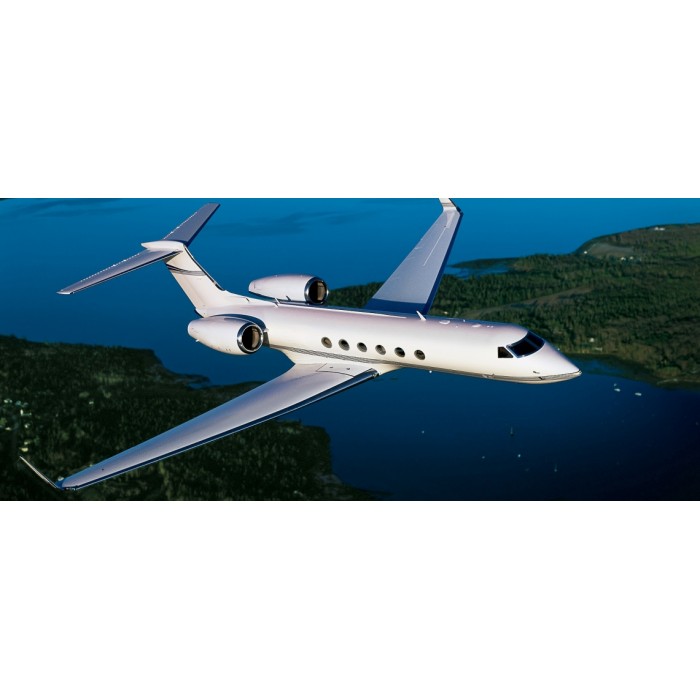
The Gulfstream GV is one of the defining aircraft in business aviation history - the ultra-long-range platform that Gulfstream Aerospace built specifically to compete with the newly introduced Bombardier Global Express and establish the company's dominance in the longest-range business jet category. The GV made its first flight on November 28, 1995, received FAA type certification in April 1997 and entered service in 1997. A total of 193 Gulfstream V aircraft were built between 1997 and 2002. The GV introduced Rolls-Royce BR710A1-10 turbofan engines at 14,750 lbf each - a major step up in capability from the GIV's Tay 611-8 at 13,850 lbf - combined with a redesigned wing of larger dimensions and a fuselage stretched by 2.13 metres over the GIV to accommodate 15 to 19 passengers in a stand-up large cabin. Jettly confirmed the GV "offered roughly 6,250 to 6,500 nm of range" at certification. The GV's 51,000 ft service ceiling - higher than any production business jet of its era - enabled flights in upper airspace clear of all commercial traffic and most weather. In 2003 the GV was succeeded by the G550 (officially designated GV-SP), which extended range to 6,750 nm, introduced the PlaneView cockpit with four 14-inch LCD displays and won the 2003 Robert J. Collier Trophy for its technological innovations.
The Gulfstream GV and its successor the G550 (GV-SP) are twin-turbofan ultra-long-range business jets - both powered by Rolls-Royce BR710 series engines, both capable of 51,000 ft operations and both providing the intercontinental range that makes non-stop London to Los Angeles, London to Singapore and London to Tokyo missions achievable. Air Charter Service confirmed the G550 "links Washington D.C. with Dubai, London with Singapore, and Tokyo with Los Angeles." Charter prices start from approximately £6,000 per flight hour. For the full fleet see our private jet price guide or browse our complete fleet.

Why charter the Gulfstream GV?
- 6,250-6,750 nm ultra-long range; 51,000 ft ceiling; London to Los Angeles; London to Singapore; London to Tokyo non-stop - the largest intercontinental range available in its class at introduction. Jettly confirmed the GV "offered roughly 6,250-6,500 nm of range" while the successor G550 extends this to 6,750 nm. AeroCorner confirmed the GV was "designed to connect major global cities without fuel stops." Grokipedia confirmed the G550's maiden flight "reaching 51,000 feet at speeds up to Mach 0.955 during initial testing." The 51,000 ft service ceiling - confirmed by the HTML specifications (15,545 m) - places the GV family above all scheduled airline traffic and above virtually all weather systems encountered on ultra-long-range intercontinental routing. Air Charter Service confirmed the G550 "links Washington D.C. with Dubai, London with Singapore, and Tokyo with Los Angeles." For charter clients whose missions include transatlantic, transpacific or Europe-Middle East non-stop routing over 12 hours, the GV family provides confirmed capability that few competing platforms match at comparable charter rates;
- Rolls-Royce BR710 turbofan series; 14,750 lbf (GV) / 15,385 lbf (G550); FADEC (G550); full-authority digital engine control; 99.9% dispatch reliability (G550); 2.6 million flight hours accumulated. Quantum Jets confirmed the G550's Rolls-Royce BR710C4-11 engines each produce 15,385 lbf of thrust with FADEC dual-channel control. Stratos Jets confirmed "in terms of dispatch reliability, it is nearly flawless, boasting a rating of 99.9 per cent" and that the BR710 engines "are renowned for reliability and efficiency." Grokipedia confirmed "the Rolls-Royce BR710 engines demonstrated exceptional reliability throughout, powering the aircraft without any major incidents or failures during the certification efforts." Air Charter Advisors confirmed "600+ G550s delivered worldwide accumulating over 2.6 million flight hours as of 2023." This combination of BR710 engine reliability and the G550's 99.9% dispatch reliability places the GV family at the highest confirmed operational dependability standard in the ultra-long-range large-cabin category;
- Stand-up cabin: 15.27 m (50.1 ft) long, 2.24 m (7.4 ft) wide, 1.85 m (6.2 ft) high; 14 oval windows; 4 distinct living areas; up to 8 lie-flat sleeping positions; two full lavatories; 100% fresh-air replenishment - designed for 12-14 hour missions. Jettly confirmed the G550 cabin "length measures about 50.1 ft, cabin height sits at approximately 6.2 ft" with "up to four distinct living areas suited for work and rest on long flights." Stratos Jets confirmed the cabin "features two full lavatories, and in certain configurations can sleep up to eight passengers" and "14 large oval windows, which infuse the 1,699-cubic-foot cabin with an abundance of natural light." Stratos Jets confirmed the G550 provides "100% fresh-air replenishment, noise reduction, and strong endurance up to 12+ hours nonstop even with full loads." The low cabin altitude pressurisation reduces passenger fatigue on 12 to 14-hour sectors compared to lower-specification aircraft. A typical charter configuration carries a forward 4-place club, a 4-place conference grouping, a 2-place club and divans converting to flat beds for up to 8 passengers on overnight transatlantic sectors. For charter clients whose intercontinental mission requires productive working and sleeping capability throughout 12+ hours in the air, the GV family provides the four-zone large cabin specification;
- PlaneView cockpit (G550 from 2003); 4x 14-inch LCD displays; Enhanced Vision System (Elbit FLIR, first on any civil aircraft); Head-Up Display (Rockwell Collins); synthetic vision; 2003 Collier Trophy winner. Quantum Jets confirmed the G550's PlaneView cockpit "with four 14-inch LCDs, industry-first standard Enhanced Vision System (EVS) by Elbit, standard Head-Up Display by Rockwell Collins, and synthetic vision system" won the "2003 Robert J. Collier Trophy for pioneering the PlaneView flight deck." The industry-first standard EVS on the G550 - using a forward-looking infrared camera to project a real-world image in low visibility - provided a level of approach safety previously unavailable as standard equipment in business aviation. The original GV carries the Honeywell SPZ-8000 avionics with EFIS displays; the G550 upgrade to PlaneView provides the current large-cabin avionics standard. For charter clients who specify the most advanced available avionics for oceanic and polar routing, confirm whether the aircraft is the original GV (SPZ-8000) or the G550 (PlaneView) before booking;
- 193 GV built (1997-2002); 600+ G550 built (2003-2021); government, military and NASA operators; Israeli Air Force; total GV family fleet defines the large-cabin ultra-long-range charter market standard. Air Charter Advisors confirmed "600+ G550s delivered worldwide" before production ceased in July 2021. Quantum Jets confirmed operators include the "Israeli Air Force, US military, NASA, JAXA, corporations, governments worldwide." The institutional operator depth of the GV family - from NASA scientific missions to head-of-state transport to corporate charter - reflects the platform's confirmed operational versatility across the most demanding flight profiles. Pre-owned G550 values ranged from $11 million to $35 million in 2026 (Air Charter Advisors), reflecting the platform's retained value and strong demand in the charter market. For charter clients who want the most widely deployed ultra-long-range large-cabin jet with the deepest operator base and highest dispatch reliability confirmation, the GV/G550 family is the definitive choice;
- GV vs G550 comparison - identical BR710 engine family, cabin and ceiling; G550 adds +250 nm range, PlaneView cockpit, EVS standard, HUD, seventh window pair, entry door moved 2 ft forward. Quantum Jets confirmed the G550 improvements over the GV: "PlaneView cockpit with four 14-inch LCDs, +250 nm range to 6,750 nm via drag reduction, +500 lb MTOW to 91,000 lb, +635 lbf per engine via BR710C4-11 (vs GV's BR710A1-10 at 14,750 lbf), seventh pair of cabin windows added, entry door moved 2 ft forward for increased usable cabin length." When chartering within the GV family, the G550 provides modern PlaneView avionics and the additional range that pushes London to Tokyo (approximately 6,000 nm) within non-stop capability at Mach 0.85 cruise; the original GV is available at lower rates for missions within 6,250 nm.
Charter cost - Gulfstream GV prices from UK airports
Hourly rates run from approximately £6,000 to £9,000 - at the top of the large-cabin jet category, reflecting 6,250-6,750 nm ultra-long range, 51,000 ft ceiling and 12-14 hour endurance with full galley and sleeping capability. Air Charter Advisors confirmed G550 charter rates of $9,000-11,500 per hour. The original GV provides comparable performance at rates below the G550. For groups of 10 to 16 on intercontinental sectors where non-stop range beyond 4,000 nm, lie-flat sleeping and full galley service are specified, the GV family provides the entry-level ultra-long-range option.
Indicative one-way prices from UK airports:
- London to New York - from £52,500 (12 passengers, approximately 7 hours 30 minutes non-stop);
- London to Dubai - from £45,000 (12 passengers, approximately 6 hours non-stop);
- London to Los Angeles - from £75,000 (12 passengers, approximately 10 hours 45 minutes non-stop);
- London to Singapore - from £90,000 (12 passengers, approximately 13 hours non-stop);
- London to Tokyo - from £90,000 (12 passengers, approximately 13 hours non-stop, G550);
- London to Moscow - from £18,000 (12 passengers, approximately 3 hours);
- London to Geneva - from £12,000 (12 passengers, approximately 1 hour 20 minutes).
Empty Leg flights appear on repositioning routes. See our Empty Legs page for current availability.

Ideal routes for the Gulfstream GV
Best matched to ultra-long-range intercontinental missions where 6,250-6,750 nm non-stop range, 51,000 ft ceiling, four-zone large cabin and 12-14 hour endurance with lie-flat sleeping serve groups of 10 to 16 on the world's longest business routes:
- Transatlantic non-stop sectors (London to New York; London to Chicago; London to Houston; London to Miami) within 5,000 nm at full passenger load. London to New York (approximately 3,450 nm), London to Chicago (approximately 3,900 nm) and London to Miami (approximately 4,400 nm) are all well within non-stop range. At Mach 0.80 long-range cruise, London to New York takes approximately 7 hours 30 minutes with four cabin zones available throughout. For corporate groups whose transatlantic missions require non-stop operation with lie-flat sleeping and galley service, the GV provides the full ultra-long-range specification;
- London to Los Angeles and London to Singapore non-stop (10-13 hours) where 51,000 ft cruise altitude clears all polar routing restrictions and weather. London to Los Angeles (approximately 5,500 nm) and London to Singapore (approximately 6,750 nm, G550) are achievable non-stop at the G550's confirmed 6,750 nm range. Air Charter Service confirmed the G550 "links London with Singapore." At 51,000 ft cruise altitude the routing options over polar airspace are fully accessible with RVSM compliance. For clients on Asia-Pacific missions from UK bases, the GV/G550 provides the confirmed range for non-stop or minimal-stop operations;
- Europe to Middle East and Indian Subcontinent sectors (London to Dubai; London to Riyadh; London to Mumbai) where 6-8 hour non-stop sectors use galley and conference capability productively. London to Dubai (approximately 3,300 nm), London to Riyadh (approximately 3,000 nm) and London to Mumbai (approximately 4,700 nm) are all within non-stop range. The four-zone cabin provides conference configuration for the working outbound sector and galley service throughout. At 51,000 ft the routing choices include direct routing over restricted airspace that lower-altitude aircraft cannot access;
- Overnight transatlantic and transpacific sectors where lie-flat sleeping for up to 8 passengers reduces 12-hour sector fatigue for arrival-ready business travel. Stratos Jets confirmed "in certain configurations the G550 can sleep up to eight passengers." For charter clients whose overnight transatlantic sector from London to New York, London to Los Angeles or London to Singapore requires lie-flat sleeping positions to arrive productive for immediate business, the GV/G550 four-zone cabin provides this at confirmed ultra-long-range rates;
- Government, diplomatic and high-value VIP missions requiring 51,000 ft ceiling, 99.9% dispatch reliability and the institutional credibility of the Gulfstream GV/G550 platform. Quantum Jets confirmed operators include "Israeli Air Force, US military, NASA, JAXA, corporations, governments worldwide." For diplomatic missions where reliability, range and platform prestige are elements of the specification, the GV/G550's 99.9% dispatch reliability, 2.6 million fleet hours and government operator depth confirm the institutional standard required.

Cabin and in-flight experience
The Gulfstream GV cabin measures 15.27 m (50.1 ft) long, 2.24 m (7.4 ft) wide and 1.85 m (6.2 ft) high - one of the longest stand-up large-cabin interiors available in a business jet. The G550 version extends the usable length slightly by moving the entry door 2 ft forward. Jettly confirmed "up to four distinct living areas" including forward conference seating, dining, reclining and sleeping zones. Stratos Jets confirmed the cabin "features two full lavatories" and "14 large oval windows which infuse the 1,699-cubic-foot cabin with an abundance of natural light." Sleeping arrangements convert divans to lie-flat beds for up to 8 passengers. The galley includes a convection oven, cutlery, crockery, glassware and ice storage - confirmed by the original specifications. Stratos Jets confirmed "100% fresh-air replenishment" and low cabin altitude pressurisation for reduced passenger fatigue on 12-14 hour sectors.
- Cabin. 15.27 m x 2.24 m x 1.85 m; full stand-up; 14 oval windows; 4 living areas; two lavatories;
- Sleeping. Up to 8 lie-flat positions (divan conversion);
- Galley. Convection oven; cutlery; crockery; glassware; ice storage; full galley crew;
- Entertainment. 110V outlets; TV; DVD/media system; satellite phone; Wi-Fi;
- Engines (GV). 2 x Rolls-Royce BR710A1-10 (14,750 lbf each);
- Engines (G550). 2 x Rolls-Royce BR710C4-11 (15,385 lbf each; FADEC);
- Avionics (GV). Honeywell SPZ-8000 EFIS;
- Avionics (G550). PlaneView (4x 14-inch LCD; EVS Elbit FLIR; HUD Rockwell Collins; Honeywell Primus Epic);
- Pressurisation. Low cabin altitude; 100% fresh air; reduced fatigue on 12-14 hour sectors.
Technical specifications
| Manufacturer | Gulfstream Aerospace, Savannah, Georgia (General Dynamics) |
| GV first flight | 28 November 1995 |
| GV FAA certification | April 1997 |
| GV production | 1997-2002; 193 aircraft built |
| G550 (GV-SP) | FAA cert August 2003; production 2003-July 2021; 600+ built |
| Aircraft class | Ultra-long-range large-cabin business jet |
| Engines (GV) | 2 x Rolls-Royce BR710A1-10 (14,750 lbf each) |
| Engines (G550) | 2 x Rolls-Royce BR710C4-11 (15,385 lbf each; FADEC) |
| Long-range cruise | Mach 0.80 / 459 kt / 850 km/h |
| High-speed cruise | Mach 0.87-0.885 / 488 kt |
| Service ceiling | 51,000 ft / 15,545 m |
| Range (GV) | 6,250-6,500 nm / 11,575-12,040 km |
| Range (G550) | 6,750 nm / 12,501 km (NBAA IFR; 8 pax; 200 nm reserves) |
| Fuel burn | ~438-450 gph |
| Dispatch reliability (G550) | 99.9% |
| Fleet hours (G550) | 2.6 million hours (as of 2023) |
| MTOW (GV) | 90,500 lb / 41,050 kg |
| MTOW (G550) | 91,000 lb / 41,277 kg |
| Cabin length | 15.27 m (50.1 ft) |
| Cabin width | 2.24 m (7.4 ft) |
| Cabin height | 1.85 m (6.2 ft) - full stand-up |
| Cabin volume | 1,669-1,699 cu ft (4 living areas) |
| Cabin windows | 14 oval windows (GV); 14+ (G550 - 7 pairs) |
| Passengers | 12-16 standard charter; 19 maximum |
| Sleeping | Up to 8 lie-flat positions |
| Baggage | ~169 cu ft / 19 suitcases capacity |
| Wingspan | 28.50 m (93.5 ft) |
| Aircraft length | 29.39 m (96.4 ft) |
| Aircraft height | 7.87 m (25.8 ft) |

Gulfstream GV vs similar aircraft
- Gulfstream GV vs Gulfstream G550. The G550 (GV-SP from 2003) adds 250 nm range (6,750 nm vs 6,250-6,500 nm GV), PlaneView cockpit with four 14-inch LCD displays (vs GV's SPZ-8000), industry-first standard EVS (Elbit FLIR) and HUD (Rockwell Collins), 635 lbf more thrust per engine (BR710C4-11 15,385 lbf vs BR710A1-10 14,750 lbf GV), 500 lb higher MTOW and entry door moved 2 ft forward for more usable cabin length. Charter rates for the G550 run above the GV. For missions within 6,250 nm and clients who prefer the lower GV rate, the GV provides comparable cabin size and ceiling; for London to Tokyo or London to Singapore missions that require the 6,750 nm G550 range, the G550 is the confirmed option;
- Gulfstream GV vs Bombardier Global 6000. The Global 6000 was Bombardier's direct competitor to the GV/G550, providing 6,000 nm range, a flat-floor cabin (6,000 cu ft) and Rolls-Royce BR710 engines in a different fuselage cross-section. The GV family counters with the PlaneView cockpit (G550), 99.9% dispatch reliability, 2.6 million fleet hours and Gulfstream's Savannah OEM support network. Both aircraft provide comparable ultra-long-range capability at similar charter rates in the large-cabin heavy jet category;
- Gulfstream GV/G550 vs Gulfstream GIV. The GIV is the direct predecessor - same Rolls-Royce Tay 611-8 family engine but 4,220 nm maximum range (vs GV's 6,250-6,500 nm) and 45,000 ft ceiling (vs 51,000 ft). Charter rates for the GIV run approximately 20 to 30% below the GV. For missions requiring London to New York non-stop at maximum available rate, the GIV provides it; for anything beyond 4,500 nm or requiring 51,000 ft ceiling, the GV is the appropriate choice.

Frequently asked questions - Gulfstream GV charter
How much does it cost to charter a Gulfstream GV?
Charter rates run from approximately £6,000 to £9,000 per flight hour. London to New York costs from £52,500 for 12 passengers. London to Los Angeles costs from £75,000. London to Geneva costs from £12,000. Air Charter Advisors confirmed G550 charter rates of $9,000-11,500 per hour. All quotes from Private Jets UK are fully itemised with no hidden charges.
What is the difference between the Gulfstream GV and G550?
The G550 (designated GV-SP during development) added 250 nm range to 6,750 nm, introduced the PlaneView cockpit with four 14-inch LCD displays, made the Enhanced Vision System (Elbit FLIR camera) and Head-Up Display (Rockwell Collins) standard equipment for the first time on any civil aircraft, increased thrust to 15,385 lbf per engine (vs 14,750 lbf GV), raised MTOW by 500 lb and moved the entry door 2 ft forward for additional usable cabin length. The G550 won the 2003 Robert J. Collier Trophy for these innovations. Charter rates for the G550 run above the original GV.
Can the Gulfstream GV fly non-stop from London to Singapore?
London to Singapore is approximately 6,750 nm. The original GV with 6,250-6,500 nm range requires a technical fuel stop on this route under most conditions. The G550 (6,750 nm range) can complete London to Singapore non-stop under standard NBAA IFR conditions with 8 passengers and 200 nm reserves. Air Charter Service confirmed the G550 "links London with Singapore." Confirm whether the specific aircraft is the original GV or G550 before booking long-range sectors near the range limit.
How many passengers can sleep on a Gulfstream GV?
Stratos Jets confirmed "in certain configurations the G550 can sleep up to eight passengers." Divan seats convert to lie-flat sleeping positions in the aft and mid-cabin zones. A typical sleeping-configured layout provides 6 to 8 flat-bed positions for overnight transatlantic and transpacific sectors. Jettly confirmed "overnight intercontinental layouts convert 8-10 seats to lie-flat beds for maximum rest." The specific sleeping configuration depends on the operator's interior fit - confirm before booking overnight sectors.
What is the Gulfstream GV cabin like compared to the GIV?
The GV cabin is 15.27 m (50.1 ft) long versus 13.74 m (45.1 ft) for the GIV - approximately 1.5 m longer. The GV fuselage was stretched 2.13 m over the GIV design, adding a full zone of cabin space and enabling the four-zone layout with additional sleeping positions. The GV and GIV share the same 2.24 m cabin width and 1.85 m height. The GV added 14 oval windows (versus 12 on the GIV), a second lavatory and a full galley with convection oven capability for 12-14 hour missions.

