


Charter a Gulfstream II


- Availability: Available for rent
Request aircraft information
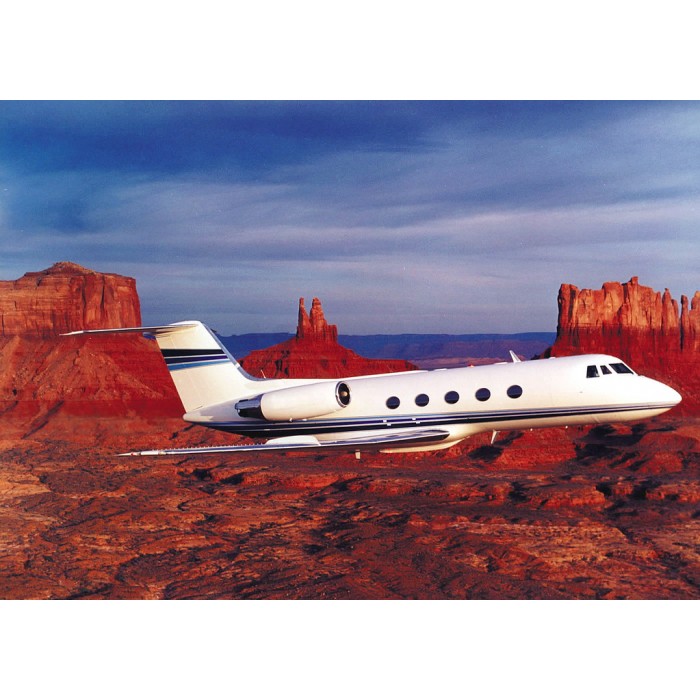
The Gulfstream II (G-II) is one of the most historically significant business jets ever built - the aircraft that established the stand-up large-cabin business jet category and held it alone for nearly two decades, offering transcontinental range at jet speeds in the only stand-up cabin available in a business jet when it entered service in 1967. Wikipedia confirmed Grumman launched the Gulfstream II on 17 May 1965 with 30 firm orders, and the first production standard aircraft flew on 2 October 1966. FAA type certification was awarded on 19 October 1967. JetAV confirmed the transformation from Gulfstream I was comprehensive: "the G-II was equipped with an entirely new swept wing, and a pair of Rolls-Royce Spey turbofans were mounted on pylons just ahead of an all-new T-tail" while retaining the Gulfstream I's large fuselage cross-section. AirLiners confirmed "total Gulfstream II and III production amounted to 464 aircraft, comprising 258 G-IIs and 206 G-IIIs." GlobalAir confirmed 258 GIIs were built before deliveries ended in 1979, with approximately 40 converted to the longer-range Gulfstream GIIB standard. In 1981 Gulfstream introduced the GIIB retrofitting the G-III wing with winglets and increased gross weight. The GII/SP variant carries Aviation Partners winglets, FAA-certified under STC ST00080SE in April 1994.
The Gulfstream II is a twin-turbofan large-cabin business jet powered by Rolls-Royce Spey Mk 511-8 engines at 11,400 lbf each - the same Rolls-Royce Spey family that powered the Hawker Siddeley Nimrod maritime patrol aircraft and the Blackburn Buccaneer strike aircraft. JetAV confirmed "for many years the Gulfstream II stood alone in its class, offering transcontinental range at jet speeds and the only stand-up cabin available in a business jet." Air Charter Service confirmed "the Gulfstream II's stand-up cabin is among the largest in its class, even compared with newer models." Charter prices start from approximately £3,500 per flight hour. For the full fleet see our private jet price guide or browse our complete fleet.

Why charter the Gulfstream II?
- Stand-up cabin: 10.33 m long, 2.22 m wide, 1.85 m high - the first stand-up large-cabin business jet; cabin dimensions comparable to the Gulfstream IV; larger than many current long-range jets. JetAV confirmed "the standup cabins of the Gulfstream line have long been some of the largest available in corporate aircraft" and confirmed the GII cabin as "7.3 ft width, 6.1 ft height and 33.9 ft length." Air Charter Service confirmed "the Gulfstream II's stand-up cabin is among the largest in its class, even compared with newer models. Its large cabin is a similar size to the newer Gulfstream IV and larger than some long-range private jets available today." The aft-mounted Spey engines place the power plants behind the cabin walls and away from the passenger environment, reducing vibration transmission into the cabin. The Gulfstream signature large oval windows - positioned to provide views downward as well as laterally - provide natural light throughout the cabin throughout long sectors. For charter clients who want the largest available cabin in a vintage heavy jet at the lowest available large-cabin rates, the GII provides confirmed comparable cabin dimensions to the GIV at meaningfully lower rates;
- Rolls-Royce Spey Mk 511-8 turbofan; 11,400 lbf each; 4,350 ft/min climb rate; 43,000 ft ceiling; transcontinental and transatlantic range; the same Spey family as Hawker Nimrod and Blackburn Buccaneer. GlobalAir confirmed the GII "climbs at 4,350 feet per minute" - an exceptional rate for a large-cabin aircraft of any era. AllAero confirmed the same 4,350 fpm climb rate and a service ceiling of 43,000 ft. The Rolls-Royce Spey Mk 511-8 turbofan engine has an 8,000-hour inspection interval confirmed by JetAV. Wikipedia confirmed the GII "received its type certificate on 19 October 1967" and the wing design "preliminary design was influenced by both cruise and low speed considerations" with airfoils "similar to those of the Grumman A-6 Intruder aircraft." The same Spey engine family powered the Hawker Siddeley Nimrod maritime patrol aircraft, the Blackburn Buccaneer and licence-built versions in the SEPECAT Jaguar - confirming the military-standard reliability engineering behind the GII powerplant. GlobalAir confirmed a full-seats range of 2,625 nm for the standard GII and 3,500+ nm for the GIIB long-range variant with tip tanks and G-III wing;
- NASA space shuttle training - GII modified to simulate space shuttle landing characteristics; direct-lift flaps; side force generators; redesigned left flight deck; the only business jet ever used as a space shuttle simulator. Wikipedia confirmed "these Gulfstream IIs were modified to simulate space shuttle flight characteristics during landing by adding in-flight thrust reversers, direct-lift flaps, and side force generators to the exterior, and by redesigning the left side of the flight deck to mimic the shuttle's flight deck." The GII's aerodynamic characteristics - particularly its approach and landing behaviour at the high angle of attack and steep descent path of the space shuttle - made it uniquely suitable for astronaut training. No other business jet type was selected for this role. This NASA selection confirms the GII's structural integrity and aerodynamic predictability across the entire flight envelope to standards required for astronaut safety. For charter clients who appreciate aviation history, the GII's space shuttle training role is the most unusual institutional endorsement any business jet has received;
- Nelson Rockefeller's personal aircraft; "Executive Two" White House callsign; Algerian government operator; 258 built; the business jet that served heads of state and corporate leaders for 30 years. Wikipedia confirmed Nelson Rockefeller, Gerald Ford's Vice President, "personally owned a Gulfstream II which he preferred to fly in over the Convair C-131 Samaritan then being used as Air Force Two for domestic flights. As such it has the distinction of having used the 'Executive Two' callsign while he was in office." The GII served governments, corporations and executive charter operators across North America, Europe, the Middle East and beyond throughout the 1970s and 1980s. The US military designation C-11 Gulfstream II confirmed government adoption. Wikipedia confirmed the Algerian government operated a GII, confirming the aircraft's international government market reach. For charter clients seeking a historically significant large-cabin jet, the GII's White House callsign history is unique among business aircraft;
- Gulfstream GIIB variant - G-III wing with winglets; increased MTOW (68,200-69,711 lb); 3,500+ nm range; 40 conversions from standard GII; also GII/SP winglet STC. AirLiners confirmed "Gulfstream IIBs are G-IIs retrofitted with the G-III's wing" including winglets, "upgraded landing gear, increased gross weight and hush kits." GlobalAir confirmed "the longer-range G-IIB variant can fly more than 3,500 nautical miles." Wikipedia confirmed the GIIB's maximum takeoff weight increased to 68,200 lb (30,900 kg) or 69,711 lb (31,620 kg) versus the standard GII's 65,500 lb. The GII/SP winglet retrofit (Aviation Partners STC, April 1994) provides winglet performance benefits in a lighter conversion. When chartering within the GII family, confirm the variant - GIIB provides the longer range and GIII-derived aerodynamics while the standard GII provides the original performance at lower rates;
- Lowest charter rate in the large-cabin stand-up jet category; GII cabin comparable to GIV at approximately 30% lower rates; the entry point to large-cabin Gulfstream charter. GlobalAir confirmed GII acquisition from $1.5 million ($2.7 million average). Air Charter Service confirmed the GII cabin "is a similar size to the newer Gulfstream IV." For charter clients who specify "large-cabin stand-up Gulfstream" at the lowest available rate, the GII is the entry point into the Gulfstream family - the same fuselage cross-section that carries through the GII, GIII and (in evolved form) the GIV, at rates that reflect the GII's vintage design era. The 4,350 ft/min climb rate and 43,000 ft ceiling are performance figures that remain competitive with current light jets despite the GII's 1967 certification.
Charter cost - Gulfstream II prices from UK airports
Hourly rates run from approximately £3,500 to £5,000 - the lowest available for a large-cabin stand-up Gulfstream, reflecting the GII's vintage 1967-era design, Spey engine fuel burn and maintenance requirements, offset by the large-cabin dimensions comparable to the GIV at significantly lower rates. For groups of 8 to 12 on medium-range European and transatlantic sectors where large-cabin Gulfstream heritage at the lowest available rate is the brief, the GII provides the specification.
Indicative one-way prices from UK airports:
- London to New York - from £31,500 (10 passengers, approximately 8 hours with fuel stop or non-stop on GIIB);
- London to Dubai - from £28,000 (10 passengers, approximately 6 hours 30 minutes);
- London to Moscow - from £14,000 (10 passengers, approximately 3 hours 30 minutes);
- London to Geneva - from £10,500 (10 passengers, approximately 1 hour 30 minutes);
- London to Paris - from £10,500 (10 passengers, approximately 1 hour 15 minutes);
- London to Los Angeles - from £45,500 (10 passengers, approximately 12 hours with fuel stop);
- Edinburgh to Istanbul - from £21,000 (10 passengers, approximately 3 hours 30 minutes).
Empty Leg flights appear on repositioning routes. See our Empty Legs page for current availability.

Ideal routes for the Gulfstream II
Best matched to medium and long-range European and transatlantic missions where large-cabin Gulfstream heritage, stand-up cabin with full galley and lavatory, and the lowest available large-cabin rate serve groups of 8 to 12:
- Medium European sectors (1 to 4 hours) where the GII's large cabin provides the full Gulfstream stand-up experience at the lowest available Gulfstream rate. London to Geneva, London to Paris, London to Moscow and London to Istanbul are all within 3,500 nm on the standard GII. For groups of 8 to 12 on European sectors where the full stand-up large-cabin Gulfstream specification is required at below-GIV rates, the GII provides the confirmed cabin dimensions at vintage jet rates. The 4,350 ft/min climb reaches cruise altitude faster than most current super-midsize jets;
- Transatlantic sectors on the GIIB variant where 3,500+ nm range enables non-stop or near-non-stop London to New York operations. GlobalAir confirmed the GIIB "can fly more than 3,500 nautical miles." London to New York (approximately 3,450 nm) is within GIIB range under standard conditions. For charter clients who want non-stop transatlantic capability in a large-cabin Gulfstream at the lowest available rate, the GIIB with G-III wing and winglets is the variant to specify. Confirm with the operator whether the specific aircraft is the standard GII (2,625 nm) or GIIB (3,500+ nm) before booking any transatlantic sector;
- Groups of 10 to 12 on medium missions where the GII's stand-up club seating, galley and aft lavatory serve the corporate charter brief. Air Charter Service confirmed the GII cabin configuration "has plenty of space onboard for four club seats, four seats in a conference grouping with a table, and a divan or two. A galley can be found at the front of the aircraft, while the enclosed lavatory is located aft of the passenger seats." For groups of exactly 10 to 12 where the GIV or GV rates are above budget and a vintage large-cabin Gulfstream is acceptable, the GII provides comparable cabin width and height at lower rates;
- Aviation heritage and historic aircraft missions where the GII's NASA space shuttle, White House "Executive Two" and 1960s design pedigree are part of the experience. The GII's historical significance - NASA space shuttle simulator, Nelson Rockefeller's "Executive Two," Algerian government transport - makes it the most historically interesting large-cabin Gulfstream available for charter. For clients who combine intercontinental business travel with an appreciation for aviation history, the GII's 1966 first flight and 1967 certification places it in the era of the Concorde programme and the moon landings;
- Budget-priority large-cabin missions where GII rates provide the full Gulfstream stand-up cabin experience at 30% below GIV rates. For charter clients who have been quoted GIV rates and want to explore whether the same basic Gulfstream large cabin specification is achievable at lower cost, the GII provides confirmed comparable cabin width (2.22 m vs 2.24 m GIV) and identical height (1.85 m) at vintage jet rates. The trade-off is the GII's Spey engine fuel consumption and noise versus the GIV's Rolls-Royce Tay, and the vintage analog avionics of non-upgraded aircraft versus the GIV's Honeywell SPZ-8000.

Cabin and in-flight experience
The Gulfstream II cabin measures 10.33 m (33.9 ft) long, 2.22 m (7.3 ft) wide and 1.85 m (6.1 ft) high - a full stand-up large cabin with Gulfstream's signature large oval windows providing natural light and downward views. Air Charter Service confirmed the standard configuration provides "four club seats, four seats in a conference grouping with a table, and a divan or two" for 10 to 12 passengers. JetAV confirmed the GII "is commonly outfitted with a large working galley, entertainment center, and full-sized aft lavatory." The galley equipment confirmed in the original specifications includes cutlery, crockery, glassware, a convection oven and ice storage. The pressurisation differential is 9.45 psi, maintaining cabin altitude at cruise levels comparable to the later GIV. Baggage holds approximately 14 to 22 suitcases in the aft compartment, accessible via the lavatory during flight.
- Cabin. 10.33 m x 2.22 m x 1.85 m; full stand-up; large oval windows; pressurised (9.45 psi);
- Layout. 10-12 standard; 14 maximum; club-4 + conference-4 + divan configuration;
- Galley. Full working galley forward; convection oven; cutlery; crockery; glassware; ice storage;
- Lavatory. Full-sized enclosed lavatory aft; baggage accessible via lavatory in flight;
- Entertainment. 110V outlets; TV; entertainment system; satellite phone;
- Engines. 2 x Rolls-Royce Spey RB.168 Mk 511-8 (11,400 lbf each; aft-mounted on pylons);
- Avionics. Original: analog Honeywell; updated installations: Honeywell SPZ-800 + Sperry SP-50G autopilot + dual Honeywell laser INS + Collins comm/nav;
- GIIB variant. G-III wing + winglets + 68,200-69,711 lb MTOW + 3,500+ nm range.
Technical specifications
| Manufacturer | Grumman / Grumman American / Gulfstream American, Savannah, Georgia |
| Grumman model number | G-1159 |
| US military designation | C-11 Gulfstream II (VC-11A Coast Guard) |
| First flight | 2 October 1966 |
| FAA type certification | 19 October 1967 |
| Production | 1967-1979; 258 GII/GIIB built; ~40 GIIB conversions |
| Variants | GII (1967); GIIB (1981; G-III wing + winglets; 3,500+ nm); GII/SP (Aviation Partners winglets STC 1994) |
| Aircraft class | Large-cabin long-range business jet |
| Engines | 2 x Rolls-Royce Spey RB.168 Mk 511-8 (11,400 lbf each; aft-mounted pylons) |
| Cruise speed | 450-475 kt / 833-880 km/h typical; 512 kt max cruise |
| Climb rate | 4,350 ft/min (1,325 m/min) |
| Service ceiling | 43,000 ft / 13,106 m |
| Cabin pressurisation | 9.45 psi differential |
| Range (GII standard) | 2,625 nm / 4,863 km (full seats) |
| Range (GIIB with G-III wing) | 3,500+ nm / 6,483+ km |
| MTOW (GII) | 65,500 lb / 29,711 kg |
| MTOW (GIIB) | 68,200-69,711 lb / 30,900-31,620 kg |
| Historical note | NASA space shuttle landing simulator; Nelson Rockefeller "Executive Two" White House callsign |
| Cabin length | 10.33 m (33.9 ft) |
| Cabin width | 2.22 m (7.3 ft) |
| Cabin height | 1.85 m (6.1 ft) - full stand-up |
| Passengers | 10-12 standard; 14 maximum |
| Baggage | 14-22 suitcases; aft compartment accessible via lavatory in flight |
| Wingspan | 20.98 m (68.8 ft) |
| Aircraft length | 24.36 m (79.9 ft) |
| Aircraft height | 7.47 m (24.5 ft) |

Gulfstream II vs similar aircraft
- Gulfstream II vs Gulfstream IV. The GIV (1987) uses Rolls-Royce Tay 611-8 engines at 13,850 lbf each (vs GII's Spey at 11,400 lbf), provides 4,220 nm range (vs GII's 2,625 nm), 45,000 ft ceiling (vs 43,000 ft) and Honeywell SPZ-8000 avionics with EFIS displays. The GIV cabin is marginally wider (2.24 m vs 2.22 m) and taller (same 1.85 m) but longer (13.74 m vs 10.33 m). Charter rates for the GIV run approximately 30 to 40% above the GII. For groups whose sectors are within 2,625 nm and want the lowest available large-cabin Gulfstream rate, the GII is the appropriate choice. For transatlantic non-stop and longer sectors, the GIV's 4,220 nm range is required;
- Gulfstream II vs Gulfstream III. The Gulfstream III (1979-1986; 206 built) is the GII's direct successor, incorporating a new wing of greater span with drag-reducing winglets, a 97 cm (3 ft 2 in) fuselage stretch, more fuel tankage for longer range and a reprofiled nose. The GIII provides 4,200+ nm range (vs GII's 2,625 nm) while retaining the same Spey Mk 511-8 engines. Charter rates for the GIII typically run above the GII. For clients who want the Spey-powered Gulfstream heritage with longer range, the GIII or GIIB provide the step up;
- Gulfstream II vs Dassault Falcon 900. The Falcon 900 is a three-engine 1980s large-cabin jet with 4,000-4,500 nm range, the same 2.34 m cabin width and 1.88 m height in a slightly different fuselage cross-section, at comparable or higher charter rates than the GII. The GII counters with lower charter rates, the unique Gulfstream oval window experience and the historical significance of being the aircraft that established the large-cabin stand-up business jet category. For groups whose charter budget places them between the GII and Falcon 900, confirm the specific variant and avionics standard of each before deciding.

Frequently asked questions - Gulfstream II charter
How much does it cost to charter a Gulfstream II?
Charter rates run from approximately £3,500 to £5,000 per flight hour - the lowest available for a large-cabin stand-up Gulfstream. London to Geneva costs from £10,500 for 10 passengers. London to New York costs from £31,500 (fuel stop required on standard GII; non-stop on GIIB). All quotes from Private Jets UK are fully itemised with no hidden charges.
What is the NASA space shuttle connection of the Gulfstream II?
Wikipedia confirmed Gulfstream IIs were modified to simulate space shuttle flight characteristics during landing by adding in-flight thrust reversers, direct-lift flaps and side force generators, and by redesigning the left side of the flight deck to mimic the shuttle's controls. This made the GII the only business jet type ever selected as a space shuttle landing simulator, validating the aircraft's aerodynamic predictability and structural integrity across the full flight envelope to astronaut-safety standards.
What is the difference between the Gulfstream II, GIIB and GII/SP?
The standard GII (258 built, 1967-1979) uses the original GII wing without winglets and has a maximum range of 2,625 nm. The GIIB (approximately 40 conversions from 1981) retrofits the G-III wing with winglets, increases MTOW to 68,200-69,711 lb and extends range to 3,500+ nm. The GII/SP retrofits Aviation Partners winglets under STC ST00080SE (1994) as a lighter modification providing winglet aerodynamic benefits without the full GIIB structural upgrade. Confirm the variant before booking any sector approaching the 2,625 nm range limit.
Can a Gulfstream II fly non-stop from London to New York?
The standard GII with 2,625 nm range requires a technical fuel stop (typically Shannon, Ireland or Reykjavik, Iceland) for London to New York (approximately 3,450 nm). The GIIB variant with 3,500+ nm range is within non-stop capability under standard conditions. GlobalAir confirmed "the longer-range G-IIB variant can fly more than 3,500 nautical miles." Confirm the specific variant (GII or GIIB) before booking transatlantic sectors.
What famous people have flown in Gulfstream IIs?
Wikipedia confirmed Nelson Rockefeller, Gerald Ford's Vice President, personally owned a Gulfstream II (N100WK) which "has the distinction of having used the 'Executive Two' callsign while he was in office" - preferring it over the official Air Force Two aircraft for domestic US flights. The Algerian government operated a GII for official transport. The GII served as the preferred aircraft of major corporations, heads of state and government agencies throughout the 1970s and 1980s.

