


Charter a Dassault Falcon 50
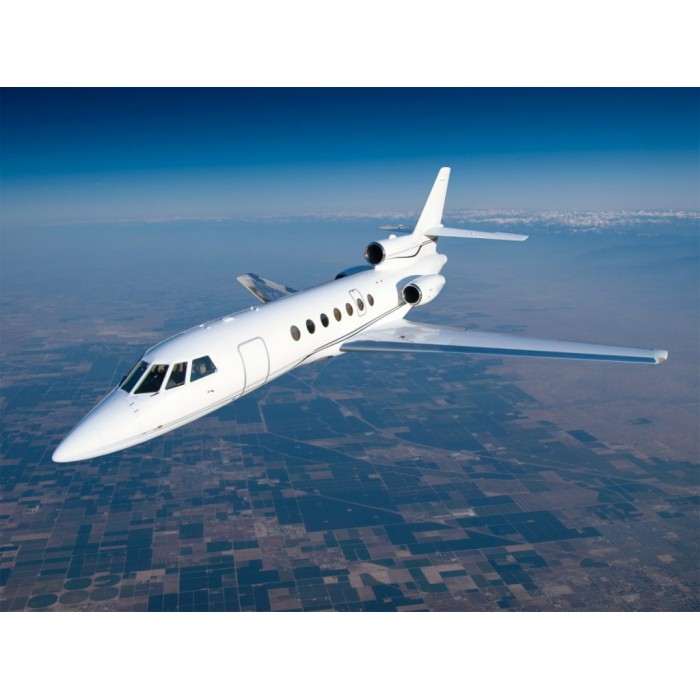


- Availability: Available for rent
Request aircraft information
The Dassault Falcon 50 holds two civil aviation firsts: it was the world's first civilian aircraft with supercritical wings (certified 27 February 1979), and the first business jet to cross the North Atlantic under FAR 121 public transport regulations. Designed from 1974 to meet demand for transatlantic range of 3,400 nm (6,300 km), the Falcon 50 made its first flight on 7 November 1976 from Bordeaux-Mérignac under pilots Hervé Leprince-Renguet and Gérard Joyeuse, powered by three Garrett TFE731-3 engines. An improved-wing version flew on 6 May 1977 from Istres with the same crew. Industrial production began November 1976 and certification was granted 27 February 1979.
The supercritical wing developed for the Falcon 50 was subsequently applied by Dassault to the Falcon 900 and Falcon 2000, making this aircraft the aerodynamic origin of the modern Dassault Falcon family. The production Falcon 50 uses three Honeywell TFE731-3-1C turbofan engines, each with an independent fuel system - the trijet configuration Dassault carried forward into the Falcon 900 series. The 7.32 m cabin seats 8 to 10 passengers in standard configuration; modified layouts reach 19. Cruise speed is 880 km/h and maximum altitude is 13,800 m (45,275 ft). Cabin width of 1.93 m exceeds the Citation Sovereign (1.68 m) and Legacy 500 (1.83 m).

Key performance figures
| Range | 3,400 nm / 6,300 km (transatlantic non-stop; FAR 121 certified) |
| Cruise speed | 880 km/h |
| Maximum altitude | 13,800 m (45,275 ft) |
| Maximum takeoff weight | 14,600 kg (32,185 lb) |
| Engines | 3 x Honeywell TFE731-3-1C (separate independent fuel systems) |
| Wing | Supercritical - world's first on a civilian aircraft (certified 1979) |
| Historic distinction | First transatlantic business jet (FAR 121); first supercritical wing |
| First flight | 7 November 1976, Bordeaux-Mérignac |

Airframe dimensions
| Aircraft length | 18.5 m |
| Aircraft height | 6.97 m |
| Wingspan | 18.86 m |
Cabin dimensions and capacity
| Cabin length | 7.32 m |
| Cabin width | 1.93 m (wider than Citation Sovereign 1.68 m and Legacy 500 1.83 m) |
| Cabin height | 1.85 m |
| Standard passengers | 8 to 10 |
| Maximum passengers | 19 (modified configuration) |
| Optimal passengers | 8 |


Cabin features
- 7.32 m cabin; 1.93 m wide - wider than Citation Sovereign (1.68 m) and Legacy 500 (1.83 m);
- 8 to 10 passengers standard; up to 19 in modified configuration;
- 3 x Honeywell TFE731-3-1C - each with independent fuel system;
- Supercritical wing - world's first on a civilian aircraft (certified 1979);
- 6,300 km / 3,400 nm transatlantic range (FAR 121 certified);
- 880 km/h cruise; 13,800 m ceiling;
- World's first civilian supercritical wing; wing subsequently on Falcon 900 and Falcon 2000;
- First flight 7 November 1976, Bordeaux-Mérignac.


The Dassault Falcon 50 holds a distinction that no other business jet can claim: it was the world's first civilian aircraft with supercritical wings, certified on 27 February 1979. The supercritical wing design - developed specifically for the Falcon 50 by Dassault - was subsequently adopted on the Falcon 900 and Falcon 2000, making it the aerodynamic origin point of the entire modern Dassault Falcon large-cabin family. The aircraft was designed from 1974 in response to demand in the United States for transatlantic range under FAR 121 public transport regulations - no business aircraft had previously been able to cross the Atlantic under those rules. The Falcon 50 was the first to do it.
The first flight took place on 7 November 1976 from Bordeaux-Mérignac under pilots Hervé Leprince-Renguet and Gérard Joyeuse. An upgraded wing version followed on 6 May 1977 from Istres with the same crew. The Falcon 50 uses three Honeywell TFE731-3-1C turbofan engines - each with a separate fuel system - in the trijet configuration that Dassault would carry forward into the Falcon 900 and Falcon 900LX. Range is 6,300 km (3,400 nm) covering the North Atlantic without stopping. The 7.32 m cabin seats 8 to 10 passengers. Charter prices start from approximately £2,600 per flight hour. For the full fleet see our private jet price guide or browse our complete fleet.
Why charter the Falcon 50?
- World's first civilian aircraft with supercritical wings - certified 1979. Certified on 27 February 1979 as the world's first civilian aircraft equipped with supercritical wings. The supercritical wing profile delays the formation of shockwaves at high subsonic speeds, enabling more efficient cruise than conventional wing designs at the same thrust level. Dassault subsequently applied this technology to the Falcon 900 and Falcon 2000 - the Falcon 50 wing is the aerodynamic foundation of the modern Dassault Falcon family;
- First transatlantic business jet under FAR 121 public transport regulations. The Falcon 50 was the first business aircraft capable of crossing the North Atlantic under FAR 121 public transport regulations - the commercial aviation safety standard that no previous business jet had been able to meet on a transatlantic routing. This certification established the Falcon 50 as the originator of the transoceanic Falcon family that includes the Falcon 900 and Falcon 8X;
- Three Honeywell TFE731-3-1C engines - each with a separate fuel system. The Falcon 50 trijet configuration uses three Honeywell TFE731-3-1C turbofan engines, each supplied by its own independent fuel system. This separation - three engines, three independent fuel systems - provides a level of system redundancy that twin-engine jets with shared fuel systems cannot match. The same trijet philosophy was carried forward into the Falcon 900 family;
- 880 km/h cruise - fast for a midsize aircraft of this vintage. At 880 km/h the Falcon 50 is faster than most competing midsize jets at similar charter rates including the Citation Sovereign (848 km/h) and Legacy 500 (834 km/h). On a London to Dubai sector this speed advantage over a 796 km/h competitor saves approximately 40 minutes;
- 6,300 km range - transatlantic non-stop. The full 6,300 km range covers London to New York non-stop with reserve, London to Dubai non-stop and most of the Eastern United States from UK airports. The aircraft was specifically designed and certified to cover 3,400 nautical miles on FAR 121 reserve fuel - the transatlantic standard;
- Aviation history significance. The Falcon 50 first flight on 7 November 1976 from Bordeaux-Mérignac under pilots Hervé Leprince-Renguet and Gérard Joyeuse, the wing redesign first flight on 6 May 1977, and the 1979 supercritical wing certification are documented milestones in civil aviation history. For aviation enthusiasts and clients who appreciate the lineage of an aircraft they charter, it connects directly to the origin of the supercritical wing in civilian aviation.
Charter cost - Falcon 50 prices from UK airports
Hourly rates run from approximately £2,600 to £3,200 - in the midsize category, above the Falcon 20 and below the Falcon 900. For 6 to 10 passengers on transatlantic and Gulf missions where the Falcon 50's historical significance and trijet pedigree are valued, the per-seat economics at this rate are competitive.
Indicative one-way prices from UK airports:
- London to New York - from £22,000 (8 passengers, non-stop, approximately 8 hours);
- London to Dubai - from £20,000 (8 passengers, non-stop, approximately 7 hours);
- London to Geneva - from £6,400 (8 passengers, approximately 1 hour 20 minutes);
- London to Athens - from £14,000 (8 passengers, approximately 3 hours 20 minutes);
- London to Riyadh - from £18,000 (8 passengers, non-stop, approximately 5 hours 45 minutes);
- Manchester to Nice - from £7,400 (8 passengers, approximately 1 hour 50 minutes);
- London to Lagos - from £22,000 (8 passengers, non-stop, approximately 6 hours 30 minutes).
Empty Leg flights appear on repositioning routes. See our Empty Legs page for current availability.
Ideal routes for the Falcon 50
Best matched to on missions where transatlantic range, the trijet safety margin and the aircraft's aviation history significance are all relevant for groups of 6 to 10:
- Transatlantic non-stop (7 to 9 hours). London to New York and London to Washington are within non-stop range. The Falcon 50 was specifically designed and certified for this mission - the FAR 121 transatlantic standard - and the aircraft's trijet configuration provides the routing freedom that twin-engine competitors on the same sector cannot match without ETOPS requirements;
- UK to Gulf non-stop (5.5 to 7 hours). Dubai, Riyadh, Abu Dhabi and Doha are all within non-stop range from UK airports. At 880 km/h the Falcon 50 covers Gulf sectors faster than most midsize competitors at comparable rates. For 8 passengers on Gulf corporate missions, the per-seat economics are competitive with twin-engine midsize alternatives;
- UK to West Africa non-stop (6 to 7 hours). Lagos, Accra and Dakar are within range. The trijet configuration is operationally relevant on transoceanic West Africa routing where diversions over the South Atlantic and Sahara require additional engine margin;
- Aviation enthusiasts and collectors. For clients who specifically want to fly the aircraft that established the supercritical wing in civil aviation, the Falcon 50 is irreplaceable. The documented first flight history - Bordeaux-Mérignac, 7 November 1976, pilots Leprince-Renguet and Joyeuse - and the 1979 certification milestone create a specific provenance that no current-production aircraft can match;
- Groups of 8 to 10 at midsize rates with transatlantic range. The Falcon 50's 6,300 km range makes transatlantic non-stop operations achievable at midsize charter rates. Most competing midsize jets cannot cross the Atlantic non-stop. For 8 passengers where the rate matters and the range is required, the Falcon 50 provides a combination few alternatives can match.
Cabin and in-flight experience
This aircraft cabin measures 7.32 m long, 1.93 m wide and 1.85 m high. Standard configuration seats 8 to 10 passengers; modified configurations can accommodate up to 19. The 1.93 m width is wider than the Citation Sovereign (1.68 m) and Legacy 500 (1.83 m), providing a genuine midsize-plus cabin feel for groups of 8.
Three Honeywell TFE731-3-1C engines each with an independent fuel system power the Falcon 50 to 880 km/h cruise at up to 13,800 m. The supercritical wing - the world's first on a civilian aircraft - enables the efficient high-subsonic cruise that gives the Falcon 50 its transatlantic range. Passengers occupy the cabin that established the Dassault design philosophy subsequently applied to the Falcon 900, Falcon 2000 and the entire modern Falcon large-cabin family.
- Cabin. 7.32 m × 1.93 m × 1.85 m;
- Width. 1.93 m - wider than Citation Sovereign (1.68 m) and Legacy 500 (1.83 m);
- Passengers. 8 to 10 standard; up to 19 modified;
- Engines. 3 x Honeywell TFE731-3-1C - each with independent fuel system;
- Wing. Supercritical - world's first on a civilian aircraft (1979);
- Range. 6,300 km / 3,400 nm - transatlantic non-stop;
- Altitude. 13,800 m (45,275 ft) maximum certified.
Technical specifications
| Manufacturer | Dassault Aviation, France |
| First flight | 7 November 1976, Bordeaux-Mérignac |
| Certified | 27 February 1979 |
| Historic distinction | World's first civilian aircraft with supercritical wings |
| Engines | 3 x Honeywell TFE731-3-1C (separate fuel systems) |
| Aircraft class | Midsize business jet (trijet; transatlantic range) |
| Maximum passengers | 10 standard; 19 modified |
| Optimal passengers | 8 |
| Range | 3,400 nm / 6,300 km (transatlantic non-stop) |
| Cruise speed | 880 km/h |
| Maximum altitude | 13,800 m (45,275 ft) |
| Maximum takeoff weight | 14,600 kg (32,185 lb) |
| Cabin length | 7.32 m |
| Cabin width | 1.93 m |
| Cabin height | 1.85 m |
| Wingspan | 18.86 m |
| Aircraft length | 18.5 m |
| Aircraft height | 6.97 m |
Falcon 50 vs similar aircraft
- Falcon 50 vs Falcon 20. The Falcon 20 has more cabin length (7.5 m vs 7.32 m), more passengers (10 to 12 vs 8 to 10 standard), less range (3,300 km vs 6,300 km) and lower charter rates (from £2,400/hr vs £2,600/hr). For groups of 8 to 10 on European missions within Falcon 20 range, the Falcon 20's lower rate and longer cabin are preferable. For transatlantic and Gulf missions where the 6,300 km range is required, only the Falcon 50 has sufficient reach at midsize rates;
- Falcon 50 vs Citation Sovereign. The Sovereign has ETOPS compliance, Honeywell Epic CDS avionics and slightly less range (5,556 km vs 6,300 km). Charter rates are broadly comparable. The Falcon 50 counters with the supercritical wing, trijet pedigree (no ETOPS constraints), more range and the 1.93 m cabin width versus the Sovereign's 1.68 m. For clients where cabin width and the additional range matter, the Falcon 50 is the stronger choice;
- Falcon 50 vs Falcon 900. The Falcon 900 has greater range (8,334 km vs 6,300 km), a larger cabin (10.11 m vs 7.32 m) and higher charter rates (from £6,200/hr vs £2,600/hr). Both are Dassault trijets that trace their aerodynamic lineage to the Falcon 50 supercritical wing. For groups of 6 to 10 on missions within this range, it provides the Dassault trijet standard at significantly lower rates. The Falcon 900 is necessary only when its additional range or cabin size are required.
Frequently asked questions - Falcon 50 charter
How much does it cost to charter a Dassault Falcon 50?
Charter rates run from approximately £2,600 to £3,200 per flight hour. London to New York non-stop costs from £22,000 for 8 passengers. London to Dubai costs from £20,000. London to Geneva costs from £6,400. All quotes from Private Jets UK are fully itemised with no hidden charges.
What makes the Falcon 50 historically significant?
Two distinctions stand out: first, the world's first civilian aircraft with supercritical wings (certified 27 February 1979), and the first business jet to cross the North Atlantic under FAR 121 public transport regulations - a standard no previous business aircraft had achieved on a transatlantic routing. The supercritical wing developed for the Falcon 50 was subsequently applied to the Falcon 900 and Falcon 2000, making this aircraft the aerodynamic origin of the modern Dassault Falcon family.
Can the Falcon 50 fly London to New York non-stop?
Yes - specifically designed and certified at 6,300 km (3,400 nm) range to cross the North Atlantic without stopping under FAR 121 reserve fuel requirements. London to New York non-stop in approximately 8 hours is achievable for 8 passengers.
How many passengers can fly on a Falcon 50?
Standard configuration seats 8 to 10 configuration. Modified configurations can accommodate up to 19. The optimal charter group is 8 passengers, with the 7.32 m cabin providing comfortable space for the full group on transatlantic and Gulf sectors.
What is the supercritical wing on the Falcon 50?
A supercritical profile uses an aerodynamic profile shaped to delay the formation of shockwaves at high subsonic speeds. Dassault developed this technology for the Falcon 50 and it was certified on the aircraft in 1979 - the first time a supercritical wing had been certified on a civilian aircraft. The same wing design was subsequently applied to the Falcon 900 and Falcon 2000. At 880 km/h cruise, the supercritical profile enables the fuel efficiency that gives the Falcon 50 its 6,300 km transatlantic range.