


Charter a Dassault Falcon 50EX
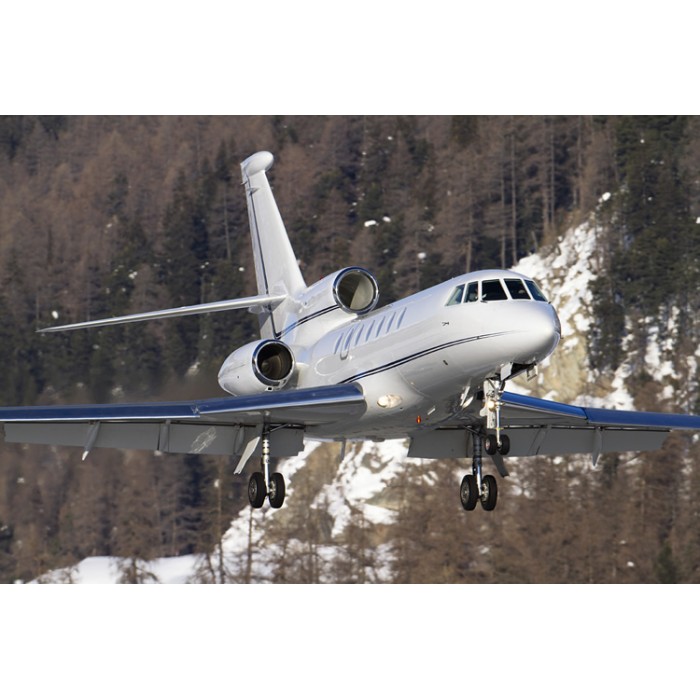


- Availability: Available for rent
Request aircraft information
The Dassault Falcon 50EX is the improved production successor to the original Falcon 50, the world's first civilian aircraft with supercritical wings. The 50EX first flew in 1996 and the last example was manufactured in late 2007 and delivered in 2008. The primary improvement over the original Falcon 50 is upgraded engines that extend range and improve fuel efficiency. The Falcon 50EX uses three engines with an S-duct centre engine arrangement - a characteristic Dassault trijet feature - and shares the same fuselage cross-section and payload capacity as the earlier Falcon 20, on which a completely new design was built: third engine, supercritical wing and area rule aerodynamic compliance.
Range is 5,695 km (3,077 nm), covering London to New York non-stop and the full Gulf from UK airports. Cruise speed is 850 km/h. The cabin measures 7.16 m long, 1.86 m wide and 1.8 m high, seating up to 9 passengers. The supercritical wing inherited from the Falcon 50 - first certified in 1979 as the world's first civilian supercritical wing - provides the aerodynamic efficiency behind the cruise speed and range. Dassault and Aviation Partners Inc. developed High Mach Blended Winglets as an efficiency upgrade kit for the type. The Falcon 50EX's successors are the Falcon 7X and Falcon 900, which carry the same trijet philosophy in larger fuselages.

Key performance figures
| Range | 3,077 nm / 5,695 km (London–New York non-stop) |
| Cruise speed | 850 km/h |
| Engines | Three - centre engine S-duct; improved vs original Falcon 50 |
| Wing | Supercritical (world's first civilian, via Falcon 50 1979) |
| Winglets | High Mach Blended Winglets (Dassault / Aviation Partners Inc.) |
| Aerodynamics | Area rule compliance |
| Production | 1996–2008 (successor to original Falcon 50) |
| Successors | Falcon 7X and Falcon 900 |

Airframe dimensions
| Aircraft length | 18.52 m |
| Aircraft height | 6.98 m |
| Wingspan | 18.86 m |
Cabin dimensions and capacity
| Cabin length | 7.16 m |
| Cabin width | 1.86 m (wider than Citation Sovereign 1.68 m) |
| Cabin height | 1.8 m |
| Passengers | 9 (maximum and optimal) |
| Fuselage heritage | Same cross-section as Falcon 20 |


Cabin features
- 7.16 m × 1.86 m × 1.8 m cabin; 9 passengers maximum and optimal;
- Same fuselage cross-section as Falcon 20; completely new design built on that section;
- Three engines - S-duct centre engine; improved vs original Falcon 50;
- Supercritical wing (world's first civilian, Falcon 50 1979); area rule compliance;
- High Mach Blended Winglets (Dassault / Aviation Partners Inc.) available;
- 5,695 km range - London to New York non-stop; Gulf non-stop;
- 850 km/h cruise; no ETOPS overwater routing restrictions;
- Production 1996–2008; successors: Falcon 7X and Falcon 900.


The Dassault Falcon 50EX is the improved production successor to the original Falcon 50 - the world's first civilian aircraft with supercritical wings. The 50EX first took off in 1996 and production ran until the last aircraft was manufactured in late 2007 and delivered in 2008. The primary improvement over the original Falcon 50 is upgraded engines that extend the range of the already long-range trijet, bringing the Falcon 50EX to 5,695 km - sufficient for London to New York non-stop and the full Gulf and Near East from UK airports. The three-engine configuration uses an S-duct centre engine - a characteristic Dassault trijet feature - and eliminates the ETOPS overwater routing restrictions that apply to twin-engine aircraft.
The 7.16 m cabin shares the same fuselage cross-section as the earlier Falcon 20 with the same payload capacity, but the Falcon 50EX was a completely new design on that cross-section, adding the third engine, the advanced supercritical wing and area rule compliance. Dassault and Aviation Partners Inc. developed High Mach Blended Winglets as an upgrade kit for the Falcon 50 family to further improve efficiency. The Falcon 50EX's successors are the Falcon 7X and Falcon 900, which carry the same three-engine philosophy in larger fuselages. Charter prices start from approximately £2,800 per flight hour. For the full fleet see our private jet price guide or browse our complete fleet.
Why charter the Falcon 50EX?
- Extended range over the original Falcon 50 - 5,695 km with improved engines. Its upgraded engines extend the range beyond the original Falcon 50, reaching 5,695 km. This covers London to New York non-stop, London to Dubai non-stop and the full Gulf and Near East from UK airports. The EX designation specifically reflects the extended range achieved through the engine improvement programme launched with the 1996 first flight;
- Three engines with S-duct centre engine - trijet routing without ETOPS constraints. The Falcon 50EX uses three engines with the S-duct arrangement for the centre engine - a characteristic Dassault engineering solution that routes intake air around the fuselage to the centrally-mounted engine. Three engines eliminate the ETOPS overwater routing restrictions on twin-engine aircraft, giving the Falcon 50EX routing freedom on transatlantic and Gulf sectors that competitors with two engines cannot match without diversion airport requirements;
- Supercritical wing inherited from the world's first civilian supercritical-wing aircraft. The Falcon 50EX inherits the supercritical wing first certified on the Falcon 50 in 1979 - the world's first civilian aircraft with this technology. That wing, later applied to the Falcon 900 and Falcon 2000, enables the 850 km/h cruise speed and fuel efficiency behind the 5,695 km range. High Mach Blended Winglets were subsequently developed by Dassault and Aviation Partners Inc. as a further efficiency upgrade;
- Area rule compliance - advanced aerodynamic design. The Falcon 50EX airframe applies area rule principles - the transonic aerodynamic optimisation technique used in high-performance military aircraft - to reduce wave drag at high subsonic cruise speeds. This design detail, unusual in the midsize business jet category, contributes to the 850 km/h cruise efficiency;
- Production 1996–2008 - final delivery the last of the Falcon 50 family. The Falcon 50EX is the definitive production version of the Falcon 50 family. The last aircraft was manufactured in late 2007 and delivered in 2008. Examples in charter service represent a mature, fully-supported airframe with a complete production and service history. Dassault support infrastructure for the type is well-established across European operators;
- 9 passengers - optimal midsize corporate group configuration. The Falcon 50EX seats 9 passengers - more than the Citation Sovereign (8 standard) and comparable to the Challenger 300 (9 standard) - in a 7.16 m cabin at midsize rates. For groups of 7 to 9 on Gulf and transatlantic missions where range is required, the Falcon 50EX provides competitive capacity at rates below large-cabin jet rates.
Charter cost - Falcon 50EX prices from UK airports
Hourly rates run from approximately £2,800 to £3,400 - in the midsize category, above the Falcon 20 and comparable to the Citation VII. For 7 to 9 passengers on transatlantic and Gulf missions, the Falcon 50EX's extended range and trijet pedigree at these rates represent strong value against shorter-range midsize alternatives.
Indicative one-way prices from UK airports:
- London to New York - from £24,000 (9 passengers, non-stop, approximately 8 hours);
- London to Dubai - from £22,000 (9 passengers, non-stop, approximately 6 hours 45 minutes);
- London to Geneva - from £6,800 (9 passengers, approximately 1 hour 20 minutes);
- London to Riyadh - from £20,000 (9 passengers, non-stop, approximately 5 hours 45 minutes);
- London to Athens - from £14,000 (9 passengers, approximately 3 hours 20 minutes);
- Manchester to Nice - from £7,400 (9 passengers, approximately 1 hour 50 minutes);
- London to Lagos - from £22,000 (9 passengers, non-stop, approximately 6 hours 30 minutes).
Empty Leg flights appear on repositioning routes. See our Empty Legs page for current availability.
Ideal routes for the Falcon 50EX
The Falcon 50EX performs best on missions where 5,695 km transatlantic range, three-engine routing freedom and midsize rates are the primary selection criteria for groups of 7 to 9:
- Transatlantic non-stop (7 to 9 hours). London to New York is within non-stop range. The Falcon 50EX was specifically designed - from the original Falcon 50 brief in 1974 - to cross the North Atlantic without stopping under FAR 121 public transport regulations. The three engines allow direct westbound polar routing without ETOPS diversion requirements;
- UK to Gulf non-stop (5.5 to 7 hours). Dubai, Riyadh, Abu Dhabi and Doha are all within range from UK airports. At 850 km/h the Falcon 50EX covers Gulf sectors faster than most midsize competitors at these rates. For 7 to 9 passengers on Gulf corporate missions, the per-seat economics are competitive with twin-engine alternatives that cannot match the trijet range;
- UK to West Africa non-stop (6 to 7 hours). Lagos, Accra and Dakar are within range. The Falcon 50EX's transatlantic-certified range and trijet configuration are operationally relevant on West Africa routing where ocean diversions on twin-engine flights require additional planning;
- Clients who want the Dassault trijet standard at midsize rates. The Falcon 50EX carries the same supercritical wing lineage and three-engine trijet philosophy as the Falcon 900 and Falcon 7X - at rates significantly below the large-cabin category. For clients familiar with larger Falcon models who want the Dassault engineering standard on European and Gulf missions within the Falcon 50EX range, it provides the family pedigree at accessible rates;
- Groups of 9 requiring transatlantic or Gulf range. Nine passengers combined with 5,695 km range is a combination few midsize jets at comparable rates can match. Most midsize jets with 9-passenger capacity are limited to 3,000 to 4,000 km range. The Falcon 50EX's additional 1,700 km reach extends the operational map significantly.
Cabin and in-flight experience
This aircraft cabin measures 7.16 m long, 1.86 m wide and 1.8 m high. It shares the fuselage cross-section and payload capacity of the Falcon 20, on which a completely new design was built: third engine, supercritical wing and area rule compliance. Up to 9 passengers sit in a standard configuration. At 850 km/h cruise the Falcon 50EX covers sectors quickly for its size and class.
The S-duct centre engine - visible externally as the intake above the fuselage at the tail - provides the third engine's power while the Dassault area rule fuselage minimises transonic wave drag. High Mach Blended Winglets developed by Dassault and Aviation Partners Inc. are available as an upgrade kit to further improve cruise efficiency on the type.
- Cabin. 7.16 m × 1.86 m × 1.8 m;
- Passengers. 9 maximum and optimal;
- Engines. Three - centre engine uses S-duct arrangement;
- Wing. Supercritical (world's first civilian supercritical wing, via Falcon 50);
- Aerodynamics. Area rule compliance;
- Winglets. High Mach Blended Winglets available (Dassault / Aviation Partners Inc.);
- Production. 1996–2008; last delivered 2008;
- Successors. Falcon 7X and Falcon 900 (larger fuselage, same trijet philosophy).
Technical specifications
| Manufacturer | Dassault Aviation, France |
| Family | Falcon 50EX (improved Falcon 50; 1996–2008) |
| Successors | Falcon 7X and Falcon 900 (trijet; larger fuselage) |
| Aircraft class | Ultra-midsize long-range business jet (trijet) |
| Engines | Three - centre engine S-duct; improved vs original Falcon 50 |
| Wing | Supercritical (Falcon 50 heritage); area rule compliance |
| Winglets | High Mach Blended Winglets (Dassault / Aviation Partners Inc.) |
| Maximum passengers | 9 |
| Optimal passengers | 9 |
| Range | 3,077 nm / 5,695 km |
| Cruise speed | 850 km/h |
| Cabin length | 7.16 m |
| Cabin width | 1.86 m |
| Cabin height | 1.8 m |
| Wingspan | 18.86 m |
| Aircraft length | 18.52 m |
| Aircraft height | 6.98 m |
Falcon 50EX vs similar aircraft
- Falcon 50EX vs Falcon 50. The Falcon 50 shares the same airframe, wing and trijet configuration. The EX adds upgraded engines for extended range (5,695 km vs 6,300 km for the Falcon 50 - the original has slightly more range according to some sources; the EX prioritises improved engine efficiency). Charter rates are broadly comparable. For most charter purposes the two variants are operationally similar; the Falcon 50EX represents the more recent production with the engine improvements applied from 1996;
- Falcon 50EX vs Citation Sovereign. The Sovereign has ETOPS compliance, Honeywell Epic CDS avionics and slightly less range (5,556 km vs 5,695 km). Charter rates are broadly comparable. The Falcon 50EX counters with three engines (no ETOPS constraints), the supercritical wing lineage, 1.86 m cabin width versus Sovereign's 1.68 m and area rule aerodynamics. For clients where cabin width and trijet routing freedom are priorities, the Falcon 50EX is preferable;
- Falcon 50EX vs Falcon 900. The Falcon 900 has greater range (8,334 km vs 5,695 km), a larger cabin (10.11 m vs 7.16 m) and higher charter rates (from £6,200/hr vs £2,800/hr). Both are Dassault trijets with no ETOPS restrictions and the same supercritical wing heritage. The Falcon 50EX provides the Dassault trijet standard at midsize rates for groups of up to 9 on missions within its range. The Falcon 900 is required only when range or cabin size exceed the Falcon 50EX specification.
Frequently asked questions - Falcon 50EX charter
How much does it cost to charter a Dassault Falcon 50EX?
Charter rates run from approximately £2,800 to £3,400 per flight hour. London to New York non-stop costs from £24,000 for 9 passengers. London to Dubai costs from £22,000. London to Geneva costs from £6,800. All quotes from Private Jets UK are fully itemised with no hidden charges.
What is the difference between the Falcon 50 and Falcon 50EX?
The EX is the improved production version of the original Falcon 50. The primary improvement is upgraded engines that extend range and improve fuel efficiency. It first flew in 1996 and the last was delivered in 2008. Both variants share the same airframe, the same supercritical wing - the world's first civilian supercritical wing, certified in 1979 - and the same trijet configuration with S-duct centre engine.
What is the S-duct engine on the Falcon 50EX?
The S-duct is an intake arrangement for the centre engine. The intake curves in an S-shape around the fuselage to deliver air to the centrally-mounted engine in the tail, rather than taking a straight path. This arrangement allows a clean fuselage shape without a large external intake scoop and is a characteristic of the Dassault trijet design used on the Falcon 50EX, Falcon 900 and Falcon 7X.
Can the Falcon 50EX fly London to New York non-stop?
Yes - at 5,695 km range it covers the London to New York sector non-stop for 9 passengers. The Falcon 50 family was specifically designed from 1974 to cross the North Atlantic under FAR 121 public transport regulations. Three engines allow direct polar routing without ETOPS diversion airport requirements.
What are the High Mach Blended Winglets on the Falcon 50EX?
Wingtip extensions developed jointly by Dassault and Aviation Partners Inc. as an upgrade kit for the Falcon 50 family. The blended winglet design reduces induced drag at high subsonic cruise speeds, improving range and fuel efficiency. On the Falcon 50EX's 850 km/h cruise profile, the winglets reduce fuel burn per nautical mile, effectively extending operational range on long sectors.