


Charter a Dassault Falcon 2000LX
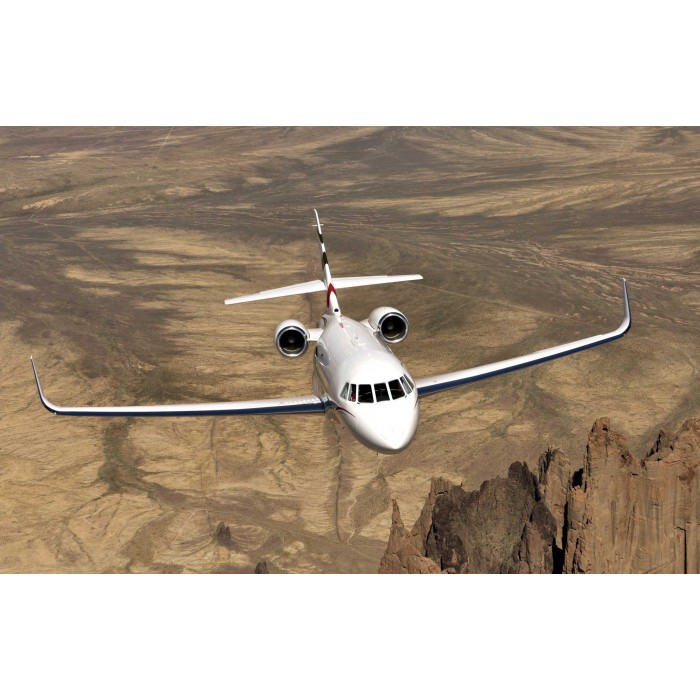


- Availability: Available for rent
Request aircraft information
The Dassault Falcon 2000LX was announced at EBACE 2007 as the definitive variant in the Falcon 2000 series: 2000 → 2000DX → 2000EX → 2000LX. It features a redesigned wing with a 21.36 m wingspan - 2.03 m wider than the Falcon 2000EX's 19.33 m - that delivers 7,400 km range and best-in-class fuel efficiency for the heavy jet category. Dassault states the Falcon 2000LX provides the lowest total cost of ownership versus peer competitors when operated intensively. Climb performance is 12,500 m in 18 minutes. Short runway capability enables operations at secondary airports closer to final destinations.
Cruise speed is 850 km/h and maximum certified altitude is 14,330 m (47,000 ft), above all commercial airline traffic. The 7.97 m cabin is 2.34 m wide and 1.88 m high - full stand-up throughout and the same dimensions as earlier Falcon 2000 series variants. Optimal configuration seats 8 passengers; maximum is 13. The cabin is equipped with video and communication systems at the latest specification. Maximum takeoff weight is 19,160 kg. The Falcon 2000LX represents the final evolution of the Falcon 2000 series and the most range-efficient large-cabin twin Dassault has produced.

Key performance figures
| Range | 3,997 nm / 7,400 km (+366 km over Falcon 2000EX) |
| Cruise speed | 850 km/h |
| Maximum altitude | 14,330 m (47,000 ft) - above commercial airline traffic |
| Maximum takeoff weight | 19,160 kg (42,240 lb) |
| Wing | Redesigned - 21.36 m (2.03 m wider than Falcon 2000EX 19.33 m) |
| Efficiency | Best-in-class fuel efficiency for heavy jets (Dassault) |
| Climb | 12,500 m in 18 minutes |
| Runway | Short runway capable |

Airframe dimensions
| Aircraft length | 20.23 m |
| Aircraft height | 7.06 m |
| Wingspan | 21.36 m (redesigned; 2.03 m wider than Falcon 2000EX) |
Cabin dimensions and capacity
| Cabin length | 7.97 m |
| Cabin width | 2.34 m |
| Cabin height | 1.88 m (full stand-up throughout) |
| Optimal passengers | 8 |
| Maximum passengers | 13 |
| Equipment | Latest video and communication systems standard |


Cabin features
- 7.97 m × 2.34 m × 1.88 m cabin - full stand-up throughout;
- 8 passengers optimal; 13 maximum;
- Latest video and communication systems standard;
- Redesigned wing - 21.36 m span (2.03 m wider than Falcon 2000EX);
- Best-in-class fuel efficiency for heavy jets (Dassault);
- Lowest total cost of ownership in peer class (intensive operations);
- 12,500 m in 18 minutes climb performance;
- Short runway capable - secondary airport access;
- 7,400 km range; 14,330 m ceiling; 850 km/h cruise.


The Dassault Falcon 2000LX was announced at EBACE 2007 as the definitive production variant of the Falcon 2000 series - the latest and most capable aircraft in the 2000 → 2000DX → 2000EX → 2000LX development line. The primary advance over the Falcon 2000EX is a redesigned wing with a 21.36 m wingspan - 2.03 m wider than the Falcon 2000EX's 19.33 m - that enables 7,400 km range while achieving best-in-class fuel efficiency for the heavy jet category. Dassault states that the Falcon 2000LX offers the lowest total cost of ownership in its peer class when operated intensively, a direct consequence of the wing redesign's efficiency improvement.
The Falcon 2000LX climbs to 12,500 m in 18 minutes - matching the Falcon 2000DX climb performance and enabling access to efficient cruise altitude quickly on any sector length. Short runway performance allows arrival at secondary airports closer to the final destination, reducing ground transfer time. At 850 km/h cruise and 14,330 m maximum altitude the aircraft operates above all commercial airline traffic. The 7.97 m cabin seats 8 passengers optimally and up to 13 at maximum, equipped with video and communication systems of the latest specification. Charter prices start from approximately £4,800 per flight hour. For the full fleet see our private jet price guide or browse our complete fleet.
Why charter the Falcon 2000LX?
- Best-in-class fuel efficiency for heavy jets - lowest total cost of ownership. Dassault states that the Falcon 2000LX provides the best fuel efficiency in the heavy jet category and the lowest total cost of ownership versus peer competitors when operated intensively. The redesigned wing - 21.36 m span versus 19.33 m on the Falcon 2000EX - is the aerodynamic mechanism. For operators and clients on intensive intercontinental schedules, the efficiency advantage translates into lower per-hour operating cost relative to the Challenger 605 and Gulfstream G450 at comparable rates;
- 7,400 km range with redesigned wing - 366 km more than the Falcon 2000EX. The Falcon 2000LX range of 7,400 km extends 366 km beyond the Falcon 2000EX (7,034 km) through the wider, more aerodynamically efficient wing. At 7,400 km the aircraft covers London to New York non-stop comfortably, London to Dubai with margin and London to Nairobi and Lagos non-stop. The added range also enables some transpacific sectors that were at the limit of the Falcon 2000EX;
- 21.36 m wingspan - 2.03 m wider than Falcon 2000EX. The Falcon 2000LX wing redesign extends the span to 21.36 m from 19.33 m on the Falcon 2000EX - a 10.5% increase. This wider wingspan increases the aspect ratio of the wing, reducing induced drag at cruise altitude and delivering the fuel efficiency and range improvement simultaneously. It is the most significant structural difference between the Falcon 2000LX and all earlier Falcon 2000 variants;
- Best-in-class climb rate - 12,500 m in 18 minutes. It climbs to 12,500 m in 18 minutes - matching the Falcon 2000DX's climb performance and placing it among the fastest-climbing large-cabin twins in regular charter service. Rapid climb to efficient cruise altitude reduces time in denser, less efficient lower atmosphere, contributing to both fuel savings and sector speed. For short to medium European sectors where climb represents a larger fraction of total flight time, this performance is operationally significant;
- Short runway capability - access to secondary airports. The Falcon 2000LX handles short runways, enabling operations at secondary and regional airports that larger-wingspan aircraft cannot use. The ability to arrive at an airport closer to the final destination reduces ground transfer time - on a 6-hour intercontinental sector, saving 30 to 45 minutes of ground transfer at the destination airport is operationally meaningful;
- Latest video and communication equipment standard. The Falcon 2000LX cabin is equipped with video and communication systems at the latest specification available at time of delivery. On 6 to 8-hour intercontinental sectors, in-cabin communication and entertainment at the current technology standard is a meaningful passenger experience advantage over older large-cabin jets at similar rates.
Charter cost - Falcon 2000LX prices from UK airports
Hourly rates run from approximately £4,800 to £5,800 - the highest in the Falcon 2000 series, reflecting the LX's range, efficiency and latest specification. For 6 to 10 passengers on Gulf and transatlantic missions, the Falcon 2000LX's 7,400 km range and best-in-class fuel efficiency at these rates provide competitive value versus the Falcon 900 at approximately 25% higher rates.
Indicative one-way prices from UK airports:
- London to New York - from £42,000 (8 passengers, non-stop, approximately 7 hours 30 minutes);
- London to Dubai - from £34,000 (8 passengers, non-stop, approximately 6 hours 30 minutes);
- London to Geneva - from £10,800 (8 passengers, approximately 1 hour 20 minutes);
- London to Nairobi - from £38,000 (8 passengers, non-stop, approximately 8 hours);
- London to Lagos - from £36,000 (8 passengers, non-stop, approximately 6 hours 30 minutes);
- London to Riyadh - from £30,000 (8 passengers, non-stop, approximately 5 hours 45 minutes);
- Edinburgh to Istanbul - from £21,600 (8 passengers, approximately 3 hours 30 minutes).
Empty Leg flights appear on repositioning routes. See our Empty Legs page for current availability.
Ideal routes for the Falcon 2000LX
The Falcon 2000LX is best matched to to long-haul and intercontinental missions where its best-in-class fuel efficiency, 7,400 km range and short-runway capability combine to serve groups of 6 to 10 at the lowest operating cost in the category:
- Transatlantic non-stop (7 to 8 hours). London to New York non-stop for 8 passengers is well within range. The Falcon 2000LX's 7,400 km handles this sector with fuel margin. The 14,330 m ceiling keeps the aircraft above North Atlantic weather. On the transatlantic routing the fuel efficiency advantage over competing large-cabin twins reduces the total operating cost difference versus the Challenger 605 and G450;
- UK to Gulf non-stop (5.5 to 7 hours). Dubai, Riyadh, Abu Dhabi, Doha and Kuwait City are all within comfortable non-stop range. The fuel efficiency improvement in the Falcon 2000LX versus the Falcon 2000EX is most pronounced on long sectors where the redesigned wing's efficiency advantage compounds over the full distance;
- UK to Africa non-stop (6 to 8 hours). Lagos, Nairobi, Accra and Dakar are all within non-stop range. The Falcon 2000LX's 7,400 km comfortably handles the full Sub-Saharan African map from UK airports. The short runway capability is relevant in East and West Africa where regional airports serving final destinations often have restricted runway lengths;
- Intensive operations where total cost of ownership matters. For operators chartering the Falcon 2000LX on multiple long-haul sectors per week, the best-in-class fuel efficiency advantage versus peer competitors translates into meaningful cost savings over a booking period. Clients who fly frequently on Gulf and transatlantic routings find the LX's efficiency a structurally lower operating cost than the Challenger 605 or G450;
- Secondary airport access for Gulf and Africa missions. The short runway capability allows the Falcon 2000LX to use regional airports at Gulf and African destinations where the final destination is not served by the main international airport. Arriving directly at a regional strip rather than routing through a major hub can save 30 to 90 minutes of ground transfer time.
Cabin and in-flight experience
This aircraft cabin measures 7.97 m long, 2.34 m wide and 1.88 m high - full stand-up throughout and effectively the same as all Falcon 2000 series variants. Eight passengers travel comfortably in optimal configuration; maximum is 13. Video and communication equipment at the latest specification is standard. At 14,330 m maximum altitude the Falcon 2000LX cruises above all commercial airline traffic, enabling the most direct routing and weather avoidance on all intercontinental sectors.
The 21.36 m wingspan - the distinguishing structural feature versus the Falcon 2000EX (19.33 m) - provides the aerodynamic efficiency behind the 7,400 km range and best-in-class fuel performance. The 18-minute climb to 12,500 m brings the aircraft to efficient cruise altitude quickly on every sector. Short runway capability adds destination flexibility at secondary airports in the Gulf, Africa and within Europe.
- Cabin. 7.97 m × 2.34 m × 1.88 m - full stand-up throughout;
- Passengers. 8 optimal; 13 maximum;
- Communication. Latest video and communication equipment standard;
- Wing. Redesigned - 21.36 m span (2.03 m wider than Falcon 2000EX);
- Efficiency. Best-in-class fuel efficiency for heavy jets (Dassault);
- Climb. 12,500 m in 18 minutes;
- Range. 7,400 km - definitive Falcon 2000 series maximum;
- Altitude. 14,330 m (47,000 ft) maximum certified.
Technical specifications
| Manufacturer | Dassault Aviation, France |
| Announced | EBACE 2007 (definitive Falcon 2000 series variant) |
| Series position | Falcon 2000 → 2000DX → 2000EX → 2000LX (latest) |
| Aircraft class | Large-cabin twin-engine business jet |
| Efficiency | Best-in-class fuel efficiency for heavy jets (Dassault) |
| Wing | Redesigned - 21.36 m span (2.03 m wider than Falcon 2000EX) |
| Climb | 12,500 m in 18 minutes |
| Maximum passengers | 13 |
| Optimal passengers | 8 |
| Range | 3,997 nm / 7,400 km (+366 km over Falcon 2000EX) |
| Cruise speed | 850 km/h |
| Maximum altitude | 14,330 m (47,000 ft) |
| Maximum takeoff weight | 19,160 kg (42,240 lb) |
| Cabin length | 7.97 m |
| Cabin width | 2.34 m |
| Cabin height | 1.88 m (full stand-up) |
| Runway | Short runway capable |
| Wingspan | 21.36 m |
| Aircraft length | 20.23 m |
| Aircraft height | 7.06 m |
Falcon 2000LX vs similar aircraft
- Falcon 2000LX vs Falcon 2000EX. The Falcon 2000EX has shorter range (7,034 km vs 7,400 km), the earlier 19.33 m wingspan and 10 passengers optimal versus 8 for the LX. Charter rates run approximately 5 to 10% higher. The Falcon 2000LX adds 366 km of range, the best-in-class fuel efficiency, the redesigned 21.36 m wing and short runway capability. For missions requiring the maximum Falcon 2000 range or intensive operators seeking the lowest per-sector fuel cost, the LX is the appropriate choice;
- Falcon 2000LX vs Challenger 605. The Challenger 605 has greater range (6,852 km vs 7,400 km - LX has more), a wider cabin (2.49 m vs 2.34 m) and comparable charter rates. The Falcon 2000LX counters with greater range (7,400 km vs 6,852 km), best-in-class fuel efficiency and the short runway capability. For clients where range and efficiency matter more than cabin width, the Falcon 2000LX is preferable. For those who prioritise the Challenger's wider cabin, it is the stronger choice;
- Falcon 2000LX vs Falcon 900. The Falcon 900 has greater range (8,334 km vs 7,400 km), a larger cabin (10.11 m vs 7.97 m) and three engines. Charter rates for the Falcon 900 run approximately 25 to 30% higher. The Falcon 2000LX provides the best-in-class fuel efficiency of the heavy jet category at large-cabin twin rates. For groups of 6 to 8 on missions within the Falcon 2000LX range, it provides the Dassault standard at significantly lower operating cost.
Frequently asked questions - Falcon 2000LX charter
How much does it cost to charter a Dassault Falcon 2000LX?
Charter rates run from approximately £4,800 to £5,800 per flight hour. London to New York non-stop costs from £42,000 for 8 passengers. London to Dubai costs from £34,000. London to Geneva costs from £10,800. All quotes from Private Jets UK are fully itemised with no hidden charges.
What makes the Falcon 2000LX fuel efficient?
The redesigned 21.36 m wing - 21.36 m span versus 19.33 m on the Falcon 2000EX - is the aerodynamic mechanism. The wider wingspan increases the aspect ratio of the wing, reducing induced drag at cruise altitude. Dassault states the Falcon 2000LX provides the best fuel efficiency in the heavy jet category, with the lowest total cost of ownership versus peer competitors when operated intensively.
How does the Falcon 2000LX differ from the Falcon 2000EX?
Three primary differences: range (7,400 km vs 7,034 km), wing (21.36 m vs 19.33 m) and fuel efficiency (best-in-class on the LX versus the EX's already improved specification). Both share the same 7.97-7.98 m cabin, 2.34 m width, 850 km/h cruise and 14,330 m altitude. It is the definitive variant; the Falcon 2000EX is the prior production version.
Can the Falcon 2000LX fly London to New York non-stop?
Yes - at 7,400 km London to New York comfortably non-stop for 8 passengers. The 14,330 m cruise altitude keeps the aircraft above North Atlantic weather throughout the sector.
How many passengers can fly on a Falcon 2000LX?
Up to 13; optimal 8. The 7.97 m, 2.34 m-wide cabin comfortably seats 8 passengers in the standard configuration. The cabin is equipped with the latest video and communication systems.