


Charter a Dassault Falcon 10
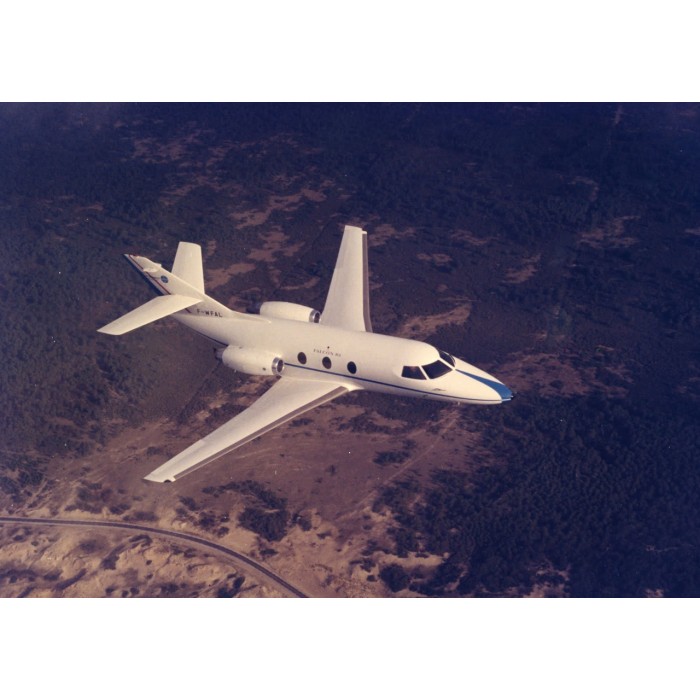


- Availability: Available for rent
Request aircraft information
The Dassault Falcon 10 is a light business jet introduced in December 1970, developed by Dassault Aviation to fill the gap between the larger Falcon 20 and smaller turboprop business jets. It is powered by two Honeywell TFE731-2-1C turbofan engines and reaches 830 km/h cruise speed with a range of 3,560 km (1,922 nm). Maximum certified altitude is 11,600 m (38,000 ft). The airframe is an aluminium monocoque structure - a stressed-skin design that produces a lighter, stiffer fuselage than conventional framed alternatives.
The wing uses a supercritical aerodynamic profile optimised for high subsonic cruise, equipped with dual-slot flaps and full leading-edge wing flaps for low-speed handling at approach and departure. This combination of supercritical cruise profile and full leading-edge flap system is a Dassault engineering signature applied to a compact light jet. The retractable tricycle landing gear has dual wheels on each main mount. The 3.87 m cabin seats 4 to 6 passengers in an executive layout with individual forward-facing seats and a rear multi-passenger bench, with a toilet on the starboard side opposite the front door. Maximum capacity is 8.

Key performance figures
| Range | 1,922 nm / 3,560 km |
| Cruise speed | 830 km/h |
| Maximum altitude | 11,600 m (38,000 ft) |
| Maximum takeoff weight | 8,500 kg (18,740 lb) |
| Engines | 2 x Honeywell TFE731-2-1C turbofan |
| Wing | Supercritical profile; dual-slot + leading-edge flaps |
| Fuselage | Aluminium monocoque |
| Introduced | December 1970 (Dassault Aviation, France) |

Airframe dimensions
| Aircraft length | 13.86 m |
| Aircraft height | 4.6 m |
| Wingspan | 13.08 m |
Cabin dimensions and capacity
| Cabin length | 3.87 m |
| Cabin width | 1.46 m |
| Cabin height | 1.49 m |
| Standard passengers | 4-6 (executive layout) |
| Maximum passengers | 8 |
| Layout | Individual forward-facing + rear multi-passenger seat |
| Toilet | Starboard side, opposite front door |


Cabin features
- 3.87 m executive cabin - individual forward-facing seats and rear bench;
- 4 to 6 passengers standard; 8 maximum;
- Toilet starboard side, opposite front door;
- Aluminium monocoque fuselage - reduced structural vibration;
- Supercritical wing - dual-slot flaps and full leading-edge flaps;
- 2 x Honeywell TFE731-2-1C turbofan - 830 km/h cruise;
- 11,600 m (38,000 ft) maximum altitude;
- Single-point pressure refuelling or gravity refuelling above wing.


The Dassault Falcon 10 is a light business jet introduced in December 1970, designed by Dassault to fill the gap between the larger Falcon 20 and smaller turboprop business jets. It applies the aerodynamic engineering that defines Dassault's military and commercial aviation work: the wing uses a supercritical aerodynamic profile optimised for cruising at high subsonic speeds, equipped with dual-slot flaps and full leading-edge wing flaps to maintain low-speed handling characteristics at the same time. This combination — supercritical wing profile for high-speed cruise, leading-edge flaps for approach and departure — is the aerodynamic signature of Dassault's design philosophy applied to a compact light jet platform.
Powered by two Honeywell TFE731-2-1C turbofan engines, the Falcon 10 delivers 830 km/h cruise speed at a maximum altitude of 11,600 m, with 3,560 km range. The 3.87 m cabin accommodates 4 to 6 passengers in an executive layout. The airframe is an aluminium monocoque structure. Charter prices start from approximately £1,800 per flight hour. For the full fleet see our private jet price guide or browse our complete fleet.
Why charter the Falcon 10?
- Dassault supercritical wing - optimised for high subsonic cruise. Its wing uses a supercritical aerodynamic profile specifically optimised for cruising at high subsonic speeds. This is the same design discipline that underpins Dassault's Rafale fighter and Falcon family wide-cabin jets - applied here to a compact 4 to 6-passenger light jet. The dual-slot flaps and full leading-edge wing flaps provide the low-speed handling required for short-runway operations while the supercritical profile delivers the 830 km/h cruise;
- 830 km/h cruise - exceptionally fast for a light jet of this size. At 830 km/h the Falcon 10 is faster than the Citation Bravo (745 km/h), Citation V (795 km/h) and Citation Mustang (684 km/h), and comparable to the Citation Encore (795 km/h) - in a smaller, lighter 4 to 6-passenger platform. On a London to Madrid sector, the speed advantage over a 745 km/h competitor is approximately 20 to 25 minutes;
- 3,560 km range - London to Dubai sector capability. At 3,560 km the Falcon 10 covers more range than most competing light jets including the Citation Bravo (3,232 km), Citation V (3,236 km) and Phenom 300 (3,650 km - comparable). London to Istanbul, London to Cairo, London to Riyadh with a short stop and London to Dubai with a fuel stop are all within operational reach from UK airports;
- Aluminium monocoque airframe - Dassault structural integrity. The aluminium monocoque structure is the same design approach Dassault applies across its aviation products. The fuselage is a stressed-skin structure with no internal frame interruptions, producing a lighter, stronger airframe than conventional semi-monocoque designs. For charter passengers, this translates into a quieter cabin with less structural vibration;
- Executive cabin for 4 to 6 passengers with toilet standard. The 3.87 m cabin is configured for 4 to 6 passengers in an executive layout with individual forward-facing seats and a rear multi-passenger bench. The toilet is on the starboard side opposite the front door - a compact but complete facility for a light jet of this size. Maximum capacity is 8;
- Introduced in 1970 - a classic of French aviation design with proven reliability. The Falcon 10 has been in service for over 50 years. In the charter market, a well-maintained example represents a proven airframe with a long service record, backed by Dassault's support network and the TFE731 engine's established maintenance infrastructure.
Charter cost - Falcon 10 prices from UK airports
Hourly rates run from approximately £1,800 to £2,200 - below the Citation Bravo and Encore and in the VLJ-to-light-jet transition zone. For 3 to 6 passengers on short to medium European missions, the Falcon 10 delivers Dassault build quality and 830 km/h performance at rates competitive with smaller, slower alternatives.
Indicative one-way prices from UK airports:
- London to Paris - from £3,600 (5 passengers, approximately 50 minutes);
- London to Geneva - from £4,400 (5 passengers, approximately 1 hour 15 minutes);
- London to Amsterdam - from £3,800 (5 passengers, approximately 55 minutes);
- London to Madrid - from £7,000 (5 passengers, approximately 2 hours 10 minutes);
- London to Rome - from £7,400 (5 passengers, approximately 2 hours 20 minutes);
- London to Nice - from £6,200 (5 passengers, approximately 1 hour 45 minutes);
- Manchester to Edinburgh - from £2,400 (5 passengers, approximately 40 minutes).
Empty Leg flights appear regularly on European repositioning routes. See our Empty Legs page for current availability.
Ideal routes for the Falcon 10
It performs best on missions where Dassault aerodynamic engineering, 830 km/h cruise and European range are the primary selection criteria for groups of 3 to 6:
- UK to near-Europe (45 to 90 minutes) for 3 to 6 passengers. Paris, Amsterdam, Brussels, Frankfurt, Zurich and Dublin - these short sectors are where the Falcon 10's 830 km/h cruise delivers the most time per pound of charter spend. The supercritical wing profile means the aircraft reaches cruise altitude and speed quickly, maximising efficiency on sectors too short for larger, heavier jets;
- UK to Mediterranean (1.5 to 2.5 hours). Nice, Rome, Barcelona, Madrid, Athens and Lisbon are all within range. At 830 km/h the Falcon 10 covers these sectors faster than most competing light jets. For 4 to 6 passengers on Southern European leisure and corporate missions, it delivers French design at light jet rates;
- UK to Near East with one fuel stop. Istanbul, Cairo and Beirut are within non-stop range. Riyadh and Amman require one short fuel stop. The Falcon 10's 3,560 km range extends its operational map significantly beyond most light jets that are limited to 2,800 to 3,000 km;
- Clients who specifically want a Dassault aircraft. Corporate and leisure travellers familiar with Falcon 2000, Falcon 7X or Falcon 8X often request the Falcon 10 for shorter European missions where a wide-cabin Falcon is over-specified. The design lineage - supercritical wing, Dassault build standards, French engineering - carries across the family;
- Aviation enthusiasts. With over 50 years in service and a specific design story - supercritical wing, monocoque fuselage, the 1970 Falcon 20 to turboprop gap it was built to fill - the Falcon 10 attracts charter passengers for whom the aircraft history is part of the value.
Cabin and in-flight experience
This aircraft cabin measures 3.87 m long, 1.46 m wide and 1.49 m high. The standard executive layout seats 4 to 6 passengers with one or two individual forward-facing seats and a rear multi-passenger seat facing them. The toilet is on the starboard side opposite the front door. Maximum capacity is 8. Tables are available for working configurations and the compact interior reflects the Dassault executive design standard applied to a light jet footprint.
At 830 km/h the Falcon 10 is among the fastest light jets in this size category. The aluminium monocoque structure reduces cabin vibration versus conventional framed designs. The Honeywell TFE731-2-1C engines are a well-established powerplant with a long service record in the Falcon family and across multiple business jet types.
- Cabin. 3.87 m long, 1.46 m wide, 1.49 m high;
- Layout. Executive - individual forward-facing seats + rear multi-passenger seat;
- Passengers. 4 to 6 standard; 8 maximum;
- Toilet. Starboard, opposite front door;
- Engines. 2 x Honeywell TFE731-2-1C turbofan;
- Wing. Supercritical profile; dual-slot flaps; full leading-edge flaps;
- Fuselage. Aluminium monocoque;
- Altitude. 11,600 m (38,000 ft) maximum certified.
Technical specifications
| Manufacturer | Dassault Aviation, France |
| Introduced | December 1970 |
| Aircraft class | Light business jet |
| Engines | 2 x Honeywell TFE731-2-1C turbofan |
| Wing | Supercritical profile; dual-slot flaps; full leading-edge flaps |
| Fuselage | Aluminium monocoque |
| Maximum passengers | 8 |
| Optimal passengers | 4 |
| Range | 1,922 nm / 3,560 km |
| Cruise speed | 830 km/h |
| Maximum altitude | 11,600 m (38,000 ft) |
| Maximum takeoff weight | 8,500 kg (18,740 lb) |
| Cabin length | 3.87 m |
| Cabin width | 1.46 m |
| Cabin height | 1.49 m |
| Wingspan | 13.08 m |
| Aircraft length | 13.86 m |
| Aircraft height | 4.6 m |
Falcon 10 vs similar aircraft
- Falcon 10 vs Citation Bravo. The Bravo has a longer cabin (4.78 m vs 3.87 m), higher capacity (7 passengers vs 6 standard), lower cruise speed (745 km/h vs 830 km/h) and comparable range. Charter rates for the Bravo are broadly similar. For clients who prioritise cabin length and passenger capacity, the Bravo is preferable. For those who want the Dassault supercritical wing engineering and 85 km/h speed advantage, the Falcon 10 is the appropriate choice;
- Falcon 10 vs Phenom 100. The Phenom 100 is a smaller VLJ with a shorter cabin (3.37 m vs 3.87 m), lower capacity (4 passengers), much lower charter rates (from £1,400/hr vs £1,800/hr) and less range. For 3 to 4 passengers on very short European sectors where the lower rate is the priority, the Phenom 100 is competitive. For 5 to 6 passengers or longer European missions where the Falcon 10's range and 830 km/h cruise are required, it is the correct choice;
- Falcon 10 vs Falcon 20. The Falcon 20 is the larger aircraft this jet was designed to complement - wider cabin, more range, higher capacity and higher charter rates. It provides the Dassault engineering lineage and supercritical wing design in a smaller, more economical platform for 4 to 6 passengers on European missions where the Falcon 20's capacity and cost are more than required.
Frequently asked questions - Falcon 10 charter
How much does it cost to charter a Dassault Falcon 10?
Charter rates run from approximately £1,800 to £2,200 per flight hour. London to Paris costs from £3,600 for 5 passengers. London to Geneva costs from £4,400. London to Madrid costs from £7,000. All quotes from Private Jets UK are fully itemised with no hidden charges.
What is the supercritical wing on the Falcon 10?
A supercritical wing uses an aerodynamic profile specifically shaped to delay the formation of shockwaves at high subsonic speeds. Dassault developed this technology for military and commercial aviation and applied it to the Falcon 10's wing, allowing 830 km/h cruise efficiency that conventional wing profiles cannot match at the same thrust level. The dual-slot flaps and full leading-edge wing flaps allow the same wing to perform well at approach speeds.
How many passengers can fly on a Falcon 10?
The standard layout seats 4 to 6 passengers. Maximum capacity is 8. The typical configuration has one or two individual forward-facing seats and a rear multi-passenger seat, with a toilet on the starboard side.
How does the Falcon 10 compare to the Falcon 20?
It was specifically designed to fill the gap between the larger Falcon 20 and smaller turboprop jets. It is smaller, lighter and less expensive to charter than the Falcon 20, with the same Dassault engineering lineage including the supercritical wing. For 4 to 6 passengers on European missions, the Falcon 10 provides the Dassault standard at light jet rates.
What engines power the Falcon 10?
Two Honeywell TFE731-2-1C engines. The TFE731 is one of the most widely used business jet engine families, with a well-established maintenance and support infrastructure across Europe. Honeywell TFE731 variants power multiple Dassault Falcon models as well as other business jet types including the Cessna Citation series.