


Charter a Cessna Citation 501


- Availability: Available for rent
Request aircraft information
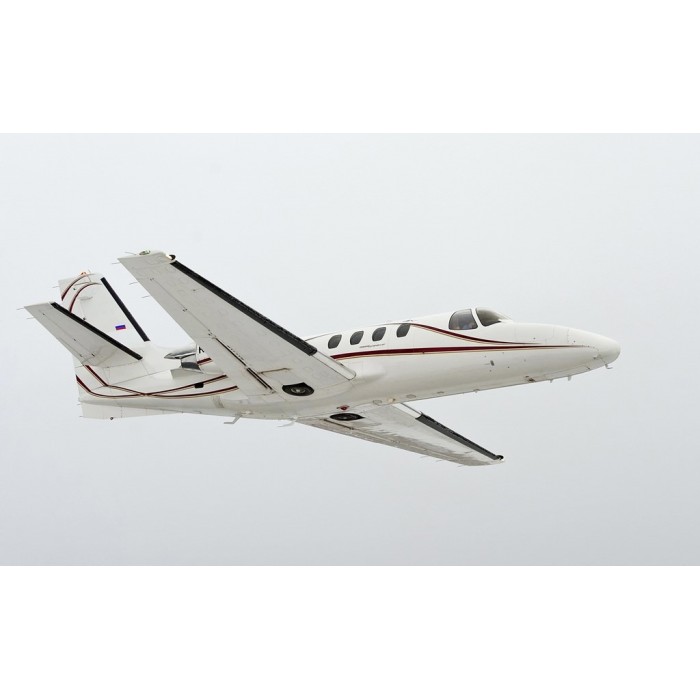
The Cessna 501 Citation I/SP is the single-pilot certified variant of the original Citation family - the founding aircraft of what became the world's largest business jet fleet, with over 8,000 Citations of all variants delivered and 41 million fleet flight hours accumulated by 2022. The Fanjet 500 prototype first flew on 15 September 1969; the production aircraft received FAA certification on 9 September 1971; and the 501 Citation I/SP, with SP designating its certified single-pilot capability, entered service in early 1977. The SP certification was Cessna's answer to a commercial problem: the Citation I required two pilots like a Learjet, but was marketed against twin turboprops that a single pilot could fly. By certifying the 501 for single-pilot operations, Cessna matched the economics of competing turboprops while offering jet performance - and freed the right-hand cockpit seat for an additional passenger. 312 Citation I/SP aircraft were built before production ended in 1985.
The Citation I/SP is powered by two Pratt and Whitney Canada JT15D-1A turbofans at 2,200 lbf each - the same engine family that underpins much of the Citation line. The straight (unswept) wing is the aircraft's defining aerodynamic feature, providing low approach speeds and short-field performance that swept-wing jets of the same era could not match. Service ceiling is 41,000 ft; maximum range is approximately 1,328 nm (2,459 km). The aircraft is a legacy design now valued primarily for its low acquisition cost, simplicity, and short-field access. Charter prices start from approximately £900 per flight hour. For the full fleet see our private jet price guide or browse our complete fleet.

Why charter the Citation 501?
- First FAA-certified single-pilot jet - SP designation created a new category in business aviation. The 501 Citation I/SP was one of the first business jets to receive FAA single-pilot type certification - the SP designation reflected this specific regulatory achievement. Wikipedia noted that the Citation I/SP "reshaped the economics" of owner-pilot operations: an owner could fly a jet without a copilot, reducing operating costs to turboprop levels and enabling a new category of owner-flown jet operations. BlackJet confirmed the 501's SP certification "contributed to the broader Citation family" that eventually built the largest business jet fleet in the world. The freed right-hand cockpit seat becomes an additional passenger position in the single-pilot configuration - relevant on shorter sectors where 7 total occupants are needed;
- Straight wing - the Citation's defining short-field advantage over swept-wing jets; low approach speed. The Citation I/SP's unswept straight wing was the deliberate design choice that enabled Cessna to "operate from airfields accessible to light twins" - as Wikipedia recorded from Cessna's original 1968 announcement. Unlike the swept wings of Learjets and other competitors, the straight wing produces high lift at low speeds, allowing approach speeds comparable to turboprops and ground rolls shorter than swept-wing jets of similar performance. For charter clients at short or obstacle-restricted airfields where a Learjet or Citation CJ cannot operate safely, the Citation I/SP's straight-wing approach performance remains relevant today. It was this characteristic that defined the original Citation mission: jet speed at turboprop field access;
- 41,000 ft service ceiling - upgraded from 35,000 ft on the original Citation 500; 8.6 psi pressurisation. Wikipedia confirmed the Citation I upgrade in 1976 increased the service ceiling from 35,000 ft to 41,000 ft and raised cabin pressure from 7.6 to 8.6 psi. At 41,000 ft the Citation I/SP operates above most commercial airline traffic on European routes and above most convective weather. The 8.6 psi pressurisation maintains a cabin altitude below 8,000 ft at FL410 - a reasonable standard for short European and regional UK sectors of 1 to 2 hours. Two JT15D-1A engines at 2,200 lbf provide the climb performance to reach this altitude within the performance limitations of the airframe;
- Founded the Citation family - the basis of the most numerous business jet fleet in history. Citation Wikipedia confirmed the Citation family has delivered over 8,000 aircraft and accumulated 41 million flight hours by 2022 - the largest business jet fleet in the world. The Citation I/SP was the founding aircraft of this lineage. It developed directly into the Citation II/Bravo (stretched fuselage, more passengers) and the Citation V/Ultra/Encore. For charter clients who value the demonstrated longevity of an aircraft lineage, the Citation I/SP's position as the founding design of an 8,000-aircraft family is a meaningful indicator of its fundamental engineering soundness;
- Avionics-upgraded fleet - Garmin GTN 750, ADS-B, TAWS, RVSM on most active aircraft. The Citation I/SP was originally equipped with analogue instrumentation typical of the late 1970s. Most active charter aircraft have been extensively modernised: FlyCraft documented a 1977-built example (N501PV) equipped with Garmin GTN 750, GDL-88 ADS-B transceiver, Avidyne EX650 MFD, TWX-670 weather, Bendix TAWS and Sperry SPZ-500 autopilot - a current avionics stack that meets modern airspace requirements. RVSM-capable aircraft operate in European RVSM airspace. Confirm the avionics specification of any specific Citation I/SP before booking;
- Low acquisition cost; low charter rates; practical for budget-sensitive short sectors. Wikipedia confirmed 1970s Citation 500s were valued at $300,000 and Citation I/SPs at $695,000 to $1.25 million in 2018 pre-owned values. This low acquisition cost translates directly to the lowest charter rates in the jet category. For groups of 4 to 6 on UK regional or short European sectors where the charter budget is the primary constraint, the Citation I/SP provides jet performance - 347 kt cruise, 41,000 ft ceiling, pressurised cabin - at entry-level rates. BlackJet confirmed the C501 "today occupies a niche: mostly owner-flown or used for specialized charter, where low acquisition cost matters more than cabin refinement."
Charter cost - Citation 501 prices from UK airports
Hourly rates run from approximately £900 to £1,300 - the lowest in the jet category, reflecting the Citation I/SP's age, compact cabin and vintage avionics on non-updated aircraft. For 4 to 6 passengers on short UK regional and European hops where jet performance at turboprop rates is the priority, the Citation I/SP is a practical option.
Indicative one-way prices from UK airports:
- London to Edinburgh - from £1,080 (5 passengers, approximately 1 hour 10 minutes);
- London to Paris - from £1,350 (5 passengers, approximately 1 hour 20 minutes);
- London to Geneva - from £1,800 (5 passengers, approximately 1 hour 40 minutes);
- Edinburgh to Manchester - from £900 (5 passengers, approximately 45 minutes);
- London to Amsterdam - from £1,350 (5 passengers, approximately 1 hour 10 minutes);
- London to Dublin - from £1,260 (5 passengers, approximately 1 hour 15 minutes);
- Manchester to Nice - from £2,700 (5 passengers, approximately 2 hours 15 minutes).
Empty Leg flights appear on repositioning routes. See our Empty Legs page for current availability.

Ideal routes for the Citation 501
Best matched to short UK regional and European missions where jet performance at entry-level rates, short-field access and single-pilot economics serve groups of 4 to 6:
- Short UK regional connections (30 to 75 minutes) from shorter airfields. Edinburgh, Manchester, Belfast, Leeds Bradford and a range of UK regional airfields accessible to light aircraft are within 30 to 90 minutes. The Citation I/SP's straight-wing short-field performance makes it usable from strips unavailable to swept-wing jets. For owner-pilots or charter clients who want jet speed from a regional UK airfield, the Citation I/SP's combined short-field access and single-pilot certification is the primary operational advantage;
- Short European day trips (1 to 2 hours) at budget jet rates. Paris, Amsterdam, Brussels, Dublin and Geneva are all within 1 to 2 hours. At approximately £900 per hour, the per-seat economics for groups of 4 to 5 on these sectors are competitive with business-class commercial fares. The pressurised cabin at 41,000 ft provides comfort above the weather. For charter clients whose priority is the lowest available jet rate on a short European sector, the Citation I/SP is the entry point;
- Owner-pilot operations where single-pilot certification and low acquisition cost are combined. BlackJet noted the Citation I/SP "today occupies a niche: mostly owner-flown or used for specialized charter, where low acquisition cost matters more than cabin refinement." For owner-pilots who hold a jet type rating and value the ability to fly without a required co-pilot on Part 91 operations, the 501's SP certification is its primary commercial rationale. The JT15D-1A engines provide straightforward handling with no unusual systems complexity;
- Sectors within 1,328 nm where the straight-wing field performance advantage over CJ series jets matters. On sectors up to 1,328 nm the Citation I/SP covers most UK regional and short European missions. Where the destination airfield is restricted in length or approach slope, the straight wing's lower approach speed may be the difference between operational access and diversion. For the specific subset of missions where a field is accessible to the Citation I/SP but not to a Citation CJ, this is a meaningful practical distinction;
- Budget-constrained corporate travel where jet comfort matters but rates must be minimised. At £900 to £1,300 per hour the Citation I/SP is typically 30 to 40% below the cheapest Citation CJ series charter rate. For corporate clients who occasionally need private jet access but cannot justify light jet rates on every trip, the Citation I/SP provides the most economical access to jet performance available in the UK charter market.

Cabin and in-flight experience
The Citation I/SP cabin measures 3.87 m (12.7 ft) long, 1.49 m (4.9 ft) wide and 1.36 m (4.5 ft) high - compact even by light jet standards, designed for 1 to 3 hour regional missions. Six passengers in the standard executive club configuration with fold-out work tables; seven maximum in the densest layout. In single-pilot operations, the right-hand cockpit seat may be available as an additional passenger position. A forward refreshment centre and aft belted lavatory are standard. The cabin is pressurised to 8.6 psi - a standard maintained to 41,000 ft service ceiling. BlackJet described the cabin as "compact and practical, built for flights of one to three hours."
Most active charter aircraft have been avionics-updated. A typical modernised Citation I/SP carries Garmin GTN 750 touch-screen navigator, ADS-B Out, Avidyne or Garmin MFD, Bendix/King TAWS and Sperry SPZ-500 autopilot. RVSM capability is standard on updated aircraft. Original 1977 aircraft carry analogue Sperry/Collins instruments; confirm the avionics level before booking. Two JT15D-1A engines at 2,200 lbf each; straight wing; Stage 3 noise compliant.
- Cabin. 3.87 m x 1.49 m x 1.36 m; pressurised; 6 standard; 7 maximum;
- Layout. Club seating; fold-out work tables; forward refreshment centre; aft belted lavatory;
- Pressurisation. 8.6 psi; 41,000 ft service ceiling;
- Avionics (updated). Garmin GTN 750; ADS-B Out; Avidyne/Garmin MFD; TAWS; RVSM; Sperry SPZ-500 autopilot;
- Avionics (original). Analogue Sperry/Collins; confirm before booking;
- Engines. 2 x JT15D-1A (2,200 lbf each); Stage 3 noise;
- Wing. Straight (unswept); low approach speed; short-field performance;
- Single-pilot. FAA-certified for single-pilot operation (Model 501 SP).
Technical specifications
| Manufacturer | Cessna Aircraft Company, Wichita, Kansas |
| Original name | Fanjet 500 (prototype); 500 Citation; Citation I; 501 Citation I/SP |
| First flight | 15 September 1969 |
| FAA certification | 9 September 1971 (500); 501 SP variant from 1977 |
| Production | 1977-1985; 312 Citation I/SP built; 689 total all Citation I variants |
| Aircraft class | Light business jet (entry-level vintage) |
| Single-pilot certification | Yes (FAA; SP designation) |
| Engines | 2 x Pratt and Whitney Canada JT15D-1A (2,200 lbf each; Stage 3) |
| Wing | Straight (unswept); low approach speed; short-field capable |
| Max cruise speed | 347 kt / Mach 0.64 (644 km/h) |
| Range | 1,328 nm / 2,459 km (41,000 ft; 45 min reserves; 1,562 lb payload) |
| Service ceiling | 41,000 ft (upgraded from 35,000 ft on original Citation 500) |
| Pressurisation | 8.6 psi (upgraded from 7.6 psi on original 500) |
| MTOW | 10,850 lb / 4,922 kg |
| Cabin length | 3.87 m (12.7 ft) |
| Cabin width | 1.49 m (4.9 ft) |
| Cabin height | 1.36 m (4.5 ft) |
| Passengers | 6 standard; 7 maximum; 8th in right cockpit seat (single-pilot ops) |
| Wingspan | 13.32 m (increased from 43.9 ft to 47.1 ft in 1976 Citation I upgrade) |
| Aircraft length | 13.26 m |
| Aircraft height | 4.36 m |

Citation 501 vs similar aircraft
- Citation 501 vs Cessna Citation CJ1+. The Citation CJ1+ is the modern successor concept - swept wing, higher cruise speed (380 kt vs 347 kt), FADEC engines, Garmin G1000 glass cockpit and single-pilot certified. Charter rates for the CJ1+ run approximately 20 to 35% above the Citation I/SP. The Citation I/SP counters with lower charter rates, shorter-field approach performance from the straight wing (lower approach speed than the CJ1+) and for some missions, access to strips the CJ1+ cannot use. For standard European charter where speed and modern avionics matter, the CJ1+ is preferable; for the tightest budgets or specific short-field airfields, the Citation I/SP is the option;
- Citation 501 vs Beechcraft King Air 300. The King Air 300 is a twin turboprop with comparable short-field access, a larger cabin (5.12 m vs 3.87 m) and lower charter rates. The Citation I/SP counters with jet engines (smoother, quieter at cruise than turboprops), higher cruise altitude (41,000 ft vs 35,000 ft) and jet certification status which some operators require for their travellers. Both aircraft target the same short-field regional mission; the King Air 300 wins on cabin space and economy, the Citation I/SP on jet certification and cruise altitude;
- Citation 501 vs Emivest SJ30-2. The SJ30-2 is a significantly more capable light jet - Mach 0.83 cruise (vs Mach 0.64), 2,500 nm range (vs 1,328 nm), sea-level cabin to FL410 and 49,000 ft ceiling. Charter rates for the SJ30-2 run approximately 60 to 80% above the Citation I/SP. For groups where maximum performance and cabin altitude are the priorities, the SJ30-2 is in a different category. The Citation I/SP is appropriate for budget-conscious regional missions where the SJ30-2's capability would be surplus to requirements and its rate cannot be justified.

Frequently asked questions - Citation 501 charter
How much does it cost to charter a Citation 501?
Charter rates run from approximately £900 to £1,300 per flight hour. London to Edinburgh costs from £1,080 for 5 passengers. London to Paris costs from £1,350. London to Geneva costs from £1,800. All quotes from Private Jets UK are fully itemised with no hidden charges.
What does SP mean in Cessna 501 Citation I/SP?
SP stands for Single Pilot - the FAA type certification designation confirming the 501 variant can be operated by one pilot without a required co-pilot. Wikipedia confirmed this was Cessna's commercial solution to the Citation I's two-pilot requirement, which put it at a disadvantage against twin turboprops that a single pilot could fly. The SP certification also freed the right cockpit seat for an additional passenger in single-pilot operations.
Why does the Citation 501 have a straight (unswept) wing?
Cessna designed the Citation I to compete with turboprops by matching their short-field access - something swept-wing jets could not do. The straight wing produces higher lift at low speeds, reducing approach speed and landing roll to levels comparable to turboprops. Wikipedia confirmed Cessna's 1968 announcement specified an aircraft capable of "operating from airfields accessible to light twins." The straight wing is why the Citation I/SP can access shorter runways than swept-wing jets of similar performance.
How many passengers can fly on a Citation 501?
Six in the standard executive club configuration with fold-out tables, forward refreshment centre and aft belted lavatory. Seven in maximum density. In single-pilot operations, the right cockpit seat may be used as an eighth position. BlackJet described the cabin as "compact and practical, built for flights of one to three hours."
Is the Citation 501 still airworthy and certified for current airspace?
Yes - most active Citation I/SP aircraft have been avionics-upgraded to meet current airspace requirements. Common updates include Garmin GTN 750 navigator, ADS-B Out transceiver, TAWS and RVSM capability. FlyCraft documented a 1977-built example with a full modern avionics stack meeting current European airspace requirements. Confirm the specific avionics standard of any aircraft before booking.

