


Charter a Cessna 421 Golden Eagle
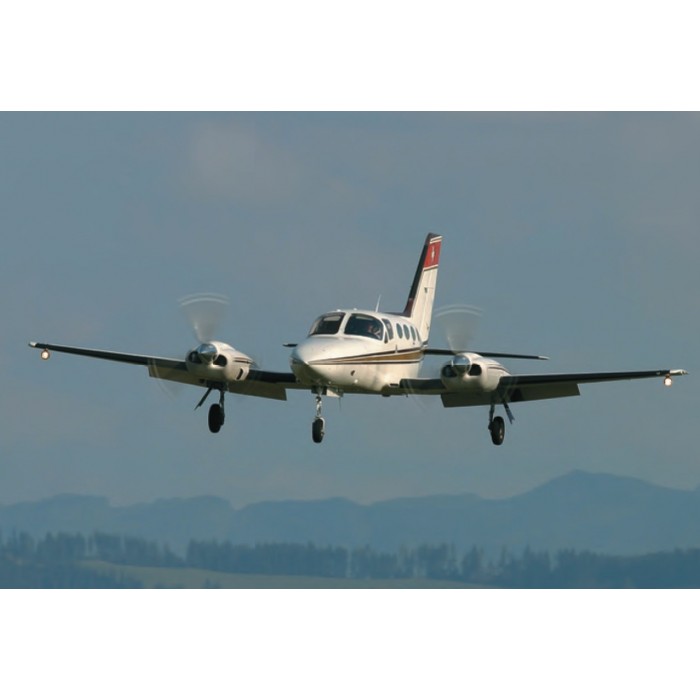


- Availability: Available for rent
Request aircraft information
The Cessna 421 Golden Eagle is the largest, fastest and most capable twin-piston aircraft Cessna ever built - a pressurised twin-engine cabin-class aircraft designed from the outset to deliver turboprop-like performance at piston-engine operating costs. FAA type certification was received on 1 May 1967, with first deliveries as the 1968 model year. Cessna sold 200 aircraft in the first year of production, confirming immediate market demand. The 421C (1976) was the final and definitive variant, introducing wet wings (replacing Stabila-Tip wingtip fuel tanks), trailing-link landing gear (from 1981 model year) and Continental GTSIO-520-L/N/H engines at 375 hp each. A total of 1,901 aircraft were delivered before production ended in 1985, covering variants 421, 421A, 421B and 421C. Military operators including the Royal New Zealand Air Force (No. 42 Squadron), Royal Cambodian Air Force, Ivory Coast Air Force, Turkish Army Aviation and Philippine Army (COMINT operations) confirm the 421's capability beyond the civil charter market. The 421C shares a common type certificate with the Cessna 401, 402, 411, 414 and 425 - the entire Cessna pressurised piston twin family.
The Cessna 421C Golden Eagle is a pressurised twin-engine piston aircraft - pressurised at 5.0 psi differential, providing sea-level cabin pressure to 10,000 ft and a comfortable 8,000 ft cabin altitude at 25,000 ft. Air Charter Service confirmed "the pressurised cabin makes the Cessna 421C much quieter than many of the rivals in its class." The Continental GTSIO-520 geared turbocharged engines feature a lower propeller tip speed than direct-drive equivalents, reducing cabin and external noise while enabling the 30,000 ft service ceiling. Charter prices start from approximately £2,500 per flight hour. For the full fleet see our private jet price guide or browse our complete fleet.

Why charter the Cessna 421 Golden Eagle?
- Pressurised cabin at 5.0 psi differential - sea-level pressure to 10,000 ft; comfortable 8,000 ft cabin altitude at FL250; 30,000 ft ceiling; quieter than any unpressurised piston twin in the charter market. The Cessna 421C's 5.0 psi pressure differential maintains a comfortable 8,000 ft cabin altitude at FL250 - the same comfort level as many turboprops. Air Charter Service confirmed "the pressurised cabin makes the Cessna 421C much quieter than many of the rivals in its class." The Continental GTSIO-520's geared propeller drive reduces tip speed and external noise compared to direct-drive piston engines of equivalent power. The 30,000 ft service ceiling enables flight above convective weather on most European short sectors. This pressurisation advantage is unavailable on the Baron 58, Piper Aztec and Piper Navajo at comparable charter rates - the 421C is the only pressurised piston twin available in the Private Jets UK fleet and sits in the unique market position between unpressurised piston twins and the entry-level turboprops;
- Continental GTSIO-520 geared turbocharged engines at 375 hp each; geared reduction drive for lower propeller noise and higher efficiency; turboprop-like performance at piston operating cost - Cessna's explicit market positioning for the 421. The G in GTSIO-520 stands for Geared - a reduction drive that lowers propeller tip speed versus a directly-driven engine of the same power output. This reduces propeller noise (the dominant noise source on piston aircraft) and improves propulsive efficiency at cruise altitude. The T denotes turbocharging, enabling the 30,000 ft ceiling. Combined with fuel injection (I) and the horizontally opposed six-cylinder configuration (O-520), the GTSIO-520 produces 375 hp per side. Cessna positioned the 421 explicitly as "turboprop-like performance at piston-engine cost" - the geared turbocharged engine was the technical basis for this claim. Air Charter Service confirmed "with six people on board, the aircraft can cruise at approximately 275 mph over a distance of 1,200 miles at 25,000 feet." Aftermarket turboprop conversions - Riley Turbine Eagle 421 (two PT6A-135 at 750 hp each) and Excalibur 421 (PT6A-135A or PT6A-112) - validate the 421C airframe's structural capability to accept significantly higher power outputs;
- 1,901 aircraft built 1967-1985; 200 sold in first year; largest and fastest Cessna twin piston; RNZAF; Cambodian Air Force; Turkish Army Aviation; Philippine Army COMINT - broad institutional confidence. 200 aircraft sold in the first year of production confirmed immediate market acceptance. The military operator list spans four continents: RNZAF No. 42 Squadron (421C), Royal Cambodian Air Force, Ivory Coast Air Force, Turkish Army Aviation (421B) and Philippine Army (421B; COMINT signals intelligence missions). The Philippine Army COMINT role - requiring extended endurance, pressurised crew environment and reliable twin-engine systems for sensitive overland surveillance - is among the most demanding operational profiles any general aviation aircraft is asked to fill. For charter clients who appreciate the validation that military selection provides, the 421C's institutional adoption across multiple armed forces confirms its reliability and capability at the top of the pressurised piston twin category;
- 421C wet wing (1976); trailing-link gear (1981); Garmin G600 TXi glass panel STC; GFC 600 digital autopilot STC; ADS-B Out compliant - most capable variant with modern retrofit availability. The 421C introduced wet wings in 1976, removing the Stabila-Tip wingtip tanks of earlier variants and providing increased fuel capacity, reduced weight and improved structural efficiency. The trailing-link landing gear from the 1981 model year provides better crosswind handling and improved ground ride quality on rough surfaces. Modern Garmin glass panel retrofits (G600 TXi integrated flight displays) and the GFC 600 digital autopilot (FAA STC for 421C) bring the active fleet to current avionics standards with coupled approaches and GPS navigation. ADS-B Out is standard on compliant aircraft. For charter clients who specify modern glass cockpit avionics in a pressurised piston twin at the lowest available pressurised rate, the 421C with Garmin retrofits provides the current-generation specification;
- 800-900 m takeoff; 700-800 m landing; short-field access with pressurised cabin; London to Madrid and New York to Atlanta range confirmed; 1,487 nm at piston-twin operating costs. Takeoff distance of 800-900 m and landing distance of 700-800 m open UK regional strips, Scottish island approaches and European mountain airfields that turboprops and jets cannot access. Air Charter Service confirmed the 421C "is capable of flying from London to Madrid or New York to Atlanta" - two of the most commercially relevant medium-range sectors in European and North American business travel. The 1,487 nm range comfortably covers all UK domestic and most Western European sectors with full passenger load. For charter clients whose destination has a short runway but who require pressurisation on the sector, the 421C uniquely combines short-field access with pressurised cabin comfort in the Private Jets UK fleet;
- Lowest charter rate for a pressurised twin-engine aircraft; bridge between unpressurised piston twins (Baron 58/Navajo at £600-700/hr) and entry-level turboprops (Cheyenne/King Air 90 at £900/hr); 5-6 passengers at pressurised rates. At approximately £2,500-3,500/hr, the 421C is the minimum available rate for pressurised twin-engine charter. The Piper Cheyenne II and King Air 90 both run approximately £900/hr for comparable short sectors with similar pressurisation and ceiling. For groups of 3 to 5 on short European sectors where pressurisation is specified and turboprop rates are above budget, the 421C provides the confirmed pressurised specification at the entry-level rate. The trade-offs versus the turboprops are speed (240-275 kt vs 275-330 kt) and climb rate - neither is operationally significant on sectors under 300 nm where ATC typically assigns cruise levels below 25,000 ft regardless.
Charter cost - Cessna 421 Golden Eagle prices from UK airports
Hourly rates run from approximately £2,500 to £3,500 - the lowest available for a pressurised twin-engine aircraft in the Private Jets UK fleet, reflecting the 421C's piston engine configuration, 5-6 passenger capacity and short-sector optimisation. For groups of 3 to 5 on short pressurised European sectors where the 421C's quiet pressurised cabin and 30,000 ft ceiling are the selection criteria at the minimum available pressurised rate, the 421C is the appropriate choice.
Indicative one-way prices from UK airports:
- London to Edinburgh - from £2,750 (5 passengers, approximately 1 hour 30 minutes);
- London to Paris - from £2,750 (5 passengers, approximately 1 hour 20 minutes);
- London to Geneva - from £3,750 (5 passengers, approximately 2 hours);
- London to Madrid - from £5,000 (5 passengers, approximately 2 hours 30 minutes);
- Edinburgh to Inverness - from £2,500 (5 passengers, approximately 45 minutes);
- London to Dublin - from £2,750 (5 passengers, approximately 1 hour 15 minutes);
- Manchester to Amsterdam - from £2,750 (5 passengers, approximately 1 hour 15 minutes).
Empty Leg flights appear on repositioning routes. See our Empty Legs page for current availability.

Ideal routes for the Cessna 421 Golden Eagle
Best matched to short UK regional and European sectors where the 421C's pressurised cabin, 30,000 ft ceiling, short-field performance and lowest available pressurised twin rate serve groups of 3 to 5:
- Short UK regional and European sectors (1 to 2.5 hours) where the pressurised cabin provides comfort unavailable in unpressurised piston twins at comparable rates. Edinburgh to Inverness, London to Paris, London to Edinburgh and London to Dublin are all within the 421C's range and sector time. The pressurised cabin at these altitudes provides a significantly quieter and more comfortable environment than the Baron 58, Piper Navajo or Piper Aztec. For groups of 3 to 5 whose priority is pressurised cabin comfort at piston-twin rates, the 421C is the entry-level option with no competitor below turboprop rates;
- London to Madrid non-stop (approximately 1,000 nm) where the 1,487 nm confirmed range and pressurised cabin at FL250 serve 5 passengers on 2.5-hour Iberian sectors. Air Charter Service confirmed the 421C "is capable of flying from London to Madrid" in a single sector. At FL250 with the pressurised cabin maintaining 8,000 ft equivalent altitude, the 421C provides a more comfortable 2.5-hour sector over Iberian convective weather than any unpressurised twin. London to Madrid is among the most commercially relevant medium-range European routes, and the 421C's range margin is entirely comfortable for this sector;
- Short-field destinations with runway under 1,000 m where pressurisation is also required - a combination unavailable in turboprops and jets at any charter rate. The 421C's 800-900 m takeoff and 700-800 m landing distances open UK regional strips, Scottish island approaches, European mountain airfields and private grass strips that the King Air 90 (2,300 ft) and Piper Cheyenne (2,000 ft) cannot access. For charter clients whose destination has a short runway and who require pressurisation on the sector, the 421C is the only aircraft combining both capabilities in the Private Jets UK fleet;
- Budget-priority pressurised missions where 421C rates of approximately £2,500-3,500/hr run significantly below Piper Cheyenne (£900/hr) and King Air 90 (£900/hr) on short European sectors. For clients whose brief specifies "pressurised twin on a short European sector" at the lowest available rate, the 421C provides the confirmed pressurised specification with 5.0 psi differential and 30,000 ft ceiling. The 30,000 ft ceiling versus the Cheyenne's 35,800 ft is not operationally significant on sectors under 400 nm where ATC assigns cruise levels below 25,000 ft regardless;
- Groups of 4 to 5 where the executive club seating and quiet pressurised cabin create a corporate environment on short sectors at minimum pressurised charter rates. The 421C cabin in standard configuration provides four to five seats in a club layout with individual armrests and fold-out tables. Air Charter Service confirmed "a privacy curtain is available to separate the back section of the cabin." The geared GTSIO-520 engines create a notably quieter cabin environment than direct-drive piston twins, making working conversation and phone calls practical throughout the flight at the lowest available pressurised rate in the fleet.

Cabin and in-flight experience
The Cessna 421C Golden Eagle cabin seats 5 to 6 passengers in standard charter configuration, with a maximum of 7 in owner-operated aircraft. Cabin height is 1.37 m (4.5 ft) - not stand-up, but pressurised to 5.0 psi differential. Air Charter Service confirmed "the cabin is typically laid out to seat five or six passengers" in a club lounge seating arrangement with individual armrests and fold-out tables. A privacy curtain is available to separate the aft section. Large oval windows provide natural light throughout. The cabin is significantly quieter than unpressurised piston twins due to both the pressurisation and the GTSIO-520's geared propeller drive. Baggage holds approximately 5 soft suitcases in the forward and aft nose/tail compartments. Many active 421Cs carry Garmin G600 TXi glass panel displays, GFC 600 digital autopilot and ADS-B Out for current avionics compliance.
- Cabin. Pressurised (5.0 psi); 5-6 seats standard charter; 1.37 m height;
- Pressurisation. Sea-level cabin to 10,000 ft; 8,000 ft cabin at FL250;
- Engines. 2 x Continental GTSIO-520-L/-N/-H (375 hp each; geared; turbocharged; fuel-injected);
- Ceiling. 30,000 ft / 9,205 m;
- Short-field. 800-900 m takeoff; 700-800 m landing;
- Avionics. Garmin G600 TXi glass panel (STC); GFC 600 digital autopilot (STC); ADS-B Out;
- Turboprop conversions. Riley Turbine Eagle 421 (PT6A-135; 750 hp each); Excalibur 421 (PT6A-135A/-112).
Technical specifications
| Manufacturer | Cessna Aircraft Company, Wichita, Kansas |
| FAA type certification | 1 May 1967 (common type cert: Cessna 401, 402, 411, 414, 425) |
| 421C type approval | 28 October 1975; production 1976-1985 |
| Production | 1967-1985; 1,901 total built (421/421A/421B/421C) |
| Aircraft class | Pressurised twin-engine piston (largest and fastest Cessna twin piston) |
| Engines (421C) | 2 x Continental GTSIO-520-L/-N/-H (375 hp each; geared; turbocharged; fuel-injected) |
| Gearing | Reduction drive lowers propeller tip speed = quieter and more efficient |
| Cruise speed | 240-275 kt / 444-509 km/h |
| Max speed | 256 kt / 474 km/h |
| Service ceiling | 30,000 ft / 9,205 m |
| Pressurisation | 5.0 psi differential; sea-level cabin to 10,000 ft; 8,000 ft cabin at FL250 |
| Range | 1,487 nm / 2,754 km |
| Takeoff distance | 800-900 m (ISA, sea level) |
| Landing distance | 700-800 m |
| MTOW | 7,450 lb / 3,379 kg |
| Passengers | 5-6 standard charter; 7 maximum |
| Cabin height | 1.37 m (4.5 ft) |
| Military operators | RNZAF; Cambodian; Ivory Coast; Turkish Army; Philippine Army (COMINT) |
| Turboprop conversion | Riley Turbine Eagle 421 (PT6A-135; 750 hp each); Excalibur 421 (PT6A-135A) |
| Wingspan | 12.54 m (41.2 ft) |
| Aircraft length | 11.10 m (36.4 ft) |
| Aircraft height | 3.49 m (11.5 ft) |

Cessna 421 Golden Eagle vs similar aircraft
- Cessna 421C vs Piper Cheyenne II. The Piper Cheyenne II is a pressurised twin turboprop at £900/hr with 283 kt cruise (vs 421C's 240-275 kt), 35,800 ft ceiling (vs 30,000 ft) and PT6A-28 turboprop engines. The 421C counters with significantly lower charter rates (£2,500-3,500/hr), 800-900 m takeoff (vs Cheyenne's approximately 2,000 ft) and lower maintenance cost on the GTSIO-520 versus the PT6A-28. For budget-priority pressurised missions under 400 nm where turboprop speed advantage is not operationally relevant, the 421C provides the pressurised specification at the minimum available rate;
- Cessna 421C vs Beechcraft Baron 58. The Baron 58 is an unpressurised twin piston at £700/hr with 200 kt cruise and 20,688 ft ceiling. The 421C counters with pressurisation (5.0 psi vs nil), 30,000 ft ceiling (vs 20,688 ft) and significantly lower cabin noise from geared engines. Charter rates for the Baron 58 run approximately 25-30% below the 421C. For clients whose primary requirement is pressurised cabin comfort on short sectors, the 421C provides the pressurised specification at rates between the Baron 58 and the turboprops;
- Cessna 421C vs King Air 90 (C90GTi). The King Air C90GTi is a pressurised twin turboprop at £900/hr with 275 kt cruise (comparable to 421C max cruise), 30,000 ft ceiling (same), Collins Pro Line 21 avionics and single-pilot certification. The 421C counters with lower charter rates and shorter field requirements (800-900 m vs King Air 90's approximately 700 m). For groups of 3 to 5 on short pressurised sectors where the King Air 90 rate is above budget, the 421C provides pressurised twin specification at the minimum available rate in the Private Jets UK fleet.

Frequently asked questions - Cessna 421 Golden Eagle charter
How much does it cost to charter a Cessna 421 Golden Eagle?
Charter rates run from approximately £2,500 to £3,500 per flight hour - the lowest available for a pressurised twin-engine aircraft in the Private Jets UK fleet. London to Edinburgh costs from £2,750 for 5 passengers. London to Geneva costs from £3,750. London to Madrid costs from £5,000. All quotes from Private Jets UK are fully itemised with no hidden charges.
Is the Cessna 421 Golden Eagle pressurised?
Yes - the Cessna 421C has a 5.0 psi pressure differential, maintaining sea-level cabin pressure to 10,000 ft and a comfortable 8,000 ft cabin altitude at FL250. Air Charter Service confirmed "the pressurised cabin makes the Cessna 421C much quieter than many of the rivals in its class." This distinguishes the 421C from the Baron 58, Piper Aztec and Piper Navajo at comparable or lower charter rates.
What is the difference between the Cessna 421, 421A, 421B and 421C?
The original 421 (1968) used Stabila-Tip wingtip fuel tanks and electro-mechanical landing gear. The 421A (1969) added fuselage stretch and extra fuel. The 421B (1971) added wingspan and nose stretch. The 421C (1976) introduced wet wings removing the wingtip tanks, trailing-link landing gear from the 1981 model year, and Continental GTSIO-520-L/N/H engines. The 421C is the most capable variant and the most commonly available in charter operations.
What makes the Continental GTSIO-520 engine unusual?
The G in GTSIO-520 stands for Geared. The geared reduction drive reduces propeller tip speed compared to a direct-drive engine of equivalent power, making the aircraft quieter and more efficient at cruise altitude. The T denotes turbocharging, enabling the 30,000 ft service ceiling. The combination of gearing, turbocharging and fuel injection provides turboprop-like performance characteristics at piston operating costs - Cessna's explicit positioning for the 421 in the market.
What turboprop conversions are available for the Cessna 421C?
The Riley Turbine Eagle 421 installs two Pratt and Whitney Canada PT6A-135 turboprops at 750 hp each, increasing cruise speed to approximately 290 kt and ceiling to 35,000 ft. The Excalibur 421 offers PT6A-135A or PT6A-112 installation. Both conversions validate the 421C airframe's structural capability to accept engines with twice the power of the original GTSIO-520. These conversions are not charter-standard but are available on the pre-owned market.

