


Charter a King Air 100


- Availability: Available for rent
Request aircraft information
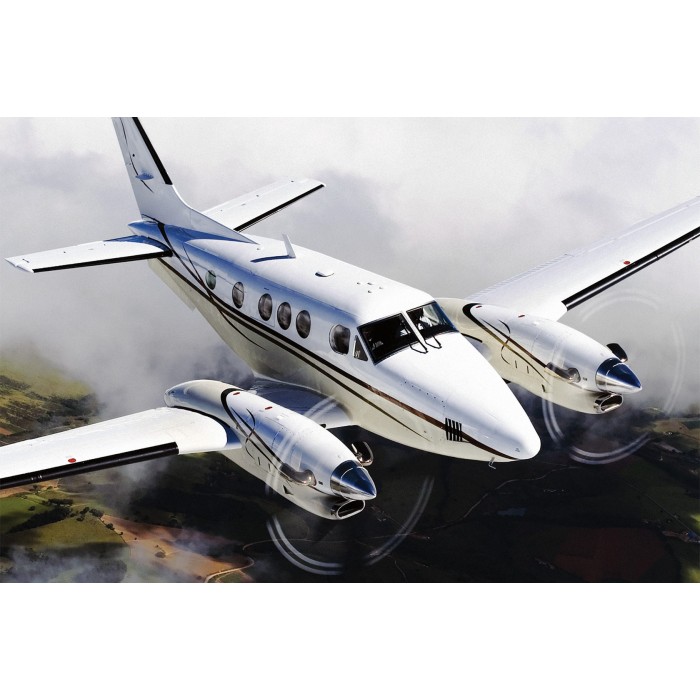
The Beechcraft King Air 100 is the original stretched King Air - the first step up from the smaller King Air 90 family and a crucial link in the King Air development chain that led directly to the King Air 200. First flown on 17 March 1969 and unveiled to the public in May 1969, the King Air 100 stretched the King Air 90 fuselage by 4.2 feet, added a new wing derived from the Beech 99 airliner, enlarged tail surfaces, twin-wheel main landing gear and more powerful PT6A-28 engines at 680 shp each. Wikipedia confirmed a total of 383 King Air 100 family aircraft were built across three variants: the original Model 100 (89 built, 1969-1972), the A100 (157 built, 1972-1979; higher gross weight, four-blade propellers, more fuel) and the B100 (137 built, 1976-1983; Garrett TPE331 engines replacing PT6A). AOPA confirmed approximately 120 of the 137 B100s remain in service. The King Air B100 notably shares its fuselage cross-section with the King Air 200 - the T-tail Super King Air that succeeded the 100 series - confirming that the 100 series provided the airframe foundation for the entire 200/300 family.
The King Air B100's Garrett TPE331 engines have an interesting origin: AOPA confirmed that "a mid-1970s strike at the Pratt and Whitney Canada factory halted delivery of PT6A engines to Beechcraft," prompting the manufacturer to develop a Garrett-powered alternative. The B100 consequently uses Garrett TPE331-6-252B engines at 715 shp each rather than PT6A turboprops - a departure from every other King Air variant. Charter prices start from approximately £1,100 per flight hour. For the full fleet see our private jet price guide or browse our complete fleet.

Why charter the King Air 100?
- Five portholes per side - three more than King Air 90; pressurised cabin with 4,000 lb useful load; first stretched King Air. GlobalAir confirmed the King Air 100 "has five round windows on each side of the main seating area, plus two smaller windows in the aft cabin" - compared to two windows per side on the King Air 90. This extra natural light makes the King Air 100 cabin notably brighter than the 90 series on the same sector. The 4,000 lb useful load (GlobalAir) enables full passenger loads with baggage, and supports cargo and medevac configurations with seats removed. Air Charter Service confirmed the King Air 100 "baggage hold is relatively large considering the aircraft's size, with room for 10 medium-sized bags." The pressurised cabin maintains comfortable altitude on all sectors to the 25,000 ft service ceiling, providing weather avoidance above most European short-sector convective activity;
- B100 Garrett TPE331-6-252B engines at 715 shp - higher shp than PT6A-28 on the 100/A100; faster cruise; PT6A strike origin story. AOPA confirmed the B100's unusual origin: a Pratt and Whitney Canada factory strike in the mid-1970s that halted PT6A engine deliveries "led Beechcraft - which had been concerned about relying on a single powerplant supplier for its entire King Air line - to develop a Plan B: the Garrett TPE331-powered King Air B100." The Garrett TPE331-6-252B at 715 shp provides a modest performance advantage over the PT6A-28's 680 shp. AOPA confirmed "the B100 compares favourably to the A100 and contemporary turboprops produced by other manufacturers." Honeywell (successor to AlliedSignal, successor to Garrett) has since "markedly improved the engine since its introduction." B100 operators seeking even better hot-and-high performance can convert the TPE331-6 to -10 standard through National Flight Services, with optional McCauley five-blade props and winglets also available;
- Beech 99 airliner wing; King Air 200-identical fuselage (B100); the airframe that directly generated both the 100 series and the King Air 200/300 family. jetAV confirmed the King Air 100 "featured a 4.2 ft stretch of the -90's fuselage, a new wing derived from the wing of the Model 99 Airliner, and enlarged tail surfaces." The Beech 99 wing gave the Model 100 a larger span and improved aerodynamic efficiency versus the King Air 90. More significantly, Wikipedia confirmed the King Air 200 "was developed from the Model 100, with the same fuselage design being used for both models" - the B100 fuselage cross-section is identical to the King Air 200 (differing in the tail configuration and wings). For aviation enthusiasts and corporate operators who appreciate the lineage, the King Air 100 represents the exact midpoint in the King Air family's evolution from the original 65-90 to the modern King Air 260;
- 235-250 kt cruise; 25,000 ft ceiling; 1,325 nm range; 3,200-foot runway capability - competitive with modern turboprops at lower charter rates. Stratos Jets confirmed the King Air 100 "can hit speeds of 307 mph" (267 kt) at maximum cruise with a non-stop range of 1,325 nm. Jettly confirmed typical cruise of 235-250 kt. Stratos confirmed a 3,200-foot takeoff capability. The 25,000 ft service ceiling - HTML confirmed 7,575 m which matches 24,852 ft - provides adequate weather avoidance on European short to medium sectors. For charter clients comparing the King Air 100 against the King Air 90 (which has 30,000 ft ceiling but comparable cruise speed), the 100 series provides the step up in cabin size, payload and baggage space that the 90 series cannot match, at broadly comparable charter rates;
- 383 total built; approximately 120 B100s active; Raisbeck Engineering mods; belly cargo pod option; well-supported 40-year-old airframe. AOPA confirmed approximately 120 B100s remain in active service from 137 built. Raisbeck Engineering offers the B100 a package including dual aft-body strakes (reducing drag and noise), high-flotation landing gear doors (improving climb, cruise and protecting wheel wells) and winglets. AOPA confirmed "nacelle wing lockers" are also available. The belly cargo pod option - mentioned in Wikipedia - mirrors the pods available on the Beech 99 and King Air 200, enabling additional cargo capacity on freight missions. The B100's $450,000-$590,000 pre-owned value (AOPA/Vref) reflects competitive acquisition cost that directly influences charter rates below the King Air 200 level;
- King Air 100 vs King Air 200 economics - same B100 fuselage cross-section; lower charter rates; slightly lower ceiling (25,000 vs 35,000 ft). The King Air B100 uses the same fuselage cross-section as the King Air 200 - essentially the same cabin feel at a charter rate below the 200 series. Air Charter Service confirmed a pre-owned B100 at "up to $600,000" versus King Air 200 values of considerably more. The trade-offs are the lower ceiling (25,000 ft vs 35,000 ft on the KA200), lower cruise speed (248 kt vs 297-310 kt) and the TPE331 engines rather than the familiar PT6A family of the 200 series. For charter clients who want the King Air 200 cabin cross-section at King Air 90-adjacent rates, the B100 fills a specific economic niche between the two better-known King Air families.
Charter cost - King Air 100 prices from UK airports
Hourly rates run from approximately £1,100 to £1,500 - between the King Air 90 (£900-1,300) and King Air 200 (£1,200-1,800), reflecting the 100 series' larger cabin and increased payload versus the 90, and its lower ceiling and cruise speed versus the 200. Air Charter Advisors confirmed charter rates starting at approximately $1,500 per hour in the US market. For groups of 5 to 7 on short UK regional and European sectors where a larger cabin than the King Air 90 is needed but King Air 200 rates are above budget, the King Air 100 provides the mid-point option in the King Air family.
Indicative one-way prices from UK airports:
- London to Edinburgh - from £1,320 (6 passengers, approximately 1 hour);
- London to Paris - from £1,320 (6 passengers, approximately 1 hour 10 minutes);
- London to Geneva - from £1,980 (6 passengers, approximately 1 hour 35 minutes);
- Edinburgh to Amsterdam - from £1,650 (6 passengers, approximately 1 hour 20 minutes);
- London to Nice - from £2,640 (6 passengers, approximately 1 hour 45 minutes);
- London to Dublin - from £1,320 (6 passengers, approximately 1 hour);
- Manchester to Malaga - from £3,300 (6 passengers, approximately 2 hours 30 minutes).
Empty Leg flights appear on repositioning routes. See our Empty Legs page for current availability.

Ideal routes for the King Air 100
Best matched to short and medium UK regional and European missions where the King Air 100's cabin step-up over the 90, pressurised twin-turboprop reliability and mid-tier charter rate serve groups of 5 to 7:
- Groups of 6 to 7 where the King Air 100's larger cabin is the upgrade from the King Air 90. The King Air 100's five-porthole-per-side cabin with club-4, individual seat and 2-seat divan standard configuration seats 7 including the belted lavatory - one to two more comfortable seats than the King Air 90 in a practically longer cabin. For groups of exactly 6 to 7 where the King Air 90's capacity is marginal, the King Air 100 is the appropriate step up at comparable rates;
- Short UK regional and European sectors (1 to 2 hours) where pressurised turboprop at mid-tier rates is the brief. Edinburgh to Amsterdam, London to Nice, Manchester to Malaga and similar 1 to 2-hour European sectors suit the King Air 100's 235-250 kt cruise and 1,325 nm range. The pressurised cabin maintains comfortable altitude on all standard European short-sector cruising altitudes. Air Charter Service confirmed the King Air 100 "ideal for short-hail flights" as its positioning in the King Air family;
- Cargo and medevac missions where the 4,000 lb useful load and belly cargo pod option enable mission flexibility. GlobalAir confirmed the King Air 100's 4,000 lb useful load supports both full passenger configurations and flexible cargo or medevac roles. The optional belly cargo pod (shared design with the Beech 99 and King Air 200 pod) adds significant external cargo capacity. With seats removed, the pressurised cabin provides adequate space and environmental control for medical transfer equipment. The King Air 100 family's long service in medevac roles reflects the type's proven cabin flexibility;
- Short-field access from 3,200-foot runways; access to smaller UK and European regional airfields unavailable to jets. Stratos Jets confirmed the King Air 100's 3,200-foot takeoff capability. This short-field performance provides access to smaller UK regional airfields, Scottish Highland approaches and European regional strips that turboprop jets and pressurised piston twins cannot use at equivalent loads. For charter clients whose itinerary includes a regional stop at a shorter airfield, the King Air 100's access credentials are the selection argument over light jets at comparable rates;
- Budget-conscious groups where the King Air 100 provides the King Air 200 cabin cross-section at King Air 90 rates. The B100 variant's fuselage cross-section is identical to the King Air 200 - the same cabin width and height at charter rates that Air Charter Advisors confirmed are below the King Air 200 series. For clients who have been quoted King Air 200 rates and want to explore whether the same basic cabin feel is achievable at lower cost, the B100 is the option to request specifically.

Cabin and in-flight experience
The King Air 100 cabin measures 5.0 m (16.4 ft) long, 1.37 m (4.5 ft) wide and 1.45 m (4.75 ft) high - the same width and height as the King Air 90 but approximately 1.0 m longer, with five portholes per side (vs two per side on the King Air 90). Air Charter Service confirmed the standard layout as "a four-seat club, one individual seat and a two-seat divan" for seven seats including the belted lavatory. A six-seat configuration uses club seating and two single seats. GlobalAir confirmed the 62 ft³ baggage compartment in the aft cabin (jetAV). The pressurisation differential of 4.7 psi maintains a cabin altitude of 8,000 ft to approximately FL200 and a 9,000 ft cabin to approximately FL220 - adequate for typical short-sector operations but lower than the King Air 200's pressurisation capability.
Avionics vary significantly by variant and upgrade status. Air Charter Service confirmed the A100 carries "dual King Gold Crown avionics and an RCA AVQ-47 weather radar." The B100 carries "Collins radios and dual VHF 20 comms, dual VIR 30 navs, Collins ADF 60A, dual TDR 90 transponders, a Sperry SPZ 200A flight director/autopilot and a Sperry Primus 300 CLR weather radar." Many active aircraft carry Garmin GNS 530 GPS retrofits. Confirm the avionics standard with the operator before booking.
- Cabin. 5.0 m x 1.37 m x 1.45 m; pressurised (4.7 psi); 5 portholes per side;
- Layout. Club-4 + 1 individual + 2-seat divan = 7 (including belted lavatory); 6-seat option;
- Baggage. 62 ft³ aft compartment; belly cargo pod option;
- Useful load. 4,000 lb - supports full passenger + cargo/medevac configurations;
- Engines (100/A100). 2 x Pratt and Whitney Canada PT6A-28 (680 shp each; 4-blade on A100);
- Engines (B100). 2 x Garrett TPE331-6-252B (715 shp each; Hartzell props; Honeywell-improved);
- Pressurisation. 4.7 psi; cabin 8,000 ft to FL200; 9,000 ft to FL220.
Technical specifications
| Manufacturer | Beechcraft / Textron Aviation, Wichita, Kansas |
| First flight | 17 March 1969 |
| Production | 1969-1983; 383 total (89 Model 100 + 157 A100 + 137 B100) |
| Variants | 100 (PT6A-28; 680 shp); A100 (PT6A-28; +fuel, 4-blade props); B100 (Garrett TPE331; 715 shp) |
| Design basis | King Air 90 + 4.2 ft stretch + Beech 99 wing + twin-wheel main gear |
| B100 fuselage | Identical cross-section to King Air 200 (different wings and T-tail) |
| Aircraft class | Twin-engine turboprop; pressurised |
| Engines (100/A100) | 2 x PT6A-28 (680 shp each) |
| Engines (B100) | 2 x Garrett TPE331-6-252B (715 shp each; Honeywell-improved) |
| Cruise speed | 235-250 kt / 435-459 km/h (267 kt max) |
| Service ceiling | 25,000 ft / 7,575 m |
| Pressurisation | 4.7 psi; cabin 8,000 ft to FL200; 9,000 ft to FL220 |
| Range | 1,325 nm / 2,453 km (A100: 1,000 nm / 1,852 km) |
| Runway | 3,200 ft takeoff |
| MTOW (100) | 10,600 lb / 4,808 kg |
| MTOW (A100) | 11,500 lb / 5,216 kg |
| MTOW (B100) | 11,800 lb / 5,352 kg |
| Useful load | 4,000 lb |
| Cabin length | 5.0 m (16.4 ft) |
| Cabin width | 1.37 m (4.5 ft) |
| Cabin height | 1.45 m (4.75 ft) |
| Cabin windows | 5 portholes per side (vs 2 per side on King Air 90) |
| Passengers | 7 standard (incl. belted lav); 10 maximum |
| Baggage | 62 ft³ aft; belly cargo pod option |
| Wingspan | 14.0 m (45.9 ft) |
| Aircraft length | 12.07 m (39.6 ft) |
| Aircraft height | 4.70 m (15.4 ft) |

King Air 100 vs similar aircraft
- King Air 100 vs King Air 90 (C90GTi). The King Air 90 has a higher service ceiling (30,000 ft vs 25,000 ft), Collins Pro Line 21 avionics and single-pilot certification. The King Air 100 counters with a longer cabin (5.0 m vs 4.5 m on the KA90), more cabin windows (5 vs 2 per side), 4,000 lb useful load and greater baggage capacity. Charter rates are broadly comparable (KA90 at £900-1,300/hr vs KA100 at £1,100-1,500/hr). For groups of exactly 6 to 7 where the 100's extra cabin length is required, it is the appropriate choice; for the highest ceiling and most current avionics at the same rate, the King Air 90 is preferable;
- King Air 100 vs King Air 200. The King Air 200 uses PT6A-42 engines at 850 shp (vs 680-715 shp on the 100), has a 35,000 ft ceiling (vs 25,000 ft) and 297-310 kt cruise (vs 235-250 kt). Charter rates for the King Air 200 run approximately 15 to 25% above the King Air 100. The B100's identical fuselage cross-section to the King Air 200 means the cabin feel is comparable. For missions within 25,000 ft ceiling and 1,325 nm range, the King Air 100 provides the King Air 200 cabin size at lower rates; for higher altitude and longer range the King Air 200 is the necessary choice;
- King Air 100 vs Piper Cheyenne II. The Piper Cheyenne II is a pressurised twin turboprop at comparable charter rates (£900-1,200/hr). The Cheyenne II has a 35,800 ft ceiling (vs KA100's 25,000 ft) and King Air-comparable range. The King Air 100 counters with a longer cabin (5.0 m vs 3.30 m Cheyenne), more seats (7 vs 6-7 Cheyenne), 4,000 lb useful load, Beechcraft King Air build quality and the deeper MRO base of the King Air family. For groups of 6 to 7 where cabin length and group comfort are priorities, the King Air 100 is the clear choice; for maximum ceiling at the lowest pressurised turboprop rate, the Cheyenne is the alternative.

Frequently asked questions - King Air 100 charter
How much does it cost to charter a King Air 100?
Charter rates run from approximately £1,100 to £1,500 per flight hour. London to Edinburgh costs from £1,320 for 6 passengers. London to Geneva costs from £1,980. London to Nice costs from £2,640. All quotes from Private Jets UK are fully itemised with no hidden charges.
What is the difference between the King Air 100, A100 and B100?
The original Model 100 (89 built, 1969-1972) used PT6A-28 engines at 680 shp and 10,600 lb MTOW. The A100 (157 built, 1972-1979) added 94 gallons more fuel, four-blade propellers reducing cabin noise, and increased MTOW to 11,500 lb - the most commonly built 100-series variant. The B100 (137 built, 1976-1983) replaced PT6A engines with Garrett TPE331-6-252B engines at 715 shp, prompted by a PT6A factory strike, and increased MTOW to 11,800 lb. The B100 fuselage cross-section is identical to the King Air 200.
Why does the King Air B100 have different engines from other King Airs?
AOPA confirmed the B100's unusual origin: a strike at the Pratt and Whitney Canada factory in the mid-1970s halted PT6A engine deliveries, leading Beechcraft to select the Garrett TPE331 as an alternative powerplant. The resulting B100 was the only production King Air to use non-PT6A engines. Honeywell (which acquired AlliedSignal, which acquired Garrett) has since improved the TPE331 reliability significantly from its 1976 introduction standard.
How does the King Air 100 cabin compare to the King Air 90?
The King Air 100 cabin is approximately 1.0 m longer than the King Air 90 (5.0 m vs ~4.5 m), has five portholes per side (vs two per side on the King Air 90) and seats 7 passengers versus 6 standard on the King Air 90. Both aircraft share the same 1.37 m width and 1.45 m height. The extra length and windows make the King Air 100 cabin noticeably more spacious and brighter than the King Air 90 on the same sector.
Is the King Air 100 still in production?
No - production ended in 1983 when the King Air 200 series made the 100 series commercially uncompetitive. A total of 383 King Air 100 family aircraft were built. AOPA confirmed approximately 120 B100s remain in active service. Textron Aviation continues to provide OEM parts and engineering support for all King Air 100 variants.

