


Charter an Adam A500
- Availability: Available for rent
Request aircraft information
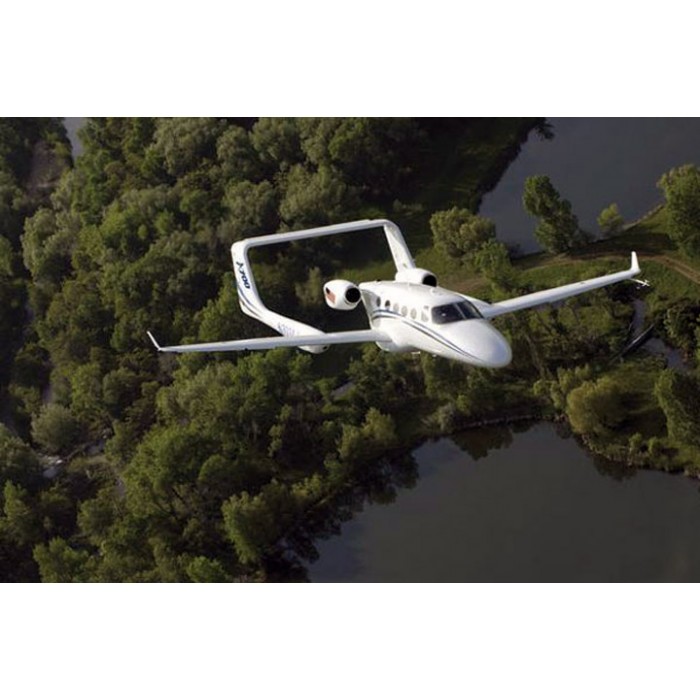
The Adam A500 is an American pressurised composite twin-engine personal and business aircraft produced by Adam Aircraft Industries - the first pressurised piston twin to receive FAA type certification in the United States in approximately 30 years. Designed by Burt Rutan as the M-309 CarbonAero technology demonstrator (Rutan's 309th aircraft design) and built by Scaled Composites, the M-309 first flew on 21 March 2000. The production A500 variant first flew on 11 July 2002 at Centennial Airport, Denver, and received FAA Part 23 IFR certification in May 2005. Adam Aircraft ceased operations on 11 February 2008 and filed for Chapter 7 bankruptcy on 19 February 2008, having delivered seven A500s against an order book of over 100 aircraft.
The A500 is powered by two Teledyne Continental TSIO-550-E turbocharged flat-six piston engines at 350 hp each, mounted in push-pull centerline thrust configuration: one engine at the nose driving a three-blade Hartzell scimitar tractor propeller and one engine aft of the cabin driving a pusher propeller. The all-composite carbon fiber and Nomex honeycomb airframe spans 44 ft and seats a pilot and five passengers in a pressurised 1.37 m-wide cabin. Cruise speed is 230 kt at 25,000 ft maximum altitude with an 8,000 ft cabin altitude. The A500 is the aircraft from which the jet-powered A700 AdamJet was derived, sharing approximately 80% of its structure. Charter prices start from approximately £900 per flight hour. For the full fleet see our private jet price guide or browse our complete fleet.

Why charter the Adam A500?
- Push-pull centerline thrust - no asymmetric handling on engine failure, unlike conventional twins. The A500 centerline thrust arrangement places both engines on the aircraft centreline: the front engine pulls and the rear pushes, with no thrust offset from the aircraft's longitudinal axis. On a conventional twin, engine failure creates asymmetric thrust that demands immediate rudder input and precise pilot response. On the A500, an engine failure produces no yaw at all - the aircraft flies straight, requiring no corrective input. Plane & Pilot noted this made the A500 "as safe and easy to handle" on one engine as a single-engine aircraft. The FAA even created a special twin rating recognising the Cessna Skymaster's centerline thrust configuration, now applicable to the A500 as well;
- First pressurised composite piston twin certified by FAA in 30 years - carbon fiber and Nomex honeycomb throughout. The A500 airframe is constructed entirely from carbon fiber epoxy composite with a Nomex honeycomb core - the same manufacturing approach used by Scaled Composites on experimental and racing aircraft. The composite wing spans 44 ft with approximately 250 parts - roughly one-tenth of a comparable metal wing's parts count. This construction reduces weight, simplifies maintenance and repair (composite is easier to fix in the field than metal), and produces a fuselage structure capable of the pressurisation levels required for a 25,000 ft-capable aircraft;
- 1.37 m-wide cabin - same internal width as a Beechcraft King Air (Plane+Pilot). Plane & Pilot specifically noted that the A500 cabin is "54 inches across, the same width as a King Air." For a pressurised piston twin priced significantly below any turboprop, this cabin cross-section is the defining comfort advantage. Three pairs of leather club seats accommodate pilot and five passengers. An airstair door on the port side provides independent boarding. AOPA described the cabin as "about the size of a Cessna CJ1." Both evaluations describe a cabin well above what the piston twin category normally provides;
- Designed by Burt Rutan - M-309 CarbonAero proof of concept, Scaled Composites construction. The A500 began as Rutan's 309th aircraft design, built as a proof of concept by Scaled Composites at Mojave. Rutan's design philosophy - composite construction, centerline thrust, twin-boom tail - is applied throughout the A500 airframe. The composite wing leading edges are removable for easy inspection and optional TKS de-ice system installation. The all-electric instrument system (no vacuum pump) eliminates vacuum system failure as a risk factor. The design pedigree directly connects the A500 to the same company that built the Voyager round-the-world aircraft and SpaceShipOne;
- Access to 10,000+ North American airports - 2,500 ft runway capability. AOPA noted that the A500 can access "some 10,000 airports across North America" versus the approximately 800 served by airlines. The short-field performance of the A500, combined with its pressurised cabin and twin-engine redundancy, opens regional airports, private strips and destinations inaccessible to any piston twin with comparable cabin pressurisation. For UK and European operations, equivalent access extends to regional airfields with shorter runways that certified turboprops of comparable cabin size typically cannot use;
- Emergency load-shedding system and dual 100-amp alternators - modern electrical redundancy with no vacuum system. The A500 electrical system provides dual 100-amp alternators - one per engine - with independent batteries. Bus-tie and load-shedding are each accomplished with a single switch. AOPA described this as "one of those modern features that make life easy for the pilot." The all-electric flight instruments eliminate vacuum pump failure as a risk. Optional FADEC engine management was planned but not available on the seven production aircraft delivered.
Charter cost - Adam A500 prices from UK airports
The Adam A500 was never produced beyond the seven pre-bankruptcy deliveries. Charter of an A500 is not available through standard fleet channels. Private Jets UK can arrange comparable pressurised piston twin or turboprop charter for groups of 4 to 5 on short regional missions.
Comparable alternatives from UK airports:
- London to Edinburgh - from £1,000 (4 passengers, Pilatus PC-12 or King Air 260, approximately 1 hour 15 minutes);
- London to Geneva - from £3,750 (4 passengers, approximately 1 hour 45 minutes);
- London to Paris - from £1,500 (4 passengers, approximately 1 hour);
- London to Amsterdam - from £1,800 (4 passengers, approximately 1 hour);
- London to Dublin - from £2,200 (4 passengers, approximately 1 hour 20 minutes);
- Edinburgh to Manchester - from £800 (4 passengers, approximately 40 minutes);
- Short airstrip UK regional mission - from £900 per hour.
See our Empty Legs page for current availability on comparable aircraft.

Ideal routes for the Adam A500
The A500's design was optimised for short regional and inter-city missions where pressurised twin-engine capability, centerline thrust safety and 230 kt cruise serve 3 to 5 passengers:
- Short regional connections (30 to 90 minutes) - the A500's primary design mission. The A500 was specifically designed for regional missions of 700 to 900 nm with 3 to 4 passengers. AOPA noted that "with three passengers across half of the U.S.A. between breakfast and lunch" was the intended mission profile. UK equivalents include London to Edinburgh, London to Manchester, London to Belfast and London to Bristol - all within 60 to 90 minutes at 230 kt cruise. The pressurised cabin at 8,000 ft cabin altitude at FL250 provides comfort above the weather on these short sectors;
- Regional airports with shorter runways - the 10,000-airport network. The A500's short-field capability opens UK regional airfields and European secondary airports inaccessible to most comparable pressurised aircraft. For groups of 3 to 4 needing to depart from or arrive at a location served only by a shorter strip, the A500 combines the short-field access of a single-engine piston with the redundancy of a certified twin and the comfort of a pressurised cabin;
- Short European hops (1 to 2 hours). Paris, Amsterdam, Brussels and Dublin are all within comfortable range at full passenger load. At 900 nm range with 3 passengers the A500 can reach Geneva, Nice and Madrid in a single sector. The pressurised club-seat cabin with airstair boarding provides a significantly more comfortable environment than any unpressurised alternative at comparable cost;
- Owner-pilot personal travel where centerline thrust simplifies handling. The A500's original market was owner-pilots - individuals who wanted a pressurised twin with simple handling, composite construction and low acquisition cost. The centerline thrust configuration was chosen specifically for this market: pilots transitioning from single-engine aircraft face no new asymmetric-thrust handling requirements. The "special" twin rating for centerline thrust aircraft confirms the regulatory recognition of this handling advantage;
- Short missions where King Air cabin width at piston twin rates is the priority. The 1.37 m-wide King Air-equivalent cabin in a piston twin priced at $895,000 new represents a value proposition no competing pressurised aircraft offered at the time. For 3 to 5 passengers on sectors where cabin comfort per pound of aircraft cost is the primary selection criterion, no comparable certified aircraft existed before or after the A500.

Cabin and in-flight experience
The A500 cabin measures 2.96 m long, 1.37 m (54 inches) wide and 1.31 m high - three pairs of leather club seats for pilot and five passengers in a pressurised environment. Cabin altitude is maintained at 8,000 ft at the 25,000 ft maximum operating altitude. An airstair door on the port side provides self-contained boarding. An emergency exit window is on the starboard side. Baggage is stored behind the aft seats; an optional ventral belly pod provides additional storage. The cabin is approximately the same size as the Cessna CJ1 according to AOPA's evaluation, with the same internal width as a Beechcraft King Air.
The electrical system uses dual 100-amp alternators with no vacuum system - all instruments are electric. Garmin dual GNS 530 navigation, Sandel SN3308 electronic HSI, S-TEC 55X autopilot and Vision Microsystems engine monitoring displays were standard. The Avidyne Entegra glass cockpit was planned for post-certification upgrades. TKS liquid de-ice was available as an option with wiring and plumbing pre-installed on all aircraft. The fuel system carries 230 US gallons (871 litres) in wet wing tanks with the left feeding the front engine and the right the rear.
- Cabin. 2.96 m x 1.37 m x 1.31 m; pressurised; 3 pairs leather club seats; 5 passengers;
- Cabin altitude. 8,000 ft at FL250 (25,000 ft maximum);
- Boarding. Airstair door (port side); emergency exit window (starboard);
- Engines. 2 x TSIO-550-E (350 hp; centerline thrust; push-pull); Hartzell 3-blade scimitar props;
- Avionics. Dual Garmin GNS 530; Sandel SN3308 HSI; S-TEC 55X autopilot; Vision Microsystems engine displays;
- Electrical. Dual 100-amp alternators; dual batteries; single-switch bus-tie and load-shedding; no vacuum system;
- De-ice. Optional TKS liquid (wing and tail); electric windscreen and propeller de-ice;
- Fuel. 230 US gal (871 L) usable; wet wing tanks;
- Baggage. Aft of cabin seats; optional ventral belly pod.
Technical specifications
| Manufacturer | Adam Aircraft Industries, Englewood, Colorado |
| Design origin | Burt Rutan M-309 CarbonAero (Scaled Composites, Mojave) |
| M-309 first flight | 21 March 2000 |
| A500 first flight | 11 July 2002 |
| FAA certification | May 2005 (FAR Part 23 IFR) |
| Production | 7 aircraft delivered; Adam Aircraft bankrupt 19 February 2008 |
| Aircraft class | Pressurised composite piston twin |
| Engines | 2 x Teledyne Continental TSIO-550-E (350 hp each; centerline thrust; push-pull) |
| Propellers | Hartzell 3-blade scimitar (front: tractor; rear: pusher) |
| Avionics | Dual Garmin GNS 530; Sandel HSI; S-TEC 55X autopilot; Vision Microsystems engine displays |
| Cruise speed | 230 kt (425 km/h) |
| Top speed | 250 kt (463 km/h) |
| Range (3 pax, full fuel) | 900 nm / 1,667 km |
| Range (full seats) | 700 nm / 1,296 km (at 170 gal) |
| Maximum altitude | 25,000 ft (7,620 m) |
| Cabin altitude | 8,000 ft at FL250 |
| MTOW | 7,000 lb (3,175 kg) |
| Fuel capacity | 230 US gal (871 L) usable; wet wing tanks |
| Cabin length | 2.96 m |
| Cabin width | 1.37 m (54 in) - same as Beechcraft King Air |
| Cabin height | 1.31 m |
| Passengers | Pilot + 5; 6 total |
| Wingspan | 13.41 m (44 ft) |
| Aircraft length | 10.27 m (33 ft 8 in) |
| Aircraft height | 2.90 m (9 ft 6 in) |
| Construction | Carbon fiber epoxy composite / Nomex honeycomb; twin-boom; H-tail |
| A700 commonality | ~80% shared structure with jet-powered Adam A700 AdamJet |

Adam A500 vs similar aircraft
- Adam A500 vs Cessna 337 Skymaster. The Cessna 337 Skymaster is the original certified centerline thrust twin - unpressurised, piston-engined and produced from 1963 to 1980. The A500 took the Skymaster's centerline thrust safety argument and applied it to a modern composite pressurised airframe with 230 kt cruise versus the Skymaster's 150 kt. The FAA's special twin rating for centerline thrust aircraft applies to both. The A500 is the Skymaster's technical successor by design philosophy rather than by lineage;
- Adam A500 vs Piper PA-34 Seneca. The Piper Seneca is the most common pressurised piston twin in the category - conventional asymmetric-thrust layout, lower cabin width and similar cruise speed. The A500 counters with centerline thrust (no asymmetric handling on engine failure), 1.37 m King Air-equivalent cabin width versus the Seneca's narrower cross-section, all-composite construction, and the Burt Rutan design pedigree. Both were available for approximately $900,000 to $1,000,000 new. The A500's 7 deliveries versus the Seneca's 4,000+ reflect the production outcome rather than the design comparison;
- Adam A500 vs Pilatus PC-12. The Pilatus PC-12 is a single-engine turboprop with greater range (approximately 1,800 nm), higher cruise speed (280 kt), a cargo door and significantly higher purchase price. The A500 counters with twin-engine redundancy (centerline thrust), a comparable 1.37 m cabin width, composite construction, lower acquisition cost and pressurised cabin at 25,000 ft. For owner-operators who needed twin-engine certification for their operation, the A500 was the only pressurised composite twin available at comparable price.
Frequently asked questions - Adam A500 charter
Is the Adam A500 available to charter?
The Adam A500 was produced in only 7 units before Adam Aircraft's bankruptcy in February 2008. Charter of an A500 is not available through standard channels. Private Jets UK can arrange comparable pressurised twin or turboprop charter for groups of 4 to 5. Contact us for current availability on similar aircraft.
What is centerline thrust and why does it matter?
Centerline thrust places both engines on the aircraft's longitudinal axis - one pulling from the front and one pushing from the rear. On a conventional twin, engine failure creates asymmetric thrust requiring immediate rudder input. On the A500, engine failure produces no yaw - the aircraft continues flying straight. The FAA recognises this with a special twin rating for centerline thrust aircraft. Plane & Pilot described the A500 as "as safe and easy to handle" on one engine as a single.
Why did the Adam A500 fail commercially despite its innovative design?
Several factors contributed. Empty weight grew from the projected 4,200 lb to 5,460 lb on the delivered aircraft - reducing useful payload at full fuel to just 160 lb, well below the 720 lb originally planned. This made the aircraft marginal for practical charter or business use at full fuel load. Adam Aircraft also struggled to raise the $75 to $150 million needed to complete A700 jet certification and scale A500 production simultaneously, leading to the February 2008 bankruptcy with only 7 aircraft delivered from an order book of over 100.
How is the Adam A500 related to the Adam A700 AdamJet?
The A700 AdamJet was developed directly from the A500, sharing approximately 80% of its structure - the same wing, twin booms, H-tail and fuselage cross-section. The A700 stretched the fuselage by 4 feet to balance the rear-mounted jet engines and replaced the TSIO-550 pistons with Williams FJ33-4A turbofans. The A500 was designed with the A700 in mind - it was deliberately built stronger than strictly necessary for a piston aircraft so the jet version could use the same structure at higher speeds and weights.
Who designed the Adam A500?
Burt Rutan - designer of the Voyager round-the-world aircraft, SpaceShipOne and over 300 other aircraft - designed the A500's predecessor M-309 CarbonAero as his 309th design. The M-309 was built by Scaled Composites at Mojave and first flew in March 2000. Adam Aircraft acquired the design, refined it into the production A500 and moved manufacturing to Denver, Colorado. The M-309 was subsequently displayed at the Wings Over the Rockies Air and Space Museum.
