


Charter a Gulfstream III
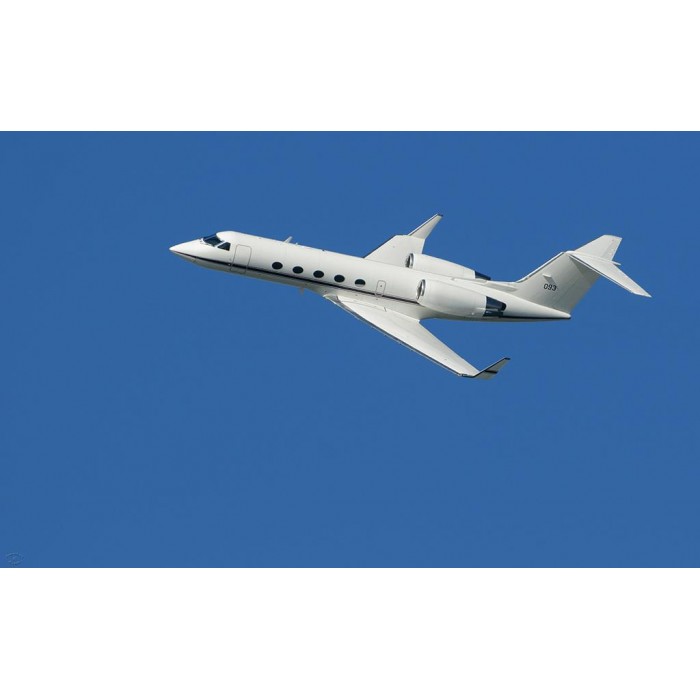


- Availability: Available for rent
Request aircraft information
The Gulfstream III is the aircraft that established the modern standard for business jet wing design - the first production business jet to fly with Whitcomb winglets, a NASA-derived technology that would subsequently become standard across the entire industry. JetAV confirmed Gulfstream announced the GIII in 1978 following Grumman's sale of its American division to Allen Paulson, with "a fuselage stretch of 4 ft., a wrap-around windshield, and a new wing incorporating a 10% increase in span as well as the new Whitcomb winglets." AOPA confirmed "the prototype GIII was rolled out in September 1979 and flew for the first time on December 2, 1979. The FAA certificated the production aircraft on September 22, 1980." A total of 202 Gulfstream IIIs were built between 1980 and 1987, succeeded by the Gulfstream IV. JetAV confirmed the new wing "results in a decrease in fuel consumption of approximately 18% as reported by Gulfstream" while the increased fuel capacity extended range by approximately 1,000 nm over the GII without requiring tip tanks. Business Jet Traveler confirmed the GIII "weighs 69,700 pounds, 7,700 more than its predecessor" with "a more aerodynamic windshield and radome, a two-foot-longer fuselage, a six-foot-longer wingspan and a tweaked wing design that reduces high-speed drag."
The Gulfstream III is a twin-turbofan large-cabin business jet powered by the same Rolls-Royce Spey Mk 511-8 engines as the Gulfstream II - 11,400 lbf each - but with an 18% more fuel-efficient wing, a 4-foot longer fuselage providing 41+ feet of stand-up cabin, and the Whitcomb winglets that reduce drag across the entire cruise envelope. Business Jet Traveler confirmed the GIII's Spey engines have an extraordinary "time-between-overhaul limit of 8,000 hours" versus "a business jet's typical fanjet engine TBO of 3,500 to 5,000 hours." Charter prices start from approximately £4,000 per flight hour. For the full fleet see our private jet price guide or browse our complete fleet.

Why charter the Gulfstream III?
- First production business jet with Whitcomb winglets; 18% fuel burn reduction; 1,000 nm more range than GII; NASA supercritical airfoil concept applied to commercial aviation for the first time. JetAV confirmed "the new wing results in a decrease in fuel consumption of approximately 18% as reported by Gulfstream" and the Whitcomb winglets - developed from NASA supercritical airfoil research - "reduced drag and improve performance" across the cruise envelope. AOPA confirmed "the GIII's swept wing, which has an integral fuel capacity of 4,400 gallons, is nine feet longer than the GII's airfoil, is more aerodynamically efficient, and features winglets - all of which combine to reduce drag and improve performance. In fact, the GIII can fly 1,000 nm farther than the GII, giving it an east-to-west transatlantic capability." The winglets that are now standard on virtually every business jet from Very Light Jets to ultra-long-range heavy jets were first applied in series production on the Gulfstream III. The GIII's 1979 winglets validated the technology before Learjet (1985), Cessna (1990s) and Airbus (2013) adopted it for their own programmes. For charter clients who appreciate aviation technology history, the GIII is the aircraft that delivered the Whitcomb winglet to the business aviation market and established wing design standards that remain current today;
- Rolls-Royce Spey Mk 511-8 TBO of 8,000 hours - more than double the typical business jet engine TBO; Grumman carrier-aircraft construction standards; "bulletproof" reliability confirmed by operators. Business Jet Traveler confirmed "the Speys have a time-between-overhaul limit of 8,000 hours. A business jet's fanjet engine typically has a TBO of 3,500 to 5,000 hours." Business Jet Traveler quoted a GIII operator on Spey reliability: "These engines are bulletproof." Business Jet Traveler confirmed "the GIII shares the rugged construction of the GII. That is to say, it is overbuilt. The GII was designed by Grumman, the company that made carrier-based naval aircraft, including the F-14 Tomcat." This military-grade structural philosophy - where components are designed to far exceed commercial aviation requirements because carrier landing cycles demand it - means the Gulfstream airframe is, in AOPA's words, "virtually indestructible." For charter clients who prioritise structural longevity and engine reliability over cabin amenity modernisation, the GIII's carrier-aircraft construction heritage provides a confidence level unavailable in purpose-designed commercial aircraft;
- US military C-20A/B/C/D/E operator; C-20C accompanies Air Force One as backup; all branches of US military operated GIII; NASA research platform; Danish Air Force SMA-3 maritime patrol - confirmed institutional confidence. Wikipedia confirmed "nearly 20 military and government operators have flown the GIII, including every branch of the U.S. military under the C-20 designation." Wikipedia confirmed the C-20C is "a Gulfstream III with upgraded and hardened secure communications, often utilised as backup aircraft accompanying the VC-25A aircraft when it is operating as Air Force One." AOPA confirmed "one U.S. Air Force C-20 was transferred to NASA's Dryden Flight Research Center and modified to serve as a testbed for flight research." Wikipedia confirmed three Royal Danish Air Force SMA-3 aircraft "for maritime reconnaissance and patrol, fisheries protection, search and rescue, and VIP transport." The GIII's C-20C role as the backup to Air Force One - with hardened secure communications - is the highest institutional confidence indicator any business jet platform can receive. Military operators include the Cameroon, Ghana, Indian, Italian, Mexican and Moroccan Air Forces. The US Coast Guard C-20B served the Commandant of the Coast Guard and the Secretary of Homeland Security. No other aircraft in the Private Jets UK fleet carries this combination of US military, Air Force One backup and international government operator history;
- 4,000 nm range at Mach 0.84 with 8 passengers; 45,000 ft ceiling; 3,800 ft/min climb rate; east-to-west transatlantic capability - the first business jet that could routinely complete New York to London without a fuel stop. FlyCraft confirmed "the GIII features a maximum certificated altitude of 45,000 feet and a range of 4,000 nautical miles at .84 Mach with eight passengers on board." Business Jet Traveler confirmed "fill up the seats (12 to 19, depending on cabin configuration) and you can fly more than 3,000 nautical miles at 45,000 feet at speeds up to 500 knots." Business Jet Traveler confirmed the GIII "climbs at a brisk 3,800 feet per minute." AOPA confirmed "the GIII can fly 1,000 nm farther than the GII, giving it an east-to-west transatlantic capability." New York to London (approximately 3,450 nm) is within the GIII's non-stop range at typical charter loads. The 45,000 ft ceiling provides weather avoidance above all commercial traffic and most North Atlantic weather systems. For charter clients whose transatlantic missions are within 3,500-4,000 nm, the GIII provides confirmed capability at below-GIV rates;
- Stand-up cabin: 41+ ft long (12.6 m), 7.3 ft wide (2.22 m), 6.1 ft high (1.85 m); 1,345 cu ft; Gulfstream signature oval windows; full galley; full enclosed lavatory; 8-13 passengers standard; Grumman "overbuilt" airframe. GlobalAir confirmed the GIII cabin "measures 41.3 feet in length, reaches 6.1 feet in height, and stretches 7.3 feet in width, totalling 1,345 cubic feet of volume." Business Jet Traveler confirmed "the GIII shares the rugged construction of the GII." Air Charter Service confirmed "the Gulfstream III's stand-up cabin is large for a long-range heavy jet, even compared to newer aircraft" with "fully adjustable chairs and divans, an enclosed lavatory, a full-size galley and a large baggage compartment." GlobalAir confirmed baggage capacity of 2,200 lb. The 4-foot fuselage stretch over the GII adds a full zone of cabin space while retaining the GII's large cross-section. For charter clients who want maximum cabin volume in a Spey-powered Gulfstream, the GIII's 41-foot cabin is 7 feet longer than the GII and provides the four-zone configuration with club seating, conference group, divan and galley at vintage large-cabin rates;
- Pre-owned from $750,000; charter rates below GIV; Spey TBO 8,000 hours means lower engine lifecycle cost than competing platforms; hushkit compliance for Stage 3; Business Jet Traveler: "There's not an airframe out there that competes at this price." Business Jet Traveler confirmed "today a used GIII runs $750,000 to $1.8 million" and quoted an operator: "There's not an airframe out there that competes with this airplane. You can take this airplane with full fuel and full seats and go right to 43,000 feet. You would have to spend another $4 million on a used Gulfstream GIV to go another 400 miles." Business Air News confirmed "the Speys are noisy, and many GIIIs have been retrofitted with sound suppression systems or hushkits on the engines to meet most noise standards through Stage 3." The hushkit options from Quiet Technology Aerospace (QTA) and Hubbard Aviation Technologies at approximately $800,000 including installation confirm Stage 3 compliance is achievable on the active GIII fleet. For charter clients who want the lowest available large-cabin stand-up Gulfstream rate above the GII, the GIII provides the confirmed operator endorsement and Spey engine longevity at rates that reflect vintage design era.
Charter cost - Gulfstream III prices from UK airports
Hourly rates run from approximately £4,000 to £5,500 - above the Gulfstream II (£3,500/hr) and below the Gulfstream IV (£5,000/hr), reflecting the GIII's longer cabin, Whitcomb winglets, 4,000 nm range and 45,000 ft ceiling at Spey-engine operating costs. FlyCraft confirmed charter at approximately $5,500 per hour. For groups of 8 to 13 on transatlantic and long European sectors where the GIII's 4,000 nm range is the selection criterion and GIV rates are above budget, the GIII provides the confirmed capability at the mid-tier large-cabin rate.
Indicative one-way prices from UK airports:
- London to New York - from £36,000 (10 passengers, approximately 8 hours non-stop);
- London to Dubai - from £32,000 (10 passengers, approximately 6 hours 30 minutes);
- London to Moscow - from £16,000 (10 passengers, approximately 3 hours 30 minutes);
- London to Geneva - from £12,000 (10 passengers, approximately 1 hour 30 minutes);
- London to Paris - from £12,000 (10 passengers, approximately 1 hour 15 minutes);
- London to Los Angeles - from £48,000 (10 passengers, approximately 11 hours with fuel stop);
- Edinburgh to Istanbul - from £24,000 (10 passengers, approximately 3 hours 30 minutes).
Empty Leg flights appear on repositioning routes. See our Empty Legs page for current availability.

Ideal routes for the Gulfstream III
Best matched to transatlantic and long-range European missions where the GIII's 4,000 nm range, 45,000 ft ceiling, 41-foot stand-up cabin and Whitcomb winglet efficiency serve groups of 8 to 13 at below-GIV rates:
- Transatlantic non-stop sectors (London to New York; London to Boston; London to Washington D.C.) where AOPA confirmed the GIII's east-to-west transatlantic capability at full seats. London to New York (approximately 3,450 nm) is within the GIII's 4,000 nm range at typical charter loads. AOPA confirmed "the GIII can fly 1,000 nm farther than the GII, giving it an east-to-west transatlantic capability" - the prevailing headwinds on westbound transatlantic routing demand the additional range that only the GIII's winglet-enhanced wing provides over the GII. At 45,000 ft the GIII clears all North Atlantic jet stream weather. For groups of 8 to 10 on transatlantic missions where GIV rates are above budget, the GIII provides confirmed non-stop capability at below-GIV rates;
- Long European and Middle East sectors where 4,000 nm and 45,000 ft allow non-stop direct routing from London to Dubai, Istanbul, Moscow and beyond. London to Dubai (approximately 3,300 nm), London to Riyadh (approximately 3,000 nm) and London to Istanbul (approximately 2,000 nm) are all comfortably within non-stop range. At 45,000 ft cruise altitude the routing options above restricted Middle East airspace at upper flight levels reduce sector time. For groups of 8 to 13 on London to Gulf missions at below-GIV rates, the GIII provides the stand-up cabin and full galley specification;
- Groups of 10 to 13 where the GIII's 41-foot cabin provides the full club-conference-divan-galley layout at the lowest available four-zone large-cabin rate. GlobalAir confirmed the GIII "typically seating 14 to 19 passengers" in maximum configuration. The standard corporate layout carries 8 to 12 in club-four, conference grouping, divan and galley configuration. For groups of exactly 10 to 13 where the GII's shorter 33.9-foot cabin is marginal and GIV rates are above budget, the GIII's 41.3-foot cabin provides the additional zone at the mid-tier rate;
- Aviation heritage missions where the C-20C Air Force One backup aircraft, NASA research platform and first-winglet-business-jet history combine with confirmed transatlantic performance. The GIII's institutional history - first winglet business jet, C-20C Air Force One backup, NASA Dryden research platform, every branch of US military C-20 operator - makes it the most historically interesting mid-tier large-cabin jet available for charter. For clients who combine transatlantic travel with an appreciation for aviation technology history, the GIII's 1979 first flight is the direct origin of the winglet technology that now appears on 90% of production business jets;
- Budget-priority large-cabin missions where the GIII provides 4,000 nm and 41-foot stand-up cabin at below-GIV rates, with confirmed Spey TBO advantage reducing lifecycle maintenance costs. Business Jet Traveler confirmed "you would have to spend another $4 million on a used GIV to go another 400 miles" over the GIII. For charter clients who are comparing GIII and GIV rates on transatlantic sectors within 4,000 nm, the GIII provides the confirmed performance at rates reflecting vintage era acquisition cost, with the Spey engine's 8,000-hour TBO providing a maintenance cost structure that offsets higher per-flight fuel burn compared to the GIV's Tay engines.

Cabin and in-flight experience
The Gulfstream III cabin measures 12.59 m (41.3 ft) long, 2.22 m (7.3 ft) wide and 1.85 m (6.1 ft) high - 7 feet longer than the Gulfstream II while retaining the same width and height. FlyCraft confirmed total cabin volume of 1,502 cubic feet. Air Charter Service confirmed "fully adjustable chairs and divans, an enclosed lavatory, a full-size galley and a large baggage compartment." The 4-foot fuselage stretch over the GII adds a zone of cabin space for a conference grouping with table in addition to the GII's standard club-four and divan layout. A standard 8 to 12 passenger corporate configuration provides four club seats forward, four conference seats with fold-out table mid-cabin, a divan or two aft of the conference area and the galley. GlobalAir confirmed baggage capacity of 2,200 lb. The 9.5 psi cabin differential maintains sea-level altitude to 22,000 ft. Gulfstream's signature large oval windows flood the cabin with natural light.
- Cabin. 12.59 m x 2.22 m x 1.85 m; full stand-up; 1,502 cu ft; 9.5 psi differential; oval windows;
- Layout. 8-12 standard; 14-19 maximum; club-4 + conference-4 + divan + galley configuration;
- Galley. Full galley forward; coffee maker; refrigerator; convection oven; standard utensils;
- Lavatory. Full-sized enclosed lavatory aft; 2,200 lb baggage compartment;
- Engines. 2 x Rolls-Royce Spey RB.168 Mk 511-8 (11,400 lbf each; aft-mounted; 8,000 hr TBO);
- Avionics. Sperry SPZ-800 + Collins Pro Line 2 (original); upgraded: Collins Pro Line 4 or Pro Line 21 + dual Honeywell laser INS + Sperry Primus 800 weather radar + Global GNS 1000 FMS;
- Winglets. Whitcomb winglets (first on any production business jet); 18% fuel burn reduction vs GII wing;
- Hushkits. QTA and Hubbard Aviation Technologies Stage 3 compliance kits available (approximately $800,000 installed).
Technical specifications
| Manufacturer | Gulfstream Aerospace Corp, Savannah, Georgia |
| Grumman model number | G-1159A |
| US military designations | C-20A/B/C/D/E (all branches US military) |
| First flight | 2 December 1979 |
| FAA type certification | 22 September 1980 |
| Production | 1980-1987; 202 aircraft built |
| Aircraft class | Large-cabin long-range business jet |
| Engines | 2 x Rolls-Royce Spey RB.168 Mk 511-8 (11,400 lbf each; aft-mounted; 8,000 hr TBO) |
| High-speed cruise | 488 kt at FL390; Mach 0.84 standard cruise |
| Long-range cruise | 442 kt / 818 km/h at FL450 |
| Climb rate | 3,800 ft/min |
| Service ceiling | 45,000 ft / 13,716 m |
| Range (8 pax; Mach 0.84) | 4,000 nm / 7,408 km |
| Range (full seats) | 3,000-3,750 nm / 5,556-6,945 km |
| Fuel capacity | 4,400 gal (integral wing tanks; no tip tanks needed) |
| Fuel burn | ~556 gph (20-25% more than GIV Tay engines) |
| Takeoff distance | 5,100-5,150 ft (sea level ISA) |
| MTOW | 69,700 lb / 31,615 kg |
| Baggage | 2,200 lb / 998 kg |
| Winglets | Whitcomb winglets (first on any production business jet; 18% fuel burn reduction) |
| Wing vs GII | +9 ft span (6 ft more span + 5 ft winglets); +4,400 gal fuel capacity |
| Cabin pressure | 9.5 psi; sea-level cabin at 22,000 ft |
| Cabin length | 12.59 m (41.3 ft) - 7 ft longer than GII |
| Cabin width | 2.22 m (7.3 ft) |
| Cabin height | 1.85 m (6.1 ft) - full stand-up |
| Cabin volume | 1,345-1,502 cu ft |
| Passengers | 8-13 standard; 19 maximum |
| Wingspan | 23.72 m (77.8 ft) |
| Aircraft length | 25.32 m (83.1 ft) |
| Aircraft height | 7.43 m (24.4 ft) |

Gulfstream III vs similar aircraft
- Gulfstream III vs Gulfstream II. The GII has a shorter cabin (33.9 ft vs 41.3 ft GIII), less range (2,625 nm vs 4,000 nm) and no winglets - the GIII's Whitcomb winglets reduce fuel burn by 18% and extend range by 1,000 nm. Both use the same Rolls-Royce Spey Mk 511-8 at 11,400 lbf with the same 8,000 hr TBO. Charter rates for the GII run approximately 15 to 20% below the GIII. For groups whose sectors are within 2,625 nm at the lowest available large-cabin rate, the GII is the choice; for transatlantic non-stop capability at below-GIV rates, the GIII is the appropriate selection;
- Gulfstream III vs Gulfstream IV. The GIV (1987) uses Rolls-Royce Tay 611-8 engines at 13,850 lbf each (20-25% lower fuel burn than Spey), has a longer cabin (13.74 m vs 12.59 m GIII), higher 45,000 ft ceiling (same) and longer 4,220 nm range (vs GIII's 4,000 nm). Business Jet Traveler confirmed "you would have to spend another $4 million on a used GIV to go another 400 miles" - for charter this translates to approximately 20-30% higher rates for 400 nm additional range. For missions within 4,000 nm the GIII provides confirmed capability at below-GIV rates; for missions requiring 4,000-4,220 nm non-stop or lower Spey fuel burn the GIV is the appropriate choice;
- Gulfstream III vs Dassault Falcon 50. The Falcon 50 is a three-engine (Garrett TFE731) 3,000 nm transcontinental large-cabin jet from the same era (certified 1979), narrower cabin (1.86 m vs GIII's 2.22 m) with tri-engine safety at comparable or higher charter rates. The GIII counters with a significantly wider cabin (2.22 m vs 1.86 m), higher range (4,000 nm vs 3,000 nm) and the US military C-20 institutional endorsement. For groups prioritising cabin width and transcontinental range over tri-engine redundancy, the GIII is the choice.

Frequently asked questions - Gulfstream III charter
How much does it cost to charter a Gulfstream III?
Charter rates run from approximately £4,000 to £5,500 per flight hour. London to New York costs from £36,000 for 10 passengers. London to Geneva costs from £12,000. FlyCraft confirmed charter starts at approximately $5,500 per hour. All quotes from Private Jets UK are fully itemised with no hidden charges.
Why were Whitcomb winglets significant on the Gulfstream III?
JetAV confirmed the GIII wing design "results in a decrease in fuel consumption of approximately 18% as reported by Gulfstream." Whitcomb winglets - NASA-developed technology that reduces induced drag by turning the tip vortex into forward thrust - were factory-installed on the Gulfstream III from 1980, making it the first production business jet to use them. The technology subsequently became standard across virtually the entire business jet industry, from Very Light Jets to ultra-long-range heavy jets. AOPA confirmed the winglets combined with increased fuel capacity "gave the GIII east-to-west transatlantic capability" - 1,000 nm more range than the GII without requiring wingtip tanks.
What military roles did the Gulfstream III serve?
Wikipedia confirmed the C-20A/B/C/D/E variants served every branch of the US military. The C-20C was "upgraded and hardened" with secure communications and "often utilised as backup aircraft accompanying the VC-25A aircraft when it is operating as Air Force One." The US Coast Guard C-20B served the Commandant and Secretary of Homeland Security. A C-20A was transferred to NASA's Dryden Flight Research Center as a research testbed. The Royal Danish Air Force SMA-3 provided maritime patrol and SAR capability. Military operators include the Cameroon, Ghana, Indian, Italian, Mexican and Moroccan Air Forces.
How does the Gulfstream III's engine TBO compare to competitors?
Business Jet Traveler confirmed the Rolls-Royce Spey Mk 511-8 engines have a TBO of 8,000 hours "versus a business jet's typical fanjet engine TBO of 3,500 to 5,000 hours." An operator described the Speys as "bulletproof." A 10-year, 4,000-hour midlife inspection cost approximately $692,000 for one engine in 2010 (Business Jet Traveler). This extraordinary TBO reflects the Spey's original design for high-cycle military jet operations, providing structural longevity that commercial aviation designs do not typically match.
Does the Gulfstream III require a hushkit for European operations?
Many GIIIs require Stage 3 hushkit compliance for operations in the US (post-2015) and most European airports. Business Air News confirmed "many GIIIs have been retrofitted with sound suppression systems or hushkits on the engines to meet most noise standards through Stage 3." AOPA confirmed hushkits are available from Quiet Technology Aerospace (QTA) of Opa Locka, Florida, and Hubbard Aviation Technologies, at approximately $800,000 including installation. Confirm Stage 3 compliance with the operator before booking.

