


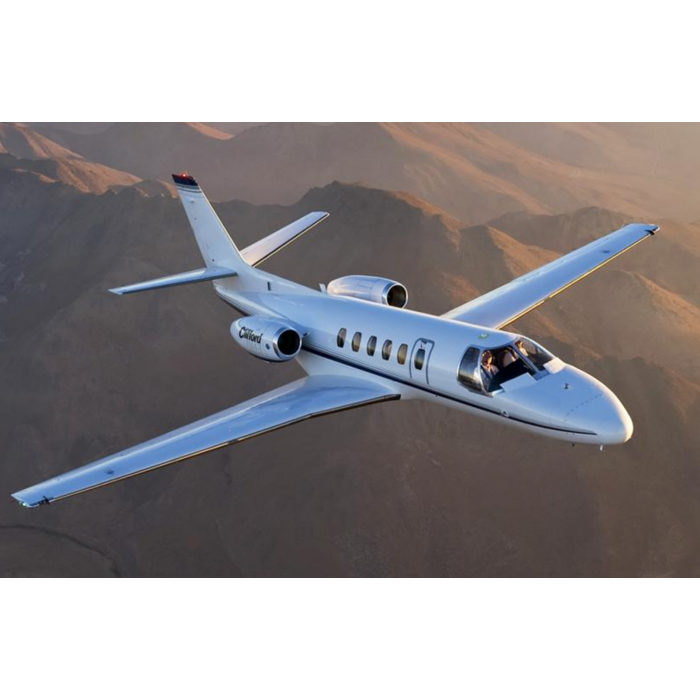
Charter a Cessna Citation Bravo


- Availability: Available for rent
Request aircraft information
The Cessna Citation Bravo is a light business jet developed by Cessna as the successor to the Citation II, first flown on 25 April 1995 and produced from 1997 to 2006. A total of 336 aircraft were built, of which 333 remain in active service - an exceptional retention rate for a type that ceased production in 2006. The Bravo is powered by two Pratt and Whitney PW530A turbofan engines, which deliver higher thrust and better fuel efficiency than the PW500 series fitted to the Citation II. The result is a higher maximum gross takeoff weight, a cruise speed of 745 km/h and a range of 3,232 km (1,744 nm). State-of-the-art digital avionics were standard at launch and have been updated throughout the fleet's service life.
The 4.78 m cabin seats up to 7 passengers with comfortable club seating, folding worktables, a bar, an enclosed aft lavatory and a closet. A dedicated luggage compartment handles cabin bags and smaller items. The cabin height of 1.47 m and width of 1.45 m are consistent with the light jet category. The PW530A engines provide a quieter cruise environment than the predecessor Citation II. Maximum certified altitude is 13,720 m (45,000 ft) and maximum takeoff weight is 6,713 kg. The Citation Bravo operates from shorter runways than most light jets and virtually all midsize jets, providing access to regional airfields unavailable to larger aircraft.

Key performance figures
| Range | 1,744 nm / 3,232 km |
| Cruise speed | 745 km/h - faster than most small turboprops |
| Maximum altitude | 13,720 m (45,000 ft) |
| Engines | 2 x Pratt and Whitney PW530A |
| Maximum takeoff weight | 6,713 kg (14,800 lb) |
| Production | 1997-2006 (336 built; 333 in service) |
| First flight | 25 April 1995 |

Airframe dimensions
| Aircraft length | 14.38 m |
| Aircraft height | 4.57 m |
| Wingspan | 15.9 m |
Cabin dimensions and capacity
| Cabin length | 4.78 m |
| Cabin width | 1.45 m |
| Cabin height | 1.47 m |
| Optimal passengers | 6 |
| Maximum passengers | 7 |
| Seating | Club configuration with folding worktables |
| Bar | Standard |
| Lavatory | Enclosed aft |
| Closet | Standard |
| Luggage | Dedicated compartment for cabin bags and smaller items |


Cabin features
- 4.78 m cabin with comfortable club seating for up to 7 passengers;
- Folding worktables at seat positions throughout;
- Onboard bar standard;
- Enclosed aft lavatory;
- Closet and dedicated luggage compartment;
- Pratt and Whitney PW530A engines - quieter cruise than Citation II predecessor;
- State-of-the-art digital avionics suite;
- Short-field capability - access to regional airfields unavailable to larger jets;
- Pressurised cabin to 13,720 m (45,000 ft);
- 333 of 336 built still in service - exceptional retention rate.


The Cessna Citation Bravo is a light business jet developed as the successor to the Citation II, featuring Pratt and Whitney PW530A engines that deliver more power and better fuel efficiency than the earlier PW500 series. First flown on 25 April 1995 and produced from 1997 to 2006, a total of 336 Citation Bravo aircraft were built - 333 of which remain in service today, a retention rate that reflects the type's operational reputation. The PW530A engines raised the maximum gross takeoff weight, increased cruise speed to 745 km/h and extended range to 3,232 km (1,744 nm) compared to its predecessor, while maintaining the Citation II's core advantage: access to smaller regional airports that larger jets cannot use.
The 4.78 m cabin accommodates up to 7 passengers with comfortable seats, folding tables, a bar, a lavatory and a closet. A dedicated luggage compartment handles smaller items and cabin bags. At 745 km/h the Citation Bravo is faster than most small turboprops while being more economical to operate than most light jets of comparable capability. Digital avionics are standard. For two to six passengers on UK domestic, short European and regional missions, the combination of speed, access to short strips and operating economy is the direct value proposition. Charter prices start from approximately £2,200 per flight hour. For the full fleet see our private jet price guide or browse our complete fleet.
Why charter the Citation Bravo?
- PW530A engines - more power, better fuel economy than Citation II. The Pratt and Whitney PW530A engines that distinguish the Bravo from its predecessor deliver higher thrust with improved specific fuel consumption. The result is a higher cruise speed (745 km/h), extended range (3,232 km) and higher maximum takeoff weight compared to the Citation II - all at lower direct operating cost per nautical mile than competing light jets with older powerplants;
- 333 of 336 built still in service - exceptional retention rate. Of the 336 Citation Bravo aircraft produced between 1997 and 2006, 333 remain in active service. This is a direct indicator of the type's build quality, reliability and the depth of the maintenance and parts network that supports it. Operators choose to keep the Bravo because it performs reliably rather than retiring it early;
- Faster than most small turboprops at 745 km/h. The Citation Bravo covers sectors where turboprops are the default alternative - short UK and European routes - at 745 km/h cruise versus a typical turboprop at 450 to 550 km/h. On a two-hour turboprop sector, the Bravo arrives 30 to 45 minutes earlier while providing a pressurised jet cabin experience throughout;
- Access to short runways and regional airports. The Citation Bravo's light weight and Pratt and Whitney PW530A engine performance allow operations from shorter runways than most light jets and virtually all midsize jets. Regional airfields without the infrastructure for larger aircraft are accessible, reducing ground transfer times significantly on many UK and European missions;
- Digital avionics - state-of-the-art for the class. The Citation Bravo was equipped with state-of-the-art digital avionics at launch and has been updated by operators throughout its service life. The cockpit specification reflects the Citation family's reputation for technically well-equipped aircraft in the light jet category;
- Cabin equipped for working travel. The 4.78 m cabin includes comfortable seats, folding tables for working, a bar, a lavatory and a closet. For two to four passengers on short to medium sectors, it provides a complete working environment without the overhead of a larger aircraft.
Charter cost - Citation Bravo prices from UK airports
Hourly rates run from approximately £2,200 to £2,700 - competitive within the light jet category and meaningfully below the midsize category. For two to four passengers on UK domestic and short European missions, the per-seat economics are excellent. For trips where a turboprop is the price-sensitive alternative, the Bravo's speed premium over a turboprop is typically 30 to 45 minutes per sector.
Indicative one-way prices from UK airports:
- London to Edinburgh - from £3,400 (6 passengers, approximately 1 hour 10 minutes);
- London to Geneva - from £5,200 (6 passengers, approximately 1 hour 25 minutes);
- London to Amsterdam - from £4,400 (6 passengers, approximately 55 minutes);
- London to Paris - from £3,800 (6 passengers, approximately 50 minutes);
- London to Dublin - from £4,000 (6 passengers, approximately 1 hour 10 minutes);
- Manchester to Nice - from £6,200 (6 passengers, approximately 1 hour 50 minutes);
- London to Frankfurt - from £5,400 (6 passengers, approximately 1 hour 20 minutes).
Empty Leg opportunities appear regularly on UK and European routes. See our Empty Legs page for current availability.
Ideal routes for the Citation Bravo
It performs best on missions where speed over a turboprop is the priority, where a regional airfield is the required departure or destination, or where a light jet rate is the budget and a four to six passenger group needs a well-equipped cabin:
- UK domestic and short-haul (45 to 90 minutes). London to Edinburgh, London to Belfast, Manchester to Aberdeen, London to Glasgow - these are the sectors where the Citation Bravo's turboprop-beating speed and short-field capability combine most effectively. Private terminals at regional airports cut ground time to under 15 minutes, making total city-to-city time competitive with commercial alternatives at a fraction of the schedule friction;
- UK to Northern Europe (1 to 2 hours). Amsterdam, Paris, Brussels, Frankfurt, Dublin, Zurich - all within the Citation Bravo's range and well-suited to its capacity. For four to six people on a same-day return, the economics of a light jet at £2,200 per hour compare well against business class for multiple passengers plus ground transfer costs;
- UK to Southern Europe (2 to 3 hours). Geneva, Nice, Barcelona, Madrid, Rome and Lisbon are within range from UK airports. The pressurised cabin and 745 km/h cruise make the Citation Bravo a practical option on these longer light-jet sectors where cabin comfort matters;
- Regional airfield access. Where the meeting is at a site served only by a regional airfield - a port, an industrial site, a resort - the Citation Bravo's short-field capability provides access that midsize and large-cabin jets cannot match. This is where the Bravo's combination of size and speed creates unique value;
- Small groups with light jet budgets. For two to four passengers where the requirement is a light jet charter with a proper cabin - lavatory, bar, folding tables, pressurised - the Citation Bravo provides the full light jet experience at rates below the Phenom 300 and Citation CJ4.
Cabin and in-flight experience
This aircraft cabin measures 4.78 m long, 1.45 m wide and 1.47 m high. It accommodates up to 7 passengers with comfortable club seating, folding worktables, a bar, a lavatory aft and a closet. A dedicated luggage compartment handles cabin bags and smaller items. The layout is efficient for a working group of two to four on a short to medium sector where the lavatory, tables and bar cover the core requirements without the weight and cost of a larger aircraft.
The PW530A engines provide a noticeably quieter cruise than the earlier PW500 series in the Citation II, and the pressurised cabin at up to 13,720 m maintains a comfortable environment throughout. Digital avionics in the cockpit are standard. The cabin specification is compact but complete for the light jet category.
- Seating. Up to 7 passengers; optimal 6 in club configuration;
- Tables. Folding worktables at each seat position;
- Bar. Onboard bar standard;
- Lavatory. Enclosed aft lavatory;
- Storage. Closet and dedicated luggage compartment;
- Engines. Pratt and Whitney PW530A - quieter and more fuel-efficient than predecessor;
- Avionics. State-of-the-art digital suite.
Technical specifications
| Manufacturer | Cessna (Textron Aviation), USA |
| Family | Citation II successor (Citation brand) |
| Aircraft class | Light business jet |
| First flight | 25 April 1995 |
| Production | 1997-2006 (336 built; 333 in service) |
| Engines | 2 x Pratt and Whitney PW530A |
| Maximum passengers | 7 |
| Optimal passengers | 6 |
| Range | 1,744 nm / 3,232 km |
| Cruise speed | 745 km/h |
| Maximum altitude | 13,720 m (45,000 ft) |
| Maximum takeoff weight | 6,713 kg (14,800 lb) |
| Cabin length | 4.78 m |
| Cabin width | 1.45 m |
| Cabin height | 1.47 m |
| Wingspan | 15.9 m |
| Aircraft length | 14.38 m |
| Aircraft height | 4.57 m |
Citation Bravo vs similar aircraft
- Citation Bravo vs Phenom 300. The Phenom 300 has greater range (1,800 nm vs 1,744 nm), a longer cabin (5.74 m vs 4.78 m) and a higher cruise speed (834 km/h vs 745 km/h). Charter rates for the Phenom 300 run approximately 10 to 20% higher. For clients who specifically need the Phenom 300's extra speed or longer cabin, the premium is justified. For those with six passengers on short to medium European sectors where the Citation Bravo's range is sufficient, the lower rate is the practical choice;
- Citation Bravo vs Citation CJ3. The CJ3 has a slightly longer cabin (4.98 m vs 4.78 m) and slightly more range (1,875 nm vs 1,744 nm) with similar cruise speed. Charter rates are broadly comparable. Both are well-suited to UK and European light jet missions. The CJ3 has a slight cabin length advantage; the Citation Bravo's PW530A engines have a stronger long-term parts and service record for some operators;
- Citation Bravo vs King Air 350. The King Air 350 is a turboprop with with more passenger capacity (9-15 passengers) and similar range but cruises at approximately 520 km/h versus the Citation Bravo's 745 km/h. On a 2-hour sector the Bravo arrives 30 to 40 minutes earlier. For groups of up to 7 who want jet speed on UK and European routes, the Citation Bravo is the appropriate choice; for larger groups on budget who accept slower speed, the King Air 350 has the capacity advantage.
Frequently asked questions - Citation Bravo charter
How much does it cost to charter a Cessna Citation Bravo?
Rates run from approximately £2,200 to £2,700 per flight hour. London to Geneva costs from £5,200 for 6 passengers. London to Edinburgh costs from £3,400. London to Paris costs from £3,800. All quotes from Private Jets UK are fully itemised with no hidden charges.
How many passengers can fly on a Citation Bravo?
Up to 7 in the standard configuration. The optimal layout is 6 passengers in club seating with folding tables, bar, aft lavatory and closet. For most charter bookings, 4 to 6 passengers in the light jet cabin is the standard group size.
What engines power the Citation Bravo?
Two Pratt and Whitney PW530A turbofan engines. These distinguish it from the predecessor the Citation II, providing more thrust, better fuel efficiency and higher cruise speed than the PW500 series fitted to the earlier model.
Does the Citation Bravo access smaller regional airports?
Yes - the light weight and PW530A engine performance allow operations from shorter runways than most light jets and virtually all midsize jets. Regional airfields that larger aircraft cannot use are accessible, which significantly reduces ground transfer times for meetings at sites served by smaller strips.
How does the Citation Bravo compare to a turboprop?
At 745 km/h, it is faster than most small turboprops (typically 450 to 550 km/h). On a two-hour turboprop sector the Bravo arrives 30 to 45 minutes earlier while providing a pressurised jet cabin with bar, lavatory and folding tables throughout. For groups of up to 6 who are considering a turboprop for budget reasons, the Citation Bravo offers jet performance at competitive light jet rates.