


Charter a Bombardier Challenger 604
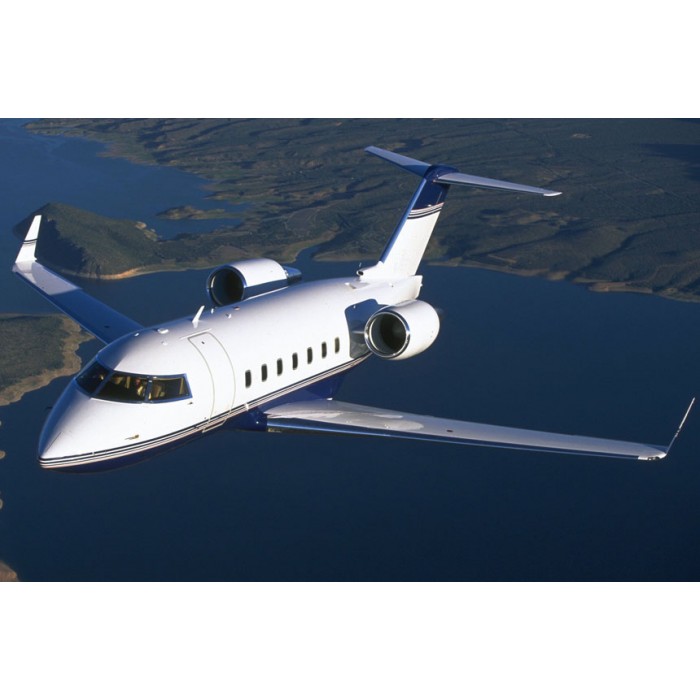


- Availability: Available for rent
Request aircraft information
The Bombardier Challenger 604 is a large-cabin business jet produced by Bombardier Aerospace in Canada, entering service in January 1996 after first flight in September 1994 and Canadian certification in September 1995. It was developed by continuously improving the Challenger 601, with the primary upgrades being GE Aviation CF34-3B engines, enlarged fuel tanks increasing maximum range to 7,458 km (4,028 nm), and the Collins Pro Line IV EFIS avionics suite with colour displays. Production continued until 2006, when it was succeeded by the Challenger 605 which retained the same airframe with updated avionics and larger windows.
The Challenger 604's development drew on Bombardier's experience with the Canadair Regional Jet programme, applying CRJ engineering refinements to the business jet platform. The CF34-3B engines - the same powerplant used on the CRJ200 commercial airliner - provided proven reliability and a worldwide maintenance network. The cabin acoustic treatment introduced with the Challenger 600 family established a benchmark for quiet cruise in the large-cabin category that remains competitive. The in-flight accessible baggage hold, sofa, cushioned armchairs and VIP interior configuration set the standard for large-cabin business jet comfort in the mid-1990s.

Key performance figures
| Range | 4,028 nm / 7,458 km |
| Cruising speed | 850 km/h (Mach 0.82) |
| Maximum altitude | 12,497 m (41,000 ft) |
| Engines | 2 x GE Aviation CF34-3B |
| Maximum takeoff weight | 21,863 kg (48,200 lb) |
| Avionics | Collins Pro Line IV EFIS with colour displays |
| Canadian certification | September 1995 |
| First delivery | January 1996 |

Airframe dimensions
| Aircraft length | 20.85 m |
| Aircraft height | 6.30 m |
| Wingspan | 19.61 m |
Cabin dimensions and capacity
| Cabin length | 8.66 m |
| Cabin width | 2.50 m |
| Cabin height | 1.86 m (stand-up throughout) |
| Optimal passengers | 10 |
| Maximum passengers | 12 |
| Standard configuration | Sofa, cushioned armchairs, pull-out tables |
| Flat-bed | Yes - sofa converts to sleeping surface |
| Baggage hold | In-flight accessible, pressurised |


Cabin features
- 8.66 m cabin - full stand-up headroom at 1.86 m throughout;
- 2.50 m width - same footprint as the Challenger 605 and 650;
- VIP configuration with sofa, cushioned armchairs and pull-out tables;
- Sofa converts to a sleeping surface for overnight operations;
- Up to 12 passengers; standard optimum 10;
- In-flight accessible pressurised baggage hold - access during flight;
- Modern audio and video systems updated on most charter examples;
- Collins Pro Line IV EFIS avionics with colour displays;
- Excellent cabin acoustic treatment - noise isolation benchmark for its era;
- Full galley with hot meal service; pre-ordered catering available;
- Private enclosed lavatory aft;
- Satellite phone and Wi-Fi available on many charter examples (confirm at booking).


The Bombardier Challenger 604 is the aircraft that established the Challenger 600 family's reputation for transatlantic capability, wide-cabin comfort and operational reliability. Introduced in 1996 as a major upgrade of the Challenger 601, it brought GE Aviation CF34-3B engines, enlarged fuel tanks extending range to 4,028 nm (7,458 km), and the Collins Pro Line IV EFIS avionics suite with colour displays. It carries up to 12 passengers in a cabin 8.66 m long and 2.50 m wide - the same fundamental footprint that the Challenger 605 and 650 would inherit - and while superseded in production by its successors, it remains widely available in the European charter market at charter rates below the newer generation variants.
For clients who need transatlantic range, a 12-seat cabin and in-flight accessible luggage on a proven airframe, the Challenger 604 delivers all of this at rates that typically run 10 to 15% below the Challenger 605 and 20 to 25% below the 650. First certified in Canada in September 1995 and delivered from January 1996, the type accumulated an extensive service record before production transitioned to the Challenger 605 in 2006. Private Jets UK arranges charters from all UK airports. See our full range of aircraft at the private jet price guide or browse the complete fleet.
Why charter the Challenger 604?
- Transatlantic range at a lower charter rate than current-generation alternatives. At 4,028 nm (7,458 km), it covers London to New York non-stop - the same practical range as the Challenger 605 and 650 - but typically commands charter rates 10 to 25% below the newer variants. For clients whose priority is transatlantic or long-range capability rather than the latest avionics generation, the value case is clear;
- The original wide cabin. At 2.50 m wide and 8.66 m long, the cabin dimensions are essentially identical to the Challenger 605 and 650 that followed it. Stand-up headroom at 1.86 m throughout. Sofa, cushioned armchairs, pull-out tables. The cabin that made the Challenger 600 family famous is the same cabin available here at a lower price;
- In-flight accessible baggage hold. Passengers can access luggage during the flight - essential on 7 to 8 hour transatlantic sectors where documents, medication or clothing may be needed. This was a selling point in 1996 and remains a practical advantage over many smaller jets today;
- Up to 12 passengers. The same 12-seat maximum as the Challenger 605, making it one of the most capable aircraft in the large-cabin charter category for large group travel;
- Proven long-service reliability. It was in production for ten years and has accumulated an extensive charter and commercial flight record since 1996. The type's reliability and worldwide maintenance network are well established;
- Excellent noise isolation. The Challenger 600 family's cabin acoustic treatment was a benchmark at its introduction and remains competitive - notably quieter than many converted regional jet alternatives at similar price points.
Charter cost - Challenger 604 prices from UK airports
Hourly rates run from approximately £4,400 to £5,200 - approximately 10 to 15% below the Challenger 605 and 20 to 25% below the 650. On a long-haul sector the saving is material: a London to New York round trip on a Challenger 604 versus a Challenger 650 can represent a £10,000 to £15,000 difference at full passenger load. For clients where the avionics generation matters less than range, cabin width and per-seat economics, this remains one of the most compelling large-cabin options in the European charter market.
Indicative one-way prices from UK airports:
- London to New York (JFK) - from £50,000 (12 passengers, non-stop, approximately 7 hours 30 minutes);
- London to Dubai - from £32,000 (12 passengers, non-stop, approximately 6 hours 45 minutes);
- London to Geneva - from £9,600 (12 passengers, approximately 1 hour 20 minutes);
- London to Athens - from £20,400 (12 passengers, approximately 3 hours 20 minutes);
- Edinburgh to Barcelona - from £15,400 (12 passengers, approximately 2 hours 30 minutes);
- London to Nairobi - from £58,000 (12 passengers, one fuel stop, approximately 9 hours total);
- Manchester to Istanbul - from £20,000 (12 passengers, approximately 3 hours 20 minutes).
Empty Leg flights on the Challenger 604 appear on repositioning routes. See our Empty Legs page for current availability.
Ideal routes for the Challenger 604
It is most compelling when long range, large group or per-seat economics are the primary consideration and the avionics generation is secondary. It performs equally well on short European hops but its value proposition is sharpest on longer missions:
- Transatlantic (New York, Boston, Miami) - 7 to 8 hours non-stop. The practical case for the Challenger 604 versus the 605 or 650 is strongest here. Same range, same cabin, 10 to 25% lower charter rate on a 7+ hour sector. For groups of 10 to 12 passengers the saving on a round trip is significant;
- UK to Gulf (6.5 to 7 hours non-stop). Dubai, Riyadh, Abu Dhabi, Doha. All within range non-stop from UK airports. Wide cabin for long-haul working and rest, in-flight baggage access on a 7-hour sector;
- Large group European travel (2 to 4 hours). For groups of 10 to 12 who need a single aircraft rather than two smaller jets. The 12-seat cabin consolidates the group and keeps communication and meeting continuity throughout the flight;
- Sub-Saharan Africa and Central Asia (one stop). Nairobi, Lagos, Johannesburg, Almaty. The 4,028 nm range covers these routes with one efficient stop. Same practical capability as the Challenger 605 on these specific missions at a lower total cost;
- Value-focused corporate travel. For corporate flight departments and frequent charter clients who know the Challenger 600 family well and are comfortable with the previous-generation avionics in exchange for meaningful cost savings on long-cycle travel budgets.
Cabin and in-flight experience
The Challenger 604 cabin measures 8.66 m long, 2.50 m wide and 1.86 m high - stand-up headroom throughout. The VIP configuration includes a sofa, cushioned armchairs and pull-out tables that, as Bombardier noted at the time of introduction, create an environment equally suited to work and relaxation. Modern audio and video systems are fitted across the fleet, with most charter examples updated to current entertainment standards since original delivery.
The in-flight accessible baggage hold is a genuine practical asset on long-haul missions. During a 7-hour transatlantic sector, access to documents, presentation materials, medication or a change of clothes is often essential for senior executives arriving directly into meetings. No midsize or super-midsize jet offers this on the same range.
- Seating. Standard 10-passenger VIP configuration; 12-passenger maximum. Sofa converts to a sleeping surface for overnight operations;
- Entertainment. Audio and video systems updated on most charter examples since original delivery. Satellite phone and Wi-Fi availability vary by operator - confirm at booking;
- Galley. Full galley with hot meal service. Pre-ordered catering available for all sectors;
- Lavatory. Private enclosed lavatory aft;
- Baggage. In-flight accessible pressurised hold - a key operational advantage on long-haul missions.
Technical specifications
| Manufacturer | Bombardier Aerospace (Canada) |
| Aircraft class | Large-cabin business jet |
| First flight | September 1994 (CF34-3A); March 1995 (CF34-3B) |
| Canadian certification | September 1995 |
| First delivery | January 1996 |
| Production ended | 2006 (succeeded by Challenger 605) |
| Maximum passengers | 12 |
| Optimal passengers | 10 |
| Range | 4,028 nm / 7,458 km |
| Cruise speed | 850 km/h (Mach 0.82) |
| Maximum altitude | 12,497 m (41,000 ft) |
| Engines | 2 x GE Aviation CF34-3B |
| Maximum takeoff weight | 21,863 kg (48,200 lb) |
| Avionics | Collins Pro Line IV EFIS |
| Cabin length | 8.66 m |
| Cabin width | 2.50 m |
| Cabin height | 1.86 m (stand-up throughout) |
| Wingspan | 19.61 m |
| Aircraft length | 20.85 m |
| Aircraft height | 6.30 m |
Challenger 604 vs similar aircraft
- Challenger 604 vs Challenger 605. The 605 (2006) updated the same airframe with Rockwell Collins Pro Line 21 avionics, larger cabin windows and a rounded tail section. The cabin dimensions and range are essentially identical. Charter rates for the 605 run approximately 10 to 15% higher. For clients where current-generation avionics or larger windows matter, the 605 is the better choice. For long-haul missions where the total saving on a transatlantic round trip is £10,000 to £15,000, the Challenger 604 earns serious consideration;
- Challenger 604 vs Challenger 850. That aircraft is a converted CRJ200 airliner with a substantially longer cabin (14.76 m vs 8.66 m) at broadly comparable charter rates. For groups of 13 to 14 passengers the 850 has a clear capacity advantage; for 10 to 12 passengers who prioritise cabin quality, noise levels and purpose-built business jet refinement, the Challenger 604 is the stronger choice;
- Challenger 604 vs Global 6000. The Global adds 2,000 nm more range, a three-zone cabin, quieter cruise and better pressurisation at charter rates approximately 30 to 40% higher. For all practical North Atlantic, Gulf and Sub-Saharan African missions, the Challenger 604 delivers comparable group capability at a materially lower price. The Global 6000 is necessary only for truly ultra-long-range operations beyond 4,000 nm.
Frequently asked questions - Challenger 604 charter
How much does it cost to charter a Bombardier Challenger 604?
Charter rates run from approximately £4,400 to £5,200 per flight hour. London to Geneva costs from £9,600 for 12 passengers. London to Dubai non-stop costs from £32,000. London to New York non-stop costs from £50,000. All quotes from Private Jets UK are fully itemised with no hidden charges.
How many passengers can fly on a Challenger 604?
Up to 12 passengers. The standard VIP configuration seats 10 with a sofa, armchairs and pull-out tables. A 12-passenger configuration is available. The sofa converts to a sleeping surface for overnight operations.
Can the Challenger 604 fly non-stop from London to New York?
Yes - with 4,028 nm range it covers the London to New York sector of approximately 3,450 nm non-stop. The same range also covers Dubai non-stop and reaches Sub-Saharan Africa and Central Asia with one efficient fuel stop.
What is the difference between the Challenger 604 and Challenger 605?
The Challenger 605 (2006) updated the same airframe with Rockwell Collins Pro Line 21 avionics, larger cabin windows and a rounded tail. The cabin dimensions and range are essentially identical. Charter rates for the 605 run approximately 10 to 15% higher. For missions where the avionics generation is less critical than cost, the Challenger 604 offers the same practical capability at a lower price.
Can passengers access their luggage during a Challenger 604 flight?
Yes. It has an in-flight accessible pressurised baggage hold, allowing passengers to retrieve items during the flight. This is a significant practical advantage on 7 to 8 hour transatlantic or Gulf sectors and is not available on most midsize and super-midsize jets of comparable charter cost.