


Charter a Bombardier Challenger 300
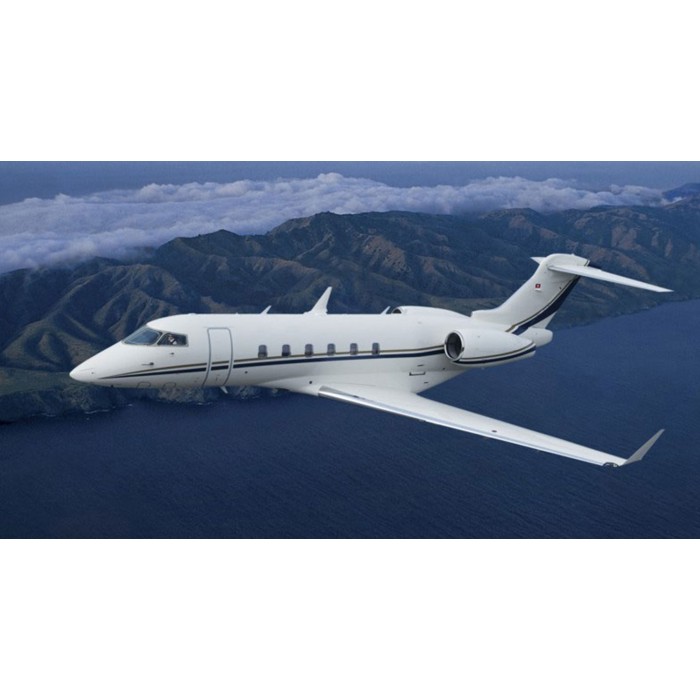


- Availability: Available for rent
Request aircraft information
The Bombardier Challenger 300 is a super-midsize business jet developed from a clean sheet by Bombardier Aerospace in Canada - unlike most Bombardier models of its era, it was not derived from the Challenger 600 family but designed entirely from scratch to a new performance brief. First flown in 1999 and entering service in 2004, it quickly became one of the most commercially successful aircraft in its category, with over 450 examples delivered before production transitioned to the updated Challenger 350 in 2014.
The aircraft is powered by twin Honeywell HTF7000 turbofan engines and features the Rockwell Collins Pro Line 21 integrated avionics suite - a glass cockpit system that significantly reduces pilot workload through centralised monitoring of flight, navigation, fuel and systems data. The Challenger 300 holds five FAA city-pair speed records for super-midsize jets and is widely regarded as one of the most reliable and economical aircraft in its class relative to cabin volume.

Key performance figures
| Range | 3,100 nm / 5,741 km |
| Cruising speed | 850 km/h (Mach 0.82) |
| Maximum altitude | 13,720 m (45,000 ft) |
| Engines | 2 x Honeywell HTF7000 |
| Takeoff distance | 4,810 ft / 1,466 m |
| Landing distance | 3,833 ft / 1,168 m |
| Maximum takeoff weight | 17,622 kg (38,850 lb) |
| Avionics | Rockwell Collins Pro Line 21 |

Airframe dimensions
| Aircraft length | 20.92 m |
| Aircraft height | 6.20 m |
| Wingspan | 19.46 m |
Cabin dimensions and capacity
| Cabin length | 8.72 m |
| Cabin width | 2.19 m |
| Cabin height | 1.85 m (stand-up throughout) |
| Optimal passengers | 8 |
| Maximum passengers | 9 |
| Seat configuration | Double-club (2+2 facing pairs) |
| Flat-bed conversion | Yes - all seats |
| Baggage hold | In-flight accessible, pressurised |


Cabin features
- Stand-up cabin height throughout - 1.85 m, full-length aisle;
- 8 fully adjustable passenger seats with individual power points and fold-out worktables;
- All seats convert to flat sleeping surfaces for overnight or long-haul operations;
- Two-zone climate control - passenger cabin and cockpit independently regulated;
- Satellite Wi-Fi on most charter-market examples (confirm availability at booking);
- In-cabin entertainment system with individual screens and Bluetooth audio;
- Full forward galley - hot meal service available on all sectors;
- Fully enclosed private lavatory with sink in the aft section;
- In-flight accessible pressurised baggage hold - retrieve luggage without landing;
- Low-heat LED lighting system for reduced eye strain on long flights.


The Bombardier Challenger 300 is one of the most consistently popular super-midsize business jets in the European charter market. Designed from a clean sheet rather than adapted from an earlier model, it entered service in 2004 and quickly established itself as the benchmark for the super-midsize category - offering a stand-up cabin comparable to aircraft one class above it, with operating costs closer to a midsize jet. For UK clients, it represents the point at which private aviation stops feeling like a convenience and starts feeling genuinely transformative: enough range to reach the Gulf non-stop, enough cabin space to work or sleep properly, and access to airports that larger jets cannot use.
Private Jets UK arranges Bombardier Challenger 300 charters from airports across the United Kingdom. Our aviation consultants are available 24/7 and will provide aircraft options with fully itemised all-inclusive pricing within 15 minutes. Charter prices for the Challenger 300 start from £4,600 per flight hour. For a full overview of aircraft categories and pricing, see our private jet price guide.
Why charter the Challenger 300?
Its appeal in the charter market comes from a combination of qualities that are genuinely difficult to find in a single aircraft at this price point:
- Stand-up cabin throughout. The Challenger 300 has a cabin height of 1.85 m - you can stand and walk the full length of the cabin during the flight, which matters considerably on sectors of 3 to 6 hours;
- True transcontinental range. At 3,100 nautical miles (5,741 km), it reaches Dubai from London without a fuel stop, connects the UK to most of North Africa, the Middle East and the eastern United States, and covers every European destination comfortably;
- Efficient operating cost for its class. The twin Honeywell HTF7000 engines deliver competitive fuel burn relative to the cabin size, making it one of the most cost-efficient options in the super-midsize segment;
- In-flight accessible baggage hold. The Challenger 300's aft baggage compartment is accessible during the flight - relevant on longer missions where passengers need access to luggage without landing;
- Short-field performance. A takeoff run of approximately 4,810 feet gives the Challenger 300 access to airports that larger jets in its range class cannot use, including Lugano, Sion and several Mediterranean island airports;
- Up to 9 passengers. The standard double-club configuration seats 8 passengers comfortably, with a 9th seat available, making it well suited for corporate groups and large family travel.
Charter cost - Challenger 300 prices from UK airports
Hourly charter rates run from of approximately £4,600 to £5,500 per flight hour depending on the aircraft's year of manufacture, operator, and seasonal demand. This rate is for the aircraft - the all-inclusive total for your flight will also include positioning fees if the aircraft needs to travel to your departure airport, landing and handling charges at both airports, standard catering, and Air Passenger Duty where applicable.
Indicative one-way prices from UK airports on a Challenger 300:
- London to Geneva - from £9,200 (9 passengers, approximately 1 hour 20 minutes);
- London to Amsterdam - from £7,800 (9 passengers, approximately 55 minutes);
- London to Palma de Mallorca - from £13,200 (9 passengers, approximately 2 hours);
- London to Dubai - from £38,000 (9 passengers, approximately 7 hours 10 minutes, non-stop);
- London to New York - from £62,000 (9 passengers, approximately 8 hours with one fuel stop);
- Edinburgh to Berlin - from £11,400 (9 passengers, approximately 1 hour 45 minutes);
- Manchester to Barcelona - from £14,800 (9 passengers, approximately 2 hours 10 minutes).
These are indicative prices. The exact cost depends on aircraft positioning, seasonal demand, fuel surcharges and any additional services. Empty Leg flights on the Challenger 300 can reduce the standard charter price by 50 to 75% on available routes - see our Empty Legs page for current availability.
Ideal routes for the Challenger 300
Its range and cabin make it the natural choice for a specific band of mission distances - too long for a light jet, too short to justify a heavy jet. It performs best on:
- UK to Southern Europe and the Mediterranean (2 to 3.5 hours). Barcelona, Rome, Athens, Palma, Ibiza, Mykonos, Santorini, Malta. The Challenger 300's stand-up cabin and in-flight baggage access are appreciated on leisure routes where passengers travel with substantial luggage;
- UK to Middle East (6 to 7.5 hours, non-stop). Dubai, Abu Dhabi, Riyadh. It is one of the smallest aircraft capable of the London-Dubai sector non-stop, making it an efficient and cost-effective choice for Gulf travel compared to larger heavy jets;
- Corporate same-day returns across Europe. London-Geneva-Milan-London in a single day. The Challenger 300's speed (850 km/h cruise) and short-field performance make complex multi-stop European days operationally reliable;
- UK to North Africa and Canary Islands. Marrakech, Casablanca, Tenerife, Las Palmas. The range comfortably covers these destinations non-stop from all UK departure airports;
- Transatlantic with one fuel stop (New York, Boston, Miami). It cannot complete New York-London non-stop; a fuel stop at Reykjavik or Halifax is standard. For fully non-stop transatlantic, the Challenger 350 or a heavy jet is required.
Cabin and in-flight experience
The cabin is one of the aircraft's defining selling points. At 8.72 m long, 2.19 m wide and 1.85 m high, it is one of the largest cabins in the super-midsize category - significantly more spacious than the Citation XLS+ or Hawker 850XP, and directly competitive with aircraft a category above it.
A double-club configuration seats 8 passengers in two pairs of facing seats on each side of the aisle. All seats are fully adjustable and convert to flat sleeping surfaces for long-haul operations - the aircraft is genuinely comfortable for overnight flights to the Gulf or early-morning transatlantic departures. A ninth seat is available where required. Each seat has individual power points, adjustable lighting and fold-out worktables.
- Entertainment and connectivity. Satellite Wi-Fi is available on most charter-market Challenger 300s (specification varies by operator - confirm at booking). In-cabin entertainment systems with individual screens, Bluetooth audio and USB charging are standard on newer examples;
- Galley and catering. A full forward galley allows hot meals to be prepared and served in flight. Standard catering includes hot and cold beverages, snacks and light meals. Bespoke catering from specific restaurants or caterers can be arranged in advance;
- Lavatory. A fully enclosed private lavatory with sink is located in the aft section. On newer Challenger 300s, the lavatory has been upgraded with improved finishes and a vanity;
- Baggage. The pressurised aft baggage hold accommodates approximately 1,600 kg of luggage and is accessible during the flight. A typical charter can carry 8 to 10 full-size suitcases plus cabin bags without restriction.
Technical specifications
| Manufacturer | Bombardier Aerospace (Canada) |
| Aircraft class | Super midsize jet |
| First flight | 1999 (entered service 2004) |
| Production | 2004 to 2014 (replaced by Challenger 350) |
| Maximum passengers | 9 |
| Optimal passengers | 8 |
| Range | 3,100 nm / 5,741 km |
| Cruise speed | 850 km/h (Mach 0.82) |
| Maximum altitude | 13,720 m (45,000 ft) |
| Engines | 2 x Honeywell HTF7000 |
| Takeoff distance | 4,810 ft / 1,466 m |
| Landing distance | 3,833 ft / 1,168 m |
| Maximum takeoff weight | 17,622 kg (38,850 lb) |
| Avionics | Rockwell Collins Pro Line 21 |
| Cabin length | 8.72 m |
| Cabin width | 2.19 m |
| Cabin height | 1.85 m (stand-up throughout) |
| Wingspan | 19.46 m |
| Aircraft length | 20.92 m |
| Aircraft height | 6.20 m |
| Baggage capacity | In-flight accessible aft hold |
Challenger 300 vs similar aircraft
When selecting a super-midsize jet for your charter, it is frequently compared against the following alternatives:
- Challenger 300 vs Challenger 350. The 350 is the direct successor, entering service in 2014. It offers slightly more range (3,200 nm vs 3,100 nm), an updated cabin interior with larger windows, and improved fuel efficiency. Charter rates on the 350 run approximately 5 to 10% higher. For most European and Gulf missions, either aircraft is equivalent in practice - the 350 becomes the better choice for the longest non-stop sectors or for clients who prefer a more contemporary cabin finish;
- Challenger 300 vs Citation Sovereign. The Citation Sovereign is a true midsize jet with a smaller cabin (1.70 m height, not stand-up throughout). Hourly rates are approximately 20% lower than a Challenger 300 charter, making it competitive for European day trips where the stand-up cabin is less critical. For sectors over 2 hours with multiple passengers, the its additional space is typically worth the difference;
- Challenger 300 vs Gulfstream G280. A close competitor introduced in 2012 with comparable range. The G280 has a slightly narrower cabin but is considered by some operators to have superior short-field performance. Availability in the UK charter market is more limited than the Challenger 300, which has a significantly larger UK charter fleet.
Frequently asked questions - Challenger 300 charter
How much does it cost to charter a Bombardier Challenger 300 in the UK?
Rates start from approximately £4,600 per flight hour. A London to Geneva sector (approximately 1 hour 20 minutes) costs from £9,200 all-inclusive for up to 9 passengers. London to Dubai non-stop (approximately 7 hours 10 minutes) costs from £38,000. The all-inclusive quote provided by Private Jets UK covers the aircraft, crew, fuel, landing fees and standard catering.
How many passengers can fly on a Challenger 300?
Up to 9 passengers can be accommodated in the maximum configuration. The standard charter configuration is 8 passengers in a double-club layout. All seats recline fully and convert to flat sleeping surfaces for overnight or long-haul flights.
Can a Challenger 300 fly non-stop from London to Dubai?
Yes. With a range of 3,100 nautical miles (5,741 km) is sufficient for the London to Dubai sector non-stop with a standard passenger load. With a full cabin of 8 to 9 passengers and full fuel, range is reduced slightly and the non-stop capability should be confirmed with the specific operator at the time of booking.
Can a Challenger 300 fly transatlantic to New York?
This aircraft cannot complete the London to New York sector non-stop - the distance of approximately 3,450 nm exceeds its maximum range. A fuel stop is required, typically at Reykjavik (Iceland) or Shannon (Ireland). For fully non-stop transatlantic, the Challenger 350, Gulfstream G450 or a heavy jet is required.
What is the difference between a Challenger 300 and a Challenger 350?
The 350 is the updated successor, introduced in 2014. Key differences: the 350 has a 100 nm greater range, improved fuel efficiency, larger windows and a modernised cabin interior with winglets visible from inside the cabin. Charter rates for the 350 are approximately 5 to 10% higher. For most UK to European and Gulf missions, both aircraft perform the same sectors - the choice often comes down to cabin preference and current availability.
How much luggage can I bring on a Challenger 300?
The pressurised aft baggage hold that is accessible during the flight. It comfortably accommodates 8 to 10 full-size suitcases plus cabin bags for a full passenger load. For trips with ski equipment, golf bags or unusually large items, advise your consultant at the time of booking so we can confirm hold capacity against your specific requirements.