


Charter a Beechcraft King Air 300
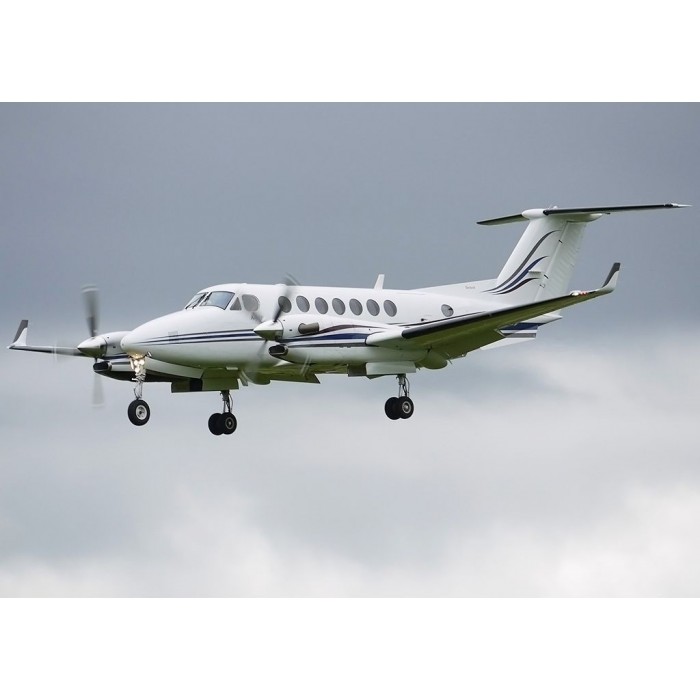


- Availability: Available for rent
Request aircraft information
The Beechcraft King Air 300 is a twin-turboprop pressurised business aircraft certified by the FAA in January 1984, with deliveries commencing in April 1984. It is a direct development of the King Air 200 series, retaining the same fuselage cross-section and T-tail configuration while introducing the more powerful Pratt and Whitney Canada PT6A-60A engines at 1,050 shp each. The PT6A-60A upgrade increased maximum takeoff weight to 14,000 lb (6,350 kg), maximum cruise speed to 320 kt and service ceiling to 35,000 ft - a ceiling Stratos Jets noted is "on average 10,000 feet higher than most competitors" in the turboprop category. The King Air 300 was produced until 1993, with 247 aircraft built across all variants including the 300LW (MTOW limited to 12,500 lb for European certification requirements) and the B300C with cargo door. The "Super" prefix was officially dropped in 1996 for all Super King Air models. The King Air 300 was succeeded by the King Air 350, which extended the fuselage by 2.9 ft and increased wingspan by 3.4 ft to accommodate a longer cabin with double-club seating.
The King Air 300 cabin measures 5.12 m long, 1.37 m wide and 1.47 m high - flat floor throughout, with a typical executive configuration of six passengers in club and individual seating. Large round windows, an airstair door on the aft port side, aft lavatory and 55 ft³ internal baggage compartment are standard. The Model 300LW variant was produced specifically for European operators facing weight-based certification requirements, with MTOW limited to 12,500 lb. Charter prices start from approximately £1,200 per flight hour. For the full fleet see our private jet price guide or browse our complete fleet.

Why charter the King Air 300?
- 35,000 ft service ceiling - 10,000 ft above most turboprop competitors; above most commercial traffic. The King Air 300's PT6A-60A engines push the aircraft to 35,000 ft - a ceiling Stratos Jets described as "on average 10,000 feet higher than most competitors" in the turboprop category. At FL350 the King Air 300 operates above most commercial airline traffic on European routes and above the majority of convective weather systems. The 2,844 ft/min climb rate reaches this altitude quickly from departure. Competitors such as the Piper Cheyenne and earlier Beechcraft models are typically limited to 25,000 to 28,000 ft. Only the Piaggio Avanti (41,000 ft) consistently exceeds the King Air 300's ceiling in the pressurised twin-turboprop category;
- PT6A-60A engines at 1,050 shp - longest production turboprop engine in its class; Blackhawk XP upgrade available. The Pratt and Whitney Canada PT6A is the defining engine of the business turboprop category, powering King Air variants continuously since 1964. The PT6A-60A on the King Air 300 produces 1,050 shp - the same fundamental free-turbine design that has accumulated billions of flight hours across the PT6 family. The Blackhawk Modifications XP upgrade replaces the PT6A-60A with PT6A-67A engines at 1,200 shp with five-blade composite propellers, boosting maximum cruise to 340 kt - 20 kt faster than standard. Wikipedia confirmed Blackhawk targets 30% of the 850 King Air 300 fleet globally. For charter clients who encounter updated aircraft, the Blackhawk upgrade is a meaningful performance improvement over the standard specification;
- 247 aircraft built (1984-1993); 300LW variant for European operators; strong platform longevity. Wikipedia documents 247 King Air 300 aircraft built across all variants - including 35 Model 300LW (MTOW 12,500 lb for European regulatory requirements) and two aircraft built specifically for the FAA for navaid calibration. The platform longevity of the King Air series - the longest production run of any civilian turboprop in its class per the original HTML - means parts availability, trained maintenance organisations and type-familiar crews exist globally. The King Air 300 shares 90%+ of its airframe with the King Air 200, further extending the support network depth;
- Short-field access - the turboprop advantage over VLJs on short European strips. The King Air 300's twin PT6A-60A turboprops provide excellent short-field performance unavailable from comparable light jets. Unlike jet aircraft which require longer certified runways and higher approach speeds, the King Air 300 can operate from strips as short as 3,500 to 4,000 ft - opening UK regional airfields, Scottish Highland strips, Alpine airports and destinations inaccessible to light jets. For groups of 4 to 6 needing access to a regional UK airfield, the King Air 300 provides pressurised twin-engine capability from runways that jets cannot use;
- 1998 UltraQuiet active noise cancellation - Elliott Aviation standard fitment on all B300s; competitive with light jet cabin noise. King Air Nation documented the UltraQuiet active noise canceling system by Elliott Aviation as standard equipment on all B300s from 1998. Beechcraft claimed noise levels "now competitive with that of light jets" following the 2008 King Air 350i cabin update, a claim that reflects the noise reduction trajectory of the King Air 300 series. For charter clients whose previous experience of turboprops included cabin noise levels noticeably above jet standards, the UltraQuiet-equipped King Air 300 delivers a meaningfully quieter environment than earlier turboprop aircraft;
- Collins Pro Line 21 on later B300s (from 2003); military ISTAR and surveillance pedigree. King Air Nation confirmed that from October 2003, all future B300 and B300C King Airs were delivered with the Rockwell Collins Pro Line 21 avionics suite - the same glass cockpit standard used on the Hawker 750 and 800XP. Earlier aircraft retain original analogue avionics; confirm standard with operator before booking. The military credentials of the King Air 300 platform include Swiss Air Force B300C for aerial photography, US Army ISTAR modifications for Task Force ODIN and multiple government surveillance operators - reflecting the structural and systems durability of the platform across demanding operational roles.
Charter cost - King Air 300 prices from UK airports
Hourly rates run from approximately £1,200 to £1,600 - in the turboprop category, below light jets but with the short-field access and twin-engine redundancy that single-engine turboprops cannot provide. For 4 to 6 passengers on short UK regional and European missions where airfield access matters, the King Air 300 provides pressurised comfort from runways unavailable to jet aircraft.
Indicative one-way prices from UK airports:
- London to Edinburgh - from £1,440 (6 passengers, approximately 1 hour 20 minutes);
- London to Paris - from £1,800 (6 passengers, approximately 1 hour 30 minutes);
- London to Geneva - from £2,400 (6 passengers, approximately 1 hour 50 minutes);
- Edinburgh to London - from £1,440 (6 passengers, approximately 1 hour 20 minutes);
- London to Dublin - from £1,680 (6 passengers, approximately 1 hour 30 minutes);
- Manchester to Amsterdam - from £1,920 (6 passengers, approximately 1 hour 40 minutes);
- Short-strip UK regional mission - from £1,200 per hour.
Empty Leg flights appear on repositioning routes. See our Empty Legs page for current availability.

Ideal routes for the King Air 300
Best matched to short UK regional and European missions where 35,000 ft ceiling, short-field access and twin-engine redundancy at turboprop rates serve groups of 4 to 6:
- Short UK regional connections (45 to 90 minutes) from or to shorter runways. Edinburgh, Manchester, Belfast, Inverness, Newquay, Humberside and dozens of UK regional airfields are within 60 to 90 minutes. The King Air 300's short-field capability opens airfields unavailable to light jets, reducing surface travel time at both ends. For groups of 4 to 6 based outside London who need to reach a meeting in another UK city, the King Air 300 may operate from a local airfield that no jet can use;
- Short European hops (1 to 2 hours) where turboprop economics at 320 kt are preferred over jet rates. Paris, Amsterdam, Brussels and Dublin are all within 1 to 2 hours at 320 kt cruise. For groups of 4 to 6 where the charter budget favours turboprop rates and the sector time difference versus a light jet (typically 15 to 20 minutes on these routes) is acceptable, the King Air 300 provides pressurised comfort and twin-engine redundancy at rates approximately 30 to 40% below a comparable light jet;
- Alpine and mountain airports (Geneva, Innsbruck, Chambery, Sion, Bern) where short-field and hot-and-high performance matter. Alpine airports with limited runway lengths and high-elevation approach requirements suit the King Air 300's turboprop performance profile. The PT6A-60A maintains good power at altitude, and the shorter landing roll versus jet aircraft provides access to Alpine strips that are operationally demanding for jets. For ski travel to Sion, Chambery or Innsbruck, the King Air 300 provides direct access from London or regional UK airports without the runway length requirements of jet alternatives;
- Mission types requiring cargo door (B300C variant) - cargo, humanitarian, surveillance. The B300C variant with cargo door provides direct access for charter clients needing cargo capability alongside passenger transport. The Swiss Air Force B300C was configured for aerial photography; US Army ISTAR operators use King Air 300 platforms for surveillance. For charter clients with mixed passenger and freight requirements on the same sector, the B300C configuration is the relevant variant to confirm with the operator;
- Owner-pilot operations and small corporate programmes where PT6A reliability and operating economics are primary. The PT6A engine family's reliability record - accumulated over billions of flight hours across the PT6 family - is the primary selection argument for small corporate programmes and owner-operators who value maintenance predictability over avionics currency. The King Air 300's shared platform with the King Air 200 means most King Air-experienced maintenance organisations can support it, providing MRO access in locations where newer turboprop types have no established base.

Cabin and in-flight experience
The King Air 300 cabin measures 5.12 m (16 ft 8 in) long, 1.37 m (4.5 ft) wide and 1.47 m (4.8 ft) high - pressurised, flat floor throughout. A typical executive configuration seats six passengers in club and individual seating with recliner chairs and side-folding tables. Large round windows run along both sides. An airstair door on the aft port side provides self-contained boarding. The aft lavatory is standard. The 55 ft³ internal baggage compartment is located near the tail and the right entrance, with both forward and aft access options confirmed by SherpaReport as accessible mid-flight.
The UltraQuiet active noise cancellation system by Elliott Aviation has been standard on all B300s since 1998, significantly reducing cabin noise levels. Later B300s (from 2003) are equipped with Collins Pro Line 21 avionics; confirm the specific standard on any aircraft before booking. The Blackhawk Modifications XP upgrade (PT6A-67A engines and five-blade composite props) provides 340 kt cruise and improved climb on retrofitted aircraft.
- Cabin. 5.12 m x 1.37 m x 1.47 m; pressurised; flat floor; large round windows;
- Seating. 6 standard (club + individual); recliner chairs; side-folding tables;
- Boarding. Airstair door (aft port side); lavatory (aft standard);
- Baggage. 55 ft³ internal; tail + right entrance compartments; mid-flight accessible;
- Noise. UltraQuiet active noise cancellation (Elliott Aviation; standard from 1998);
- Engines. 2 x PT6A-60A (1,050 shp each); or Blackhawk XP upgrade: PT6A-67A (1,200 shp) + 5-blade props;
- Avionics. Original analogue (pre-2003) or Collins Pro Line 21 (B300/B300C from October 2003); confirm before booking;
- Pressurisation. Standard King Air pressurisation system.
Technical specifications
| Manufacturer | Beech Aircraft Corporation (now Textron Aviation / Beechcraft) |
| FAA certification | January 1984 |
| First delivery | April 1984 |
| Production | 1984-1993; 247 aircraft built (incl. 300LW and B300C variants) |
| Variants | Model 300 (MTOW 14,000 lb); Model 300LW (MTOW 12,500 lb; European market); B300C (cargo door) |
| Successor | King Air 350 (fuselage +0.88 m; wingspan +1.0 m; winglets; from 1990) |
| Aircraft class | Pressurised twin-turboprop business aircraft |
| Engines (standard) | 2 x Pratt and Whitney Canada PT6A-60A (1,050 shp each) |
| Engines (Blackhawk XP) | PT6A-67A (1,200 shp) + 5-blade composite props; 340 kt cruise |
| Max cruise speed | 320 kt (593 km/h) |
| Long-range cruise | 265 kt (491 km/h) |
| Climb rate | 2,844 ft/min |
| Service ceiling | 35,000 ft (approx 10,000 ft above most turboprop competitors) |
| Range | 1,480-1,570 nm / 2,740-2,908 km (load dependent) |
| MTOW (300) | 14,000 lb / 6,350 kg |
| MTOW (300LW) | 12,500 lb / 5,670 kg |
| Cabin length | 5.12 m (16 ft 8 in) |
| Cabin width | 1.37 m (4.5 ft) |
| Cabin height | 1.47 m (4.8 ft) |
| Passengers | 6 typical executive; 8-9 maximum |
| Baggage | 55 ft³ internal; mid-flight accessible |
| Wingspan | 16.61 m |
| Aircraft length | 13.34 m |
| Aircraft height | 4.57 m |
| Noise | UltraQuiet ANC standard from 1998 |
| Avionics | Collins Pro Line 21 (B300/B300C from October 2003); analogue on earlier aircraft |

King Air 300 vs similar aircraft
- King Air 300 vs King Air 350. The King Air 350 is the direct successor - same PT6A-60A engines but fuselage stretched by 2.9 ft (0.88 m), wingspan increased by 3.4 ft and winglets added. Wikipedia confirmed the 350 has two extra cabin windows per side and MTOW increased to 15,000 lb. The King Air 350 provides a longer cabin for double-club seating that the King Air 300's 5.12 m cabin does not permit. Charter rates for the King Air 350 run approximately 15 to 25% above the King Air 300. For 6-passenger groups on shorter sectors, the King Air 300 at lower rates is the economical choice; for 8-passenger groups requiring double-club layout, the King Air 350 is necessary;
- King Air 300 vs Pilatus PC-12. The Pilatus PC-12 is a single-engine turboprop with a longer cabin, cargo door, lower operating cost and higher cruise speed in recent variants (320 kt in PC-12 NGX). Charter rates are broadly comparable. The King Air 300 counters with twin-engine redundancy (critical for overwater and demanding weather operations), 35,000 ft ceiling (vs PC-12's approximately 30,000 ft), pressurised twin-engine reliability and the PT6A fleet's 60 years of service history. For operations where twin-engine certification is required by the operator or client, the King Air 300 is the appropriate choice over any single-engine turboprop;
- King Air 300 vs Cessna Citation Mustang / CJ1. The Citation Mustang and CJ1 are light jets with higher cruise speeds (380 to 412 kt), jet-smooth performance and pressurised cabins at comparable or slightly higher charter rates. The King Air 300 counters with superior short-field performance (shorter takeoff and landing roll than jets), 55 ft³ baggage (internal, mid-flight accessible), turboprop operating economics at shorter runways and a 35,000 ft ceiling. For missions where the destination airfield limits jet access, the King Air 300 remains the practical choice despite the light jet's speed advantage.

Frequently asked questions - King Air 300 charter
How much does it cost to charter a King Air 300?
Charter rates run from approximately £1,200 to £1,600 per flight hour. London to Edinburgh costs from £1,440 for 6 passengers. London to Paris costs from £1,800. London to Geneva costs from £2,400. All quotes from Private Jets UK are fully itemised with no hidden charges.
What is the difference between the King Air 300 and the King Air 350?
The King Air 350 is the direct successor with a fuselage stretched by 2.9 ft (0.88 m) and wingspan increased by 3.4 ft with winglets added. This provides a longer cabin with double-club seating for 8 passengers, two extra windows per side and increased MTOW of 15,000 lb. The King Air 300 has the shorter 5.12 m cabin suitable for 6 passengers in a single club configuration. The King Air 350 entered production in 1990 and continues as the King Air 350i and 360.
What is the King Air 300LW?
The Model 300LW is a variant produced specifically for European operators facing weight-based certification requirements. Maximum takeoff weight is limited to 12,500 lb (5,670 kg) versus the standard 300's 14,000 lb, to meet regulatory thresholds in various countries. 35 King Air 300LW aircraft were built. Performance differs from the standard 300 at the reduced MTOW.
What is the Blackhawk XP upgrade on the King Air 300?
The Blackhawk Modifications XP upgrade replaces the standard PT6A-60A engines with PT6A-67A engines at 1,200 shp (versus the standard 1,050 shp) and installs five-blade composite propellers. This increases maximum cruise speed by 20 kt to 340 kt and improves climb performance. Wikipedia confirmed Blackhawk targets 30% of the 850 King Air 300 fleet globally. On upgraded aircraft, confirm the Blackhawk specification with the operator before booking.
How many passengers can fly on a King Air 300?
Six in the standard executive club configuration, which is the typical charter setup. Maximum configuration can accommodate 8 to 9 passengers at higher density. The 5.12 m cabin with recliner seating, side-folding tables and aft lavatory is optimised for 4 to 6 passengers on regional and European missions.

