


Charter a King Air 200
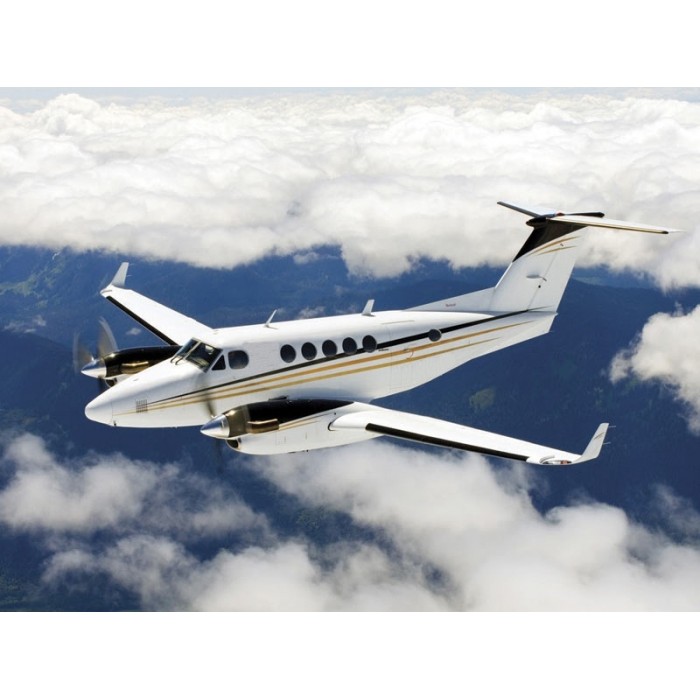


- Availability: Available for rent
Request aircraft information
The Beechcraft King Air 200 is the aircraft that defined the turboprop charter category - in continuous production since 1974 in one form or another, with over 1,800 airframes built across the 200 series family and 964 King Air B200s confirmed active by AMSTAT, it is the most widely available turboprop in the world for private charter. Design work began in October 1970 as the Model 200; the prototype first flew on 27 October 1972; FAA certification followed in December 1973; and the first civil delivery took place in February 1974. The King Air 200 was a substantial development of the earlier King Air 100 - retaining the same basic fuselage but adding a T-tail, greater wingspan and span, increased fuel capacity, higher operating weights and uprated Pratt and Whitney Canada PT6A-41 engines at 850 shp each. The B200 variant (from May 1980) upgraded to PT6A-42 engines and 4-blade McCauley propellers. The B200GT (from 2007) introduced PT6A-52 engines and Collins Pro Line 21 avionics before evolving into the current King Air 250 and King Air 260 (from 2020, with 1,720 nm range and 310 kt cruise).
The King Air 200 is a twin-engine turboprop, not a jet aircraft. This distinction matters for charter clients: turboprops burn significantly less fuel than jets of comparable cabin size, access shorter and unpaved runways that jets cannot use, and produce lower operating costs per seat mile on sectors under 500 nm. The King Air 200's noise-reduced cabin, speed, space and cost-efficiency make it a great charter option for reaching small or remote airfields that larger aircraft cannot access. Charter prices start from approximately £1,200 per flight hour. For the full fleet see our private jet price guide or browse our complete fleet.

Why charter the King Air 200?
- 21,000+ accessible airfields; short and unpaved runway capability - the aircraft that reaches where jets cannot. The King Air 200's turboprop configuration and low stall speed give it access to airfields unavailable to any jet aircraft. Short grass strips, highland Scottish airfields, Alpine grass strips, private estate runways and remote island approaches that jet aircraft require a minimum of 4,000 ft paved surface to reach are all accessible to the King Air 200 from 2,500 ft or less. Its ability to operate from short, unimproved runways makes it versatile, while its pressurised cabin and 35,000 ft altitude ceiling offer the ability to cruise above weather. For charter clients who want to land at a private airfield, a Scottish Highland strip or a remote European approach, the King Air 200 is the practical choice where no jet can follow;
- PT6A-42 engines - the world's most reliable turboprop powerplant; 400 million+ flight hours; 1-in-650,000 hours shutdown rate; 3,600-hour TBO. The PT6 family has accumulated over 400 million hours in service, with a shutdown rate of 1 in 650,000 hours and a 3,600-hour TBO. The PT6A-42 at 850 shp is the definitive powerplant in the King Air 200 series - the same basic engine family that powers the Pilatus PC-12 NGX, Cessna Caravan and hundreds of other commercial turboprops globally. The PT6's unrivalled reliability record over five decades is the primary reason the King Air 200 is the aircraft of choice for medevac, military, government and remote operations worldwide. Depreciation is slower compared to light jets, and parts support is strong globally. For charter clients, PT6A reliability translates directly to departure reliability - King Air 200s very rarely cancel for mechanical reasons;
- 1,800+ King Air 200 series built; 964 B200s in active service; most widely available charter turboprop in the world. With over 1,800 produced, it is usually readily available to charter or purchase. According to AMSTAT, there are 964 aircraft currently in service, including 567 in North America. The depth of this fleet means same-day charter availability on the King Air 200 is higher than any other turboprop type. The large fleet also provides unmatched MRO depth: PT6A-42 overhaul facilities, parts suppliers and King Air type-rated crews are available globally. For UK and European operations, multiple King Air 200s are available within 24 hours from most regions. Corporate Jet Investor confirmed 1,180 B200 airframes delivered - making it the most successful aircraft in the King Air family;
- Single-pilot certified; lower charter rates than jets of comparable cabin size; electronically tuned vibration absorbers for quiet cabin. The King Air 200 can be flown as a single-pilot configuration or with two pilots. Air Charter Advisors always recommends using a two-pilot configuration as it adds additional levels of safety. The single-pilot certification reduces fixed crew costs. The King Air 200 uses electronically tuned vibration absorbers to decrease noise throughout the cabin and flight deck. These absorbers, positioned throughout the airframe, reduce propeller-induced vibration that would otherwise be noticeable in the passenger cabin, providing a quieter environment than unmodified turboprop aircraft of comparable performance. The King Air 200 charter rate of approximately £1,200/hr makes it substantially more economical than any comparable-cabin jet for groups of 4 to 7 on sectors under 600 nm;
- Medevac workhorse; RAF; US Army C-12; Royal Flying Doctor Service; 50+ military operators - the most government-trusted turboprop. The Super King Air family has been in continuous production since 1974, the longest production run of any civilian turboprop aircraft in its class. Military and government operators include the US Army (C-12 designation), the Royal Air Force, the Royal Australian Flying Doctor Service, the Royal Malaysian Air Force (B200T surveillance configuration) and the US Navy T-54A Marlin II trainer. The Beechcraft 1900 regional airliner was derived from the Model B200 King Air, validating platform engineering. For charter clients who want an aircraft with government and military pedigree on demanding remote operations, the King Air 200's track record is unmatched in the turboprop category;
- B200GT / King Air 250 / King Air 260 evolution - PT6A-52; Pro Line 21; 1,720 nm; 310 kt - the same platform continuously updated to 2024. Beechcraft introduced the B200GT in 2008, upgrading to PT6A-52 engines for a higher cruise speed, better runway performance and superior handling of hot and high conditions. The subsequent King Air 250 (B200GT) and King Air 260 (from December 2020, with Multi-Scan weather radar and autothrottle) continue this evolution. The United States Navy awarded a contract to Beechcraft for 10 modified King Air 260 aircraft to replace the King Air H90-based T-44 Pegasus as its primary multi-engine trainer, with options to purchase up to 64 airframes. When chartering, confirming the specific variant - standard B200, B200GT/King Air 250, or King Air 260 - determines the avionics standard and performance level available.
Charter cost - King Air 200 prices from UK airports
Hourly rates run from approximately £1,200 to £1,800 - significantly below jet aircraft of comparable cabin size, reflecting the King Air 200's turboprop operating economics, single-pilot certification and lower acquisition cost. The cost to charter a King Air 200 starts at around $1,800-$2,000 an hour, and hourly rates will vary based on year of make, model, and other factors. For groups of 4 to 7 on short UK regional and European sectors where short-field access or lower rates are priorities, the King Air 200 provides the best value in the turboprop charter category.
Indicative one-way prices from UK airports:
- London to Edinburgh - from £1,440 (6 passengers, approximately 1 hour 10 minutes);
- London to Paris - from £1,560 (6 passengers, approximately 1 hour 20 minutes);
- London to Geneva - from £2,160 (6 passengers, approximately 1 hour 50 minutes);
- Edinburgh to Inverness - from £1,200 (6 passengers, approximately 40 minutes);
- London to Amsterdam - from £1,560 (6 passengers, approximately 1 hour 15 minutes);
- London to Dublin - from £1,440 (6 passengers, approximately 1 hour 10 minutes);
- Manchester to Nice - from £2,640 (6 passengers, approximately 2 hours 15 minutes).
Empty Leg flights appear on repositioning routes. See our Empty Legs page for current availability.

Ideal routes for the King Air 200
Best matched to short UK regional and European missions where short-field access, turboprop economics and PT6A reliability serve groups of 4 to 7 at entry-level charter rates:
- Short UK regional sectors (30 to 90 minutes) where short-field access is the primary requirement. The King Air 200's ability to operate from strips of 2,500 ft or less opens Scottish Highland airfields, island approaches, private estate strips and small regional airfields inaccessible to any jet. Inverness, Wick, Stornoway, Kirkwall, Sumburgh, Islay, Tiree and private grass strips in England and Scotland are all within the King Air 200's operational envelope. For groups who need to land at a destination with a short or unpaved runway, the King Air 200 is typically the only pressurised multi-engine option available;
- Short European day trips (1 to 2.5 hours) where turboprop economics matter more than jet speeds. Paris, Amsterdam, Brussels and Dublin are all within 75 to 90 minutes. At these sector lengths the King Air 200's approximately 297-310 kt cruise is meaningfully slower than a jet, but the charter rate saving of 25 to 40% versus an equivalent-cabin light jet is substantial for budget-conscious groups. For corporate groups of 4 to 6 on regular short European sectors, the King Air 200's economics are the selection argument;
- Medevac and medical transfer missions - the most widely used medevac aircraft in Europe. The King Air 200 is the standard medical evacuation aircraft across European and global air ambulance operations, used by the Royal Flying Doctor Service, multiple European air ambulance services and military medical transport. The cabin configuration for stretcher, oxygen and IV equipment is thoroughly established. For charter clients requiring urgent medical transfer with a pressurised aircraft capable of operating from short airfields near hospitals, the King Air 200 is the first-choice turboprop platform;
- Remote airfield access and island operations in Scotland, Ireland and European islands. Charter groups travelling to the Scottish Islands, Hebrides, Orkney, Shetland, Channel Islands, Scilly Isles and remote European airfields without jet-capable infrastructure find the King Air 200 the practical solution. The pressurised cabin at 35,000 ft ceiling provides weather avoidance capability on longer crossings. The short-field landing performance enables direct access to destination airfields that would otherwise require onward road or helicopter connections;
- Owner-pilot and corporate flight department operations where single-pilot certification reduces crew costs. The King Air 200's single-pilot certification means corporate flight departments can operate the aircraft with one qualified pilot, reducing crew costs versus two-pilot requirement jets. For charter clients whose operator uses a single-pilot configuration (Air Charter Advisors recommends two pilots regardless), the crew economics contribute to lower charter rates. Avionics upgrades including Garmin G1000 retrofit and Pro Line 21 (on B200GT/King Air 250) have modernised the cockpit considerably on updated aircraft.

Cabin and in-flight experience
The King Air 200 cabin measures 5.08 m (16.7 ft) long, 1.37 m (4.5 ft) wide and 1.45 m (4.75 ft) high. Club seating for four is standard, with options for additional forward/rear-facing chairs or a belted lavatory. Basic refreshment center and storage options are available. Six passengers in a standard charter configuration; up to nine in high-density layout. The semi-enclosed lavatory option provides basic privacy. The King Air 200 uses electronically tuned vibration absorbers to decrease noise throughout the cabin and flight deck, reducing propeller vibration more effectively than unmodified turboprop aircraft. The cabin is pressurised to a maximum of 6.5 psi on the B200 variant, maintaining a comfortable cabin altitude on climbs to the 35,000 ft service ceiling.
Avionics vary significantly by age and refurbishment: original aircraft carry analogue instruments; B200SE and later carry EFIS; B200GT/King Air 250 carries Collins Pro Line 21 with full glass cockpit. Earlier B200s came with analog steam gauge panels, but most have been upgraded. Autopilot, TCAS, weather radar and WAAS/LPV approach capabilities are commonly retrofitted. Baggage capacity is 55 ft³ (1.51 m³). Confirm the specific avionics standard and configuration with the operator before booking.
- Cabin. 5.08 m x 1.37 m x 1.45 m; pressurised (6.5 psi B200); 35,000 ft ceiling;
- Layout. Club-4 standard; 6 typical; 9 maximum; semi-enclosed lav option;
- Noise. Electronically tuned vibration absorbers standard;
- Baggage. 55 ft³ (1.51 m³);
- Engines. 2 x PT6A-42 (850 shp each; 3,600-hr TBO) on B200; PT6A-52 on B200GT;
- Avionics. Varies: analogue (early B200); EFIS (B200SE); Pro Line 21 (B200GT/KA250); Garmin G1000 retrofit common;
- Single-pilot. Certified for single-pilot operation (two pilots recommended).
Technical specifications
| Manufacturer | Beechcraft / Textron Aviation, Wichita, Kansas |
| First flight | 27 October 1972 |
| FAA certification | December 1973 |
| First civil delivery | February 1974 |
| Production | 1974-present (King Air 260); 1,800+ total 200 series; 1,180 B200s |
| Variants | 200 (PT6A-41); B200 (PT6A-42); B200GT/KA250 (PT6A-52); KA260 (2020) |
| Aircraft class | Twin-engine turboprop (not a jet) |
| Engines (B200) | 2 x Pratt and Whitney Canada PT6A-42 (850 shp each; 3,600-hr TBO) |
| Engines (B200GT) | 2 x Pratt and Whitney Canada PT6A-52 (850 shp; higher altitude performance) |
| Cruise speed | 297-310 kt / 550-574 km/h |
| Service ceiling | 35,000 ft / 10,670 m |
| Range (B200, NBAA IFR) | ~1,580 nm / 2,926 km |
| Range (B200GT/KA260) | 1,720 nm / 3,185 km |
| MTOW | 12,500 lb / 5,670 kg (B200) |
| Pressurisation | 6.5 psi (B200) |
| Noise reduction | Electronically tuned vibration absorbers standard |
| Single-pilot certified | Yes |
| Cabin length | 5.08 m (16.7 ft) |
| Cabin width | 1.37 m (4.5 ft) |
| Cabin height | 1.45 m (4.75 ft) |
| Baggage | 55 ft³ / 1.51 m³ |
| Passengers | 6 standard; 9 maximum |
| Wingspan | 16.61 m (54.5 ft) |
| Aircraft length | 13.34 m (43.7 ft) |
| Aircraft height | 4.57 m (15.0 ft) |

King Air 200 vs similar aircraft
- King Air 200 vs Pilatus PC-12 NGX. The Pilatus PC-12 NGX is a single-engine turboprop with a larger cabin volume (330 ft³ vs approximately 265 ft³ on the King Air 200), flat floor and BMW-designed interior. Charter rates are broadly comparable. The King Air 200 counters with twin-engine safety redundancy (two engines vs one), higher cruise ceiling (35,000 ft vs 30,000 ft for PC-12), faster cruise (310 kt vs 290 kt) and the deeper MRO base of 1,800+ aircraft vs the PC-12 fleet. For groups where twin-engine safety is required by corporate policy, the King Air 200 is the appropriate choice; for cabin space and floor flatness, the PC-12 is preferable;
- King Air 200 vs King Air 300. The King Air 300 uses PT6A-60A engines at 1,050 shp (vs 850 shp on the B200), providing 320 kt cruise (vs 297-310 kt), 35,000 ft ceiling (same) and comparable range. Charter rates for the 300 run approximately 10 to 20% above the 200. The B200 counters with 1,800+ airframe availability (vs 247 King Air 300s built), lower rates and the PT6A-42's proven reliability. For speed-priority missions where the 10 kt difference matters, the 300 is preferable; for availability and lower rates, the 200 is the practical choice;
- King Air 200 vs Learjet 31A. The Learjet 31A is a light jet at approximately comparable charter rates. The Learjet 31A provides 465 kt cruise (vs 310 kt for the King Air 200) and Stage 3 jet compliance, but requires 4,000 ft minimum paved runway and has a smaller cabin (1.32 m height vs 1.45 m on KA200, no stand-up in either). The King Air 200 counters with short-field access from 2,500 ft, unpaved runway capability, lower fuel costs and PT6A reliability. For speed-priority jet-capable airport missions the 31A is faster; for short-field and turboprop economics the King Air 200 is the choice.

Frequently asked questions - King Air 200 charter
How much does it cost to charter a King Air 200?
Charter rates run from approximately £1,200 to £1,800 per flight hour. London to Edinburgh costs from £1,440 for 6 passengers. London to Geneva costs from £2,160. Manchester to Nice costs from £2,640. All quotes from Private Jets UK are fully itemised with no hidden charges.
Is the King Air 200 a jet or turboprop?
The King Air 200 is a twin-engine turboprop aircraft, not a jet. It is powered by Pratt and Whitney Canada PT6A-42 turboprop engines (propeller-driven turbines), not turbofan or turbojet engines. This means lower fuel burn than jets of comparable cabin size, access to shorter and unpaved runways, and lower charter rates. The trade-off is slower cruise speed - approximately 297 to 310 kt versus 430 to 465 kt for comparable light jets.
What is the difference between the King Air 200, B200 and B200GT?
The original King Air 200 (from 1974) used PT6A-41 engines. The B200 (from 1980) upgraded to PT6A-42 engines, McCauley propellers and revised landing gear. The B200GT (from 2007, sold as King Air 250) added PT6A-52 engines for better hot-and-high performance and Collins Pro Line 21 avionics. The current King Air 260 (from 2020) adds Multi-Scan weather radar, autothrottle and 1,720 nm range. When chartering, confirm the specific variant as avionics and performance vary substantially.
How many passengers can fly on a King Air 200?
Six in the standard charter configuration; up to nine in high-density layout. Standard seating is club-four with additional forward or rear-facing chairs. A semi-enclosed belted lavatory is available as an option. The cabin height of 1.45 m does not allow standing during flight. Baggage capacity is 55 ft³ in the aft compartment.
Can the King Air 200 land on grass or short runways?
Yes - the King Air 200 can operate from paved or unpaved runways as short as approximately 2,500 ft. This opens access to Scottish Highland airfields, island airstrips, private estate runways and small regional airfields inaccessible to any jet aircraft. The King Air 200 is the standard aircraft for remote airfield operations in the UK, Australia, Canada and across Africa and Latin America. Confirm the specific airfield surface and landing weight with the operator before booking.

