

Charter an Emivest SJ30-2


- Availability: Available for rent
Request aircraft information
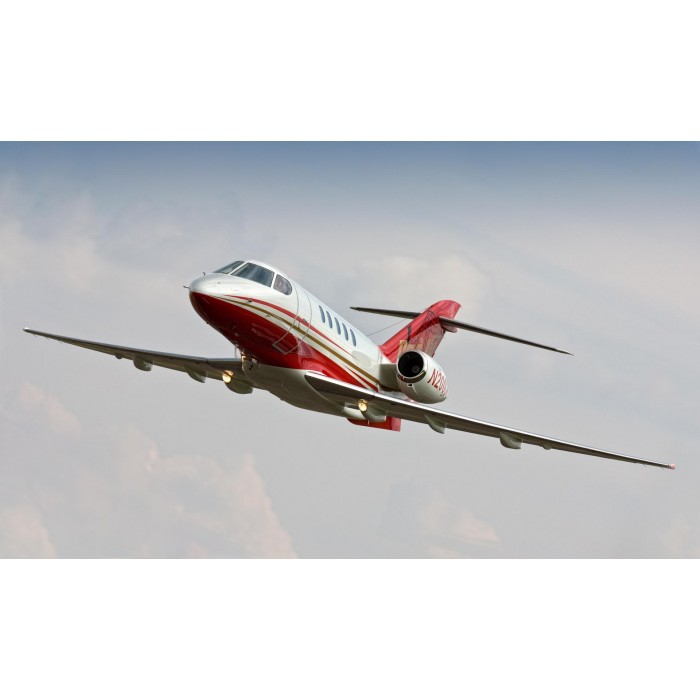
The Emivest SJ30-2 is a light business jet with a development history stretching back to 1988 — one of the longest certification programmes in business aviation. Originally designed by Ed Swearingen as the SA-30 Fanjet, backed by Gulfstream Aerospace from October 1988 and then the Jaffe Group from September 1989, the first SJ-30 flew on 13 February 1991. The programme was subsequently acquired by Sino Swearingen Aircraft Corporation, a Taiwanese-American joint venture, which stretched the fuselage by 4.3 ft (1.3 m) and increased the wingspan by 6 ft to create the SJ30-2. The SJ30-2 prototype flew on 8 November 1996 and received FAA type certification on 27 October 2005, with first delivery on 1 November 2006. Dubai investors acquired Sino Swearingen in 2008, renaming it Emivest Aerospace; production ceased in November 2009 following financial difficulties. SyberJet Aircraft acquired the assets in 2011 and subsequently developed the SJ30i with updated Honeywell Primus Epic 2.0 avionics.
The SJ30-2 holds two distinctions that set it apart from every other light jet produced: Mach 0.83 / 486 kt maximum cruise — the highest in its class — and a sea-level cabin maintained to 41,000 ft, enabled by a 12 psi pressurisation differential (versus the industry standard 8 to 9 psi). Flight Global's flight test described it as a «long-range rocket in a niche of its own.» Two Williams FJ44-2A engines at 2,300 lbf provide 49,000 ft maximum altitude and 2,500 nm range when lightly loaded. The Honeywell Primus Epic avionics suite with three 8×10-inch LCD displays and Primus 331 weather radar is standard. Single-pilot IFR certified. Charter prices start from approximately £1,600 per flight hour. For the full fleet see our private jet price guide or browse our complete fleet.
Why charter the Emivest SJ30-2?
- Sea-level cabin to 41,000 ft — the only light jet with 12 psi pressurisation. The SJ30-2 maintains a sea-level (0 ft) cabin altitude up to FL410 — a direct consequence of its 12 psi pressurisation differential, versus the 8 to 9 psi standard on all other business jets. At FL430 during the Flight Global test flight, the indicated cabin altitude was just 500 ft. Every other light jet at comparable altitude maintains a cabin altitude of 6,000 to 8,000 ft. The pressurisation vessel was tested to 31.4 psi — a world record during FAA pressurisation ultimate load testing. For passengers sensitive to the dehydration and fatigue effects of high cabin altitude, the SJ30-2's sea-level environment on every sector is an entirely unique capability in the light jet class;
- Mach 0.83 / 486 kt maximum cruise — fastest in the light jet class. The SJ30-2 achieves Mach 0.83 maximum cruise and Mach 0.76 / 436 kt long-range cruise — the highest high-speed cruise of any certified light business jet. At Mach 0.81 cruise during the Flight Global evaluation, total fuel flow was 850 lb/hr at 459 kt true airspeed. For comparison, most competing light jets cruise at Mach 0.75 to 0.78. The speed advantage over a Phenom 300 or Citation CJ4 on a 2-hour European sector amounts to 10 to 20 minutes — meaningful on same-day return missions where schedule is the constraint;
- 2,500 nm range at light load — transatlantic capable for a light jet. At light loading the SJ30-2 covers 2,500 nm (4,630 km) — a range figure that overlaps with many midsize jets and, as Flight Global noted, is sufficient to cross the Atlantic with three occupants without a fuel stop in Greenland or Iceland. With four passengers the range is 2,220 nm (4,110 km), more than double that of the Beechcraft Premier 1A on the same sector. This combination of light-jet operating economics with midsize-adjacent range is the SJ30-2's defining commercial proposition;
- 49,000 ft service ceiling — above all commercial traffic and most weather. The SJ30-2 is certified to 49,000 ft — a figure that exceeds most competing light jets by 8,000 to 18,000 ft and equals or exceeds several large-cabin long-range aircraft. Flight Global confirmed the aircraft had flown at this altitude during testing. Operating at FL490 places the SJ30-2 above the jet stream, above most convective weather and above all commercial airline traffic on European and transatlantic sectors. Single-pilot IFR certification applies throughout the envelope;
- Williams FJ44-2A engines at 2,300 lbf — same proven powerplant as the Beechcraft Premier 1A. The SJ30-2 uses the same Williams FJ44-2A turbofans as the Beechcraft Premier 1A — a powerplant with an extensive operational record across multiple certified aircraft types. Rear pod mounting on the fuselage keeps engine noise away from the passenger cabin. At long-range cruise (Mach 0.76) fuel flow drops to 720 lb/hr total — efficient for a light jet at this speed and altitude;
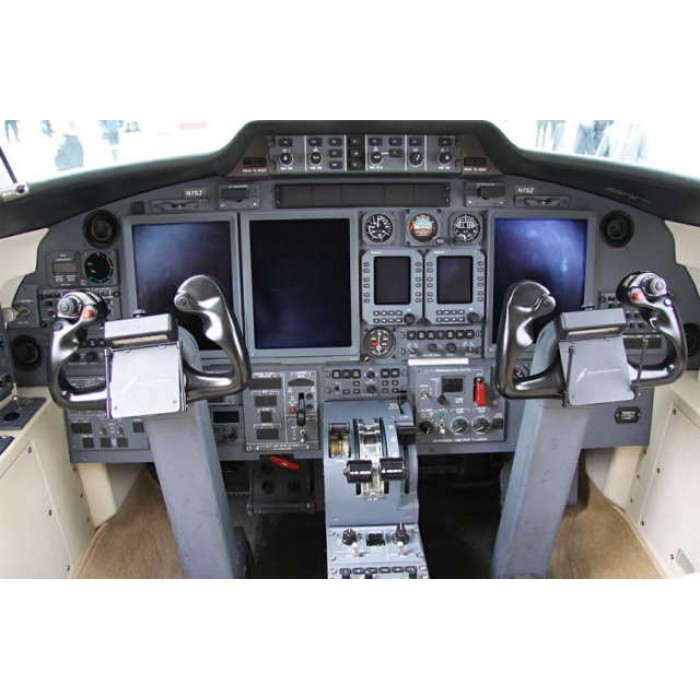
- Honeywell Primus Epic with Primus 331 weather radar and Iridium phone — full business specification. The SJ30-2 avionics suite comprises three Honeywell DU-180 8×10-inch flat panel LCD displays, dual IC-615 avionics computers with FMS and GPS, Primus 331 colour weather radar in the nose and optional TCAS 2000 traffic advisory system. An Iridium satellite phone with wireless cabin handset, 110V outlets in both cockpit and cabin, moving map display and self-contained flushing toilet complete the standard specification. Berthable cabin seats reconfigure to flat-bed positions.
Charter cost — Emivest SJ30-2 prices from UK airports
Hourly rates run from approximately £1,600 to £2,200 — reflecting the SJ30-2's rarity, Mach 0.83 cruise and unique sea-level pressurisation. Availability is limited: only a small number of aircraft are in active charter service. For 2 to 5 passengers on European and longer missions where speed and cabin comfort matter equally, the SJ30-2 provides a combination unavailable from any other light jet.
Indicative one-way prices from UK airports:
- London to Edinburgh - from £1,920 (4 passengers, approximately 55 minutes);
- London to Geneva - from £2,880 (4 passengers, approximately 1 hour 15 minutes);
- London to Paris - from £1,920 (4 passengers, approximately 50 minutes);
- London to Dubai - from £19,200 (4 passengers, non-stop possible at light load, approximately 6 hours);
- London to Reykjavik - from £6,400 (4 passengers, non-stop, approximately 3 hours);
- London to Moscow - from £9,600 (4 passengers, non-stop, approximately 3 hours 30 minutes);
- London to Nice - from £3,200 (4 passengers, approximately 1 hour 40 minutes).
Empty Leg flights appear on repositioning routes. See our Empty Legs page for current availability.
Ideal routes for the Emivest SJ30-2
Best matched to speed-sensitive European missions and longer transatlantic-adjacent sectors where Mach 0.83 cruise, sea-level cabin and 2,500 nm range serve groups of 2 to 5:
- Short European sectors where Mach 0.83 shaves 10 to 20 minutes versus competing light jets. Paris, Amsterdam, Brussels, Geneva and Nice are all within 50 to 100 minutes at Mach 0.83. The speed advantage over a Phenom 300E (Mach 0.78) or Citation CJ4 (Mach 0.737) on these sectors delivers the fastest light jet journey time available. With the sea-level cabin throughout, passengers arrive at the destination in measurably better condition than on competing aircraft at 6,000 to 8,000 ft cabin altitude;
- UK to Reykjavik, Azores and North Atlantic islands (2.5 to 4 hours) — light jet range that reaches mid-Atlantic. Reykjavik (approximately 1,200 nm), the Azores (approximately 1,500 nm) and Canary Islands (approximately 1,700 nm) are all within comfortable non-stop range. For a light jet these routings would normally require a fuel stop; the SJ30-2's 2,500 nm envelope eliminates it. The 49,000 ft ceiling provides weather clearance on North Atlantic routing that most light jets cannot reach;
- Speed-sensitive same-day return missions in Europe. For corporate clients whose schedule requires an outbound sector, meeting time and return within a single day, the Mach 0.83 cruise combined with the sea-level cabin means the SJ30-2 converts the fastest possible sector time while delivering passengers in the best possible condition for the meeting at the destination. No other light jet provides both simultaneously;
- Long European sectors to Eastern Europe and Scandinavia (2.5 to 4 hours). Warsaw, Stockholm, Oslo, Istanbul and Moscow are all within non-stop range. At Mach 0.83 these sectors take 2 to 3.5 hours. The berthable flat-bed cabin seats allow rest on the longer afternoon sectors. The Primus 331 weather radar and 49,000 ft ceiling provide weather avoidance capability well above what these sectors typically require;
- Transatlantic at light load — three occupants, no fuel stop. As Flight Global noted, with three occupants the SJ30-2 can cross the Atlantic without a fuel stop in Greenland or Iceland. At four passengers the 2,220 nm range is marginal for a direct London to New York crossing but opens Boston, Halifax and other eastern seaboard destinations that the standard light jet cannot reach non-stop from the UK.
Cabin and in-flight experience
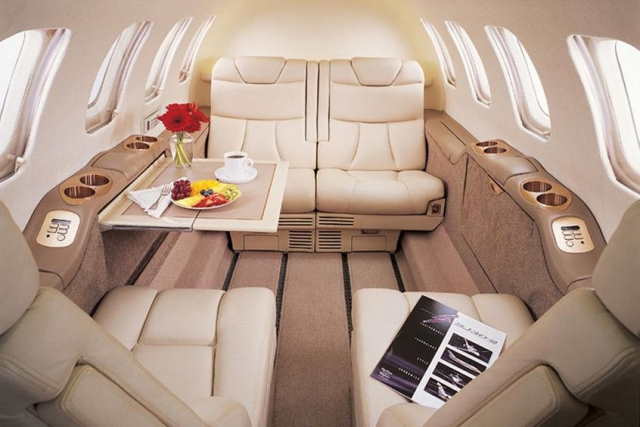
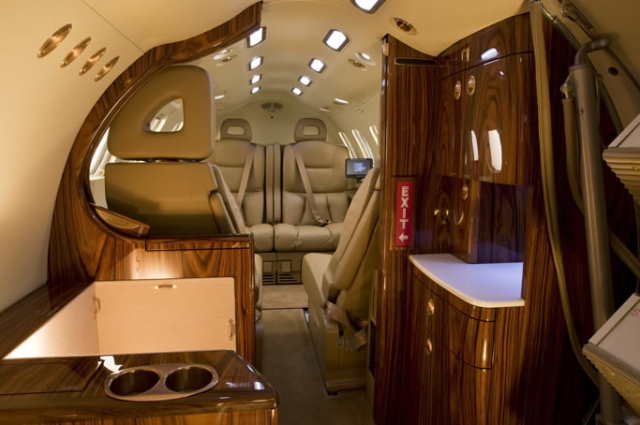
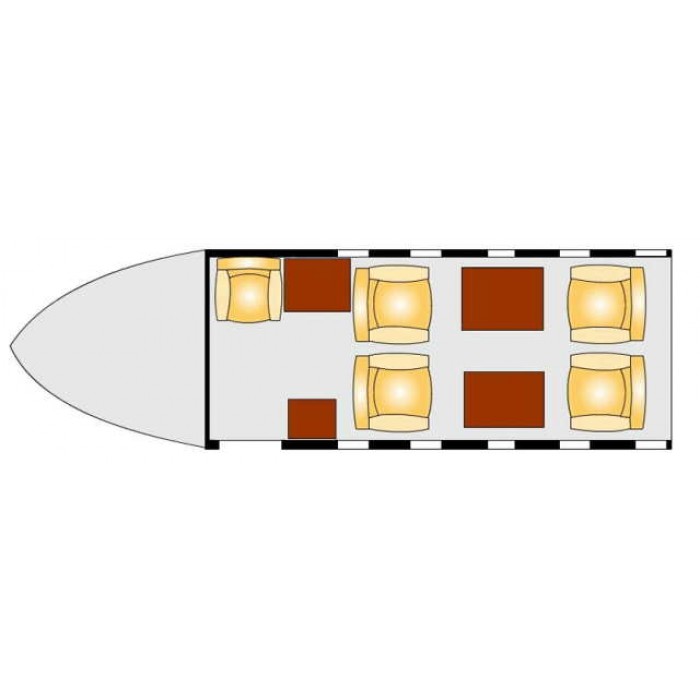
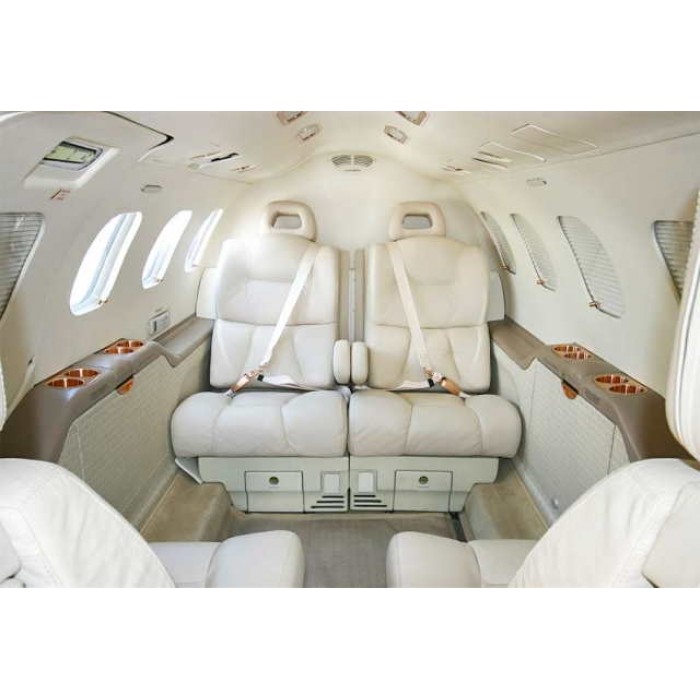
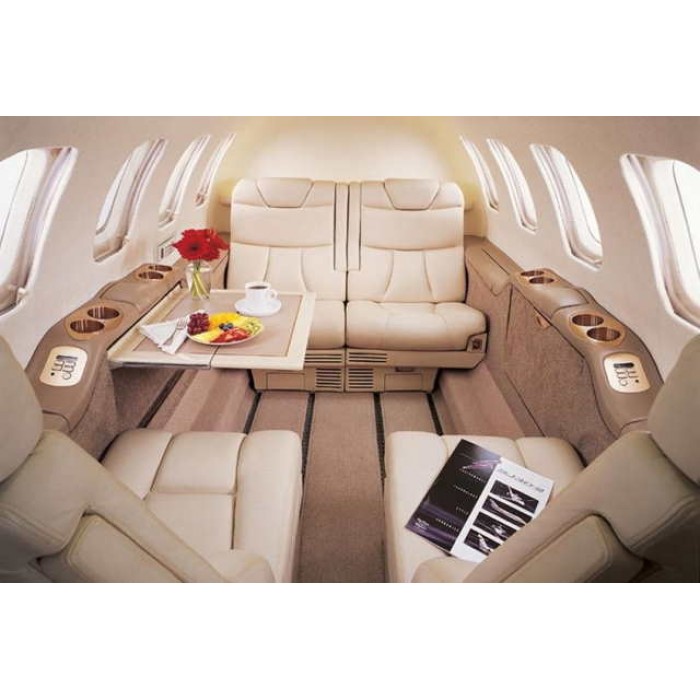
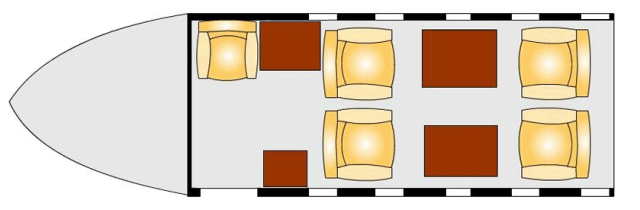
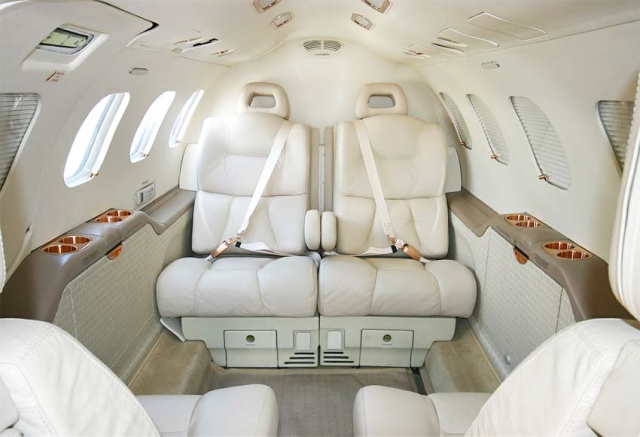
The SJ30-2 cabin measures 3.87 m long, 1.47 m wide and 1.32 m high — compact by light jet standards, but with a cabin altitude of 0 ft (sea level) maintained throughout cruise at FL410 and only 500 ft at FL430. Six extra-wide berthable seats recline to full flat-bed; aft-facing seats fully recline. Fold-out work tables have 110V sockets and computer ports. Cabin side consoles provide magazine storage; five reading lights and two table lights supplement the eleven overhead lights.
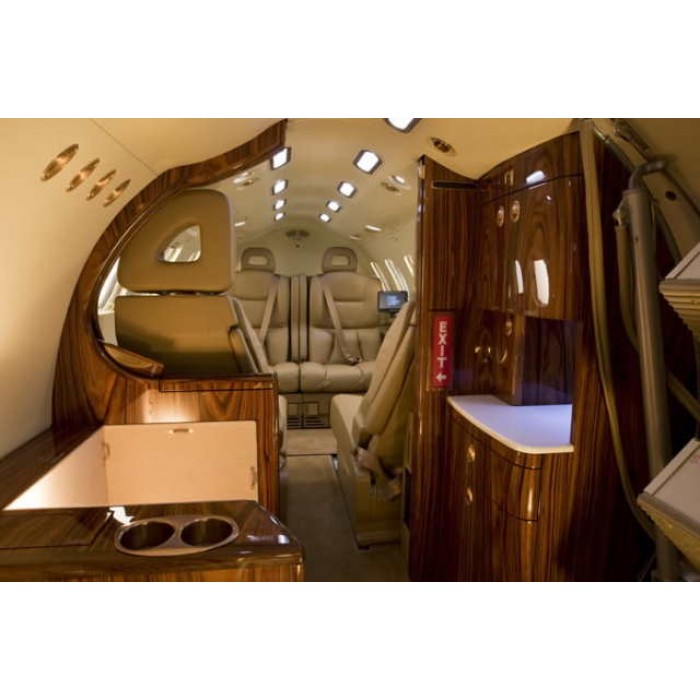
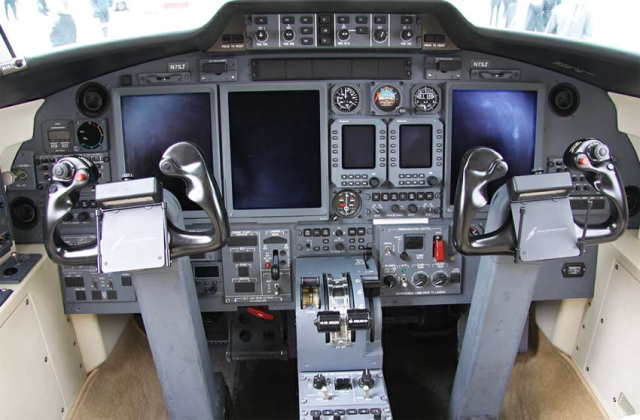
A mid-cabin divider with stowing doors separates forward and aft zones. A self-contained flushing toilet is fitted as standard with a side-facing installation. An Iridium satellite phone with one wireless cabin handset is standard. A full-height refreshment centre and lower drawer cabinet complete the galley area. Moving map display is fitted in the passenger cabin. Three Honeywell DU-180 8×10-inch LCD displays, Primus 331 weather radar, dual IC-615 computers with FMS and GPS occupy the flight deck. 110V power is available in both cabin and cockpit.
- Cabin. 3.87 m × 1.47 m × 1.32 m; 6 berthable seats; sea-level altitude to FL410;
- Pressurisation. 12 psi (vs 8-9 psi standard); sea level to FL410; 500 ft at FL430;
- Seats. Extra-wide; fully berthable; 110V sockets; computer ports; fold-out tables;
- Toilet. Self-contained flushing; side-facing; standard;
- Communications. Iridium satellite phone; wireless cabin handset; moving map display;
- Power. 110V in cabin and cockpit;
- Avionics. Honeywell Primus Epic; 3× DU-180 8×10-inch LCD; dual FMS/GPS; Primus 331 weather radar; optional TCAS 2000;
- Engines. 2 × Williams FJ44-2A (2,300 lbf; same as Premier 1A); rear pod mounted.
Technical specifications
| Manufacturer | Sino Swearingen / Emivest Aerospace, San Antonio, Texas |
| Development start | 1988 (SA-30 Fanjet); SJ30-2 first flight 8 November 1996 |
| FAA certification | 27 October 2005 |
| First delivery | 1 November 2006 |
| Production ended | November 2009 (Emivest bankruptcy 2010; SyberJet 2011) |
| Aircraft class | Light business jet (fastest in class) |
| Engines | 2 × Williams FJ44-2A (2,300 lbf / 10.23 kN each; rear pod mounted) |
| Avionics | Honeywell Primus Epic; 3× DU-180 8×10-inch LCD; dual IC-615; FMS; GPS; Primus 331 radar |
| Max cruise speed | Mach 0.83 / 486 kt (901 km/h) — fastest in light jet class |
| Long-range cruise | Mach 0.76 / 436 kt (807 km/h) |
| Fuel flow (Mach 0.81) | 850 lb/hr (386 kg/hr) at 459 kt TAS |
| Range (light load) | 2,500 nm / 4,630 km |
| Range (4 passengers) | 2,220 nm / 4,110 km |
| Service ceiling | 49,000 ft (14,935 m) |
| Cabin altitude | Sea level (0 ft) to FL410; 500 ft at FL430 |
| Pressurisation | 12.0 psi (vs 8-9 psi industry standard); tested to 31.4 psi (world record) |
| Takeoff BFL | 3,939 ft / 1,200 m |
| Landing distance | 2,941 ft / 896 m |
| MTOW | 13,950 lb / 6,330 kg |
| Cabin length | 3.87 m (12.7 ft) |
| Cabin width | 1.47 m (4 ft 10 in) |
| Cabin height | 1.32 m (4 ft 4 in) |
| Passengers | 6 + pilot; single-pilot IFR certified |
| Wingspan | 12.90 m (42 ft 4 in) |
| Aircraft length | 14.26 m (46 ft 9 in) |
| Aircraft height | 4.33 m (14 ft 2 in) |
Emivest SJ30-2 vs similar aircraft
- Emivest SJ30-2 vs Embraer Phenom 300E. The Phenom 300E has a larger cabin (4.92 m vs 3.87 m), more passengers (10 vs 6), longer range in production and an extensive global support network. Charter rates are comparable or slightly higher. The SJ30-2 counters with Mach 0.83 maximum cruise (vs Phenom 300E's Mach 0.78), the sea-level cabin to FL410 (vs Phenom 300E's 6,000 ft at similar altitude), 49,000 ft ceiling and 2,500 nm range at light load. For 2 to 4 passengers where maximum speed and minimum cabin altitude are the priorities, the SJ30-2 is without equal in the light jet class;
- Emivest SJ30-2 vs Beechcraft Premier 1A. The Premier 1A has a significantly larger cabin (4.11 m × 1.68 m vs 3.87 m × 1.47 m) and wider cross-section. Charter rates are broadly comparable. The SJ30-2 counters with Mach 0.83 cruise (vs Premier 1A's Mach 0.80), sea-level cabin (vs Premier 1A's standard pressurisation), 49,000 ft ceiling (vs 41,000 ft) and 2,500 nm range at light load (vs 1,380 nm). Flight Global specifically noted that the SJ30-2's range with four passengers at 4,110 km exceeds the Premier 1A's on the same sector by more than double. For range and speed the SJ30-2 is superior; for cabin space the Premier 1A is preferable;
- Emivest SJ30-2 vs Learjet 70. The Learjet 70 has a longer cabin (5.39 m vs 3.87 m), more passengers (6 standard), Global 7500-derived winglets and stronger operator support from Bombardier's network. The SJ30-2 counters with higher maximum cruise (Mach 0.83 vs Mach 0.81), the unique sea-level cabin (vs Learjet 70's 6,000 ft), 49,000 ft ceiling (vs 51,000 ft — comparable) and 2,500 nm range at light load (vs 2,060 nm). For passengers who will not compromise on cabin altitude, the SJ30-2 is the only option.
Frequently asked questions — Emivest SJ30-2 charter
How much does it cost to charter an Emivest SJ30-2?
Charter rates run from approximately £1,600 to £2,200 per flight hour. London to Geneva costs from £2,880 for 4 passengers. London to Edinburgh costs from £1,920. London to Paris costs from £1,920. Availability is limited — contact Private Jets UK to confirm current aircraft on the fleet.
What makes the SJ30-2 pressurisation system unique?
The SJ30-2 maintains a sea-level (0 ft) cabin altitude up to FL410 using a 12 psi pressurisation differential — compared to the 8 to 9 psi standard across all other certified business jets. During the Flight Global test flight, cabin altitude at FL430 was indicated at just 500 ft. The pressure vessel was tested to 31.4 psi during an FAA pressurisation ultimate load test — a world record. No other light jet in production or current charter service provides a sea-level cabin at high cruise altitude.
How fast is the Emivest SJ30-2?
Maximum cruise is Mach 0.83 / 486 kt (901 km/h) — the fastest certified maximum cruise speed in the light jet category. Long-range cruise is Mach 0.76 / 436 kt. At Mach 0.81 during the Flight Global evaluation, fuel flow was 850 lb/hr at 459 kt true airspeed. The SJ30-2 cruise speed advantage over a Phenom 300E (Mach 0.78) translates to approximately 12 minutes saved on a London to Geneva sector.
How many passengers can fly on a Emivest SJ30-2?
Six passengers plus one pilot in standard configuration; single-pilot IFR certification throughout. The cabin seats four to five comfortably for most missions, with the sixth position available. Berthable seats recline to flat-bed; work tables with 110V sockets, a flushing toilet and Iridium phone are standard.
Is the Emivest SJ30-2 still in production?
No — Emivest ceased production in November 2009 and filed for bankruptcy in October 2010. SyberJet Aircraft acquired the assets in 2011 and developed the updated SJ30i (maiden flight 9 October 2019) with Honeywell Primus Epic 2.0 avionics and a new interior, priced at $8.5 million. The original SJ30-2 remains available as a pre-owned and charter aircraft from the small fleet produced between 2006 and 2009.