


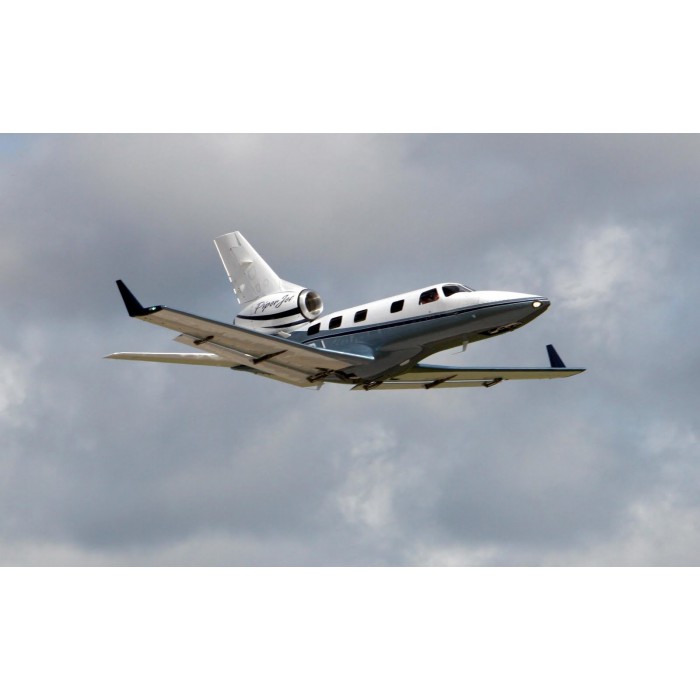
Piper PA-47 PiperJet


- Availability: Available for rent
Request aircraft information
The Piper PA-47 PiperJet was one of private aviation's most ambitious and technically innovative cancelled programmes - a single-engine very light jet with its Williams FJ44-3AP turbofan engine mounted inside the vertical stabilizer, announced in October 2006 and cancelled in October 2011 before a single production aircraft was built. The sole prototype - which first flew on 30 July 2008 - is preserved at the Florida Air Museum at Lakeland, Florida. The Smithsonian Institution also expressed interest in acquiring the aircraft following programme cancellation. Wikipedia confirmed the PiperJet was "the first proposed single-engined civilian aircraft with a podded engine located on the tail" - a radical departure from every competing VLJ design of the period.
The PiperJet was not certified, did not enter production and is not available for charter. The aircraft featured in this section of our fleet as a historical and technical reference - one of aviation's most significant "what-if" designs from the VLJ era. The programme was cancelled in October 2011 due to a combination of the post-2008 economic downturn, rising development costs, FAA uncertainty regarding single-engine jet certification at 35,000 ft and the narrowing cost gap between the PiperJet and established twin-engine competitors. Piper CEO Simon Caldecott stated at cancellation that "the market for light jets is not recovering sufficiently and quickly enough to allow us to continue developing the programme under the economic circumstances we face." For available charter aircraft see our complete fleet or request a quote via our private jet price guide.

Why the Piper PA-47 PiperJet mattered
- Engine-in-vertical-stabilizer configuration - first proposed single-engine civil jet with tail-mounted podded engine; Coanda-effect vectored nozzle. Flying Magazine confirmed the PiperJet team "drew inspiration from the McDonnell Douglas DC-10 airliner" in integrating the engine with the vertical stabilizer. This configuration provided clean undisturbed airflow to the FJ44-3AP, protected tail surfaces from hot exhaust without additional complex shielding, and allowed shorter, lighter landing gear without an overwing or overwing-fuselage engine mount. The critical engineering challenge was the high thrust line: with the engine mounted far above the centre of gravity, applying power pushed the nose downward. The design team first addressed this with an automatic pitch trim system, then replaced it with a vectored thrust nozzle based on the Coanda effect - an innovation developed by Williams International that redirected exhaust downward and aft to counteract the pitch coupling, eliminating the trim system's weight and complexity;
- Williams FJ44-3AP turbofan at 2,820 lbf - same engine family as the Cessna Citation CJ series; straight duct intake in the vertical stabilizer avoiding S-duct complexity. Military Factory confirmed the FJ44-3AP produces 2,820 lb of thrust. The FJ44 family powers the Cessna Citation CJ-series and the Williams FJ33 (from which the FJ44 is derived) powered the Saab 105 and Grob G180. The straight duct intake integrated into the vertical stabilizer - similar in concept to the DC-10's centre engine - provided the clean airflow that an S-duct arrangement (as used in tri-jets like the Falcon 900) would have disrupted. Wikipedia confirmed the straight duct design "offered clean, undisturbed airflow and no concerns about hot engine exhaust affecting the airframe";
- 180 pre-orders at $2.2 million; announced October 2006; competitor to Eclipse 500 and Cessna Citation Mustang - Piper's first and only jet attempt. Wikipedia confirmed 180 pre-orders received by February 2007 at a $2.2 million price point. Simple Flying confirmed "by early 2007, Piper revealed it had already received approximately 180 pre-orders." The PiperJet was announced as a direct competitor to the Eclipse 500 and Cessna Citation Mustang - the twin-engine VLJs that dominated market attention in 2006-2007. Unlike those competitors, Piper chose a single-engine configuration to reduce operating costs and complexity. The single-engine argument was sound in principle but proved commercially difficult: Bolt Flight confirmed "many business jet customers remained hesitant about purchasing a single-engine jet, regardless of engineering assurances";
- PiperJet Altaire redesign (October 2010) - larger circular-section fuselage; conventional yoke replacing side-stick; 5-seat capacity; $2.6 million. Wikipedia confirmed that following a change of ownership at Piper, the company in October 2010 announced the Altaire as a revised design: larger circular-section fuselage providing 9 more inches of headroom and 4 more inches of elbow room than the original PA-47, a conventional control yoke replacing the side-stick, a three-foot-wide cabin door, and 5 passenger seats (vs 7 in the original PA-47 configuration). 160 customers transferred their order positions to the Altaire. Wikipedia confirmed the Altaire was "cancelled in October 2011 due to economic conditions" despite being described as "technically successful";
- FAA single-engine jet certification concern - a fundamental regulatory obstacle that contributed directly to cancellation. Simple Flying confirmed one of the "several factors" contributing to the cancellation was "an indication from the Federal Aviation Administration that it may not certify a single-engine jet to fly to 35,000 feet." This regulatory uncertainty - distinct from the technical engineering challenges that the design team had largely resolved - created commercial uncertainty that potential buyers and investors could not discount. The combination of FAA certification uncertainty, rising development costs from the 2008 global financial crisis, and the narrowing price gap between the PiperJet/Altaire and established twin-engine VLJs removed the business case for continuing the programme;
- Sole prototype preserved at Florida Air Museum, Lakeland, Florida; Smithsonian Institution also expressed interest - historical significance confirmed. The Florida Air Museum historical marker confirmed: "Total Produced: 1; First Flight: July 2008; Cancelled: October 2011." Flying Magazine confirmed "when it became clear the programme would progress no further, the Smithsonian expressed an interest in acquiring the sole prototype." The prototype made demonstration flights at EAA AirVenture and other airshows during its brief active period. Military Factory confirmed the cancellation "inevitably led to a layoff of some 150 Piper employees and refunds/product credits for its customers." The PiperJet programme cost Piper significant resources but produced genuine aerodynamic and engineering advances - particularly the vectored thrust nozzle - that remain relevant to future single-engine jet design discussions.
PA-47 PiperJet timeline
- 1965-2006 (design origin). Piper studies single-engine jet concepts. Programme formally announced October 2006 at $2.2 million target price. Eclipse 500, Citation Mustang and HondaJet are the twin-engine competitors;
- February 2007. 180 pre-orders confirmed. Entry into service initially planned for early 2010;
- 30 July 2008. Sole PA-47 prototype makes first flight. Vectored thrust nozzle replaces original automatic pitch trim system;
- 2008-2009. Global financial crisis. VLJ market collapses. Imprimis purchases Piper. First delivery pushed back to mid-2013. Development costs escalate;
- October 2010. Piper announces PiperJet Altaire redesign - larger circular-section fuselage, conventional yoke, 5 seats, $2.6 million. 160 customers transfer order positions;
- October 2011. Programme cancelled. CEO Simon Caldecott: "The market for light jets is not recovering sufficiently." 150 employees laid off. Customers receive refunds. Sole prototype donated to Florida Air Museum;
- Present. Prototype displayed at Florida Air Museum, Lakeland, Florida. Smithsonian Institution expressed acquisition interest.

Ideal alternatives for PiperJet charter clients
The PiperJet was targeted at owner-operators and charter clients seeking a single-engine VLJ at approximately $2.2 million. Its closest available alternatives today are twin-engine VLJs and light jets in the Private Jets UK fleet:
- HondaJet HA-420 - single-engine jet concept evolved into twin-engine OTWEM design; 422 kt; 1,547 nm; Garmin G3000; London City certified. The HondaJet addressed the PiperJet's target market with an over-the-wing engine mount (OTWEM) twin-turbofan configuration that eliminated the single-engine regulatory and customer-acceptance barriers while keeping the wing and cabin clean. Charter rates from approximately £2,500/hr. See our HondaJet HA-420 page for full details;
- Cessna Citation 501 - the aircraft the PiperJet competed against; twin JT15D; Stage 3; 347 kt; 41,000 ft; single-pilot certified. The Citation 501 (SP) was the first FAA-certified single-pilot jet - the aircraft the PiperJet hoped to succeed in the light jet entry market. Charter rates from approximately £900/hr. Available in the Private Jets UK fleet;
- Piper Cheyenne II - the highest-performing Piper aircraft available for charter; pressurised turboprop; 283 kt; 35,800 ft. For clients who want a Piper aircraft with pressurised cabin performance at £900/hr, the Cheyenne II provides the highest performance Piper in the Private Jets UK fleet. See our Piper Cheyenne page.

Cabin and design specifications (as proposed)
The PA-47 PiperJet fuselage was based on the Piper PA-46 Meridian single-engine turboprop with a 4-foot (1.2 m) fuselage extension. Wikipedia confirmed the fuselage cross-section was identical to the PA-46 series. The cabin was designed to seat 7 passengers with a side-stick flight control for the pilot. The Altaire redesign increased headroom by 9 inches and width by 4 inches, added a three-foot cabin door, and revised the control to a conventional yoke, while reducing standard seating to 5 passengers for a less cramped arrangement. Neither the PA-47 nor the Altaire received FAA type certification. The specifications below are design targets, not certified performance figures.
- Status. Cancelled October 2011; 1 prototype built; never FAA certified; not available for charter;
- Engine. 1 x Williams FJ44-3AP turbofan (2,820 lbf); mounted in vertical stabilizer;
- Nozzle. Vectored thrust (Coanda effect) to counter nose-down pitch from high thrust line;
- Target cruise. 360 kt (666 km/h) at 35,000 ft;
- Target range. 1,300 nm (2,408 km) with full fuel;
- Target ceiling. 35,000 ft (FAA certification for single-engine jet at this altitude uncertain);
- Fuselage. PA-46 cross-section + 4-foot extension;
- Proposed passengers. 7 (PA-47); 5 (Altaire);
- Prototype location. Florida Air Museum, Lakeland, Florida.
Technical specifications (design targets - not certified)
| Manufacturer | Piper Aircraft, Vero Beach, Florida |
| Programme announced | October 2006 |
| First flight (prototype) | 30 July 2008 |
| Programme cancelled | October 2011 (Altaire also cancelled October 2011) |
| Aircraft built | 1 prototype only; 0 production aircraft |
| FAA certification | Never achieved |
| Prototype location | Florida Air Museum, Lakeland, Florida |
| Pre-orders | 180 (PA-47); 160 transferred to Altaire; all refunded/credited |
| Target price | $2.2 million (PA-47); $2.6 million (Altaire) |
| Engine | 1 x Williams FJ44-3AP (2,820 lbf; single turbofan in vertical stabilizer) |
| Target cruise speed | 360 kt / 667 km/h at 35,000 ft |
| Target ceiling | 35,000 ft (FAA single-engine jet certification uncertain) |
| Target range | 1,300 nm / 2,408 km (full fuel) |
| Wingspan | 13.59 m |
| Aircraft length | 10.29 m |
| Aircraft height | 5.01 m |
| Proposed passengers | 7 (PA-47); 5 (Altaire) |

PiperJet vs contemporary VLJs
- PA-47 PiperJet vs Eclipse 500. The Eclipse 500 was the PiperJet's primary twin-engine competitor - both announced around 2006 for the VLJ market. The Eclipse 500 entered service with twin Williams EJ22 engines, Avio NG avionics and 370 kt cruise. Eclipse Aviation went bankrupt in 2008, was revived as Eclipse Aerospace, and delivered a total of approximately 259 aircraft. The PiperJet's single-engine configuration offered lower operating costs versus the Eclipse 500's twin-engine complexity, but the Eclipse 500 achieved FAA certification and production that the PiperJet never reached. Both programmes struggled; both represent the VLJ era's ambitious ambitions against market reality;
- PA-47 PiperJet vs Cessna Citation Mustang. The Citation Mustang (Model 510) was the most commercially successful VLJ of the era - twin Pratt and Whitney Canada PW615F engines, Garmin G1000 avionics, 340 kt cruise, single-pilot certified. Cessna delivered approximately 479 Mustangs before discontinuing production in 2017. The PiperJet's $2.2 million target price was broadly comparable to the Mustang's production price, removing the cost advantage that a single-engine design should have provided. This price convergence was cited as a material factor in the PiperJet's cancellation;
- PA-47 PiperJet vs HondaJet HA-420. The HondaJet solved the single-engine problem differently: twin GE Honda HF120 turbofans in an over-the-wing engine mount (OTWEM) configuration that kept the wing aerodynamically clean and the cabin free of spar intrusion. The HondaJet entered service in 2015 - four years after the PiperJet was cancelled. At 422 kt cruise, 1,547 nm range and Garmin G3000 avionics, the HondaJet is what the PiperJet aimed to be as a category - an innovative light jet that challenged convention - but with twin engines that resolved the regulatory and customer-acceptance barriers that ultimately ended the PiperJet programme.

Frequently asked questions - Piper PA-47 PiperJet
Is the Piper PA-47 PiperJet available for charter?
No - the Piper PA-47 PiperJet was cancelled in October 2011 before receiving FAA certification or entering production. Only 1 prototype was built; it is preserved at the Florida Air Museum in Lakeland, Florida. The aircraft was never certified for passenger operations and is not available for charter. For available charter options, see the Private Jets UK complete fleet.
Why was the Piper PA-47 PiperJet cancelled?
Wikipedia confirmed four contributing factors: the post-2008 global financial crisis devastating the VLJ market; rising development costs; an FAA indication that it might not certify a single-engine jet to fly at 35,000 ft; and the narrowing cost gap between the PiperJet and comparable twin-engine VLJs. Piper CEO Simon Caldecott stated: "The market for light jets is not recovering sufficiently and quickly enough to allow us to continue developing the programme under the economic circumstances we face."
What happened to the PiperJet orders?
180 customers had placed pre-orders for the PA-47 at $2.2 million each. When the original PA-47 design was replaced by the PiperJet Altaire in October 2010, 160 customers transferred their order positions to the Altaire at $2.6 million. When the Altaire was also cancelled in October 2011, Military Factory confirmed all customers received refunds or product credits. Approximately 150 Piper employees were laid off as a result of the cancellation.
Where is the PiperJet prototype now?
The sole PA-47 prototype is displayed at the Florida Air Museum at Lakeland, Florida, with a historical marker confirming: "Total Produced: 1; First Flight: July 2008; Cancelled: October 2011." Flying Magazine confirmed that the Smithsonian Institution also expressed interest in acquiring the prototype following cancellation.
What made the PiperJet's engine configuration unique?
The FJ44-3AP turbofan was mounted inside the vertical stabilizer - the first proposed single-engine civil jet with a tail-podded engine. This required a straight-duct air intake (similar to the DC-10's centre engine concept) and a vectored thrust nozzle based on the Coanda effect to counter the nose-down pitch that resulted from the high thrust line. Flying Magazine confirmed the team "successfully engineered solutions for critical challenges" - the programme's failure was economic rather than technical.

