


Charter a Cessna 340


- Availability: Available for rent
Request aircraft information
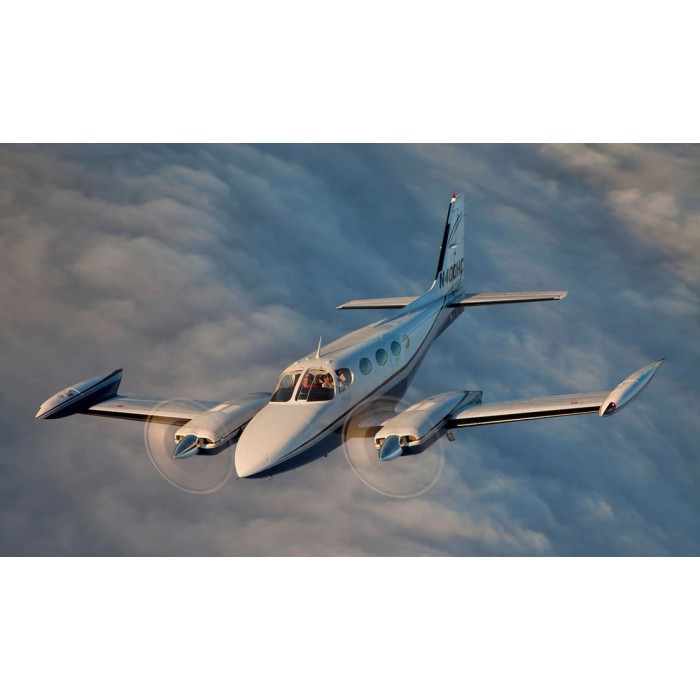
The Cessna 340 holds a unique place in aviation history as the world's first pressurised cabin-class light twin-engine aircraft - and remains the world's best-selling pressurised cabin piston twin to this day. Airliners.net confirmed "when released, the Cessna 340 joined the Beechcraft Duke as the only other six-seat pressurised piston twin from a major manufacturer, positioned in Cessna's product line between the 310 and the eight-seat 414 and 421." Development began in 1969, but the loss of the prototype in early 1970 delayed certification and production deliveries did not begin until 1971. The 340 borrowed its wings from the Cessna 414, its undercarriage from the Cessna 310 and used an all-new fail-safe pressurised fuselage with centre aisle and integral airstair door. Early models used Continental TSIO-520-K engines at 285 hp each; in 1976 the 340A introduced the TSIO-520-NB at 310 hp with 3-blade McCauley propellers of reduced diameter to meet ICAO Annex 16 noise requirements. Aviator Insider confirmed 1,287 Cessna 340s were produced in total between 1972 and 1984, with 948 of these being the superior 340A model. Aviator Insider confirmed the 340A is "the world's best-selling piston-powered, cabin-class pressurized twin."
The Cessna 340 is a pressurised twin-engine piston business aircraft - pressurised at 4.2 psi differential, maintaining an 8,000 ft cabin altitude at 20,000 ft. Airliners.net confirmed the 340's "pressurisation system with a differential of 0.29 bar (4.2 psi) kept the cabin's internal altitude at 8,000 ft while the aircraft was at 20,000 ft." The 340 is smaller than the Cessna 421C (which it sits below in the Cessna pressurised twin hierarchy) and optimised for 4 passengers at lower charter rates. Charter prices start from approximately £400 per flight hour. For the full fleet see our private jet price guide or browse our complete fleet.

Why charter the Cessna 340?
- World's first pressurised cabin-class light twin; world's best-selling pressurised piston twin with 1,287 built; 4.2 psi pressurisation; 8,000 ft cabin at 20,000 ft; 29,800 ft ceiling - pressurised travel at the lowest available twin-engine rate. Airliners.net confirmed the 340 introduced "a pressurisation system with a differential of 0.29 bar (4.2 psi) that kept the cabin's internal altitude at 8,000 ft while the aircraft was at 20,000 ft" and "an all-new fail-safe fuselage." Aviator Insider confirmed the 340A is "the world's best-selling piston-powered, cabin-class pressurized twin" with nearly 600 registered in the US alone. The 29,800 ft service ceiling (confirmed by GlobalAir and AeroCorner) enables flight above most European short-sector weather. AeroMugs confirmed "this feature alone set it apart from many of its contemporaries, transforming cross-country flights from a noisy, fatiguing affair into a serene, high-altitude experience." For charter clients who want pressurised cabin comfort at the lowest available twin-engine rate - below the Cessna 421C (£2,500-3,500/hr), Piper Cheyenne (£900/hr) and King Air 90 (£900/hr) - the 340A provides the confirmed pressurised specification for 4 passengers;
- Continental TSIO-520-NB at 310 hp each (340A); 3-blade McCauley propellers reduced to 75.5 inches for ICAO noise compliance; full power to 20,000 ft; 243 kt max cruise; 1,406 nm range - the definitive 340 variant. VREF confirmed the 340A's TSIO-520-NB engines provide "strong climb performance and efficiency at altitude, making it a reliable choice for both business and personal operations" with the ability to "maintain full power up to 20,000 feet." GlobalAir confirmed "a maximum cruise speed of 243 knots and a range of approximately 1,406 nautical miles." The 340A was introduced in 1976 specifically because early owners "considered the original 340 aircraft underpowered" at 285 hp per side (Aviator Insider). The 310 hp TSIO-520-NB engine with intercoolers for improved efficiency and the reduced-diameter 3-blade props that meet ICAO Annex 16 noise requirements represent the complete solution Cessna developed for the light pressurised twin market. Of 1,287 Cessna 340s built, 948 were the 340A - confirming the model's market dominance within the series;
- Integral airstair door; centre aisle; 4.2 psi pressurisation; "shirt-sleeve comfort" at cruise altitude; RAM engine modifications; APM strakes; spoiler STC - the most modified and upgraded piston twin in the charter market. Wikipedia confirmed the 340's "airstair door" and "centre aisle" as key design features. AeroMugs confirmed the pressurised environment delivers "shirt-sleeve comfort" where "passengers could relax" at high altitude. Aviator Insider confirmed popular modifications: RAM Aircraft engine upgrades providing extra useful weight and performance; Aircraft Performance Modifications (APM) strakes that "re-energize and straighten airflow" providing "reduced fuel use and an increased cruise speed by 4 to 6 knots" while reducing adverse yaw and stall speed; spoiler STC enabling "rapid descents without careful planning while preventing engine damage"; STOL kits and vortex generators improving low-speed handling. Aviator Insider confirmed "of the owner reviews I have read, all love their Cessna 340A." For charter clients who want the most refined version of the world's best-selling pressurised piston twin, the RAM- or APM-modified 340A represents a genuinely enhanced aircraft over the standard specification;
- Wings from Cessna 414; undercarriage from Cessna 310; fail-safe pressurised fuselage; 1,287 built 1972-1984; nearly 600 US-registered in service - the strongest parts and support network of any pressurised piston twin. Airliners.net confirmed the 340 "borrowed heavily from other Cessna twins of the time including the wings from the 414 and the 310's undercarriage and a similar tail unit." The shared Cessna family parts commonality across the 310, 340, 414 and 421 means the 340A benefits from the same Cessna supply chain and maintenance network as Cessna's larger twins. Aviator Insider confirmed "finding parts to support the aircraft is not difficult" with nearly 600 registered in the US. The Cessna 340A main wing spar service bulletin is not due until 15,000 hours; most aircraft sit at 4,000-6,000 hours, meaning "another 30 years before this bulletin seriously impacts resale." For charter operators evaluating the 340A's long-term supportability, the deep fleet and shared Cessna parts network provide confidence unavailable in less numerous pressurised piston twins;
- Positioned between the Cessna 310 (unpressurised) and the Cessna 414/421 (larger pressurised twins); 4 passengers at the lowest available Cessna pressurised rate; Riley Rocket 340 (Lycoming TIO-540-R 340 hp) and Riley Super 340 modifications available. Airliners.net confirmed the 340 was "positioned in Cessna's product line between the 310 and the eight-seat 414 and 421." The 340A sits at the entry level of the Cessna pressurised twin hierarchy: above the unpressurised 310 and 402, at the same pressurised level as the Beechcraft Duke, and below the 6-seat 414 and 7-seat 421C. Wikipedia confirmed the Riley Rocket 340 conversion fits "two 340 hp Lycoming TIO-540-R engines" for improved speed and climb, and the Riley Super 340 installs "two 310 hp Continental TSIO-520-J/-N engines" on earlier airframes. These aftermarket modifications extend the 340A's operational life and performance envelope. For charter clients who want entry-level Cessna pressurised twin capability at the lowest available pressurised rate, the 340A provides the confirmed specification for groups of up to 4;
- Beechcraft Duke was the only competitor at launch; the 340 won the market with 1,287 built versus Duke's 596; integral airstair door; centre aisle; the commercial validation of a 50-year market-leading position. Airliners.net confirmed the 340 competed against only "the Beechcraft Duke as the only other six-seat pressurised piston twin from a major manufacturer" at launch. The 340's 1,287 production run versus the Duke's 596 confirmed market preference for the Cessna's airstair door, centre aisle and parts commonality with the wider Cessna twin family. The 340 was subsequently positioned against the Piper Seneca II (unpressurised, at lower cost) in the market - but the pressurised cabin that the Seneca could not match remained the 340's decisive selling point throughout the 1970s and into the 1980s. The 340A's 50-year market-leading position as the world's best-selling pressurised cabin piston twin is a commercial validation without parallel in its category.
Charter cost - Cessna 340 prices from UK airports
Hourly rates run from approximately £400 to £600 - the entry-level rate for a pressurised twin-engine aircraft, reflecting the 340A's 4-passenger capacity, TSIO-520-NB piston engines and its position at the base of the Cessna pressurised twin hierarchy. For groups of 2 to 4 on short European sectors where the 340A's pressurised cabin, 29,800 ft ceiling and 243 kt cruise at the lowest available pressurised rate are the selection criteria, the 340A is the appropriate choice.
Indicative one-way prices from UK airports:
- London to Edinburgh - from £600 (4 passengers, approximately 1 hour 30 minutes);
- London to Paris - from £600 (4 passengers, approximately 1 hour 20 minutes);
- London to Geneva - from £900 (4 passengers, approximately 2 hours);
- Edinburgh to Inverness - from £400 (4 passengers, approximately 40 minutes);
- London to Amsterdam - from £500 (4 passengers, approximately 1 hour 10 minutes);
- London to Dublin - from £500 (4 passengers, approximately 1 hour 10 minutes);
- Manchester to Brussels - from £450 (4 passengers, approximately 1 hour 10 minutes).
Empty Leg flights appear on repositioning routes. See our Empty Legs page for current availability.

Ideal routes for the Cessna 340
Best matched to short UK regional and European sectors where the 340A's pressurised cabin, 29,800 ft ceiling and 243 kt cruise serve groups of 2 to 4 at the entry-level pressurised twin rate:
- Short UK regional and European sectors (45 minutes to 2 hours) where the pressurised cabin provides comfort at 20,000 ft that no unpressurised piston twin can match at comparable rates. Edinburgh to Inverness, London to Paris, London to Edinburgh and London to Amsterdam are all within the 340A's range and sector time. The 4.2 psi pressurised cabin maintaining 8,000 ft equivalent altitude at FL200 provides a significantly quieter and more comfortable environment than the Piper Aztec, Piper Navajo or Baron 58. For groups of 2 to 4 on short sectors where the 340A's pressurised cabin is the priority, it is the entry-level pressurised option in the Private Jets UK fleet;
- London to Geneva (2 hours) and London to Madrid (2.5 hours) where 29,800 ft ceiling enables flight above Alpine and Iberian summer convective weather. The 340A's 29,800 ft ceiling provides a meaningful weather avoidance advantage over unpressurised piston twins limited to 18,000-26,000 ft on these sectors. At 243 kt and FL250-FL290, the 340A delivers the Alpine and Iberian charter sector in pressurised comfort at the lowest available pressurised rate. For groups of 2 to 4 where the Cessna 421C (£2,500-3,500/hr) or King Air 90 (£900/hr) rates are above budget, the 340A provides the pressurised Alpine sector specification;
- Groups of exactly 2 to 4 where the 340A's 4-passenger cabin is appropriately sized and the lower rate versus the Cessna 421C makes the 340A the economical pressurised choice. The 340A is most efficiently used at 3 to 4 passengers - its designed optimal load. For the same number of passengers, the Cessna 421C (5-6 seats; £2,500-3,500/hr) provides more space at significantly higher rates. For charter clients whose group is exactly 2 to 4 and who want pressurisation without paying for the 421C's extra capacity and rate, the 340A fills this gap directly;
- Budget-priority pressurised missions where 340A rates at £400-600/hr run below every other pressurised twin in the Private Jets UK fleet and approach the rates of unpressurised piston twins. The 340A's charter rate overlaps the upper end of the unpressurised piston twin range (Piper Aztec at £600/hr, Baron 58 at £700/hr) while providing pressurisation those aircraft cannot offer. For charter clients whose brief is "pressurised twin at the minimum available rate for 4 people," the 340A sits at the precise intersection of piston-twin rates and pressurised capability;
- Owner-operators and private pilots who want the 340A for personal travel using the same aircraft for charter through Private Jets UK between personal uses. Aviator Insider confirmed "of the owner reviews I have read, all love their Cessna 340A" - the 340A has an unusually loyal owner community driven by the combination of pressurised comfort, 243 kt cruise, 1,406 nm range and manageable operating costs for a pressurised twin. The world's best-selling pressurised piston twin has the parts availability, modification market and pilot training resources to support sustained charter use alongside private ownership.

Cabin and in-flight experience
The Cessna 340 cabin seats 4 passengers plus 1 pilot in standard charter configuration. AeroCorner confirmed cabin dimensions of approximately 3.68 m long, 1.40-1.50 m wide and 1.34 m high. The cabin is pressurised to 4.2 psi differential, maintaining 8,000 ft cabin altitude at FL200. Airliners.net confirmed the airstair door and centre aisle as standard features. The airstair provides independent passenger boarding without external steps. The centre aisle allows full access to all four passenger seats. Many active 340As carry glass panel upgrades including Garmin G1000 or G500 displays and modern autopilots. RAM aircraft engine modifications and APM strakes are common on higher-specification aircraft. Optional fuel tanks (wing locker tanks) extend range beyond the standard 163 gallons usable.
- Cabin. Pressurised (4.2 psi); 4 passengers standard; airstair door; centre aisle; 1.34 m height;
- Pressurisation. 8,000 ft cabin at 20,000 ft; 29,800 ft service ceiling;
- Engines (340A). 2 x Continental TSIO-520-NB (310 hp each; turbocharged; intercooled; fuel-injected);
- Props. 3-blade McCauley constant-speed; 75.5-inch (1,920 mm) diameter; ICAO Annex 16 compliant;
- Fuel. 163 gal usable standard; optional wing locker tanks available;
- Common mods. RAM engine upgrade; APM strakes (+4-6 kt cruise; reduced yaw); spoiler STC; STOL kit; vortex generators; Garmin glass panel.
Technical specifications
| Manufacturer | Cessna Aircraft Company, Wichita, Kansas |
| First delivery | 1971 (Cessna 340); 1976 (Cessna 340A) |
| 340A certification | 19 November 1975 |
| Production | 1972-1984; 1,287 total (403 Cessna 340 + 884 340A); + 64 Cessna 335 |
| Historical significance | World's first pressurised cabin-class light twin; world's best-selling pressurised piston twin |
| Aircraft class | Pressurised twin-engine piston business aircraft |
| Engines (340A) | 2 x Continental TSIO-520-NB (310 hp each; turbocharged; intercooled; fuel-injected) |
| Propellers | 3-blade McCauley constant-speed; 75.5-inch; ICAO Annex 16 noise compliant |
| Max cruise speed | 243-244 kt / 450-452 km/h |
| Economy cruise | 227 kt / 420 km/h (long-range settings) |
| Climb rate | 1,650 ft/min |
| Service ceiling | 29,800 ft / 9,085 m |
| Pressurisation | 4.2 psi; 8,000 ft cabin at 20,000 ft |
| Range | 1,406 nm / 2,603 km |
| Fuel capacity | 163 gal usable standard; wing locker tanks optional |
| MTOW | 5,990 lb / 2,719 kg |
| Useful load | ~1,800-2,000 lb / 816-907 kg |
| Takeoff run (50 ft) | 2,175 ft / 663 m |
| Landing roll | 770 ft / 235 m |
| Cabin length | 3.68 m (12.1 ft) |
| Cabin width | 1.40-1.50 m (4.6-4.9 ft) |
| Cabin height | 1.34 m (4.4 ft) |
| Passengers | 4 standard charter; 5 maximum (owner-ops) |
| Wingspan | 11.62 m (38.1 ft) |
| Aircraft length | 10.46 m (34.3 ft) |
| Aircraft height | 3.84 m (12.6 ft) |

Cessna 340 vs similar aircraft
- Cessna 340A vs Cessna 421C Golden Eagle. The 421C is the larger Cessna pressurised piston twin at £2,500-3,500/hr with 5.0 psi pressurisation (vs 340A's 4.2 psi), 30,000 ft ceiling, 5-6 passengers and Continental GTSIO-520 geared engines at 375 hp each. The 340A counters with significantly lower charter rates (£400-600/hr), easier handling for single-pilot charter operations and the same Cessna parts network. For groups of 2 to 4 on short sectors where the 421C's extra capacity is not needed and its higher rates are above budget, the 340A provides the Cessna pressurised twin specification at entry-level rates;
- Cessna 340A vs Beechcraft Baron 58. The Baron 58 is an unpressurised twin piston at £700/hr with 200 kt cruise and 20,688 ft ceiling. The 340A counters with pressurisation (4.2 psi; vs Baron 58's nil), 29,800 ft ceiling (vs 20,688 ft) and lower charter rates. The Baron 58 counters with London City Airport certification and Garmin G1000 NXi avionics standard. For clients whose primary specification is pressurised cabin comfort, the 340A provides it; for London City access, the Baron 58 is required;
- Cessna 340A vs Piper Seneca V. The Piper Seneca V is an unpressurised twin piston at £500-600/hr with counter-rotating Continental TSIO-360-RB engines at 220 hp each, 25,000 ft ceiling and 5 passengers. The 340A counters with pressurisation (4.2 psi), a higher ceiling (29,800 ft vs 25,000 ft), 243 kt cruise (vs 177 kt Seneca V) and the world's best-selling pressurised piston twin heritage. For groups of 4 whose specification includes pressurisation, the 340A provides it at comparable or lower rates than the Seneca V on short European sectors.

Frequently asked questions - Cessna 340 charter
How much does it cost to charter a Cessna 340?
Charter rates run from approximately £400 to £600 per flight hour - the lowest available for a pressurised twin-engine aircraft. London to Edinburgh costs from £600 for 4 passengers. London to Geneva costs from £900. Edinburgh to Inverness costs from £400. All quotes from Private Jets UK are fully itemised with no hidden charges.
Is the Cessna 340 pressurised?
Yes - the Cessna 340 was the world's first pressurised cabin-class light twin, with a 4.2 psi differential maintaining 8,000 ft cabin altitude at 20,000 ft and a 29,800 ft service ceiling. Airliners.net confirmed it introduced "a pressurisation system with a differential of 0.29 bar (4.2 psi) that kept the cabin's internal altitude at 8,000 ft while the aircraft was at 20,000 ft" as a design feature specifically "designed to provide shirt-sleeve comfort" at altitude.
What is the difference between the Cessna 340 and 340A?
The original 340 (1972-1975) used Continental TSIO-520-K engines at 285 hp each, which owners considered underpowered. The 340A (from 1976) introduced the TSIO-520-NB at 310 hp with intercoolers, 3-blade McCauley propellers reduced to 75.5 inches diameter to meet ICAO Annex 16 noise requirements, and slight weight increases. Aviator Insider confirmed 948 of the 1,287 Cessna 340s built were the 340A. The 340A is the standard for charter operations due to its superior power, noise compliance and availability.
Why is the Cessna 340A historically significant?
The 340 was the world's first pressurised cabin-class light twin-engine aircraft. Airliners.net confirmed it was one of only two six-seat pressurised piston twins from a major manufacturer at launch (alongside the Beechcraft Duke). The 340 outsold the Duke more than two to one. Aviator Insider confirmed the 340A "has become the world's best-selling piston-powered, cabin-class pressurized twin" with nearly 600 registered in the US alone.
What modifications are commonly fitted to the Cessna 340A?
Aviator Insider confirmed the most popular upgrades are: RAM Aircraft engine modifications for improved performance and useful weight; Aircraft Performance Modifications (APM) strakes adding 4-6 kt cruise speed and reducing fuel burn; spoiler STC for rapid descents without engine shock cooling risk; STOL kits and vortex generators improving low-speed handling; and Garmin G1000 or G500 glass panel upgrades replacing original analog instrumentation. RAM-modified 340As are "highly sought after in the used aircraft market due to superior performance characteristics."

