


Charter a Bombardier Global Express
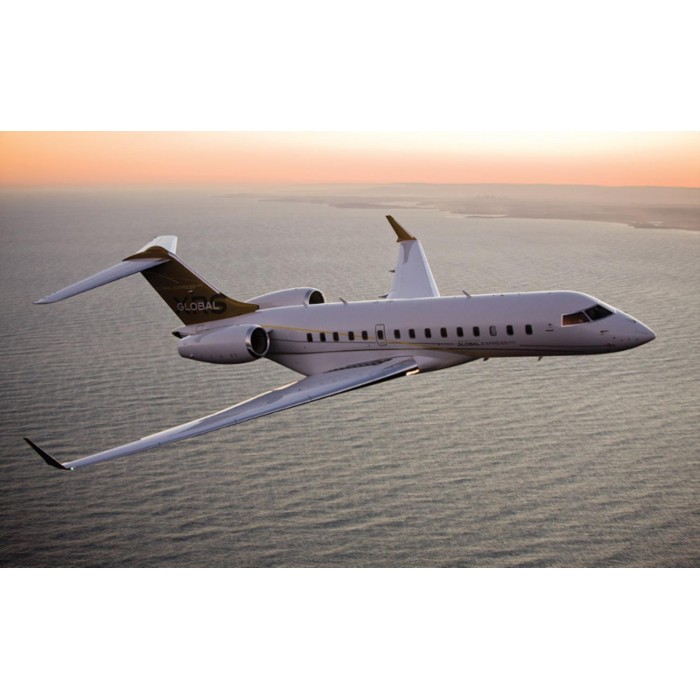


- Availability: Available for rent
Request aircraft information
The Bombardier Global Express is the original aircraft of the Global Express family, entering service in 1998 as the longest-range and fastest business jet then in production. It was developed by Bombardier in collaboration with Mitsubishi Heavy Industries (wing structure) and Shorts Brothers (rear fuselage), with the design process driven by a specific brief: create a business jet capable of connecting any two major cities on Earth with a single fuel stop or none, in a cabin large enough to accommodate genuinely separate working, dining and sleeping environments. The aircraft established the three-zone cabin layout that all subsequent Global family variants would maintain.
Power is provided by two Rolls-Royce BR710 turbofan engines, delivering a cruise speed of 935 km/h and a maximum altitude of 15,545 m (51,000 ft) - above commercial airline traffic and virtually all weather systems. The 100% fresh air system - outside air processed through the engines rather than recirculated cabin air - was a deliberate fatigue-reduction feature specified in the original design brief. The 27 large cabin windows, low cabin altitude and three independently controllable cabin zones were all engineering decisions aimed at the same goal: ensuring passengers arrive at a 12-hour destination in productive condition. The Global Express was succeeded by the Global Express XRS in 2006 and the Global 6000 in 2012, both of which retained the same fundamental cabin dimensions.

Key performance figures
| Range | 6,750 nm / 12,500 km |
| Cruise speed | 935 km/h (Mach 0.89) |
| Maximum altitude | 15,545 m (51,000 ft) |
| Engines | 2 x Rolls-Royce BR710 |
| Maximum takeoff weight | 41,957 kg (92,500 lb) |
| Service entry | 1998 |
| Air system | 100% fresh air (not recirculated) |
| Cabin windows | 27 large windows |

Airframe dimensions
| Aircraft length | 30.3 m |
| Aircraft height | 7.57 m |
| Wingspan | 28.5 m |
Cabin dimensions and capacity
| Cabin length | 14.70 m |
| Cabin width | 2.49 m |
| Cabin height | 1.91 m (stand-up throughout) |
| Optimal passengers | 8 |
| Maximum passengers | 19 (high-density) |
| Cabin zones | 3 independent (forward / central / aft) |
| Zone 1 (forward) | Double cabin - meetings and lounge |
| Zone 2 (central) | 4-seat conference / dining table + cradle seat |
| Zone 3 (aft) | 3-seat sofa + 2 captain's chairs, converts to sleep |
| Flat-bed conversion | Yes - all zones independently convertible |
| Baggage hold | Large capacity; confirm in-flight access at booking |


Cabin features
- 14.70 m cabin - one of the largest in any business jet available for charter;
- Three independently controllable cabin zones - different activities in each simultaneously;
- Forward zone: double cabin for meetings and lounge use;
- Central zone: 4-seat conference/dining table and cradle seat;
- Aft zone: 3-seat sofa and 2 captain's chairs, full flat-bed conversion;
- 27 large windows - maximising natural light on 12+ hour sectors;
- 100% fresh air system - no recirculated cabin air;
- Low cabin altitude for reduced fatigue and dehydration;
- Individual seat controls, HD entertainment and satellite phone at each seat;
- International and domestic Wi-Fi;
- Full galley with hot meal service and optional private wine cellar;
- Private enclosed lavatory aft;
- Maximum 19 passengers; optimal 8 for full three-zone comfort.


The Bombardier Global Express is the original aircraft that established Bombardier's position in the ultra-long-range business jet category - the aircraft that, when it entered service in 1998, set new benchmarks for range, speed and cabin comfort that shaped the entire market segment. With a range of 6,750 nm (12,500 km) and a cruise speed of 935 km/h, it was the first business jet to connect London to Tokyo, London to Sydney with one stop and London to Los Angeles non-stop in genuine large-cabin comfort. 27 large cabin windows, a 100% fresh air system, three distinct seating zones across 14.70 m of cabin and a low cabin altitude all addressed the specific problem of fatigue on 12 to 16 hour missions - not as marketing language but as engineered solutions.
In the current charter market, it sits below the Global Express XRS, Global 6000 and Global 7500 in terms of production vintage and avionics generation, with charter rates that reflect this positioning. For clients who need genuine ultra-long-range non-stop capability for up to 19 passengers and are comfortable with a pre-2003 aircraft, it remains a capable and cost-efficient option at this mission profile. Private Jets UK arranges charters from all UK airports with prices from approximately £5,400 per flight hour. See the full fleet and pricing at our private jet price guide or browse the complete aircraft catalogue.
Why charter the Global Express?
- The aircraft that defined ultra-long-range business aviation. When it entered service in 1998 it was the longest-range business jet in production, capable of London to Tokyo and London to Los Angeles non-stop. That capability remains intact - the 6,750 nm range covers every major long-haul city pair from UK airports that has ever been relevant for business travel;
- Three fully separated cabin zones. The forward zone serves as a double cabin ideal for meetings. The central zone features a four-seat conference table or dining table. The aft zone has a three-seat sofa and two captain's chairs. Each zone converts independently to a sleeping configuration - passengers can transition between work, dining and sleep without reconfiguring the entire cabin;
- 27 windows and 100% fresh air. The 27 large windows are an unusual design choice for an aircraft of this size and age - they were specified deliberately to bring natural light into a cabin where passengers would spend 12 to 14 hours. Combined with the 100% fresh air system (not recirculated cabin air) and low cabin altitude, the result was measurably lower fatigue on arrival compared to earlier-generation long-range jets;
- Up to 19 passengers. Maximum capacity is 19 in high-density configuration - more than most ultra-long-range jets in regular charter service. The optimal configuration is 8 passengers for the most comfortable experience across the three cabin zones;
- Individual seat controls, HD entertainment and satellite connectivity. Individual controls at each seat, high-resolution entertainment systems, satellite phone and international Wi-Fi were part of the original design brief rather than retrofit additions;
- Ultra-long-range at the most accessible price in the Global family. As the original variant, it commands the lowest charter rates in the Global Express lineage while delivering the same fundamental cabin volume and range as its successors.
Charter cost - Global Express prices from UK airports
Hourly rates run from approximately £5,400 to £6,600 - below the XRS and Global 6000, reflecting the original production vintage. On sectors of 10 hours or more, the saving per flight versus a Global 6000 at comparable cabin volume is meaningful on the total charter cost.
Indicative one-way prices from UK airports:
- London to New York - from £54,000 (8 passengers, non-stop, approximately 7 hours 20 minutes);
- London to Dubai - from £34,000 (8 passengers, non-stop, approximately 6 hours 45 minutes);
- London to Los Angeles - from £64,000 (8 passengers, non-stop, approximately 11 hours);
- London to Hong Kong - from £74,000 (8 passengers, non-stop, approximately 12 hours);
- London to Geneva - from £10,600 (8 passengers, approximately 1 hour 20 minutes);
- London to Cape Town - from £70,000 (8 passengers, non-stop, approximately 11 hours);
- London to Tokyo - from £84,000 (8 passengers, one fuel stop, approximately 14 hours total).
Empty Leg flights appear on repositioning routes, particularly transatlantic. See our Empty Legs page for current availability.
Ideal routes for the Global Express
Like its successors, this aircraft earns its position on missions where non-stop ultra-long-range is genuinely required rather than merely convenient. On these specific sectors there is no adequate substitute at a lower price:
- Transatlantic non-stop (New York, Los Angeles, Miami) - 7 to 11 hours. The 6,750 nm range covers all North American city pairs non-stop from UK airports including Los Angeles (approximately 5,400 nm) and Vancouver (approximately 4,700 nm). For groups of 6 to 8 using the three-zone cabin across a 10-hour sector, the multi-zone layout justifies the cabin category;
- East Asia (Hong Kong, Singapore, Tokyo) - 11 to 14 hours. Hong Kong is within range non-stop (approximately 5,970 nm). Tokyo requires a fuel stop from London. Singapore (approximately 6,700 nm) is at the edge of range in standard conditions. The three-zone cabin and full flat beds are not optional comfort features on these sectors - they are operational requirements for arriving in a productive state;
- Sub-Saharan Africa non-stop (Cape Town, Nairobi, Johannesburg) - 10 to 12 hours. The range covers Southern and East Africa non-stop, eliminating the logistical complexity of fuel stops in challenging African operational environments;
- Gulf non-stop (Dubai, Riyadh, Abu Dhabi) - 6.5 to 7 hours. Technically overspecified for the sector length, but for groups of 12 to 19 passengers where single-aircraft consolidation and cabin volume are priorities, the economics at full capacity are reasonable;
- Government and delegation missions requiring maximum capacity. At up to 19 passengers in high-density configuration, few ultra-long-range jets can move a large official delegation in a single aircraft on intercontinental sectors.
Cabin and in-flight experience
The Global Express cabin measures 14.70 m long, 2.49 m wide and 1.91 m high. The three-zone layout was designed specifically for the problem it solves: how do you keep 8 to 12 passengers productive, comfortable and rested across 12 to 14 hours without requiring them to share the same space for the entire journey?
The forward double cabin is configured for meetings and lounge use - two facing seats with privacy from the rest of the cabin. The central zone has a four-seat conference table that converts to a dining table, opposite a cradle seat. The aft zone features a three-seat sofa and two captain's chairs, convertible to sleeping positions. Each zone operates independently for lighting, temperature and entertainment - a passenger sleeping in the aft zone is not disturbed by a meeting in the forward zone.
- 27 windows. An unusually high number for a business jet of this length - deliberately specified to maximise natural light in a cabin where passengers spend 12+ hours;
- 100% fresh air. No recirculated cabin air - outside air is processed through the engines and delivered fresh throughout the flight;
- Low cabin altitude. Reduces fatigue and dehydration on ultra-long sectors compared to aircraft with higher cabin pressurisation altitudes;
- Entertainment and connectivity. High-resolution individual entertainment systems, satellite phone and international and domestic Wi-Fi;
- In-flight galley. Equipped to serve full meals throughout any sector length. Optional private wine cellar storage available;
- Lavatory. Private enclosed lavatory in the aft section.
Technical specifications
| Manufacturer | Bombardier Aerospace (Canada) |
| Aircraft class | Ultra-long-range large-cabin jet |
| Service entry | 1998 |
| Family position | Original Global Express (succeeded by XRS, Global 6000, Global 7500) |
| Maximum passengers | 19 |
| Optimal passengers | 8 |
| Range | 6,750 nm / 12,500 km |
| Cruise speed | 935 km/h (Mach 0.89) |
| Maximum altitude | 15,545 m (51,000 ft) |
| Engines | 2 x Rolls-Royce BR710 |
| Maximum takeoff weight | 41,957 kg (92,500 lb) |
| Cabin zones | 3 (forward / central conference / aft rest) |
| Cabin windows | 27 large windows |
| Air system | 100% fresh air (not recirculated) |
| Cabin length | 14.70 m |
| Cabin width | 2.49 m |
| Cabin height | 1.91 m |
| Wingspan | 28.5 m |
| Aircraft length | 30.3 m |
| Aircraft height | 7.57 m |
Global Express vs similar aircraft
- Global Express vs Global Express XRS. The XRS added a 674 kg wing-root fuel tank increasing range from 6,750 nm to 6,150 nm, improved cabin lighting, faster refuelling capability and a higher cruise speed. Charter rates for the XRS run approximately 5 to 10% higher. For most ultra-long-range missions the original Global Express delivers the same practical capability - on rare occasions where the additional range of the XRS matters (London to Singapore non-stop in adverse winds), the XRS is the better choice;
- Global Express vs Global 6000. The 6000 (2012) brought Ka-band Wi-Fi at up to 15 Mbps, updated seat design, improved cabin lighting and better avionics. The fundamental cabin dimensions are identical. Charter rates run approximately 20 to 30% higher. For clients where connectivity and cabin finish are priorities, the Global 6000 is the clear choice. For pure intercontinental range and cabin volume at the lowest price in the family, the original variant remains relevant;
- Global Express vs Gulfstream G550. A direct contemporary competitor. The G550 has comparable range (6,750 nm), entered service in 2003 and has a slightly narrower cabin. Both are proven ultra-long-range platforms at broadly comparable charter rates. The Global Express has more windows and the 100% fresh air system; the G550 has slightly newer avionics. Availability at the time of booking typically determines the choice for UK clients.
Frequently asked questions - Global Express charter
How much does it cost to charter a Bombardier Global Express?
Charter rates run from approximately £5,400 to £6,600 per flight hour. London to New York non-stop costs from £54,000 for 8 passengers. London to Dubai costs from £34,000. London to Los Angeles costs from £64,000. All quotes from Private Jets UK are fully itemised with no hidden charges.
What is the range of the Bombardier Global Express?
At 6,750 nm (12,500 km) - sufficient for London to Los Angeles, London to Hong Kong, London to Cape Town and London to New York non-stop. Tokyo from London requires one fuel stop. London to Sydney requires two stops regardless of aircraft.
How does the Global Express compare to the Global Express XRS?
The XRS added a 674 kg wing-root fuel tank, improved cabin lighting, faster refuelling and a higher cruise speed. Charter rates for the XRS run approximately 5 to 10% higher. For most ultra-long-range missions both aircraft deliver equivalent practical capability.
How many passengers can fly on a Global Express?
Maximum capacity is 19 in high-density configuration. The optimal configuration for multi-zone comfort is 8 passengers. For large official delegations or group travel needing maximum capacity on intercontinental sectors, the high-density layout is available.
Why does the Global Express have 27 windows?
The 27 large windows were specified deliberately to maximise natural light in a cabin where passengers spend 12 to 14 hours. Combined with the 100% fresh air system and low cabin altitude, the design prioritised passenger fatigue reduction on ultra-long-haul sectors - a specific engineering decision rather than an aesthetic one.